Contemporary music publisher Music Haven has launched a new digital download service for its sheet music collection. Available via the Music Haven website, this service will initially offer digital downloads of piano music, the centrepiece of which is the first published edition of Czech composer Pavel Zemek Novák’s 24 Preludes and Fugues for solo piano.
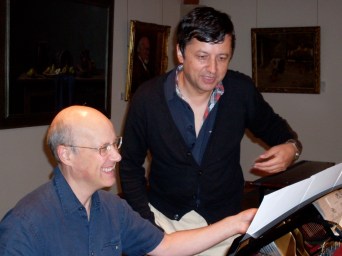
William Howard and Pavel Novák
Described by British composer David Matthews as “one of the finest piano works of our time, a worthy companion to Ligeti’s three books of Etudes”, Pavel Novák’s 24 Preludes and Fugues were composed for pianist William Howard between 1989 and 2006, and were recorded by Howard on the Champs Hill label in 2011. But like much of Novak’s music, this work has remained unpublished until now.
Peter Fribbins, composer, writes:
“Music Haven Ltd. is delighted to announce the publication of Pavel Zemek Novák’s 24 Preludes and Fugues for piano. An ambitious and important contribution to the contemporary piano repertoire, they are written in a musical language that has immediate connection and expressive presence. We are also pleased to be able to make Novák’s work more widely and easily available around the world by launching this work via our digital publishing platform.”
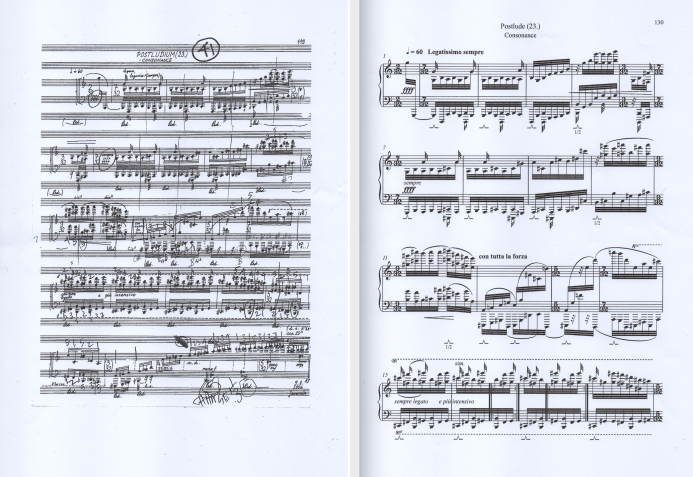
The new edition has taken several years to prepare and the process has been extremely challenging. Painstakingly typeset by composer Cydonie Banting from a hand-written manuscript replete with complex and idiosyncratic notation, and edited by Pavel Novák and William Howard, the work is divided into four books, which reflect the evolution of Novak’s musical language.
Excerpt from score, before & after typesetting
Now for the first time, pianists can explore this remarkable music in an accessible and beautifully typeset digital edition, available from Music Haven. Pianist William Howard says: “I am confident that other pianists around the world will now take up this powerful and dazzlingly original work.
The complete score is available to purchase as a digital download from Music Haven’s webshop
Music Haven Ltd publishes and promotes new classical music in all its manifestations. At its core are the works of a number of established contemporary British composers, including James Francis Brown, Peter Fribbins and Alan Mills, whose music is complemented by exciting new discoveries, or reconstructions, of lost classical works of the past. Scores are beautifully presented and edited to the highest standards.
A key part of Music Haven’s mission is to foster meaningful collaboration between composer and performer, and in doing so, bring fine music to a wider audience.
An interview with Chinwe D John, a medical doctor and author, whose first EP “Within a Certain Time and Place” was released in March 2022.
Tell me a little about your background. Have you always written poetry?
Firstly, let me say thank you for hosting an interview with me. I was born in California to Nigerian parents, and had lived on four continents by the time I was a teenager. Due to my younger siblings schooling in the UK, I came to spend a modest amount of time in England. I ended up pursuing my post medical school training in the States, where I practice my medical vocation as a Physical Medicine and Rehabilitation specialist. I did not start out writing poetry, though my first published work “Tales of Fantasy and Reality”, was a poetry book.
For as long as I have had memory of myself, I have written stories, and made up simple melodies. Growing up during my time in Nigeria, the school system sharply separated art and science courses, once one got into the higher secondary school years. I always wanted to be in the medical field, but also had a passion for literature. There were no options available for me to pursue a combined training in both fields, so I became a partially self-taught student of literature, sitting in formal lectures during class breaks, and devouring as many books as I could get my hands on. It helped that my parents, both professionals in the field of science, encouraged reading in all of us siblings.
How did you come to write your song “Now as Before” and what motivated you to approach a British composer rather than one based in the US to write the music?
In October of 2020, there was growing tension in the air here in the States, and I turned, as I often do, to classical music for solace. Serendipity led me to discover the work of tenor Andy Staples, and I was enchanted by his wonderful singing voice and versatility. Around the same time, there were numerous news reports in UK news outlets, on the unique plight of its classical musicians due to a combination of the pandemic, and EU work restrictions. This led me to take a closer look into the classical music industry, and my conclusion was unless a new audience was brought in, once the core supporting demographic passed on, there would be no way for the industry to exist as we know it.
Added to this, was the trend to decrease funding for the arts in UK schools. I decided to do my small bit to support an industry that had given me a lot. In my mind, one way to increase classical music’s listening audience, was to commission contemporary composers, and have them set music to lyrics which are reflective and relevant to our current times.
As to why the UK? Many reasons, some of which I have already mentioned. For me, if the UK, which had been a major influence when it came to orchestral music/choirs/literature, was investing less in the arts, it signified a global shift in perspective. A reduction of value in the arts, to me signifies a reduction of value in matters of humanity, at a time when technological advancements do not appear to be matched by an advancement in our expression of humanity.
I wrote the lyrics to “Now as Before” in January 2021, and it was the first time I was writing in four years. The line which gave birth to the song, came from a line I had written about eight years ago for a never published poem. I knew that I wanted to write a song whose main theme was Hope. I wanted the song to touch on some of the internal conflicts and challenges we face today as individuals, show how these challenges have always existed, and perhaps give some suggestion as to how to address them.
It was a really challenging time – it still is – and I felt a prayer would help ease people’s minds. Mid-February of 2021, I was invited to a live Zoom event by La Nuova Musica. A question I posed (regarding the need to commission contemporary classic composers to set music to lyrics reflective of our present time), got the attention of Andy Staples, who was a guest artist at the event. This for me was a sign to continue with my search for a UK based composer, with the hope that he, Andy, would agree to collaborate on the song once it was completed.
How did you meet composer Geoff Hannan?
In January of 2021, serendipity at play once again, led me to a recommendation, which in turn led me to the London Sinfonietta’s website. On this website was a list of composers whom they had commissioned through the years. I listened to works from many composers, including those on a BBC “postcards from composers” feature, and made a list of six composers whose use of melody worked with what I had in mind for the lyrics. Geoff was amongst the composers on the list, and I contacted him at the end of February to enquire if he would accept a commission to write music for a piece whose theme would be Hope. He asked if I had any lyrics, and after I sent over the lyrics for “Now as Before”, he composed the music for the chorus that very day.
How do you feel Geoff Hannan has responded to your lyrics in his music?
Honestly, and with great attention to the meaning of the lyrics. The music compliments the lyrics beautifully. He is a fantastic musical interpreter of emotion, and it shows in these songs.
What are the main themes explored in your songs on the EP?
“Now as Before”: Hope. The repetition of history. The importance of interpersonal interaction. Our interconnectedness with nature.
“Changing Fate”: Predetermined versus Undetermined fate. The Judas and Job questions. Nihilism and apathy versus Optimism and action.
“Oriented”: Perception of reality. Mental status. Time travel. Everlasting love.
Who are your favourite writers/poets?
I will list a few favourites:
Writers: Shakespeare, Charles Dickens, Victor Hugo, Roald Dahl, Oscar Wilde, Jane Austen, E.M Foster, P.G. Wodehouse, George Orwell, Cyprian Ekwensi, Chinua Achebe, James Clavell, Milan Kundera, Umberto Eco, and Chimamanda Ngozi Adichie.
Poets: Khalil Gibran, Charles Baudelaire, Arthur Rimbaud, Dana Gioia, Sahir Ludhianvi, Leonard Cohen, Bob Dylan, David Olney, Joan Baez, Nina Simone, and Maya Angelou.
And who are your favourite composers/musicians? Did your musical taste influence how you approached writing these songs?
Composers:
Old time favourites are: Purcell, Handel, Bach, Mozart, Beethoven, Tchaikovsky, Rachmaninoff, R.D. Burman, Ennio Morricone, Claude-Michel Schönberg and John Williams.
Currently, I am paying closer attention to, and discovering works by Schubert, Mahler, Schumann, and the contemporary composers with whom I am collaborating.
Musicians: Stevie Wonder, Van Cliburn, Glenn Gould, Arthur Rubinstein, Abner Jay, Jeff Buckley, The Smiths, Bob Marley, Jacques Brel and too many others to list here.
Yes, my musical taste did influence how I wrote these songs. Additionally, when I am trying to write a poem or a song lyric, my lines come accompanied by simple melodies. This helps both in ensuring a smooth rhythm, and coaxing the words to come along.
How does it feel to have your lyrics represented in songs written by Geoff and performed by Andy Staples and Alisdair Hogarth? What do you feel these musicians bring to the project?
It feels wonderful! This EP project is one of the most unique and successful projects I have ever initiated. Working with people you know is challenging enough, working successfully with strangers during a global pandemic, is nothing short of a miracle. All three brought their musical genius and experience, but genius alone would not have brought about a successful collaboration. All three artists brought dedication, work ethic, and a commitment to the goal. They also made sacrifices. Andy and Alisdair had the additional task of finding a distributor for the work, which they handled with great aplomb, getting the EP released by the great Voces8 label. I am very thankful to Geoff, Andy and Alisdair, for collaborating with me. I hope listeners connect with our music, and the goal of our EP “Within a Certain Time and Place”, is achieved.
“Within a Certain Time and Place” is available now on the Voces8 label and via streaming. Listen here
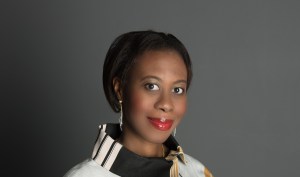
Chinwe D. John is a medical doctor and author, who was born in the U.S to Nigerian parents. In 2012 she published a book of narrative poetry Tales of Fantasy and Reality. This was followed by a novel The Boy in the Painting, Book 1 of The Time Shield Series, in 2016. Within a Certain Time and Place, released in 2022, is her first EP
An interview with cellist Louise McMonagle to coincide with the release of her recording of Round by the Ness by Trish Clowes, to celebrate International Women’s Day 2022
Who or what inspired you to pursue a career in music and who or what have been the most important influences on your musical life and career?
My parents sent my sisters and I along to the local music centre on Saturday mornings – it was called Bannerman Music School at the time, now called East Glasgow Music School. I am certain they had no idea how this would shape the rest of my life! It was here that I had my first cello lesson aged 6 and was lucky to have a very special teacher. Pamela Duffy had studied at Guildhall in London before returning to Glasgow. She was a buzz of inspiration and impossibly exciting stories from the big smoke, and she made lessons incredibly fun! Without this early influence I’m sure it would never have crossed my mind that I could end up a cellist in London!
After that there are so many influences and inspirations we would be here all day. But I want to mention a couple that stand out. When I was 12 I joined the Music School of Douglas Academy, a state funded centre for excellence in Glasgow. I can’t speak highly enough of my education there, where every music teacher made a huge impact on me. In our first term I remember the composition teacher William Sweeney playing us Alban Berg Violin Concerto. I heard only a random confusion of notes and remember us 12 year olds sneaking glances at each other – what is this! A few years later we listened to the piece again in music history and I was so shocked to discover it now sounded beautiful and was a piece of music that made sense to me. I remember having a little moment where I saw how much I must have learned without realising it.
Another really warm memory of my formative musical years was my time in Glasgow Schools Symphony Orchestra, who met once a year for a summer residency at Castle Toward on the Argyll peninsula. It can’t be overstated how magical it was for a bunch of city kids to spend a week by the sea in a remote castle! The conductor of the orchestra was composer John Maxwell Geddes, an extraordinary man and an inspiration to a whole generation of musicians from Glasgow. We often played pieces that he wrote specially for us, his Castle Suite for example, which I instantly loved. I remember being fascinated by the way the time signature kept changing!
When I look back at these experiences, and then look at the path I have taken it hammers home to me how important working with young people is, and the impact it can have.
What have been the greatest challenges of your career so far?
Finding an instrument! This is a huge issue for string players in particular. I moved to London when I was 18 to study at the Royal Academy of Music, and I couldn’t believe my luck when they loaned me their stunning Testore cello for a number of years. It was a gorgeous instrument with incredible depth of sound. I’d never had an old cello before and enjoyed imagining how the cello had probably played my repertoire countless times before me! The experience will stay with me forever. But of course eventually it had to be returned, and on my budget searching for a cello to follow it was an impossible task!
Which performances/recordings are you most proud of?
During the pandemic I took a very unexpected turn and decided to develop a YouTube channel. The idea came from my love for performing cello repertoire that steps outside the mainstream. Over the last 10 years I have worked on so many wonderful contemporary cello pieces directly with composers, but it struck me as sad that I had no record of most of these live performances. In lockdown I suddenly found myself with lots of time on my hands so I decided to challenge myself to start recording.
Live music has thankfully now returned, but I enjoyed my lockdown project so much that I’ve decided to continue on my mission. Today, on International Women’s Day, I have added a new piece written specially for me by composer and jazz saxophonist Trish Clowes. Although her background is jazz, Trish listens widely and her compositions have many influences. Trish has always held a particular fascination with a cello piece she heard me perform years ago, Heinz Holliger Chaconne from the Sacher Variations. It’s a piece that showcases many extended techniques and timbres that the cello can offer. Inspired by this, Trish decided to write Round By The Ness for me and I was intrigued to see how she took some of these techniques and translated them into her own musical language. You can watch the performance here:
Which particular works/composers do you think you perform best?
These days I’m most known for performing music by living composers, and playing in contemporary music group the Riot Ensemble.
I joined the group 5 years ago and have given around 200 world and UK premieres by composers from more than 30 countries in that time! I’ve learned so much through this experience – unique notation, extended techniques, prepared cello… I honestly think nothing could surprise me anymore! What I love about this genre of music is the huge contrast of styles and sounds I’m exposed to. And the beauty of it is, there is so much variety in the music of the last 50 years that I think you can find something to suit every taste.
What do you do off stage that provides inspiration on stage?
Listening to other performers is the most inspiring thing for me. Any genre, style instrument. Dancers, gymnasts, actors. Watching performers who communicate and who make you forget about everything else – that is the most inspiring thing to me.
How do you make your repertoire choices from season to season?
When I’m listening to music a lot of the time I want to hear something new. Most of my repertoire choices come from listening journeys online where one discovery leads to another in an endless chain.
When I hear something new that I love, I’m instantly thinking where and when would be the perfect situation to programme it. I always loved making mixtapes back in the day, and I like to think of programming in the same way, handpicked for each audience.
Do you have a favourite concert venue to perform in and why?
I’ve played in some wonderful halls around the world – Bucharest, Berlin, Shanghai, a stage built off the side of a cliff in Italy, Alhambra in Granada, but my favourite performances tend to be in smaller intimate venues where you feel more connection to the audience. I enjoy playing in settings where people don’t normally hear cello, where you feel you can surprise them and maybe even make them think differently about classical music. I have worked a lot with the Scottish Chamber Orchestra who regularly tour the Scottish Highlands and Islands, and playing in those community halls have been some of my favourite performances.
What do you feel needs to be done to grow classical music’s audiences?
Music is for everyone. A lot of people tell me they don’t listen to classical music yet they experience it in films and tv and find that they love it! Some people feel classical music isn’t for them because they never had the chance to learn an instrument. The number one way to reach more people is to invest in music education, and tackle the notion that classical music is just for the privileged. Schemes like Big Noise in Scotland, and Every Child A Musician in Newham east London are visionary, where every child in a whole year group is given an instrument and regular lessons completely free. I wish every child in the country could have this experience as part of their school education.
Classical music can also be associated with a lot of pomp and circumstance – evening dresses, tailcoats and bow ties, knowing when to clap, grand buildings. This might be glamour and showbiz to some, but can seem old fashioned, too formal, or alienating to others. “Why does that violinist get to bow on their own?” someone once asked me after an orchestral concert. I think we forget that concerts are a string of traditions and rituals that can be baffling to the uninitiated. While I hope there will always be space for traditions and a bit of showbiz in our presentation, I think classical music also needs to exist outside of concert halls – in schools as I’ve said, but also in less formal spaces, and at different times of day. There is a thriving music series in London called Daylight Music. Concerts take place on Saturday afternoons, and tea and cake is served. The curator lines up three sets with performers from different genres, and what draws the audience is the chance to experience something new, to hear styles of music they might not normally hear, all in a comfortable friendly setting. Time and time again this series has come up when I chat to people who have never attended a ‘classical concert’ but tell me they enjoyed watching an instrumentalist at one of these events. Their new season will be announced soon so do check it out!
Growing audiences is a big and complex topic, but certainly investing in music education, rethinking the formal concert paradigm, and more risk taking and imaginative curation have important roles to play.
What is your most memorable concert experience?
In January 2019 Riot Ensemble travelled to Reykjavik to play at Dark Music Days festival. The snow was deeper than my boots and daylight came only for a few hours in the middle of the day. We were giving the world premiere of a piece written for us by Austrian composer Georg Friedrich Haas called Solstices. It’s a 70 minute ensemble piece to be performed in pitch black darkness. We’ve played it in a few venues now and the challenge is always getting the hall dark enough… covering every crack and even emergency exit signs has not always been possible. But at this venue, the darkness was perfect and so intense that I could not see my own hand when I held it in front of my face! The ensemble had a central position in the hall and the audience were seated all around us. I think it’s true that we listen differently in the dark. The atmosphere was like no other concert I’ve ever experienced and I’m not sure anything could ever quite compare to my memory of it!
As a musician, what is your definition of success?
Having concerts that excite me. Playing with other musicians who inspire me. Reaching the end of a concert and feeling I did a good job, that I gave everything I had.
What advice would you give to young/aspiring musicians?
Listen listen listen to music and artists you love, admire and who inspire you! Practice! And know that it happens in small steps, so have the courage to put yourself forward for the summer school/audition/performance opportunity that you have been mulling over, and incrementally one thing will lead to another!
What’s the one thing in the music industry we’re not talking about which you think we should be?
Cuts to music and instrumental lessons in schools. Classical music won’t have a future if it is only for the privileged.
Scottish cellist in London, Louise McMonagle is a versatile performer who enjoys making music in many environments.
Highlights include winning the Ernst Von Siemens Ensemble prize (2020), performing at Wigmore Hall (London), playing as soloist in Boulez Messagesquisse at the VIVA Cello Festival (Switzerland), recording Berio Sequenza XIV with Four Ten Media, and performing with eminent jazz musicians such as Trish Clowes (BBC NGA), Kit Downes (Mercury prize nominee), Evan Parker etc.
‘Open Up’ is the debut album from the Charlie Foxtrot Piano Collective, released on 16th July 2021. Written and produced by Caroline Wright, the album includes 11 tracks of original multi-tracked piano music.
The idea behind the album was to create a coherent set of compositions that indulge my love of piano but also explore the orchestral potential of the instrument. The creative process involved a mixture of composing, improvising, and arranging. I wanted to avoid using samples or MIDI, to maintain both an acoustic and improvisatory feel to the music, so everything was recorded on – or inside – a real grand piano. This meant numerous recording sessions for every track, as well as detailed mixing to achieve the right balance between different parts.
The album moves from relatively upbeat, simple tracks to darker, more complex pieces, with lots of modal harmonies and rhythmic ostinatos looped throughout. The music has a diverse range of influences, from classical to contemporary, as well as film, folk, jazz, dance and electronica. Some of the pieces are re-workings of older compositions (the oldest dating back to 1995!), while others were written in early 2021. There were many different inspirations for pieces: an amazing poem (The Hill We Climb), a beautiful photo (Falling Light), a wildlife documentary (Whale Song), some awful weather (Storm), a strong emotion (Anticipation), or a musical concept (Lockdown Boogie – which is really a study for the left-hand, in disguise!). The album title refers not only to opening up the piano to explore the sounds under the lid, but also to society opening up after the lockdowns of 2020-21, as well as personally opening up as an artist and deciding to put my music out into the world.
The Cross-Eyed Pianist is free to access and ad-free, and takes many hours every month to research, write, and maintain.
If you find joy and value in what I do, please consider making a donation to support the continuance of the site

 Chinwe D. John is a medical doctor and author, who was born in the U.S to Nigerian parents. In 2012 she published a book of narrative poetry Tales of Fantasy and Reality. This was followed by a novel The Boy in the Painting, Book 1 of The Time Shield Series, in 2016. Within a Certain Time and Place, released in 2022, is her first EP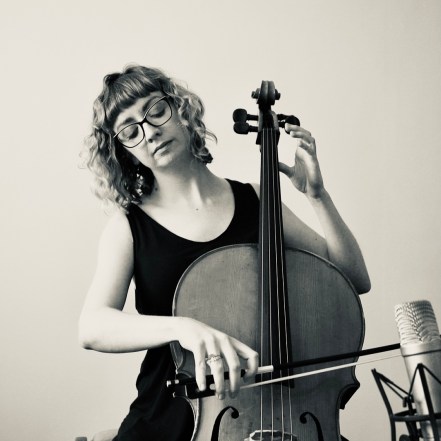




 The Cross-Eyed Pianist