Who or what inspired you to take up the saxophone, and pursue a career in music? 

Naomi Sullivan: Heather Sullivan (my mother). My family all play music, although I’m the only person who pursued it as a career. My mother gave us recorder lessons, then I played flute until I got irritated that it felt so quiet compared to the brass band playing we all did. I tried a friend’s tenor saxophone, which seemed more cathartic and I’ve stuck with it. I still uphold that my siblings are far more talented than me, but they are possibly a little wiser, (as to finances).

Neil McGovern: The sound of the saxophone was something that really struck me as a young child. It really drew me in and appealed to me though I hadn’t actually heard it very much. Pursuing a career in music felt like the right decision for a long time. Performing became very normal and pursuing excellence in this was always a great aim for me.

Who or what have been the most important influences on your musical life and career? 

Naomi: Jim Muirhead taught me at Chetham’s and suggested auditioning at the Royal College of Music. Which is why I ended up studying with Kyle Horch who is still hugely influential in both my teaching and playing. I spent a year at Northwestern University and studied with Fred Hemke. His sense of fun, knowledge and presence is ever so powerful. I can’t imagine a better list of teachers, three very different but all brilliant, kind and inspiring musicians.

Also, all the music I listened to growing up has to be an important factor. I suppose it builds a strong sense of musical connection that becomes a lasting and positive part of your essence or sense of self, if that’s not too whimsical.

And as I get longer in the tooth, my students constantly surprise, challenge, motivate and amuse me. I’ve been very lucky.

Neil: All my teachers – Kyle Horch, Alistair Parnell, and those who gave me so much in the early years too. My parents provided the material and financial means to study music, but primarily they were relentless encouragers and supporters. The interests, and often the intensity of certain fellow students significantly shaped my own musical goals and directions.

What have been the greatest challenges of your career so far? 

Naomi: Other than paying the bills? Not giving up or running away from being so regularly out of one’s comfort zone. The unrealistic expectations you can put on yourself and the self-criticism that can go with that.

Neil: I feel very blessed to have been able to work in music since the day I finished Music College. Not everyone in life will like you or how you play, that’s fairly obvious. Sometimes fatigue or illness can hamper performances, other times it can strangely help them! I think learning to say no to certain things is hard, often musicians idolise the gig, the concert above anything else, no matter how poorly paid or uninspiring it actually is. Trying to maintain some values and purpose in what you’re doing is probably the hardest thing. There’s an awful lot of cynicism and jaded feeling around which is easy to slip into.

Which performance/recordings are you most proud of?

Naomi: I am quietly confident that the ultimate Syzygy performance is yet to come… Away from the quartet, I have really enjoyed playing with duo partner, Masahito Sugihara and am proud that we always managed to find energy to play despite always being on a demanding schedule. We’ve had some good adventures. I am grateful for his friendship, musicianship, generosity and patience.

Neil: I’ve come away from the majority of performances happy with the overall impact. Unusual performances stand out, such as Syzygy’s concert in a National Portrait Gallery room playing music specifically related to the artwork there. The Huddersfield Contemporary Music Festival was a wonderful surprise because we were on so early in the day and were expecting a couple of enthusiasts only in the audience, but the place was packed and the atmosphere buzzing. Recordings can be very difficult, with the tyrannical expectation of perfection looming over every session, but Syzygy’s Maslanka recording has been a really great experience for me personally, because of the exceptional talent of my friends in the quartet and the mastery of the producer, Simon Hall who made everything come together so well.

Which particular works do you think you play best? 

Naomi: Speaking for Syzygy, I think we all like playing extrovert, intense pieces and when we’re all on the same wavelength in regard to energy and enjoyment, I do think it makes for better chamber music.  But the saxophone is a remarkable instrument in it’s potential to create such an extreme range of sounds, colours and voices, it’s quite difficult to pick one genre or particular work.

Neil: Syzygy really is at its best with involved and cutting edge repertoire. The group really got its teeth into the Xenakis quartet (Xas) early on and this sort of set the precedent for playing difficult and substantial music. The concentration and connection involved when playing together is quite remarkable – I remember this feeling especially during intensive rehearsals of the Andriessen quartet ‘Facing Death’, but also with the Maslanka’s ‘Songs…’.

How do you make your repertoire choices from season to season? 

Naomi: It normally comes from either a new commission, or finding a theme we feel works. And can vary, depending on who has asked us to play. I like concerts or projects that have a theme or offer the chance to draw on and learn from other art forms – literature, art, architecture. This is particularly useful when playing so much contemporary music.

Neil: I think we’re always looking for something new and unusual, trying to contribute something of note to the canon. Hopefully over time there will be more and more great works for saxophone quartet. We make decisions based on the music we really feel is worthwhile.

Do you have a favourite concert venue to perform in and why?

Naomi: Performing in informal or unusual venues currently seems popular way of engaging with wider audiences. I definitely feel more at home in informal environments (especially those with a flattering acoustic), where people are free to listen or not. Such as the National Gallery or Royal Academy of Arts. Syzygy played at Proud in Camden once, that was an interesting night.

Neil: I think the soon to be demolished Adrian Boult Hall will always be a special place to me, it’s where Syzygy first performed live and where we recorded the Maslanka.

Favourite pieces to perform? Listen to? 

Naomi: I’m not sure I have a favourite as it depends on so many factors, i.e. what one is doing or if one needs to have a mood brightener or a good wallow. I suppose one of my favourite aspects of music (listening/performing) is its ability to trigger extremely powerful memories, emotions and connections through abstract sounds. Or performing when you feel fully immersed in a feeling of energised focus, full involvement, and enjoyment. It makes things better. If you’re cooking, you cook better with Dr. John to listen to.

Neil: To perform: probably Joe Cutler’s ‘Screaming 229a’. To listen to I would say Alex Buess’ ‘ata-9’.

Who are your favourite musicians? 

Naomi: Again, it’s very hard to be specific but the first musician’s that spring to mind include: Flaming Oh, John Cage, Robert Wyatt, Margaret Price, Nick Drake, Frans Brüggen, Archie Shepp, Horovitz and all my chamber music friends.

Neil: I love a German avant-garde jazz group called ‘Der Rote Bereich’, and also harpsichordist Elisabeth Chojnacka, but really there are too many to name.

What is your most memorable concert experience?

Naomi: With regard to Syzygy, a few years ago we played on the Southbank as part of the Park Lane Group Young Artist’s Series. The programme was challenging (Xennakis:Xas and DavidBedford’sFridiof Kennings) and called for us to use 13 saxophones and a tambourine. There was a full audience, which is always a refreshing surprise at saxophone concert. I remember feeling the best sort of nervous – when you feel as prepared as you can be and excited about the music you’re playing.

Neil: Having finished a soundcheck for a gig, walking out of the venue’s front door only to be greeted by Animal Rights protestors chanting “Blood, blood, blood on your hands,” at us. Quite bewildering.

What do you consider to be the most important ideas and concepts to impart to aspiring musicians? 

Naomi: Find your own way and try to work out what part of the music industry suits you and how you can contribute something. However, try not to say ‘no’ to any opportunity as I suppose we find our own voice from our experiences. Be proactive, communicative, curious, don’t loose energy and don’t always take things too seriously. You really can’t please everyone; you can only do your best. But try to be honest with yourself as to what your ‘best’ is.

Neil: Work really hard and keep going. Develop good taste and play music that has some substance to it.

What is your idea of perfect happiness? 

Naomi: Finding my house keys when I believe they are lost. Especially if I think I’ve left the oven on.

Where would you like to be in 10 years’ time?

Neil: As a group, I’d like Syzygy to have made a number of recordings and had some great new music written for saxophone quartet. I think we’ve scratched the surface of what the group is capable of, but there’s potentially so much more.

What do you enjoy doing most?

Naomi: Playing chamber music.

Naomi Sullivan is Soprano Saxophone in Syzygy Quartet.

Neil McGovern is Baritone Saxophone in Syzygy Quartet.

Syzygy Quartet’s album Songs for the Coming Day by David Maslanka is available to buy from Amazon now. Read a review here

Syzygy saxophone quartet were formed after playing together at the 2009 World Saxophone Congress in Bangkok with the London Saxophone Ensemble. The quartet was established with the aim to promote and perform established contemporary works, alongside new music written especially for the ensemble.
Syzygy’s debut performance was in the Adrian Boult Hall, Birmingham, as part of the Frontiers & Andriessen Festival, where they performed Louis Andriessen’s Facing Death. Since then the quartet have gone on to perform at major chamber concert venues across the UK, including performances at the Huddersfield Contemporary Music Festival, and at the Purcell Room as part of the Park Lane Group Young Artists New Year Series. They made their debut at St Martin-in-the-Fields in July 2012 and have performed at the National Portrait Gallery and the Royal Academy of Art. They have also conducted workshops and performed at Chetham’s School of Music, Trinity College of Music, and Birmingham Conservatoire.

They recently recorded their debut CD, being the only ensemble in Europe to be awarded the performing and recording rights for David Maslanka’s ‘Songs for the Coming Day’, a captivating work which will be released in the near future. They were supported by the Help Musicians UK (formerly MBF) from whom they received an Emerging Excellence award.
http://syzygyquartet.co.uk/wp/

Guest review by Karine Hetherington

I don’t go to the British Museum as often as maybe I should. My education in ancient civilizations sadly ceased the minute I left primary school. However I still love the Greek myths. I have happy memories of fashioning the Greek gods and heroes from papier-mâché and chicken wire in class and recall my felt tip drawing of Prometheus writhing in agony as an eagle pecked out his liver!

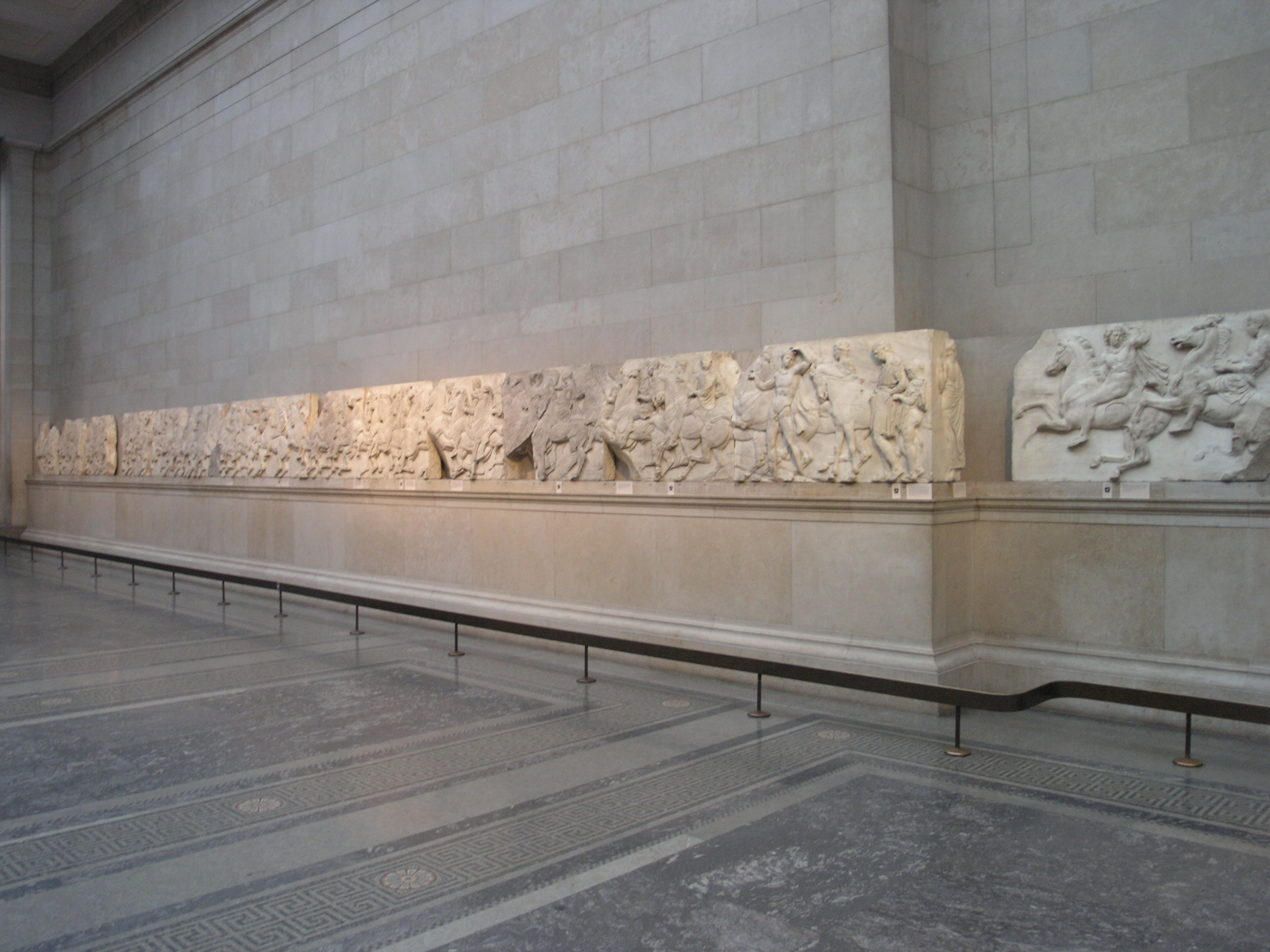
When I received an invitation to attend a talk and musical concert at the British Museum about the Parthenon Frieze in June, it seemed the ideal opportunity to renew my interest and to learn something of the precious exterior ornamental band which ran around the 2,500- year-old Parthenon temple.  I also wanted to know what all the fuss was about, why lawyer Amal Clooney, one month after marrying superstar George, was taking up the Greek cause to return the priceless marbles to Greece. Today, around 60% of the frieze is housed in Room 18 of the British Museum, the majority of the remaining 40% resides in the Acropolis museum.

The Parthenon Freize at the British Museum (picture source: Wikipedia)

So I set out on a gloriously sunny evening in June with the words of my friend Molly Borthwick (generous supporter of that day’s event) whirling around in my mind: “You haven’t met Ian (Jenkins), you haven’t heard him speak! He’s the world expert on Greek and Roman sculptors. You’ll lurvv him!”   When Molly says these things, I listen.

An hour later I was in the back row of the lecture hall. Without any ceremony a silver-haired Ian Jenkins walked on stage, looking the part of Victorian gentleman and flamboyant academic in his slightly creased, pin-striped suit and a silver watch chain, from which hung his museum key. From his lectern he perused the audience. I scanned the room myself. My gaze flitted across the packed lecture hall composed of suited men and women in heels and summer dresses, over to a younger crowd nearer to where I was sitting, in jeans, sneakers and dark tee-shirts, some of whom, started to canoodle the minute they sat down.

I went back to reading the programme: “Ian is the curator of the Museum’s critically acclaimed exhibition ‘Defining beauty: the body in ancient Greek art”. “The body” I thought to myself, a theme which is bound to get the punters in at the British Museum. Tonight however, Ian’s angle had changed. We were being offered: ‘The Parthenon Frieze: a symphony in stone’. As I am a great classical music lover and a Wigmore Hall regular, I was intrigued by the musical connection. This, coupled with the fact that we were going to be treated to a live UK premier of newly commissioned work entitled Panathenaia which had been inspired by the Parthenon frieze.

Ian explained that the frieze was the decorative sculptural upper band of marble, which originally ran off the entrance to the Parthenon temple.  The frieze evokes the ‘Great Panathenaia’, the festival held every four years to celebrate the birth of Athena. Here we had to imagine it in situ: two parallel processions progress along opposite sides of the building towards their finishing point on the east wall. We see horsemen, chariots, animals for sacrifice, young women and magistrates or tribal heroes. There are chariot races that day and music competitions, the prizes special jars, filled with olive oil, with a depiction of the event on them.   The high point of the ceremony is the presentation of the peplos or sacred cloth, newly woven, to adorn an ancient olive statue of Athena.  Presiding over these festivities are the gods and goddesses. The interesting thing, Ian tells us, is that there is a question mark over whether the gods are viewing these events from on high – that is from Mount Olympus – or down at the Temple in Athens, suggesting perhaps the merging of the human and the divine. Have humans become godlier or have the gods become more plebeian? There is a pause whilst we take this in. A man in front of me stops tapping the screen on his iPhone and looks up, as if he has just woken up to this momentous question left hanging in the air.  He looks around vaguely then bows his head again and resumes his silent tapping.

Ian’s talk becomes more and more fascinating as he draws all sorts of modern artistic parallels with the frieze. He sees the same arrangement of horses in a work painted by the great artist Mark Gertler in 1916, ‘The Merry go round’ and so on. And then comes Ian’s tour de force. “The symphony” which is to be found in the Parthenon Frieze. Ian starts to show us slides of his transcription of the frieze, which he has converted into a sort of Braille, in which the numerous figures seen from above, are represented by simple shapes. And here I quote from the Panathenaia librettist Paul Williamson, as I’m not a musicologist : “The heads of the horsemen, for example, are shown as ovals, laid out in rows to indicate the depth of field. The effect of the semibreve-like ellipses arranged on staves, as it were, is incredibly like musical notation.”

Oh my! My brain is now reeling, I am eager to hear the music to give it a rest.

Full of anticipation we leave the lecture hall, and make our way up a grand staircase to Room 18, the Parthenon frieze viewing gallery.

Twenty minutes later, having finally settled in our seats, we are able to admire the frieze for real; we stare at the sections of white marble sculptures on the walls, beautifully lit, looking so clean, the figures so beautifully fluid and lovingly preserved, though incomplete. It is hard to believe that they are so ancient. The TV camera is there with Patricia Wheatley, formerly with the BBC and head of the BM Broadcasting unit, the photographers with their telescopic lenses, all now aiming at the stage, for the choir, two sopranos, the orchestra and lead violinist Hugo Ticciati (soon to be playing at the Wigmore I noticed with interest) has just stepped in. The enthusiastic Ticciati starts speaking a little fast on the stage, but it doesn’t matter, all I need to know is in the programme, namely that it was he who had the idea of commissioning this work in the first place.  Ticciati enlisted the services of award-winning composer Thomas Hewitt Jones (Winner of the 2003 BBC Young Composer Competition) and they chose Paul Williamson to write the libretto. Ticciati and his orchestra performed the finished work once in Sweden last summer, at a summer festival he organises, and instead of the Parthenon, a rock-balancing artist was called in to reconstruct his own frieze with some stones from a nearby lake. Apparently the last irregular diamond of stone was put in place as the music ended.

Wow! I thought, not bad, not bad at all. But even a rock-balancing artist cannot compete with these beautiful smooth, sculpted warriors running along the wall.

A young bearded conductor steps up on stage with tight corkscrews curls, followed by two late musicians, who, cowering with embarrassment and grasping their violins quickly find their seats.

Panathenaia is a Cantata in eight movements for string orchestra, timpani, soloists and choir. The hugely talented composer, Thomas Hewitt-Jones drew his inspiration from certain figures from the frieze and temple statues.

The instrumental Prelude opens with the tense plucking of strings and jagged rhythms, then the full orchestra enters into a slow lumbering movement of strange, mysterious sounds marking the start of the Athenian procession or is it the wars that preceded the building of the Parthenon temple, as there is the rumble of drums.   We are transported back to c. 495-429 BC, where the instruments one imagines to have such different discordant sounds.

In marked contrast, the following “Temple” movement with the Choir, is one of beautiful high, ethereal voices, denoting the harmony and beauty of the land and holy building where justice reigns: “This ancient land’s an orderly/Arrangement, wrought from flowing forms”.

“The Weaver’s Song” following, sung with great feeling by the fine blonde soprano Paulina Pfeiffer is both mournful and serious in tone – serious because she is weaving the sacred cloth which will clothe the statue of Athena, therefore a great responsibility – mournful – because she is alone, separated from her warrior boyfriend who is taking part in the chariot races during the festival: “Eros, has made me dull”. Apparently in rehearsals, Paulina, was disturbed by her voice ricocheting off the frieze in Room 18. She was, I was told, holding back tonight, and I noticed her shoulders stiffen a little as one particular high note echoed around our heads. The effect however was thrilling!

I loved “The Lyric Suite”: Hugo Ticciati’s achingly beautiful violin, sometimes so haunting and then the unsettling bassoon, plucking of strings and tympani which crescendos into a full-blown orchestral swell setting things up for Prometheus and his challenge with the gods.

In “Prometheus” we had the gorgeous pairing of the blonde soprano and dark mezzo-soprano, Karolina Blixt. Blixt looked very striking in her Grecian ivory dress and liquid eye liner eyes which flashed at the audience, causing quite a ripple amongst the male members who looked up at her in complete reverence (I see a star in the making). “Ah but the gods have lost their spark” they sing signifying the decline in the influence of the gods, making way for Prometheus who “…freed the agent of change/That far-seeing rascal”. The sopranos snarl the word “rascal”

In “Shadows in a dream” the choir asks what harmony is possible when humanity inherits the earth? Tympani – storm rumblings loud then soft and distant, set the scene for the following “Birth of Pandora”, Zeus’s revenge on humanity. I loved the amazing anarchic dance of the satyrs attending the birth of the beautiful, ‘baneful’ Pandora. “Caper on your crooked legs” – wonderful alliteration by Paul Williamson the librettist. And finally the Coda – plucking of double basses like footsteps fading away. The music has turned full circle. We are back to where we started.

Loud applause. Ian Jenkins the curator, the musicians, singers, composer, librettist and conductor, had transported us into another world, another time. It had been an exciting, illuminating experience, one that I am very keen to repeat. These sorts of happenings however are rare and require money, time, commitment and passion. Vision too. I felt privileged to have attended such an event.

Since then I have returned to admire the frieze in the British Museum twice!

Discover this extraordinary composition performed by orchestra and singers for the first time ever in the British Museum’s Duveen Gallery, which houses the Parthenon Sculptures. Surrounded by these stunning carvings, Panathenaia celebrates their artistry and tells the story portrayed in the timeless stones.

Karine Hetherington is a teacher and writer who lives in London. A dual-British and French national, with a Russian ancestry thrown in, her short stories and novels reflect her passion for both the detail and grand sweep of European history. After studying creative writing at Birkbeck College in London, Karine has been telling stories that have brought history to life, with tales of love and adventure that draw on the detail of real events and real lives. Karine’s novel ‘The Poet and the Hypotenuse’ is available now. Read an extract here

Meet the Artist……Thomas Hewitt Jones

Who or what inspired you to take up composing, and pursue a career in music? 

I grew up surrounded by a family of musicians. Everyone played in the local brass band and my grandparents were really my first teachers. When I was 15 I received a scholarship to study at Chethams School of Music in Manchester and whilst there a friend and I sneaked out of school one day to see a production of the Rite of Spring. It was the first time I’d experienced orchestral music and dance performed live together and I found the whole experience hugely overwhelming. As soon as I left the theatre I knew I wanted to write music.

Who or what are the most significant influences on your musical life and career as a composer? 

Early on in my career it was brass bands that provided me with a way into music. I grew up playing the tenor horn and moved onto French horn when I started at Chethams. It was here that I experienced orchestral music for the first time. The music of Stravinsky, Turnage, Prokofiev, John Adams really struck a chord with me. Even now I find those early influences really underpin what I want to do as a composer. My music is often very fast, driven and rhythmic. It’s immediate, and for me that’s important.

What have been the greatest challenges of your career so far? 

I’m about to start working on an opera. I think this will be my most challenging project, but I can’t wait to get started on it.

What are the special challenges/pleasures of working on a commissioned piece? 

For me the aim of the process is to hear my music performed. I’ve never been good at writing music without a performance in mind. The process is hard, long and at times frustrating but to finally hear the music performed is what drives me. Of course when you are working to a specific commission or brief you can’t necessarily write whatever you want, but the restraints that come with a commission are good for me; it gives me structure and a guide.

What are the special challenges/pleasures of working with particular musicians, singers, ensembles and orchestras? 

I love collaborating with other artists. As a composer you spend a great deal of time alone and this can sometimes be counter productive. So the opportunity to actually create music with other musicians, artists or choreographers is something I thrive on. I really work my best when I’m working with others, so when I’ve collaborated with choreographers or librettists I feel I’ve written some of my strongest pieces. When you know the ensemble you are working with so well it can help drive the creative practice. I have a great relationship with Tredegar Town Band, for whom I have written two large works now. Since I know the players and conductor so well we can just get straight the heart of the music. It’s wonderful.

Which works are you most proud of?  

That’s a tough one because I am very self-conscious about the music I write. In most of my works there are moments that bother me, either because listening now I find it naïve or I feel I could do it better if I was able to write the piece again. But I suppose the two pieces I’m most proud of are Dark Arteries, a ballet I’ve just completed about the miners’ strike, and Velocity, which was commissioned to open the Last Night of the Proms in 2014. It was such an honour to be asked to write that piece, the whole experience was just incredible.

What is your most memorable concert experience? 

A few years ago I heard the Berlin Philharmonic play Brahms 2 in Oxford at 10:30 in the morning. I have never heard such an incredible sound in my life. Every single player, from the front desk to back, played like they were leading the orchestra and the performance was thrilling. I heard them play the whole of the Firebird score last year at the Proms and I was in tears at the end. They’re such an incredible group of musicians.

What do you consider to be the most important ideas and concepts to impart to aspiring musicians? 

A career in music is tough and is full of challenges and frustrations and so you have to work hard and practice your craft every day. Go to lots of concerts and listen to lots of different kinds of music. Take what you do seriously and be self critical, but don’t be self critical it impedes on you improving, know when to give yourself credit!

Where would you like to be in 10 years’ time? 

Happy, comfortable, maybe taking a walk in the Blue Mountains.

What is your idea of perfect happiness?

Having a lovely time on my roof with my London family…. Also eating sushi….

What is your most treasured possession? 

My pictures of my friends and family.

What do you enjoy doing most? 

Time in London. I love this town and it breaks my heart to see what’s happening to it at the moment. I just hope that we can get it back on track, it’s the most amazing city in the world and we shouldn’t allow greedy, corporate villains to take it from us. It is the centre of cultural universe and we must fight to keep it that way.


TendlerLeather—ScionFullana

Who or what inspired you to take up the piano and pursue a career in music?

It was a combination of things. In one regard, I took piano lessons since the age of six and, at least in my own memory, was rather unremarkable as a student. By middle school, however, I was playing certifiably classical music, though not well. By high school, when I hit the more advanced work of Chopin I started to see the creative possibilities of classical music—how I could really express through it—and then a kind of riptide dragged me from Chopin to Rachmaninov to Prokofiev to Copland to a whole world of modern and classical music. Totally obsessed, it was then that I started to practice, study, and really hustle to prepare for conservatory. On the flipside, I was bullied pretty relentlessly growing up, and the piano eventually served as a kind of escape. Not only could I retreat into my practice regime and not really have to navigate the hallways of my high school, but my talent itself—you know, this idea being special or exceptional at something—worked as a kind of shield or barrier from the harassment. And I guess it almost worked.

Who or what were the most important influences on your musical life and career?

The first pianist who really inspired me was William Kapell, an American virtuoso who died young, in a plane crash, in the 1950s. His playing had such personality and fire, and he had such strong convictions as an artist and such a complicated inner-world, almost debilitatingly nervous as a performer. I needed an idol who was both astonishing and complex, when in classical music everyone else seemed so perfect and unflappable. I should add that, while I’ve worked with dozens of teachers in my lifetime, all of them great artists, it was really my first teacher, a local piano instructor in Barre, Vermont, who let me truly explore music as I wished until I grew to love it on my own terms. He allowed me to play in the truest sense of the word, and as a musician I owe everything to him. He received my book’s dedication.

What have been the greatest challenges of your career so far?

I tend to wrestle with time, and always have. If I’m not practicing or reading or working on something, I’m apt to spiral into depression and guilt over what I didn’t get to and how that’s a reflection of my own deeply personal failure. This probably stems from a sense that I started late as a musician. I mean, I don’t even really know if I started late, and evidence probably shows that I actually didn’t start late, but it’s a perception I have and I battle it all the time. Even at Indiana University, I told myself that I had a tremendous amount of catching up to do, even though I really had an astonishingly accomplished number of years there. So I might also owe my life in music to this impulse to absorb and perform and push forward, but still, it’s a challenge and can feel kind of miserable in the day-to-day. I tend to believe that everyone else has it all figured out and that I’m the only one who can waste a whole morning drinking a cup of coffee.

Which performance/recordings are you most proud of?

I love the recording I did of my book, 88×50, which I don’t think a lot of people know about even though it’s on iTunes, streaming on Spotify, and is pretty much anywhere online. I spent months recording it at the DiMenna Center for Classical Music in New York, and the result is really fun and full of surprises. I also like the life that my live recording of Cage’s Sonatas and Interludes has taken since I released it for free on the web over five years ago, though I think I play the piece quite differently now. Also, Autumn Lines, is a very personal speaking-pianist piece that I released a few years back. Frankly, I’ve found that it’s too traumatizing to do live, so I’ve stopped performing it, nor will I really listen to it or watch live footage from concerts of it, but people seem to like it and I do like it, too. It’s just an intense composition from an intense period in my life. I’m proud of it, I just don’t like being around it. In terms of performance, most recently I performed a concert of music by Cage and Cowell at the open-air Maverick Theatre in Woodstock New York, where Cage’s 4’33” had its premiere in 1952. That was an incredible honor and a huge career highlight for me. Also, this week I organized a twenty-four pianist performance of Bach’s Well-Tempered Clavier, Book One, featuring mostly new music pianists, which was an epic and totally shattering experience in all the best ways.

Which particular works do you think you perform best?

I tend toward modern music by Americans, and love exploring the wide range of whatever that means. That said, I also like when a program pushes me out of my comfort zone, either backwards or forwards.

How do you make your repertoire choices from season to season?

It really depends on the series, the space, and sometimes the specific requests of my hosts. This season I learned a program of music by Luciano Berio, another by Henry Cowell, and for this festival coming up in London, I learned Morton Feldman’s Palais de Mari—all simply because my presenters asked. The great thing is, I’ll probably play this music for the rest of my life.

Do you have a favourite concert venue to perform in and why?

Probably the Rothko Chapel in Houston Texas. The space itself… the air… it has a kind of epsom salt effect on a person, just pulling stuff out that one doesn’t even know is there. I’ve played three concerts at Rothko Chapel, and would like to do a fourth! They consistently present inspiring and fearless programming for free to the public, so I’m proud to call it home.

Favourite pieces to perform? Listen to?

There are certain pieces I come back to, like the Cage Sonatas and Interludes. I’ve played that for eight years now—not constantly, but coming back to it once or twice a year—and each year it feels a little more settled and a little more internalized. It’s like seeing an old friend and jumping right back into a conversation, but then being like, “Hey, what’s different? Did you do something with your hair?” Something’s always a little different when I come back to it. I finally think I play that work with total assuredness—no traps or doubts or anything like that—which makes me think that perhaps it takes eight years for me to truly know a piece! Honestly, though, I find myself totally enrapt and obsessed with whatever I’m working on at a given time. In the days before a concert, I feel totally consumed with that music and its world, and after, I feel a little lost and desperate. In terms of listening, I only occasionally listen to classical or concert music. My brain buzzes too much with it on. I’d rather listen to bluegrass or artists outside of my field.

Who are your favourite musicians?

Nonspecifically, I’m taken with musicians who have a firm sense of their own creative identity, an unshakable passion for their craft, and the humility to understand that their journey is their own, and they have no obligation to mirror anyone else’s life or standards. I have countless examples of these kinds of people in my life, and aspire to their grace every day, people who seek to move their listeners rather than impress.

What is your most memorable concert experience?

Gosh, that’s really tough to answer. Every concert on my fifty-state tour from about ten years ago felt like a miracle. The good ones and the disastrous ones, they all still beat the odds in that I was creating a life in music when for all intents, people… experts…had told me that there were only certain ways to do it, certain avenues to take, and of course all were supposedly closed to me. So the experience of just getting out there and doing it and having people actually respond…well, yeah it was simply miraculous.

What do you consider to be the most important ideas and concepts to impart to aspiring musicians?

That there’s a place for anyone in music. Truly. Everyone has a seat at the table. One has to envision that place, though, be open to it shape-shifting over the years, which it will, and put in the work to build it, simply carving into that identity, that little niche, every day. Some days will feel super tough and other days effortless, but faith and tenacity and a great deal of devotion—those are the ingredients to a life in music. Not Hanon, I’m afraid.

What is your present state of mind?

Anxiety, worry, dread, fear, embarrassment, doubt, wonder, joy, gratitude… a regular morning.

Adam Tendler has been called “an exuberantly expressive pianist” who “vividly displayed his enthusiasm for every phrase” by The Los Angeles Times, an “intrepid…outstanding…maverick pianist” by The New Yorker, a “modern-music evangelist” by Time Out New York, and a pianist who “has managed to get behind and underneath the notes, living inside the music and making poetic sense of it all,” by The Baltimore Sun, who continued, “if they gave medals for musical bravery, dexterity and perseverance, Adam Tendler would earn them all.”

Tendler has performed solo recitals in all fifty United States, including engagements at Columbia University, Bard College, Princeton University, New York University, Kenyon College, Boston Conservatory, San Francisco Conservatory, Portland State University, University of Nebraska, University of Alaska and Rice University’s Shepherd School of Music, as well as artistic landmarks including Houston’s Rothko Chapel and James Turrell’s Skypace in Sarasota, where he was the space’s first musical performer. 

Tendler’s memorized performances of John Cage’s complete Sonatas and Interludes include a sold-out concert at The Rubin Museum in New York City and a featured solo recital in the “Cage100” festival at Symphony Space on what would have been Cage’s 100th birthday, listed by New York Magazine as one of the Top 10 Classical Music Events of 2012. In 2014, Tendler performed Cage’s 31’57.9864” in an appearance with the John Cage Trust at Bard College’s Fischer Center, presenting a realization of Cage’s 10,000 Things, and in 2015 he performed music by Cage and Henry Cowell, including Cage’s 4’33”, at the famed Maverick Theatre in Woodstock NY, where 4’33” had its premiere.

Tendler’s memoir, 88×50, about the year he performed solo recitals in all fifty states, was a 2014 Kirkus Indie Book of the Month and Lambda Literary Award Nominee. His premiere recording of Edward T. Cone’s 21 Little Preludes will appear in 2015, and he is developing an album of piano works by American composer, Robert Palmer. He also maintains the blog, The Dissonant States.

A graduate of Indiana University, Tendler presides over a private teaching studio in New York City, and in 2013 joined the piano faculty of Third Street Music School Settlement, the country’s first community music school.

adamtendler.com


