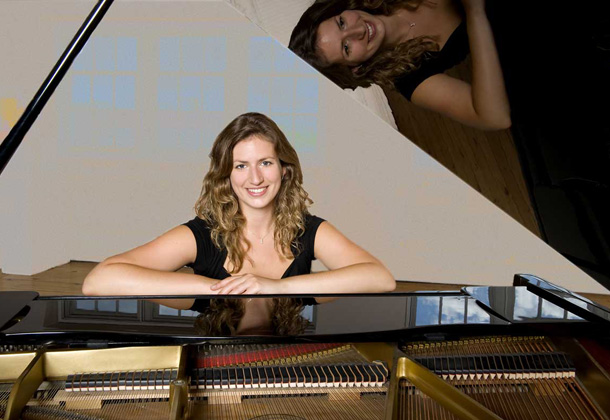
Nadine André is a classical pianist and teacher who performs both as a soloist and chamber musician and teaches piano and chamber music at three institutions, including the junior department at the Royal Academy of Music in London. Here Nadine explains why she has decided to embark on one of the most comprehensive and demanding Pilates teacher training programmes in the world.

I frequently meet musicians who suffer from injury or debilitating, ongoing physical issues that prevent them from playing their instruments freely. In some cases, people who have dedicated their whole lives to music have to stop playing altogether. I find this incredibly frustrating and, until recently, I have never come across a method of therapy or exercise that is truly rehabilitative and that can address and fix the cause of these issues.

Don’t get me wrong, physical therapy sessions are great! They can be restorative, alleviate pain and improve well-being, however, it is rare that these sessions get to the very root of a physical problem and deal with fixing the issue in the WHOLE body, not just the isolated area. If the therapy does treat the whole body, the effects often wear off and the issue returns. Medical intervention frequently involves temporary treatments such as steroid injections into a joint and, while surgery is occasionally necessary, it can often be avoided, and should only be a last resort.

I have amassed so many questions about this over the years…

  • Is playing the piano with ease really this difficult?
  • Is practising the particulars on your instrument for endless hours really the best way to achieve a perfect state in performance?… Apparently not.
  • Is there a form of exercise or therapy that can truly change the body, from the inside out?
  • Is there a form of deep and comprehensive training I can do that isn’t medical that will enable me to help my fellow musicians?
  • Is there a way of learning to be more integrated, where the mind can become much more closely connected to the body, but that also strengthens it? (I’m a huge fan of Alexander Technique and have had years of private lessons but, for all its virtues, it doesn’t address muscle weakness.)

After mulling over different possibilities and trying different forms of therapy and exercise to improve my own body, I have finally found what I believe is the perfect solution. I make this sound like I’ve given it the occasional thought… far from it. I’ve agonised over this, had sleepless nights on occasion, questioned my identity as a teacher and struggled with dealing with my own physical pain for years. This is a decision that I arrived at when several aspects of my life converged into one moment. Corny though it may sound, it was indeed an epiphany (and happened at about 2am last summer).

I discovered Pilates almost 6 years ago and I loved it. I received expert tuition from Sonja Fitzpatrick in Epsom, and once I’d had my light-bulb moment and decided to train as a Pilates teacher, Sonja encouraged me to do my research and try different methods. I knew that I wanted to train as true to Joseph Pilates’ method as possible and researching this lead me to Classical Pilates.

kp_image_3
(image from Kinetic Pilates)

It was in February this year (2019) that I came across Kinetic Pilates in north London, and discovered that Rebecca Convey is THE UK teacher-trainer for Romana’s Pilates. I did some digging and found out that Romana was a devoted student of Joseph Pilates’, working closely with him and his wife Clara for years. After his death, Romana set up a teacher training programme with Clara that would ensure future teachers of his method stayed as true to his system and approach as possible. It seemed that this was as close as I would get to learning Pilates (or ‘Contrology’ as Joseph called it), as it was meant to be learnt.

After several weeks of lessons with Rebecca and James Palmer, another fantastic teacher at Kinetic Pilates, I noticed my piano playing start to change. My hands felt much lighter, my pelvis more stable and my whole body was more powerful. The technical issues I’d been dealing with for decades were melting away and I was playing with much greater ease. I knew that this was my path and felt certain that this teacher training method would enable me to fulfil my desire to help others.

Read the full article on Nadine’s website
nadine_andre_about


For those of us who engage in music, as performers and teachers, the classical canon offers an endless source of excitement, thrilling stories and fantasies, portrayed in myriad colours, moods and styles. The desire to play this music and revel in its wonders is very potent and is what motivates us to practise, play, perform, and teach. Sharing the music with others is a special joy all of its own.

Alongside this, the musician’s daily life can be tough, restrictive and lonely: the routine of practising, trying to make a living in an uncertain, highly competitive profession, seeking out performance opportunities, travelling, teaching, and the quotidian admin of managing a career. When the creative pursuit of music feels more like a task than a passion, it can lead to a loss of joy.

There are added pressures too: the rigours of the musician’s training can affect one’s attitude to the music. It stops being a source of excitement and exploration and instead becomes a sequence of technical exercises to be practised with clinical precision to the point of perfection.  The need always to be at the top of one’s game, the knowledge that, as a performer, one is only as good as one’s last performance, the precarious nature of the profession – all these can impact on one’s attitude to the music.

How do we preserve the joy when so many pressures can conspire to remove it from our music making?

As a teacher, I think it should start in the earliest lessons. Too often children are encouraged not to make a mistake, to aim for perfection – an unrealistic artificial construct – and in doing so become fixated on avoiding errors rather than revelling in the pleasure of the music, relishing and cherishing the sounds they are making.

…too much emphasis is placed on how they [music students] perform, and too little on what they experience.

Mihaly Csikszentmihalyi, author of FLOW


Embrace the experience

As we mature and develop as musicians, whether or not we choose the path of formal training in conservatoire, our focus should remain on “the experience”. Of course we must practise deeply and intelligently, with due care and attention, but not to the exclusion of everything else. Life experience, from the mundane to the extraordinary, all feeds the artistic temperament and brings vitality and imagination to our music making.

Make the music for you and remain curious

Intrinsic motivation – whereby one undertakes a task or activity for its own sake rather than in the hope of gaining some sort of external reward or praise – leads to better focus and concentration, and far more fulfilling outcomes. So make the music for you – and don’t continually seek praise or endorsement from others; nor compare yourself to others.

Thirst for knowledge is a form of intrinsic motivation and this thirst can be fulfilled by learning new music and enjoying the process of learning. Personal fulfilment can be derived from knowing one is getting better, while the physical and mental satisfaction of actually playing music is a pleasure in itself and can lead to a state of flow, where one enjoys the activity for its own sake.

Regular reminders of why we have chosen to devote ourselves to music, which focus on the intrinsic motivations, rather than career advancement or external endorsement, and recalling our love for and pleasure in the art form, are very important too.

Give yourself permission for downtime

Taking regular breaks from practising and the other minutiae of managing one’s career allows time to refocus and reset. Regular exercise, plenty of sleep, having someone help with the mundane tasks, and getting away from it all by doing something else – reading a book, visiting an exhibition or simply chilling with a TV programme.

Acceptance

Know and accept that feelings of frustration and disgruntlement with one’s working life as normal and common to everyone.


And some helpful advice from musicians themselves:

Finding a few minutes amongst the (often huge) stresses of deadlines to engage in ‘play’/procrastination…and lots of listening to all kinds of music.

Thomas Hewitt Jones, composer


Reflect regularly on the transience of stress and anxiety and the permanence of art. Treat it as your friend, not your enemy. Even if things get much worse and they always can, know that art will always be with you and will continue long after you’re gone. A thirst for life and creation when willed into being tends to overwhelm the desire for death (of one form or another).

Luke Jones, pianist


For me, playing is the release. I mostly compose via improvisations, so as my mind wanders and deals with daily stress, my music is moving around under my fingers looking for a way to ground myself.

Simon Reich, pianist and composer


at times when my work is not bringing new repertoire to me, I find there is no cure for fatigue that is better than making a new thing

Sally Whitwell, pianist and composer


For me the joy is in the music. I love music.

Joseph Fleetwood, pianist

performers-quotes-15-1377772242-view-1

For those of us who engage in music, as performers and teachers, the classical canon offers an endless source of excitement, thrilling stories and fantasies, portrayed in myriad colours, moods and styles. The desire to play this music and revel in its wonders is very potent and is what motivates us to practise, play, perform, and teach, and sharing the music with others is a special joy all of its own.

But alongside this, the musician’s daily life can be tough, restrictive and lonely: the routine of practising, trying to make a living in an uncertain, highly competitive profession, seeking out performance opportunities, travelling, teaching, and the quotidian admin of managing a career. When the creative pursuit of music feels more like a task than a passion, it can lead to a loss of joy.

There are added pressures too: the rigours of the musician’s training can affect one’s attitude to the music. It stops being a source of excitement and exploration and instead becomes a sequence of technical exercises to be practised with clinical precision to the point of perfection.  The need always to be at the top of one’s game, the knowledge that, as a performer, one is only as good as one’s last performance, the precarious nature of the profession – all these can impact on one’s attitude to the music.

How do we preserve the joy when so many pressures can conspire to remove it from our music making?

As a teacher, I think it should start in the earliest lessons. Too often children are encouraged not to make a mistake, to aim for perfection – an unrealistic artificial construct – and in doing so become fixated on avoiding errors rather than revelling in the pleasure of the music, relishing and cherishing the sounds they are making.

…too much emphasis is placed on how they [music students] perform, and too little on what they experience.

Mihaly Csikszentmihalyi, author of FLOW


Embrace the experience

As we mature and develop as musicians, whether or not we choose the path of formal training in conservatoire, our focus should remain on “the experience”. Of course we must practise deeply and intelligently, with due care and attention, but not to the exclusion of everything else. Life experience, from the mundane to the extraordinary, all feeds the artistic temperament and brings vitality and imagination to our music making.

Make the music for you and remain curious

Intrinsic motivation – whereby one undertakes a task or activity for its own sake rather than in the hope of gaining some sort of external reward or praise – leads to better focus and concentration, and far more fulfilling outcomes. So make the music for you – and don’t continually seek praise or endorsement from others; nor compare yourself to others.

Thirst for knowledge is a form of intrinsic motivation and this thirst can be fulfilled by learning new music and enjoying the process of learning. Personal fulfilment can be derived from knowing one is getting better, while the physical and mental satisfaction of actually playing music is a pleasure in itself and can lead to a state of flow, where one enjoys the activity for its own sake.

Regular reminders of why we have chosen to devote ourselves to music, which focus on the intrinsic motivations, rather than career advancement or external endorsement, and recalling our love for and pleasure in the art form, are very important too.

Give yourself permission for downtime

Taking regular breaks from practising and the other minutiae of managing one’s career allows time to refocus and reset. Regular exercise, plenty of sleep, having someone help with the mundane tasks, and getting away from it all by doing something else – reading a book, visiting an exhibition or simply chilling with a TV programme.

Acceptance

Know and accept that feelings of frustration and disgruntlement with one’s working life as normal and common to everyone.


And some helpful advice from musicians themselves:

Finding a few minutes amongst the (often huge) stresses of deadlines to engage in ‘play’/procrastination…and lots of listening to all kinds of music.

Thomas Hewitt Jones, composer


Reflect regularly on the transience of stress and anxiety and the permanence of art. Treat it as your friend, not your enemy. Even if things get much worse and they always can, know that art will always be with you and will continue long after you’re gone. A thirst for life and creation when willed into being tends to overwhelm the desire for death (of one form or another).

Luke Jones, pianist


For me, playing is the release. I mostly compose via improvisations, so as my mind wanders and deals with daily stress, my music is moving around under my fingers looking for a way to ground myself.

Simon Reich, pianist and composer


at times when my work is not bringing new repertoire to me, I find there is no cure for fatigue that is better than making a new thing

Sally Whitwell, pianist and composer


For me the joy is in the music. I love music.

Joseph Fleetwood, pianist

performers-quotes-15-1377772242-view-1

Please don’t shoot at the pianist; he’s doing his best

I sometimes get the feeling people think musicians are invincible….

We engage in a highly complex, technical and artistic activity which requires huge physical and mental agility and concentration. When we perform, our meticulous preparation enables us to make everything we do look effortless, synthesised and beautiful. In the moments of performing, we offer the music to the audience as a cultural gift to be shared between us in the wondrous experience that is live performance. On stage we dissemble, we act, to maintain a veneer of confidence and poise. Because no one can know how many goddam hours you put in in the practice room or that your journey to the venue was delayed, how tired you are feeling from working all week without a break, or how much that recurrent shoulder problem has been troubling you. To publicly admit to these vulnerabilities would quickly destroy the mystique of the performer.

sticking-plaster-on-a-finger-cristina-pedrazzini

As performers, vulnerability is integral to the profession. By performing we choose to put ourselves out there, hold our music, and ourselves, up for scrutiny, for praise and criticism. It can be a lonely, masochistic activity, never more so in an age where live performance has become almost an Olympic sport in its obsessive need for perfection and the general competitiveness of the profession.

Vulnerability develops early on in the musician’s life, usually at an age when we are not yet fully formed, barely aware of our individual self or identity. The special training musicians undergo can engender multiple emotional problems – the autocractic teacher who constantly breaks down the student’s confidence, for example, or the competitive atmosphere of specialist educational institutions. We are taught how and why to practice and perform by more senior practitioners who cannot possibly know what our individual strengths and weaknesses really are, and who may not offer enough concern or advice on managing the complex aspects of the musician’s life. In addition, where one may have excelled at school, a “gifted pupil”, on arriving at music college one may face the uncomfortable fact that one is now just another among equals, and so begins the toxic habit of looking at what others are doing and constantly comparing oneself to them. The training then becomes a kind of rat race or “musical anorexia”, played out in cloistered, rarefied surroundings. Despite all of this, we find we can achieve great things, and so we carry these learnt habits, and vulnerabilities, into adulthood and career, reluctant to give them up.

Get a bunch of musicians together in a “safe space” and they will talk of their vulnerabilities, their anxieties and fears. In researching this article, I inadvertently created such a safe space and the discussion became a kind of help group where people could talk honestly about their vulnerabilities: it was eye-opening and humbling.

Like physical injury and performance anxiety, admitting to emotional vulnerability is a taboo area, an admittance of weakness or lack of ability which may lead to less work. Musicians have a precarious, peripatetic existence at the best of times. The good news is that musicians are beginning to feel more confident about discussing these issues, and some educational establishments now offer specialist support, including mindfulness training, Alexander technique and counselling. Opening up and discussing your vulnerabilities with others can be remarkably reassuring and often cathartic: you realise you are “not alone” – because many of us share the same anxieties.

In addition, growing maturity and confidence encourages us to discover and implement personal innate methods and motivation, which allow us to reject those early, sometimes toxic, influences or processes, and we become better able to manage and even appreciate our vulnerabilities.

each experience, good and bad…..has potential for helping my overall development

– Carla, flautist

Paradoxically, vulnerability makes us better musicians. Without the emotional sensitivity of our vulnerability, we would not be able to develop, create and play music in a meaningful way; nor would we be able to forge connections and unspoken lines of communication between colleagues and audience in performance. Vulnerability also keeps us humble in the face of the greatness of the music. Asking oneself “Am I good enough?” can be curiously empowering too, if one chooses to avoid comparing oneself to others and instead focuses on one’s own work, forging an individual path through growing maturity, self-determination, musical understanding, and mastery with a willingness to embrace setbacks and cul-de-sacs along the way and to learn and move on from these. Acknowledging and accepting the Inner Critic, without allowing its voice to overwhelm us, is also essential to the creative process and should not be regarded as a sign of weakness. It also prevents our ego getting in the way of our creativity.

openness to the full spectrum of our experience is the starting point for compelling and mature musicianship. Suffering and joy are equally endemic to the human condition, and sharing the full range of our emotions with our audiences, through our presence and through the music we make, is not a selfish act, but a generous one

– Nora Krohn, violist


It’s vital: vulnerability, doubt, openness – how else to communicate with any vestige of meaning?

– Rolf Hind, pianist & composer


I honestly don’t think you can play meaningful music without being at least a little bit vulnerable somewhere – it’s about caring a lot, taking risks and being human

– Carla, flautist


Further reading

Handling your vulnerability as an artist