Don’t legalise music theft!

More than 1000 musicians have come together to release a silent album protesting the UK government’s planned changes to copyright law, which will make it easier to train AI models on copyrighted work without a licence.

The album, titled Is This What We Want?, features recordings of empty studios and performance spaces, representing the impact on artists’ and music professionals’ livelihoods that is expected if the government does not change course.

Under the heavily criticised proposals, UK copyright law would be upended to benefit global tech giants. AI companies would be free to use an artist’s work to train their AI models without permission or remuneration. The government’s proposed changes would require artists to proactively ‘opt-out’ from the theft of their work – reversing the very principle of copyright law. ‘Opt-out’ models are near impossible to enforce, have yet to be proven effective anywhere else in the world, and place enormous burdens on artists, particularly emerging talent.

The album is co-written by more than 1000 musicians, including Kate Bush, Annie Lennox, Damon Albarn, Billy Ocean, Ed O’Brien, Dan Smith, The Clash, Mystery Jets, Jamiroquai, Imogen Heap, Yusuf / Cat Stevens, Riz Ahmed, Tori Amos, Hans Zimmer, James MacMillan, Max Richter, John Rutter, The Kanneh-Masons, The King’s Singers, The Sixteen, Roderick Williams, Sarah Connolly, Nicky Spence, Ian Bostridge, and many more. The group includes recording artists, composers, conductors, singers, and producers, and features winners of Oscars, GRAMMYs and BRIT awards.

The track listing spells out a simple message: “The British government must not legalise music theft to benefit AI companies.”

In 2023, UK music contributed a record £7.6 billion to the economy with exports of UK music reaching £4.6 billion. Under proposed changes to UK copyright law, the government risks diminishing music’s proven economic success, extinguishing jobs in the music industry and undermining Britain’s global soft-power advantage.

Ed Newton-Rex, the organiser of the album, said: “The government’s proposal would hand the life’s work of the country’s musicians to AI companies, for free, letting those companies exploit musicians’ work to outcompete them. It is a plan that would not only be disastrous for musicians, but that is totally unnecessary: the UK can be leaders in AI without throwing our world-leading creative industries under the bus. This album shows that, however the government tries to justify it, musicians themselves are united in their thorough condemnation of this ill-thought-through plan.”

Kate Bush, one of the artists involved in the album said: “In the music of the future, will our voices go unheard?”

Composer, pianist and producer Max Richter, one of the artists involved in the album, said: “The government’s proposals would impoverish creators, favouring those automating creativity over the people who compose our music, write our literature, paint our art.”

Singer-songwriter Naomi Kimpenu, one of the artists involved in the album, said: “I fear that we will become the last generation of artists that can build careers in UK music. We cannot be abandoned by the government and have our work stolen for the profit of Big Tech. These proposals will shatter the prospects of so many emerging artists in the UK. If AI steals the rewards of creativity, it destroys that creativity. The government’s plan would be a dystopian future no one voted for, and we must choose a different path.”

All profits from the album will be donated to the musicians’ charity Help Musicians. The full list of musicians and groups involved can be seen at
https://www.isthiswhatwewant.com/ which will be live from the time of album launch.

[Source: press release]

#IsThisWhatWeWant?

Help raise awareness by sharing the album and its message with friends and colleagues, and around your network. Use the hashtage #IsThisWhatWeWant? when sharing on social media.

Write to your MP to protest the government’s planned changes to copyright law.

isthiswhatwewant.com

The following Japanese terms are all about warding off laziness and boosting motivation plus tips for embracing the concept of doing your bestThey are useful as general rules for life; here I have interpreted them for the benefit of musicians:

Ikigai

Have a purpose in life

Ikigai comes from two wordsIki meaning life, and Gai which describes your value or worth. It’s the reason you wake up each morning, what drives you, and what gives you fulfilment and purpose in life.

For the musician, this probably seems obvious – music is your purpose. Whether you’re a professional or an amateur musician, if you genuinely love and care about music, pursue it with passion.

Kaizen

Making small improvements, every day

This is particularly helpful for musicians in their daily practising/training and is a useful reminder that achievable goals and slow gains are, ultimately, more motivating, meaningful and personally fulfilling than striving for perfection from the outset. We tend to define achievement through one significant moment – learning a whole page or movement of a piece of music, for example – and underestimate the value of making small improvements on a daily basis which accumulate to create a significant whole. Recognizing and celebrating small milestones and achievements is an important aspect of Kaizen. Musicians should acknowledge their progress, which can be a motivating factor to continue improving.

Shoshin

Beginner’s mindset

“I am a beginner. I am always learning” – Fou Ts’ong, pianist (1934-2020)

Shoshin encourages approaching tasks with an open, eager, and non-judgmental mindset. In the context of the musician, this may include: openness to learning; abandoning preconceptions and biases; embracing and learning from mistakes; curiosity and creativity; humility.

By applying shoshin, musicians can maintain a sense of wonder and enthusiasm in their musical journey, leading to ongoing growth and a deeper connection with their art.

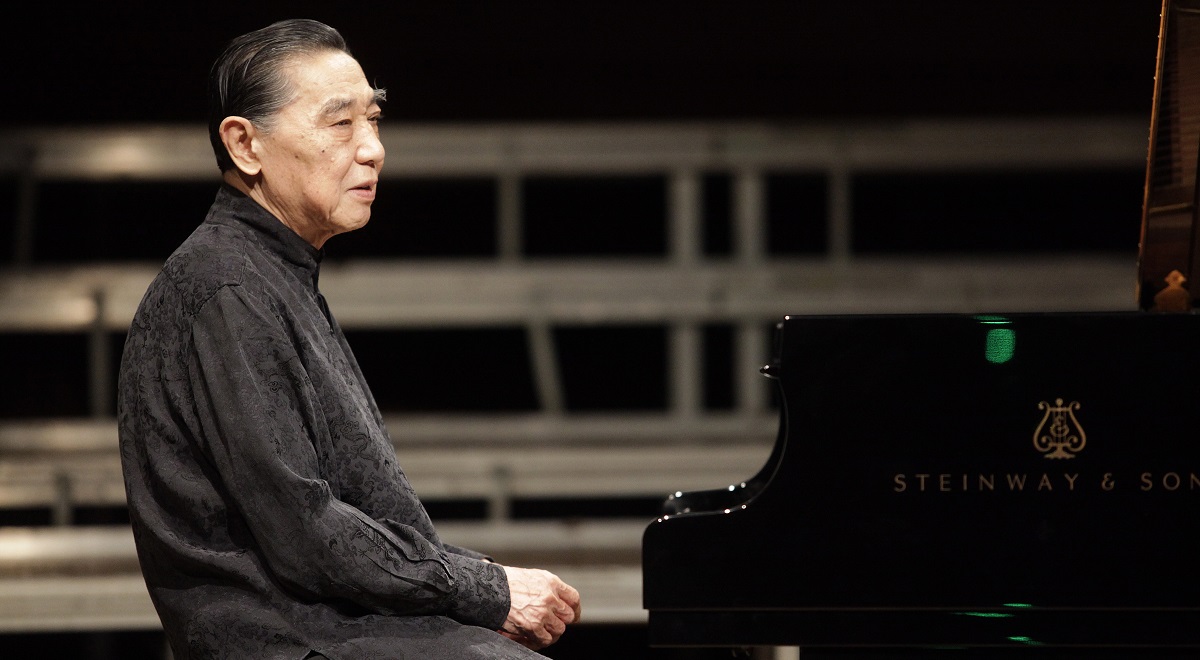
Fou Ts’ong

Ganbaru

Doing your best / persevering

Ganbaru conveys the idea of doing one’s best, putting in maximum effort, and persevering through challenges. It’s about pushing yourself to your limits and never giving up, even when the going gets tough. For musicians, applying ganbaru may involve: diligent, deliberate practice; resilience; commitment to excellence; consistency; maintaining a positive attitude.

Ganbaru encourages musicians to work tirelessly to achieve their musical aspirations and reach their highest potential.

Nintai

Patience and perseverence

Patience is a virtue in Japanese culture. It’s also a very useful attribute for musicians to cultivate! When applied to musicians, nintai may include:

  1. Having a long-term Perspective: Musicians should appreciate that mastering their art is a gradual process and be patient in their development.
  2. Endurance: They must persevere through challenges, setbacks, and plateaus in their musical journey.
  3. Staying Committed: Nintai encourages musicians to stay dedicated to their practice and goals, even when progress seems slow.
  4. Respect for the Process: Appreciating the value of each step and the learning process itself is essential.

This site is free to access and ad-free, and takes many hours to research, write, and maintain. If you find joy and value in what I do, why not


Guest post by Jill Timmons, DMA

A number of years ago, my editor at the Oregon Musician* asked me to write on the topic of invisible work as it relates to performance and teaching. The dog days of summer were winding down and concert season was about to unfold. Students and teachers were returning to their academic schedules, and as my editor suggested, it might be a timely topic to explore how invisible work undergirds our careers as artists and educators.

I found myself pondering for days this notion of invisible work as it relates to the creative process. What is central to the lives of artists and teachers can be elusive in terms of a precise definition. Here in the distant outpost of the music industry, artists and educators devote vast amounts of time to their craft, a large portion of which often goes unrecognized. It’s a little like an iceberg. The visible part might be our public performances, reviews, recordings, publications, workshops, residencies, and the list goes on. As an educator, one’s professional persona can include students in recitals, auditions, competitions, master classes, service to the profession, and so forth. These are the public events, the actions we take that others see, and those tangible results that are evident. But this all hints at something deeper. Like all icebergs, the bulk of the structure lies hidden beneath the surface. For musicians, this is at the heart of our invisible but essential work. It contains our long-term commitment to study, to practice, and to the formal education that often begins in childhood. It requires a sustained and passionate devotion to the art. There are countless hours of practice, lessons, master classes, years of higher education, mentors, finding the right teacher, and a search for that cadre of like-minded folks pursuing their own pilgrimage into music. It’s all invisible work.

As artists and educators, we know experientially about this unseen and often solitary work. I am not writing about anything that is a mystery or an unknown. On the other hand, what is mysterious is how we convey this understanding and application of invisible work to our students and our audiences. Without the invisible work, there is no true encounter with music let alone a career. In an age when a student might win a contest with the same four pieces they have played for years, or when loud and fast is modelled by performances that feature theatrics and histrionics as new realms of performance practice, it is little wonder that our young people today may be short on time in the “invisible world.”

Invisible work has its own demands: blocks of uninterrupted time, a quiet space, self-reflection, study (not just drilling the notes!), scholarship, and countless hours alone with your instrument. You become the measure of your work and your mastery of the music, and it is you that know in that private way the struggles, the triumphs, and the arduous trek to fluency. This is why great teachers are the ones who offer a language and wisdom about the nature and necessity of invisible work. Without it, there is no artistry.

As teachers, we can validate and encourage the invisible work of our students. From our experience, we can offer a road map for this temporal and elusive terrain, confirming the power and necessity of this work. In our culture of instant gratification and unrelenting distraction, we can serve as a guide to our students into that private world of exploration, study, preparation, and mastery. If they are lucky, our students will encounter not only great musical works but also themselves. As teachers this is our invisible work.

From my vantage point, the biggest impediment facing artists, regardless of age, is the quantitative approach to life. It’s that insatiable appetite for more. For our young students it can take the form of more after-school activities, more extracurricular pursuits, more awards, ribbons, contests, trophies, you name it. Pile it up for that résumé. And I am not speaking of just young people. For professionals in the field, it can be an unquenchable thirst for more concerts, residencies, workshops, students, publications, degrees, accolades, piled higher and deeper. But more is not an indication of quality – it’s just an amount. Quality, conversely, is the result of invisible work, and invisible work requires time. Think of Einstein’s theory of relativity. As an unknown patent clerk, he laboured over that construct for years. There was nothing remarkable on the surface. But underneath was a reservoir of imagination, original thought, brilliance, courage, and invisible work. Einstein forever changed our notion of the universe.

Not all students, however, subscribe to Einstein’s model of how essential invisible work is to mastery and original thought. For those students who believe that volume is equated with excellence, a word of caution. The music profession has its own rules. The world of artistry and the gateway into the profession requires, first and foremost, quality. Only the depth of your artistry, and your integrity and wisdom in service to the music will sustain a career. It takes years to have entrance into this world and the price of admission is invisible work.

Years ago, I encountered a wildly talented student who could sightread just about anything in the advanced piano repertoire. And with a little practice, she could cobble together something approaching performance level. She had an extraordinary gift. For her, however, music was all about the tip of the iceberg – being on stage, tearing through “big pieces,” dazzling the audience, and so forth. It was a challenge to convey to her that without that invisible work of practice hours, lessons, going to a deeper level with her music, and cleaning up the technical fluffs, she would not reap that true reward – a deep and informed connection to composers and their music. It was many years into her professional training before she grasped in an experiential way the power of developing her invisible work.

Over the course of my life, I have been drawn to invisible work. It’s my joy and my passion. And while I relish the tip of the iceberg from time to time, it is the private labour that gives me the greatest reward and exhilaration. I continue to search for ways to convey this rich experience to my students. In addition to “iceberg,” there are a lot of “i” words connected with invisible work: intrinsic, illusive, interesting, illustrative, intuitive, integral, intriguing, illuminating, independent, to mention a few. These might be useful words to weave into our teaching as we enlighten our students and audiences about the power and impact of invisible work. Now that Fall is nearly upon us and as we return to our performance and teaching schedules, invisible work can continue to serve as the underpinning of our efforts. It’s a great time to reflect on what that means for each of us.

*Online scholarly journal for the Oregon Music Teachers Association—MTNA). Excerpts reprinted from Jill Timmons with permission from the Oregon Musician © 2016.

**For more information and an in-depth narrative, see my recent publication, The Musician’s Journey, Second Edition (Oxford University Press, 2023). https://global.oup.com/academic/product/the-musicians-journey-second-edition-9780197578520

It can come as quite a shock to encounter a professional musician outside of their natural home of the concert hall. Generally, our only contact with them, as audience members, may be a brief conversation in the green room after a concert or at a post-concert CD signing. When on stage, musicians seem to exist in a strange ‘other’ world separate from ours; this ‘mystique’ is created partly by the musicians themselves who require a certain distance in order to work.

The virtuoso at home can be disappointingly ordinary, as I discovered when, some years before I started writing regularly about classical music, I interviewed a British concert pianist at his home in the leafy suburbs. I had expected something more refined, more esoteric. His piano room was not some Lisztian salon, as I had naively imagined it might be, all crimson swags and a bust of the composer for inspiration, or an ascetic monkish cell, but a tidy “office” equipped with the tools of his trade – a grand piano and a career’s worth of scores neatly lining one wall. What came as more of a shock was that he talked about the fine art of creating beautiful music for others to enjoy as if it were any other nine-to-five job. I later realised that this was his way of balancing his practice time and a busy diary of concerts with his obligations to his family, and the need for “down time”.

In fact, most musicians are normal people: they live in ordinary homes, have families, pets, cars to service, a mortgage or rent to pay. This “ordinariness” has been more than confirmed by the many videos musicians have released online of them playing in their own homes during the lockdowns imposed around the world in response to coronavirus. We got a glimpse into their living rooms and studios and discovered they are, generally, just like us! They “normalise” the incredibly artistic and highly intellectual thing that they do on stage in order to function day to day and get their work (practising) done. Because for them, music is their job.

But of course what marks them out is their ability to transform the normal into the beautiful, the pedestrian into the transcendent, and the everyday into the extraordinary.

Musicians are extraordinary. Their meticulous approach to physical and psychological conditioning is akin to that of an elite athlete and the parallels between sport and music are very close – from day-to-day training to peak performance. Musicians, like elite sportspeople, require discipline, dedication and commitment to do what they do and do it well, and many make huge sacrifices to achieve this.

In addition to finely-tuned motor function, musicians also possess superior cognitive skills as evidenced by their ability to process, finesse and memorise vast amounts of data in the form of notes and directions on the score, an activity in which they engage on a daily basis during the practice and study of the music.

Their working hours are long, arduous and often unsociable – the late nights, the travelling, the Sisyphean accumulation of airmiles, nights spent in faceless continental hotels in beautiful, historic cities they won’t ever have time to explore because of rehearsal commitments…. In addition, the profession is very precarious – and this has been amply and very sadly confirmed by the pandemic. It’s a lifestyle not many of us would choose.

And yet in spite of all of this, musicians have chosen this life. In interviews, many talk about how “the music chose them”, rather than the other way round, and speak of the incredible power music, and the desire to share it with others in performance, exerts over them. This need, this will to play is what drives them, and as audience members we can only marvel at this extraordinary cultural gift which musicians are prepared to give to us.


Image: Photo by Ivanna Blinova on Unsplash


This site is free to access and ad-free, and takes many hours to research, write, and maintain. If you find joy and value in what I do, please consider making a donation to support the continuance of this site

Make A Donation