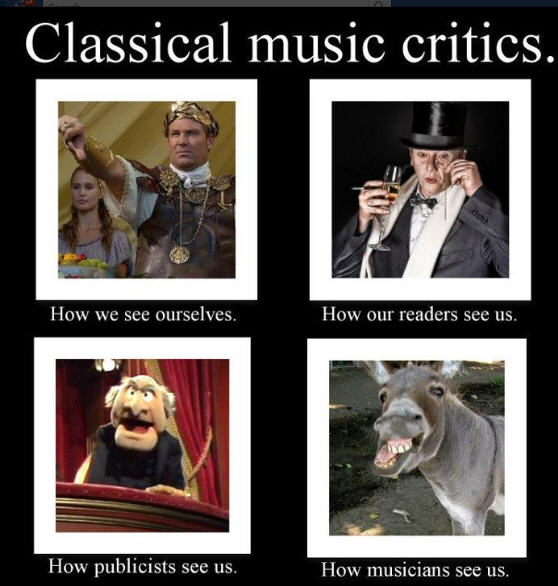
Reviews, and critics, are curious things. As Lisa Hirsch says on her blog ‘Iron Tongue of Midnight’, music reviews and music criticism serve the following purposes:
- Journalistic: recording what happened and when and by which musicians
- Opinion: recording a critic’s opinion (we hope a highly informed opinion) of what happened
- Contextual: placing what happened within some historical and musical context
- Preservation: enabling people in the far future to get a look at what happened, why, and the impression it made
Good reviews don’t make personal comments on the performer (recall the storm around the very negative comments about the physical appearance of singer Tara Erraught), nor allow the writer’s personal taste to rule the review (i.e. reviewers shouldn’t give a negative review just because they don’t like a particular composer or work: they should be able to put aside such likes or dislikes to offer an objective comment on the performance). Good reviews offer the writer’s considered opinion of the concert: was it effective and did it work? Which parts stood out, which did not? But at the end of the day, a review is one person’s view on someone else’s interpretation.
Some years ago I attended a concert of music by Musorgsky and Liszt by Georgian pianist Khatia Buniatishvili at London’s Wigmore Hall. For many members of the audience, and some critics it was a coruscating display of imaginative and risk-taking pianism, the Liszt pieces in particular performed with the kind of vertiginous virtuosity which Liszt himself may well have approved of. One critic didn’t like the concert, describing the playing as “rash” and “immature” and ended his review with the comment “on the question of whether Buniatishvili can ever be a serious artist, the jury is very much still out” (full review here). A few days later, Khatia Buniatishvili responded to this review with some remarks on her personal interpretation of the pieces (read her response here)
Ms Buniatishvili’s detractor in ‘The Guardian’ had just as much right to give her three stars as ‘The Evening Standard’ critic did in awarding her five stars. And she had every right to reply to her detractor. But I wonder whether such a rebuttal serves any real purpose in the great scheme of things. An international artist like Khatia Buniatishvili will play many concerts in many cities across the world and be heard by many hundreds of people, some of whom are critics and reviewers. A single concert is just a day in the life, and a single negative review is unlikely to make or break an artist.
The violinist Patricia Kopatchinskaja had, for awhile, her own way of dealing with negative reviews. One page of her website was a ‘trashcan’ for negative reviews through which she responded to factual errors and rebuked lapses of taste. She also demanded to know who – herself or the critic – had spent longer studying the score or living with the composer.
Some artists simply don’t bother to read their reviews, and some have agents, managers, mentors and partners who filter the reviews. Performers have to have the courage of their convictions, to get up on stage day in day out and give concerts without worrying unduly what reviewers and critics are going to say. Fundamentally, concerts are about sharing music and entertaining the audience, not playing to please the critics. Without an audience, there would be no concerts (and without concerts, there would be fewer reviewers!).
An informal poll amongst the musical/journalistic community with whom I interact online revealed that most performers felt responding to reviews was a waste of time and that one should hold one’s head high and move on. The only time when a response may be justified is if the review contains inaccuracies or comments which can be construed as slanderous or unduly personal, or where the reviewer has made assumptions about the performer’s lack of form without proper justification or being in possession of all the facts (for example, if the performer is ill, but no announcement is made ahead of the concert). For the purposes of this debate, I am quoting some of the comments by colleagues (musicians and critics/reviewers):
“the dynamic in all this has changed substantially with social media. The critic makes a public statement and the artist can, if he or she so wishes, make a public statement back without having to do anything as cumbersome as, say, write an open letter. These days, artists, both talented and less talented, can succeed by simply getting the public behind them without any help from PRs and record companies.”
This is a good point: social media has had a huge impact on the way artists and performances are received, and has “democractised” reviewing: everyone can be a critic or reviewer these days, with tweets and Facebook/YouTube “likes”
“this whole issue goes round and round and round and round. There are critics. Some are good, some not so good. Some are helpful, some not. Some, sometimes, offend intentionally or otherwise. All get it wrong sometimes, some more than others. But better to be written about than ignored. So there are critics.”
“I have only once responded to a critic. And that is because he was inaccurate and commented on a discography which doesn’t exist. Beyond that, I just play and don’t give a flying duck what anyone thinks – I’ve been at a piano since I was a toddler and have earnt that right. Many/most critics have been to a certain mileage of performances and done a certain amount of reading/research and have an impressive general knowledge of all things musical. They have earnt the right to write. The best any of us can do is go to live concerts and make up our own minds” (a musician)
And a reviewer writes:
“When I review, I arrive at the concert wanting to enjoy it and assuming that the performer will give sincerely of their best. Intelligent listening will always find flaws as well as good things, and it’s dishonest to misrepresent the experience; but there are ways of phrasing this – and still keeping it lively and readable (the critic has as much of an obligation to their audience as the performer has to theirs). I’ll only hand down a slating if I detect actual cynicism.”
I return to my earlier comment: a review is just one person’s opinion and is neither right nor wrong. Confident artists know this and are able to move on from a negative review, looking ahead to the next concert. And some artists will always divide critics…..






 The Cross-Eyed Pianist