jackwhite1

Who or what inspired you to take up composing, and pursue a career in music?

My parents and especially my granddad have always been very supportive and encouraging. My granddad always wanted to be able to play the piano and compose, but he wasn’t offered any opportunities to learn when he was younger. I think that’s what drove him to encourage me: he saw that I enjoyed it, and made sure I took all the opportunities I could.

Who or what were the most significant influences on your musical life and career as a composer?

It may sound obvious, but my parents. I couldn’t have been offered the opportunities I have been today without their help and support.

What have been the greatest challenges/frustrations of your career so far?

I think it’s important to learn how to fail ‘productively’. As a freelance composer you are never going to get every single opportunity you put yourself forward for. It’s important to try and remain positive. Take criticism on board where you think it’s fair, but remember that your music should ultimately be defined by you. There have been times when I have felt it was right to reject criticism. Knowing when to do this can be tricky to navigate when you’re starting out.

With every performance you get better at communicating the music in your mind’s ear to an audience. This process is a very personal one. It operates on many levels between transcription and translation. No-one can tell you whether it has been successful other than yourself. Do not be too self-critical when you make a mistake, because that’s how you learn.

What are the special challenges/pleasures of working on a commissioned piece?

It’s great when you can shape a piece around a specific group. I always try to feed off the energy and enthusiasm of an ensemble when I write.

What have been your favourite aspects of working with London Music Masters as part of your award over the last year?

I think the performance of my piece “Flutter” in Festival Hall was very exciting.  I loved seeing the faces of the children after they had performed the piece, they looked like they had enjoyed performing it, and that was very satisfying for me.

Can you tell me a little bit more about how the piece came about?

I had the idea of using pieces of foil on the strings, to make the piece a bit more fun for the very young performers.  This came from the idea of music’s transformative power which has the possibility to effect change in people’s lives. The piece was written for beginner string players and a choir, so this idea became part of the chorus: “Music is a butterfly, filling the air with something you can’t buy, because
it makes my heart-beat flutter”.

What feedback did you receive from the piece?

Well it was lovely to hear that the piece had been well received by the LMM teachers who said that it was aimed at just the right level without being too simplistic.  I also had a few parents come up to me to thank me after the concert. One mother said that her child had been singing it all the time, so I apologised as you may expect!   When I was writing it I structured the whole piece around the simplest part (just using open strings) and built it up from there. I think this approach worked well rather than taking the hardest part and working back.

You’ve also been writing for a YCAT artist as part of the award, can you tell us who it is yet?

Yes, it’s the trombonist Peter Moore.  I was very excited to have the opportunity to write for such a talented performer.

What have you written for him?

The piece is called ‘Three After-Dinner Pieces’.  It’s in three movement and each is based on a different type of cheese.

Cheese? Tell us more about this….

I am a big fan of cheese in all it’s different variety.  I work part time in a cheese shop in Cardiff called “Madame Fromage” and I thought it would be a unique way of structuring a piece. My ideas have come both from the physical form and taste of the cheese, and its country of origin. For example, in the first movement (Stilton) the mouldy striation reminded me of unsynchronised fanfares, which have become part of the texture of the work. Similarly the viscosity of Epoisses has allowed an exploration of glissandi effects in the trombone part.

Which cheeses did you select for your piece?

Stilton, Caerphilly and Epoisses, the last of these being my favourite.

Are you pleased with the piece?

Yes, I haven’t written for the trombone as a solo instrument before, and Peter is such an excellent performer with an amazing expressive range that I wanted to write something to show this off.  I will be looking forward to the premiere very much.

When is the premiere and where will it be performed after that?

27th September in Colston Hall, Bristol, with the first London performance on October 3rd, in Wigmore Hall. I am also lucky to be able to conduct some workshops around this performance in association with LMM. We will be visiting schools to talk about the writing of the piece.

What are you working on at the moment?

I have been commissioned to arrange a recording of Satie’s “Parade” for National Dance Wales, in a performance about the Russian revolution.  BBC NOW are recording the piece in early September so I will have my work cut out for me to get everything ready in time for the performances on 25th Oct in Wales Millennium Centre, Cardiff and the 29th in Pontio, Bangor.


Of which works are you most proud?

I love the recording of my BBCSO orchestral piece ‘Digital Dust’. Also, the multi-part choral piece ‘Islands (Ynysoedd)’ I wrote for what became a celebration of Sir John Tavener’s life in Southwark Cathedral, following his death. More recently I wrote a piece for Côr Aduniad called ‘We Have No Right To The Stars’. This is a translation of a poem by Hedd Wyn, and I think it’s one of my favourite choral settings to date.

How would you characterise your compositional language?

I like to describe my style as emotional and accessible. When I was first getting inspired by music I used to get the ‘tingle factor’ (when the hairs on the back of your neck used to stand up) when I listened to music I loved. I have tried to find a compositional language which allows others to feel a strong emotional attachment to my work.

How do you work?

I like to write straight into the computer if I am working on a piece. I usually work at a piano to sketch ideas, and when I am happy with them, notate them straight away.

Who are your favourite musicians/composers?

Kaija Saariaho, Jonathan Harvey, Michael Tippett, John Tavener, Benjamin Britten, Tori Amos, Björk.

What is your most memorable concert experience?

I can’t remember the exact details but I watched Vaughan Williams’ ‘Fantasia on a Theme by Thomas Tallis’ when I was very young. I can remember the music having a profound impact upon me.

What do you consider to be the most important ideas and concepts to impart to aspiring musicians?

Learning how to listen is probably the most important part of becoming a musician. It takes time to develop and is fundamental to your success in all areas of the business.

Where would you like to be in 10 years’ time?

In a studio which would make Hans Zimmer jealous!

What is your idea of perfect happiness?

Being truly grateful for everything you have.

What is your most treasured possession?

My piano.

What do you enjoy doing most?

Laughing.

What is your present state of mind?

Upbeat.


Jack White studied music at Somerville College, Oxford.  His postgraduate studies have been undertaken solely at Cardiff University where he has recently finished his PhD in composition.  His research interests are in electroacoustic composition and the combination of this media with traditional ensembles in ‘live’ performance.  He is also interested in the scoring methods used by electroacoustic composers and the relationship between such methods and a work’s identity.

Jack White is the recent recipient of a London Music Masters award

Jack White’s website


5f3e69_e385f87332164cdbbb4075d6aa12adf3

Who or what inspired you to take up conducting, and pursue a career in music?

My journey into conducting was slightly unusual: I became interested in music ‘accidentally ‘ aged around 10, thanks to some Sibelius and Beethoven on vinyl, and the only classic music in my parents’ collection. No music was made at home, no family member encouraged it, I was just fascinated. A neighbour heard I was interested and offered me free trombone lessons as he had been a professional, so that instrument became my first outlet. I just knew I wanted to conduct too, and put on a charity concert aged 16 (Fauré Requiem), then gained a place to study trombone at the RAM. I played in orchestras, early music ensembles, theatre and chamber groups until my early 30’s when conducting took over, thanks to a Junior Fellowship at Trinity Laban Conservatoire, funded and appointed by Sir Charles Mackerras. This is the short version! But perhaps differently to a number of others in my profession, I didn’t formally study conducting, and I didn’t do an undergrad at Oxbridge. That would have been nice.

Who or what have been the most important influences on your musical life and career?

People who have supported me over the years include Sir Charles Mackerras, and the composers Matthew Taylor and James Francis Brown. Each have done so in very different ways, but each have inspired me through their all-consuming passion for music, their artistic integrity, and (perhaps more important than anything else) simple ‘gestures of friendship’. Also, outside of the purely music world the theatre director Peter Avery, who has opened my eyes to so many things about performance, art and life in general.

In terms of musical influences, I feel I am still discovering them day by day. In terms of interpretation I have been fascinated by many involved with ‘historically informed practices’, such as Harnoncourt, Mackerras, Herreweghe etc. More recently I have observed fascinating work being done by Sakari Oramo and Ivan Fischer, who seem to have no fear about introducing imagination and experimentation into their work with the exceptional musicians they lead: The Budapest Festival Orchestra’s appearance at the Southbank centre earlier this year may just have been the best concert-going experience of my life – despite my not agreeing with some of the interpretation! The sense of engagement in their performance, and the generosity with which they delivered the music, was just exceptional.

In the recorded sphere, I have noticed how many times I listen to Sir Neville Marriner and feel he has hit tempi spot-on. Also listening and watching online, Andrew Manze seems to offer fascinating perspectives: I want to get to one of his live performances now.

I have also been hugely inspired by people I have seen combining what I loosely call ‘theatre pratices’ with stunning all-round musicianship: I have watched them work utter magic on younger people at the Ingenium Academy Summer School (an International Summer School for musicians held in Winchester). There have been many, but those I have worked with more closely include Matthew Sharp and Dominic Peckham. I think their styles are the future of music education, frankly.

An unexpected inspiration has also come through my work in Palestine with the Edward Said National Conservatory of Music and Palestine Youth Orchestra: My eyes have been opened not only to the reality of the Palestine – Israel conflict, but also how much we can assume here in the West that we ‘own’ classical music. Wait until you hear these guys play….

What have been the greatest challenges of your career so far?

Trying to swap from one genre (playing) to another (conducting) in a profession where people pigeon-hole each other mercilessly. What on earth would I know about string playing, for example?! And working with non-professionals and youth orchestras as often as I do, I know that others will assume that my approach wouldn’t transfer into working with established professional ensembles.

Also something I have only realised relatively recently , which is that conducting appears to be quite an upper/upper-middle class business. I’m state educated, from the West Midlands and don’t have family connections in music, arts management or banking. People talk a lot about how being female is a barrier to becoming a conductor, but actually I think there’s a much greater demographic/class barrier in the way.

Which performances are you most proud of?

A number with my ensemble sound collective: A performance of Britten’s Serenade for tenor, horn and strings in 2014 at the Little Missenden Festival with Robert Murray lingers in the memory, also world and London premières of music by Matthew Taylor – most recently his Concerto for Flute and Orchestra with Daniel Pailthorpe; a UK première of a super-funky overture by Carl Nielsen Amor øg Digteren (with Sinfonia Tamesa) and the first performances of a secular oratorio by Rachel Stott about William Blake, Companion of Angels.

I have been quite proud of performances of Sibelius Symphony No.7 with Sinfonia Tamesa, Beethoven’s Eroica with sound collective and the Fifth Symphony with the Palestine Youth Orchestra. Just a few weeks ago I was privileged to accompany cellist Matthew Sharp and the Hertford Symphony Orchestra in an extraordinary performance of the Dvorák concerto.  I’m not sure the roof is back on the concert hall yet.

As well as the above, projects that stand out for different reasons include a production of Kurt Weill’s Die Dreigroschenoper in London and Berlin with a cast of over 60’s who had never sung before in public, and an outreach project with sound collective in Somerset, where teenagers composed companion pieces to Stravinsky’s The Soldiers Tale.

Which particular works do you think you perform best?

I think my main strength lies in conducting symphonic repertoire. Sibelius, Beethoven, Brahms, Nielsen and Dvorák – with Schumann in development at the moment – are all composers with whom I feel a great affinity. I try very hard to get close to what they intended, and pray I can spend the rest of my life doing so. I also love tone poems with a solid narrative; Tschaik Romeo & Juliet, Sibelius Pohjola’s Daughter… That sort of dramatic, fantastical stuff!

How do you make your repertoire choices from season to season?

There are so many variables in the business of programming, from soloists you want to work with through to acknowledging composer anniversaries. I find myself now working two years ahead to ensure I have enough time to properly think, and properly research new ideas.Sadly, money comes into it too: Late Romantic and 20th century works are often expensive, with music hire and PRS to consider but also all those wonderful colourful instruments that cost a bomb, such as percussion, harp, celeste, vibraphone…and if that piece isn’t some form of guaranteed box office winner, you can be in real trouble. In a conversation with someone recently who was railing about the conservative programming that’s prevalent and  the need for the classical music business to take up an alternative approach to programming, I felt it appropriate to (slightly misquote) Bill Clinton’s election campaign strategist in 1992: It’s the economy, stupid.One thing I try to do is ensure each season has a balance with music that is new to me, and if possible something brand-new. I also try to ensure that I have allowed nothing onto programmes that I don’t have huge enthusiasm for – it’s absolutely fatal for conductors to end up rehearsing and performing music that means nothing to them. It never goes well when that happens, believe me.

Do you have a favourite concert venue to perform in and why?

Symphony Hall in Birmingham is a fabulous space which, as huge as it is, feels intimate and warm to perform in. I’d also like to return to the Philharmomie in Luxembourg and Vienna’s Musikverein as a conductor, having loved playing in both halls.

Favourite pieces to perform? Listen to?

There isn’t much to beat a Beethoven Symphony in terms of energy, drive and sheer joy in performance. Also Sibelius. I would love to do more opera in the future, having got a huge emotional kick out of Poulenc’s Dialogues des Carmélites, Puccini’s La bohème and Stravinsky’s The Rake’s Progress when I had chance to conduct them.To listen to….I really couldn’t choose a one single ‘Desert Island disc’, so as a cop out I think the music I no longer get the chance to perform: Bach, Monteverdi, Gabrieli.

Who are your favourite musicians?

The ones who genuinely care, and who genuinely put themselves last and the music first. You won’t that find many out there, but they do exist.

What is your most memorable concert experience?

It’s hard to choose as performances come with so many different aspects – the music, the perfomers, the venue, and of course those rare ones where something magical occurs and everyone just feels it.But (also with a really driven and energetic Beethoven 5 during the concert as a part of the memory) I don’t think I will ever forget giving a concert with the Palestine Youth Orchestra in Amman, Jordan, during the Gaza conflict of 2014. The concert was given in aid of the Edward Said music school in Gaza, and afterwards I was interviewed by Gaza Television, who asked me to send a message to the people there who had watched the concert….I forget now what I actually said, but I do remember thinking any words could not have conveyed the humanity inside Beethoven’s music.

What do you consider to be the most important ideas and concepts to impart to aspiring musicians?

  • Sing
  • Read books around your subject, such as history and literature (conductors)
  • Sing first, practice second (instrumentalists, conductors)
  • Ignore the cynicism which is so prevalent and easy to join in with’ but be realistic about what you can achieve in non-commercial music, unless you have a private income
  • Sing
  • Don’t work for less than you know you should – you devalue it for everyone else as well as yourself when you do
  • Understand how harmony works
  • Do some more singing

Tom Hammond is Co-Artistic Director of the Hertfordshire Festival of Music. Further details here

Appointed by Sir Charles Mackerras as the first Junior Fellow in conducting at Trinity Laban Conservatoire, Tom Hammond has  developed a rich and musically diverse career that encompasses working with top-flight  professionals, youth orchestras, non-professionals, and devising and leading education and outreach projects. 

Winning awards and critical acclaim en route, Tom has built a reputation for developing ensembles musically and artistically, whilst encouraging thoughtful programming, championing new music and developing relationships with outstanding soloists. In 2011 Tom was appointed an Associate of the Royal Academy of Music, in recognition of his achievements in conducting.

Tom Hammond is Artistic Director of sound collective, Music Director of Sinfonia Tamesa, the Essex Symphony Orchestra and the Hertford Symphony Orchestra, a Principal Conductor at the Ingenium Academy International Summer School, Guest Conductor of the Palestine Youth Orchestra, and Principal Conductor and Music Director of the Yorkshire Young Sinfonia.

Soloists with whom Tom has collaborated include Øystein Baadsvik, Philippa Barton, Dimi Bawab, Richard Birchall, Jonathan Byers, Simon Callaghan, Jonathan Dormand, Sadie Fields, Susana Gaspar, Christopher Guild, Amy Green, Emma Halnan, Pamela Hay, Anna Harvey, Fenella Humphreys, Boyan Ivanov, Matthew Jones, Amanda Lake, David le Page, James Mainwaring, Elisabeth Meister, Robert Murray, Mohamed Najem, Daniel Pailthorpe, Olivia Ray, Catriona Scott, Alicja Smietana, Veronika Shoot, William Stafford, Matthew Sharp, Reem Talhami and Andrew Zolinsky.

www.tom-hammond.org.uk

Twitter : @tomhammond music


11

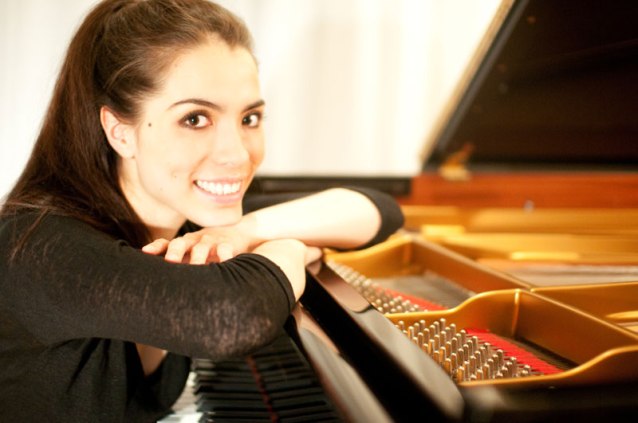
Who or what inspired you to take up the piano and make it your career? 

There are no musicians in my family but we always had a piano at home (my mother played as a hobby pianist) and my older sister was also having lessons, so I started playing as soon as I could climb onto a piano stool. I didn’t decide to become a professional pianist until quite late – I was 16 when I was in professional environment for the first time at Chetham’s School of Music and knew this was what I wanted to do for the rest of my life.

Who or what were the most important influences on your musical life and career?

My most important influence in my musical life was definitely my time at the Royal College of Music. I really feel that I met many of the most important people in my life today there and that I found myself as musician, pianist and person in the seven years I studied at the RCM for.

What have been the greatest challenges of your career so far? 

I think the greatest ongoing challenge for a musician is to be able to accept that each piece of music you choose to play is a life-long work. You will never be entirely content with what you have achieved at the time or when you come off stage. You always strive for something better – but in a way, it’s also the beauty of music making.

Which performances/recordings are you most proud of? 

My debut album for the label KNS Classical is very exciting. I recorded a disc with two major works by Schumann (Sonata No.3 and ‘Davidsbündlertänze’) which are both very special to me.

Which particular works do you think you play best? 

I can identify myself most with the German Romantic repertoire. I always felt that the music by Brahms and Schumann were very innate in me. But I also enjoy playing many works by Liszt and much of the Russian repertoire. I have been able to explore much of this with my professor and long-term mentor Dmitri Alexeev.

How do you make your repertoire choices from season to season? 

I tend to have long-term projects for the next few years and I usually combine these with my current interests. I always think that coherence or an inner connection of works in a recital programme is very important.

Do you have a favourite concert venue to perform in and why? 

I don’t necessarily have one favourite concert hall but one of my favourites is definitely the Laeiszhalle in Hamburg. It’s a beautiful hall with a wonderful acoustic and it brings back great memories as Hamburg is the city where I spent most of my childhood.

Favourite pieces to perform? Listen to? 

Currently works by Schumann and Rachmaninov’s Second Piano Concerto. I always love working on every programme I choose for each season. For listening it’s perhaps slightly different – I tend not to listen to that much piano music. I mainly listen to orchestral and chamber music and operas. I do occasionally enjoy listening to Jazz as well.

Who are your favourite musicians? 

Many great artists from the past have given me much inspiration over the years, it’s impossible to list all of them but there are a few that I would single out: Furtwängler, Edwin Fischer, Sofronitsky, Kempff to name a few.

What is your most memorable concert experience? 

The most memorable concert I have experienced was a piano recital by Radu Lupu in Brighton where his rendition of Schubert’s Sonata in A D959 was beyond description..…

What do you consider to be the most important ideas and concepts to impart to aspiring musicians?

First and foremost, to choose music as a career for the right reasons – one must love music to the extend that you could not live without it. Being creative, imaginative and respectful towards the music you are playing.

Where would you like to be in 10 years’ time? 

Having the freedom to combine concertizing, teaching and family life.

What is your idea of perfect happiness? 

To lead a harmonious life where I can enjoy music and family life to the full.


Caterina Grewe’s debut solo album of piano music by Robert Schumann is available now on the KNS Classical label. More information

German-Japanese Pianist Caterina Grewe, born in Tokyo in April 1988, has performed to great critical acclaim throughout the UK and continental Europe as a Steinway Artist.

More about Caterina here

218-colour-hi-res-steven-osborne-may13-c-b-ealovega-web-profile-740x410
(Photo Benjamin Ealovega)

Who or what inspired you to take up the piano and pursue a career in music?

There was a piano in the house and as soon as I could reach the keyboard, I was mucking about on it. I was very, very drawn to it and spent every spare minute playing it. I didn’t sleep much as a kid and I would get up very early and go straight to the piano, and my dad would come down and tell me it was too early to be playing.

I didn’t really think in terms of planning any kind of career. I loved playing piano, I went to music college, won a competition and secured a few concerts and it kind of started from there – I was very lucky with that. But there was always a very visceral attachment to the piano.

Who or what have been the most important influences on your musical life and career?

There have been a few:

One would certainly be Ian Kemp, my tutor at university. His way of looking at music, at analysing it, was so passionate in an understated way. He went right to the essence of music

Richard Beauchamp, my piano teacher at St Mary’s School in Edinburgh, was very musically opened-minded

Renna Kellaway, my teacher at RNCM, gave me a real grounding in technique which was lacking before

Arnaldo Cohen – he was very influential. He had a way of looking at the smallest detail in the broadest scope

Bobby Mann of the Juilliard Quartet and chairman of Naumburg Competition, which I won in 1997. He was a musical guru without particularly trying to be. But he could make a single remark to me after a concert and that would form the basis of several years of exploration for me. He could put his finger on the absolute nub of an issue.

How do you make your repertoire choices from season to season

It tends to be based on an instinct of what I am desperate to learn next. Happily, the repertoire being so big, you don’t have to retread old ground if you don’t want to, so I’ve always been moving on to new things.

In fact, in the last few months this has been the first time I’ve actually had to think what I want to play. It’s also driven by recordings – what am I dying to do.

Are there any composers whose music you keep returning to?

Definitely Beethoven, Rachmaninov and Ravel. Beethoven has this incredible balance of very strong structure and an extremely wild spontaneity which breaks out of structure. How he keeps those things in balance, especially in the mid to late works, I find unbelievably satisfying

Rachmaninov’s completely visceral connection to the music, in terms of how he expresses things that really no one else quite does, how open he is to his own emotions

What attracted you to the music of George Crumb and Morton Feldman, and what is the particular appeal of this music for you?

I first heard George Crumb’s ‘Black Angels’ while I was at school and I was quite amazed by the variety of character, the craziness of it, the bizarre sound effects: I found it really compelling. There’s the sense that he is really interested in character, with a complexity which never seems gratuitous. Later I came across his piano music. I love the soundworld, the sense of atmosphere. He talks about growing up in west Virginia and the atmosphere of being in the forest – the birds and other sounds.

Rather often composers towards end of 20th century are showing off their wares, especially in the 60s and 70s, and it’s refreshing to find someone who is interested purely in sound, that visceral quality of sound

Morton Feldman’s music is very ambiguous. I first came across it when Ivan Volkov told me he’d heard ‘Palais de Mari’ played in one of his festivals. I found it very interesting, and I loved it. It’s a really really beautiful piece of music.

It’s a very extreme position that he takes on music – like John Cage – that the notes aren’t that important, but it’s the moment to moment experience of the notes, letting go of that self-satisfaction that exists around some music. It strikes me that there is maybe a philosophical paradox to really do that – even though you might be able to encourage people to lose the sense of where they are

Will you perform the Feldman from memory?

Oh no! Absolutely not! I don’t memorise music like that because it’s so much trouble and it seems like a needless waste of energy, and I really don’t think it adds anything to play it from memory. There is this obsession about memorisation for pianists, but increasingly I don’t bother if I don’t think it’s necessary. It’s so insignificant in the great scheme of things

What do you consider to be the most important ideas and concepts to impart to aspiring musicians?

The big thing is to enjoy it, to play music that you love, not to feel pushed into playing music that doesn’t suit you. Choose music that you really love playing, not because a teacher has told you to learn it.

It can take a while to discover what you really want to do. A lot of people in the profession lose that love for the music, so anything you can do to guard against is important.

Steven Osborne’s standing as one of the great pianists of his generation was publicly affirmed in 2013 with two major awards: The Royal Philharmonic Society Instrumentalist of the Year and his second Gramophone Award, this time in the Instrumental category for his recording of Mussorgsky Pictures at an Exhibition and solo works by Prokofiev. Previous awards include a 2009 Gramophone Award for his recording of Britten’s works for piano and orchestra, as well as first prize at both the Naumburg International Competition (New York) and Clara Haskil Competition.

www.stevenosborne.co.uk

(Interview date: 2nd May 2016)