Who or what inspired you to take up your chosen instrument, and pursue a career in music?

I remember being fascinated by the piano in my grandmother’s house, and this led to my mother teaching me to read music at the age of three.I do not remember,as a child, hearing much music, none of my friends played an instrument, but I remember my grandmother played by ear, and sang music-hall songs to me, which I loved. They must have embedded themselves deep in my memory, as I still remember many of these, including all the words!

One strange memory stands out. My mother, before her marriage, had worked in the office of a local chemist, a Mr. Lester, of whom she spoke occasionally, with the greatest respect and admiration. I had never met this gentleman before, but on one memorable occasion I was taken, by my mother, to visit him at his home. He possessed a fine gramophone, and played me some of his precious 78rpm records. I was about 6 years old at the time. Two recordings stand out in my memory. One was the Grieg piano concerto, which I was hearing for the first time. It made a tremendous impression on me, and I determined that I would one day perform it,(which I did.) The second recording was an odd choice to play to a child, but I was overwhelmed. It was Kirsten Flagstad singing Sibelius songs, and it was one of the most powerful musical experiences of my life. I had never heard anything like it, the powerful intensity of this magnificent voice, and the vivid colours of this unfamiliar music made a huge impression on me. I never saw Mr. Lester again, but he brought magic into my life.

And when I gave my first public performance, at the age of seven, the feeling of engaging with an audience , and sharing  this magical world of music was so exhilarating,that I knew, without a doubt, that I wanted to be a pianist.

Further motivation and inspiration came from my repeated reading of ‘Prelude’,a book based on the early life of Eileen Joyce, who was arguably the most famous concert pianist at that time in Britain. I was captivated by this highly romanticised account of a child from a very ordinary background being swept into the extraordinary and exciting world of music. I devoured the stories of her inspiring lessons with eminent European teachers, and the manic regimes of practising, which all culminated in a dazzling career. It was heady stuff, and I became even more determined to enter this fascinating world myself one day.

I was taken to hear Eileen Joyce play on one  occasion by a family friend, who took me backstage afterwards to meet this glamorous superstar of the classical music world. I remember her gorgeous frocks, and, in marked contrast, her workmanlike hands. As she shook my hand, I remember being struck by their immense power.

Who or what have been the most important influences on your musical life and career?

The first time I heard a great pianist in recital was in my early teens, when I I attended a Sunday afternoon concert given by Artur Rubinstein at the Royal Festival Hall. I was mesmerised by the sheer joy and freedom of his playing. This represented the ideal of piano playing that I would, from then on, aspire to.

At the age of seventeen I began my studies at the Royal Academy of Music, where my teacher was Vivian Langrish, who had been a student of Tobias Mattay, alongside Myra Hess. He taught me the importance of sound quality and variety of colour, and greatly expanded my tonal range. Also, while a student, I played for many singers, and was hugely influenced by the great singing teacher, Flora Nielsen, who first revealed the wonders of French song to me, opening the door to the exquisite music of Debussy and Faure in particular.

But I think the greatest inspiration and influence on my playing came from two violinists, the remarkable Hungarian violin professor, Bela Katona, and the legendary violinist Nathan Milstein.

Bela had the most extraordinary ability to reveal the inner life and structure of the music, while at the same time demanding a meticulous attention to detail.

One of the greatest experiences of my life was playing with Nathan Milstein. Every rehearsal was a lesson with a great master. He would demonstrate on the violin what he wanted me to do on the piano. I learnt so much just trying to develop my touch to match his attack on the string, and the freedom of his bow arm to make the gestures of the music. It was awe-inspiring. And throughout, there was always his insistence on the vital importance of the bass line. I learned to focus my attention on a fully independent and fully present and vital bass line, which underpins everything.

Finally, I must acknowledge the influence of jazz, in particular, great jazz pianists, most notably Oscar Peterson Bill Evans and Erroll Garner. From first hearing jazz in my early teens, I knew that I wanted to play classical music with the freedom, spontaneity and immediacy of these artists. This is still my ideal.

What have been the greatest challenges of your life so far?

One’s life as a musician is a continuous, never-ending series of challenges, and it is in meeting these challenges that one develops. But two huge personal challenges stand out for me.

The first was a very serious illness at the age of 28, when , quite suddenly, all my joints, right down to fingers and toes, seized up, and I became completely immobilised. I spent some weeks in hospital, where the doctors were completely baffled, and considered that I would never walk again, and certainly never play the piano. Eventually, however, slowly and painfully, movement returned, curiously, one joint at a time. The fingers were the last to return, taking several months. I gradually eased back into playing again, finding my way back gently into professional work by doing a little accompanying, and then duo playing and chamber music, as my strength returned. I did not return to solo playing in public, as, due to my illness, I had developed severe anxiety about performing from memory. I was now teaching at the Royal Academy of Music, and was also invited to teach at TrinityCollege, and to establish an ensemble class there. Thus I found myself enjoying a thriving and fulfilling career, performing and teaching, which continued over the following three decades.

And then, shortly after my 60th birthday, came my second huge challenge, when I lost most of my sight, due to haemorages behind the retinas of both eyes. It was extraordinary timing, as, just four years earlier, I had begun training in NLP, ( Neuro-Linguistic-Programming), during which, using one of the very powerful processes we were being taught, I succeeded in eliminating my memory anxiety. I had been looking forward to performing solo again when this new catastrophe struck. Recitals had already been booked, and these, of course, now had to be postponed, while I adjusted to a new, and frightening reality, but I knew that, although I had to give up all ensemble playing due to my severely impaired sight, I would be able to perform solo, from memory. Now there were new challenges, but my desire to continue to play carried me through, and again, I rebuilt my strength and my career, with the support of my wonderful husband Ian, and an amazingly loyal and devoted group of ex-students, who had become wonderful friends over the years.

Which performances/recordings are you most proud of?

My last CD , of solo piano music by Fauré, and the previously-released disc of music by Saint-Saens.

Which particular works do you think you play best?

I think that is for others to express their opinions. During the past few years I have felt a particular affinity with the music of Chopin, Fauré, Debussy and Ravel.

How do you make your repertoire choices from season to season?

I allow ideas, or the desire to play particular works, to come to me, and then I play around with them, experimenting, until they come together to form programmes. It’s a creative process.

Do you have a favourite concert venue to perform in and why?

The Holywell Music Room, Oxford. It has special personal memories for me, and I love its intimacy and unique history.

Who are your favourite musicians?

Gyorgy Cziffra, Dinu Lipatti, Clara Haskil, Vladimir Horowitz, Claudio Arrau, Emil Gilles, Artur Rubinstein, Marta Argerich, Nathan Milstein, Beaux Arts Trio.

Jazz pianists, Erroll Garner, Oscar Peterson, Bill Evans.

What is your most memorable concert experience?

My most memorable concert experience was when I performed in the Memorial concert for John Bingham In 2005, at Blackheath Halls in London.

John was a wonderful pianist and a very special colleague and friend. We had met at Harold Craxton’s studio when we were both 16 years old, and entered the Royal Academy of Music together the following year as scholarship students. We resumed our friendship later when we were both teaching at Trinity College of Music.

At the same time as John was suffering his final illness, leading to his tragic and untimely death, I also had been ill, and had lost most of my sight. Despite my extreme physical weakness at that time, I felt compelled to volunteer to play at John’s memorial concert, such was the bond between us. I knew exactly what I should play— the Fourth Ballade of Chopin, a work which had been special to both of us since our student days.

This would be a momentous experience for me for another reason. As I have related earlier, I had not performed solo in public since a previous illness three decades earlier had left me unable to perform from memory in public. I also described how I had cured this anxiety, and was able to resume performing solo again. This performance at John’ s concert was to be my first solo appearance for more than thirty years. As the date for the concert drew near,  I became apprehensive, thinking how crazy I had been to volunteer, when I knew that, not only would I be performing alongside some very eminent musicians, but that the hall would be packed with many distinguished pianists and other highly respected members of the music profession.

The little sight I had left was also highly distorted at that time, so, on the day, before the concert, I practised finding my way to the piano, which, fortunately, was at ground level, with no treacherous stairs to negotiate.

When the time came for my entrance, the doors opened, and then the most extraordinary thing happened. As I tentatively began to walk forward, I found myself following the figure of a woman, who I instinctively knew was another version of myself. She was taller than me, with hair much darker and longer than mine, but I had no doubts as to her identity. And I suddenly felt quite confident, knowing that she would lead me safely to the piano. As I sat down on the stool, I sensed her sitting down by my side, ( although there was no actual chair there.) I felt entirely at ease, and as I played the opening bars I felt her gradually drift away. I felt inspired, with a sense that all was well, and the music seemed to play itself. Afterwards I received a wonderful ovation from the audience, and I knew that this  was a turning point in my life. I have no explanation to offer, but assumed that my mysterious guide must have been a kind of doppelgänger.

As a musician, what is hour definition of success?

For me, success is when I experience the sense of being ‘in the flow’ in a performance, truly in the moment, being at one with myself, with the music and the audience, in a kind of ‘magic loop’. The music seems to play itself. One cannot make this happen. One can only prepare meticulously, and in a way which creates the greatest potential for this to happen. Then, miraculously, sometimes the gods will smile on us!

What do you consider the most important ideas and concepts to impart to aspiring musicians?

Be curious, allow yourself to experiment.

Ask the question How?

Be kind to yourself.

Embrace uncertainty.

Do not strive for perfection, but follow your dreams, and move step by step towards your goals. Enjoy the journey. Remember that we ‘play’ a musical instrument!

What is your most treasured possession?

I have two. My beloved Steinway piano, and my beautiful Cornish Rex cat, Leo.

What is your present state of mind?

Curious.
Christine Croshaw’s recording of piano music by Gabriel Fauré is available now


Christine Croshaw has enjoyed a long and successful career as a solo pianist, accompanist and chamber music player.

Her concert engagements have taken her to most major venues around the U.K., including many appearances at the Wigmore Hall, Queen Elizabeth Hall and Purcell Room.

She has performed across the Continent in France, Germany, Austria, Spain, Portugal, Italy, Malta, Norway and Denmark, Finland, Poland and Switzerland, and also in North America. Festival appearances include Cheltenham, Lichfield, Kensington and Chelsea, Ludlow, Chichester, Lisbon, Bermuda and Taomina.

Read more

La and Leo – Christine’s Croshaw’s blog

Who or what inspired you to take up your chosen instrument, and pursue a career in music?

I remember being fascinated by the piano in my grandmother’s house, and this led to my mother teaching me to read music at the age of three. I do not remember, as a child, hearing much music, none of my friends played an instrument, but I remember my grandmother played by ear, and sang music-hall songs to me, which I loved. They must have embedded themselves deep in my memory, as I still remember many of these, including all the words!

One strange memory stands out. My mother, before her marriage, had worked in the office of a local chemist, a Mr. Lester, of whom she spoke occasionally, with the greatest respect and admiration. I had never met this gentleman before, but on one memorable occasion I was taken, by my mother, to visit him at his home. He possessed a fine gramophone, and played me some of his precious 78rpm records. I was about 6 years old at the time. Two recordings stand out in my memory. One was the Grieg piano concerto, which I was hearing for the first time. It made a tremendous impression on me, and I determined that I would one day perform it,(which I did.) The second recording was an odd choice to play to a child, but I was overwhelmed. It was Kirsten Flagstad singing Sibelius songs, and it was one of the most powerful musical experiences of my life. I had never heard anything like it, the powerful intensity of this magnificent voice, and the vivid colours of this unfamiliar music made a huge impression on me. I never saw Mr. Lester again, but he brought magic into my life.

And when I gave my first public performance, at the age of seven, the feeling of engaging with an audience, and sharing this magical world of music was so exhilarating, that I knew, without a doubt, that I wanted to be a pianist.

Further motivation and inspiration came from my repeated reading of ‘Prelude’,a book based on the early life of Eileen Joyce, who was arguably the most famous concert pianist at that time in Britain. I was captivated by this highly romanticised account of a child from a very ordinary background being swept into the extraordinary and exciting world of music. I devoured the stories of her inspiring lessons with eminent European teachers, and the manic regimes of practising, which all culminated in a dazzling career. It was heady stuff, and I became even more determined to enter this fascinating world myself one day.

I was taken to hear Eileen Joyce play on one  occasion by a family friend, who took me backstage afterwards to meet this glamorous superstar of the classical music world. I remember her gorgeous frocks, and, in marked contrast, her workmanlike hands. As she shook my hand, I remember being struck by their immense power.

Who or what have been the most important influences on your musical life and career?

The first time I heard a great pianist in recital was in my early teens, when I I attended a Sunday afternoon concert given by Artur Rubinstein at the Royal Festival Hall. I was mesmerised by the sheer joy and freedom of his playing. This represented the ideal of piano playing that I would, from then on, aspire to.

At the age of seventeen I began my studies at the Royal Academy of Music, where my teacher was Vivian Langrish, who had been a student of Tobias Mattay, alongside Myra Hess. He taught me the importance of sound quality and variety of colour, and greatly expanded my tonal range. Also, while a student, I played for many singers, and was hugely influenced by the great singing teacher, Flora Nielsen, who first revealed the wonders of French song to me, opening the door to the exquisite music of Debussy and Faure in particular.

But I think the greatest inspiration and influence on my playing came from two violinists, the remarkable Hungarian violin professor, Bela Katona, and the legendary violinist Nathan Milstein.

Bela had the most extraordinary ability to reveal the inner life and structure of the music, while at the same time demanding a meticulous attention to detail.

One of the greatest experiences of my life was playing with Nathan Milstein. Every rehearsal was a lesson with a great master. He would demonstrate on the violin what he wanted me to do on the piano. I learnt so much just trying to develop my touch to match his attack on the string, and the freedom of his bow arm to make the gestures of the music. It was awe-inspiring. And throughout, there was always his insistence on the vital importance of the bass line. I learned to focus my attention on a fully independent and fully present and vital bass line, which underpins everything.

Finally, I must acknowledge the influence of jazz, in particular, great jazz pianists, most notably Oscar Peterson Bill Evans and Erroll Garner. From first hearing jazz in my early teens, I knew that I wanted to play classical music with the freedom, spontaneity and immediacy of these artists. This is still my ideal.

What have been the greatest challenges of your life so far?

One’s life as a musician is a continuous, never-ending series of challenges, and it is in meeting these challenges that one develops. But two huge personal challenges stand out for me.

The first was a very serious illness at the age of 28, when , quite suddenly, all my joints, right down to fingers and toes, seized up, and I became completely immobilised. I spent some weeks in hospital, where the doctors were completely baffled, and considered that I would never walk again, and certainly never play the piano. Eventually, however, slowly and painfully, movement returned, curiously, one joint at a time. The fingers were the last to return, taking several months. I gradually eased back into playing again, finding my way back gently into professional work by doing a little accompanying, and then duo playing and chamber music, as my strength returned. I did not return to solo playing in public, as, due to my illness, I had developed severe anxiety about performing from memory. I was now teaching at the Royal Academy of Music, and was also invited to teach at Trinity College, and to establish an ensemble class there. Thus I found myself enjoying a thriving and fulfilling career, performing and teaching, which continued over the following three decades.

And then, shortly after my 60th birthday, came my second huge challenge, when I lost most of my sight, due to haemorages behind the retinas of both eyes. It was extraordinary timing, as, just four years earlier, I had begun training in NLP, ( Neuro-Linguistic-Programming), during which, using one of the very powerful processes we were being taught, I succeeded in eliminating my memory anxiety. I had been looking forward to performing solo again when this new catastrophe struck. Recitals had already been booked, and these, of course, now had to be postponed, while I adjusted to a new, and frightening reality, but I knew that, although I had to give up all ensemble playing due to my severely impaired sight, I would be able to perform solo, from memory. Now there were new challenges, but my desire to continue to play carried me through, and again, I rebuilt my strength and my career, with the support of my wonderful husband Ian, and an amazingly loyal and devoted group of ex-students, who had become wonderful friends over the years.

Which performances/recordings are you most proud of?

My last CD , of solo piano music by Fauré, and the previously-released disc of music by Saint-Saens.

Which particular works do you think you play best?

I think that is for others to express their opinions. During the past few years I have felt a particular affinity with the music of Chopin, Fauré, Debussy and Ravel.

How do you make your repertoire choices from season to season?

I allow ideas, or the desire to play particular works, to come to me, and then I play around with them, experimenting, until they come together to form programmes. It’s a creative process.

Do you have a favourite concert venue to perform in and why?

The Holywell Music Room, Oxford. It has special personal memories for me, and I love its intimacy and unique history.

Who are your favourite musicians?

Gyorgy Cziffra, Dinu Lipatti, Clara Haskil, Vladimir Horowitz, Claudio Arrau, Emil Gilels, Artur Rubinstein, Martha Argerich, Nathan Milstein, the Beaux Arts Trio.

Jazz pianists: Erroll Garner, Oscar Peterson, Bill Evans.

What is your most memorable concert experience?

My most memorable concert experience was when I performed in the Memorial concert for John Bingham in 2005, at Blackheath Halls in London. John was a wonderful pianist and a very special colleague and friend. We had met at Harold Craxton’s studio when we were both 16 years old, and entered the Royal Academy of Music together the following year as scholarship students. We resumed our friendship later when we were both teaching at Trinity College of Music.

At the same time as John was suffering his final illness, leading to his tragic and untimely death, I also had been ill, and had lost most of my sight. Despite my extreme physical weakness at that time, I felt compelled to volunteer to play at John’s memorial concert, such was the bond between us. I knew exactly what I should play— the Fourth Ballade of Chopin, a work which had been special to both of us since our student days.

This would be a momentous experience for me for another reason. As I have related earlier, I had not performed solo in public since a previous illness three decades earlier had left me unable to perform from memory in public. I also described how I had cured this anxiety, and was able to resume performing solo again. This performance at John’ s concert was to be my first solo appearance for more than thirty years. As the date for the concert drew near,  I became apprehensive, thinking how crazy I had been to volunteer, when I knew that, not only would I be performing alongside some very eminent musicians, but that the hall would be packed with many distinguished pianists and other highly respected members of the music profession.

The little sight I had left was also highly distorted at that time, so, on the day, before the concert, I practised finding my way to the piano, which, fortunately, was at ground level, with no treacherous stairs to negotiate.

When the time came for my entrance, the doors opened, and then the most extraordinary thing happened. As I tentatively began to walk forward, I found myself following the figure of a woman, who I instinctively knew was another version of myself. She was taller than me, with hair much darker and longer than mine, but I had no doubts as to her identity. And I suddenly felt quite confident, knowing that she would lead me safely to the piano. As I sat down on the stool, I sensed her sitting down by my side, ( although there was no actual chair there.) I felt entirely at ease, and as I played the opening bars I felt her gradually drift away. I felt inspired, with a sense that all was well, and the music seemed to play itself. Afterwards I received a wonderful ovation from the audience, and I knew that this  was a turning point in my life. I have no explanation to offer, but assumed that my mysterious guide must have been a kind of doppelgänger.

As a musician, what is hour definition of success?

For me, success is when I experience the sense of being ‘in the flow’ in a performance, truly in the moment, being at one with myself, with the music and the audience, in a kind of ‘magic loop’. The music seems to play itself. One cannot make this happen. One can only prepare meticulously, and in a way which creates the greatest potential for this to happen. Then, miraculously, sometimes the gods will smile on us!

What do you consider the most important ideas and concepts to impart to aspiring musicians?

Be curious, allow yourself to experiment.

Ask the question How?

Be kind to yourself.

Embrace uncertainty.

Do not strive for perfection, but follow your dreams, and move step by step towards your goals. Enjoy the journey. Remember that we ‘play’ a musical instrument!

What is your most treasured possession?

I have two. My beloved Steinway piano, and my beautiful Cornish Rex cat, Leo.

What is your present state of mind?

Curious.
Christine Croshaw’s recording of piano music by Gabriel Fauré is available now


Christine Croshaw has enjoyed a long and successful career as a solo pianist, accompanist and chamber music player.

Her concert engagements have taken her to most major venues around the U.K., including many appearances at the Wigmore Hall, Queen Elizabeth Hall and Purcell Room.

She has performed across the Continent in France, Germany, Austria, Spain, Portugal, Italy, Malta, Norway and Denmark, Finland, Poland and Switzerland, and also in North America. Festival appearances include Cheltenham, Lichfield, Kensington and Chelsea, Ludlow, Chichester, Lisbon, Bermuda and Taomina.

Read more

La and Leo – Christine’s Croshaw’s blog

Who or what inspired you to take up the piano and pursue a career in music?

I fell in love with music and the piano at about 4 years old when I first heard it played by a teacher at my kindergarten. I still remember that magical moment.

Who or what have been the most important influences on your musical life and career? 

When I was about 12, I had a brief period of study with a concert pianist in Hong Kong who inspired me to see music as a vocation. I have been very fortunate to have studied with some wonderful teachers and mentors, including Joan Havill and Robert Silverman. The writings of Schumann, and letters of Brahms have also been a huge influence on me. Launching MusicArt  in 2015 was a crucial step in my career which opened up many new opportunities to collaborate with, and commission works from, contemporary visual artists, choreographers, and poets, who shape my current work in music.

What have been the greatest challenges of your career so far?

It was a great challenge to combine performing with pursuing my doctoral research on the musical aesthetics of Schumann and Brahms at the Guildhall School/City University of London. Another challenge was launching MusicArt to collaborate for the first time with a painter, composer, and an art gallery. I learned from these two experiences to never give up and that challenges often lead to good things!

Which performance/recordings are you most proud of?

It was unforgettable to do a live broadcast for Classic FM from my own living room to commemorate Mozart’s 225th anniversary in 2016. It was very intimate yet reached out to so many people at the same time.

With my ensemble Minerva Piano Trio, I am proud of our year-long residency at St John’s Smith Square 2016/17. We joined forces to commission a new arrangement and dance choreography of scenes from Ravel’s Daphnis and Chloe for piano trio and dance. Our revival of the rarely performed Brahms’ Piano Trio in B major, Op. 8 (original version) was also one of the highlights for me during this residency.

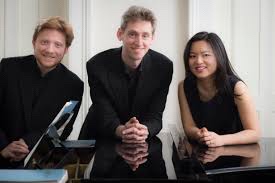
Minerva Trio © Anthony Dawton

Which particular works do you think you play best?

I tend to choose pieces that speak to me on a personal level. Dinu Lipatti once said that it’s not enough to like the piece you play, but the piece must also like you! I play a wide range of repertoire but have a soft spot for Schumann, Brahms, and Ravel.  As long as I can make a connection with the sound world of a particular piece, then I feel inspired to share it.

It is thrilling to premiere a new work as there is a sense of freedom in communicating a piece for the first time. I love the collaborative aspect of working together with a composer, which is very creative and exciting.  That connection I mentioned before then extends to a kind of real affinity with the composer.  At the moment I am working with Hong Kong-born British composer Raymond Yiu.

How do you make your repertoire choices from season to season?

I build on my core repertoire every season. In the past, I would tend to be more composer-focused. If I started to play one piece by Schumann, I would then aim to cover his entire output in order to gain a better understanding of the composer’s language. These days I am interested in finding ways to create dialogues between different works in a programme.

While I love my core repertoire for concert programmes (for example, I will be playing Beethoven, Schumann, and Ravel at St Martin-in-the Fields in December), I am also constantly looking for new stimulants for something adventurous.  For my next MusicArt concert I will present a world premiere concert-installation ‘Conceptual Concert in Three Acts’, inspired by the collaboration between Robert Rauschenberg and John Cage and performed within an exhibition of their works at Galerie Thaddaeus Ropac.  It will involve the music of John Cage, an installation of sound and spoken dialogue, and a new musical work created in collaboration with composer Raymond Yiu and poet Kayo Chingonyi.

Do you have a favourite concert venue to perform in and why?

I had a fantastic experience playing Arvo Pärt’s Fratres at an open space outside Central St Martins for a fashion show in London with a few hundred people in the audience. Since then I am happy to play anywhere as long as it is aesthetically pleasing or stimulating to the senses in some way, not just acoustically.

Who are your favourite musicians?

I have huge admiration for Leonard Bernstein, especially since I discovered his Eliot Norton lecture series, The Unanswered Question. He said, ‘The best way to know a thing is in the context of another discipline.’ Like other great musicians, he reminds one that music and humanity are inseparable.

What is your most memorable concert experience?

For me, playing Beethoven’s Emperor Concerto at LSO St. Luke’s in London was as special and memorable as playing John Cage’s 4’33” while silently reading a poem at an art gallery. I don’t think I can choose between the conventional and creative approach to playing concerts, as I love both.

As a musician, what is your definition of success?

Success is constantly achieving what I set out to do. It’s important to me to generate creative ideas on a regular basis, work with people whom I admire, and create unique experiences for the audience. When I can do these things continuously at a high level, then I am happy.

What do you consider to be the most important ideas and concepts to impart to aspiring musicians?

Treat music as an art form that demands the utmost dedication and discipline. Career is by no means guaranteed. After you finish training and studying at the conservatoire or college, your colleagues and collaborators become, in a way, your teachers. Learn to listen through playing with others.

What is your most treasured possession?

The Yamaha C3 grand piano that I have had since I was 12. It has travelled with me from Hong Kong to Vancouver to London. I had wanted a grand piano from the very beginning, and my mother promised if I reached Grade 8 she would buy me one. It turned out she started saving for it from the day she promised, so she could afford it, just in case! That was a great motivation and I made sure to get it as quickly as possible.

Video links:

Debussy  – https://www.youtube.com/watch?v=epJymUc2rDY

Brahms: Intermezzo in A major, Op. 118, No. 2 https://www.youtube.com/watch?v=OImMONM78TI

Music by Arvo Pärt – Für Alina

Poem by Zaffar Kunial – Sunlight

https://www.youtube.com/watch?v=iG-g7bfLpec

ERDEM
London Fashion Week SS14

Annie Yim, pianist
Richard Birchall, cellist

https://www.youtube.com/watch?v=4rTeQ8Iaqnc

John Cage the Lover and Poet (audio)

https://vimeo.com/193910760

OR

John Cage Dream (1947)

https://www.youtube.com/watch?v=PEknsWJLp-o

Scenes from Daphnis and Chloe (2017)
Minerva Piano Trio
Thomasin Gülgeç, dancer
Estela Merlos, dancer

https://www.youtube.com/watch?v=PdsMBr1JfBw

Who or what inspired you to take up the piano and pursue a career in music?

Nobody has forced me or suggested me to become a musician. My parents had many recordings as they were classical music lover. So I often listened to classical music since when I was a child and I liked it very much. That’s how I started to become close to and to love classical music.

Who or what have been the greatest influences on your musical life and career?

I would say meeting with many great musicians have been the most important influences on my musical life, people like Myung-Whun Chung, Radu Lupu, Krystian Zimerman, Mikhail Pletnev, Alfred Brendel, Murray Perahia and many others…..I learned a lot even while having a conversation with them.

What have been the greatest challenges of your career so far?

Maybe participating some competitions….. I wanted to play for audiences across the world and I thought winning the competition was the easiest way to reach that goal. And it was true, the Chopin Competition gave me a lot of opportunities, but I’m still against competitions. Many great musicians like Arcadi Volodos or Piotr Anderszewski didn’t win any competitions.  The competition kills the musical idea, imagination and freedom. I felt so free after I won the Chopin competition because I realized that I don’t have to do this kind of thing anymore.

Which performances/recordings are you most proud of?

Brahms Quartet in g minor from the Rubinstein competition in 2014. It was the only performance which I enjoyed during that competition.

Which particular works do you think you play best?

I have no idea…

How do you make your repertoire choices from season to season?

These days I simply play the pieces that I want to play. A few years ago, I wanted to show or express many sides of my musicality. But not anymore. I always feel comfortable when I play the music I love.

Do you have a favourite concert venue to perform in and why?

So many places where they have a good piano, good acoustic and good audience. Like Carnegie hall in New York, the Concertgebouw in Amsterdam, Paris and Berlin’s Philharmonie, KKL in Luzern, Elbphilharmonie in Hamburg, Suntory hall in Tokyo…..

Who are your favourite musicians?

Radu Lupu, Krystian Zimerman, Mikhail Pletnev, Alfred Cortot, Edwin Fischer, Arcadi Volodos, Grigory Sokolov, Carlos Kleiber, Myung Whun Chung any many others

What is your most memorable concert experience?

My debut recital in Korea in 2005 when I was 11. After the performance, I realized that I really loved sharing my music with the audience.

As a musician, what is your definition of success?

Actually I still don’t know what being successful as a musician is and I don’t want to think about it. My goal is play better than yesterday and to be satisfied with my performance more often. I’m rarely happy with my performance…

What advice would you give to young or aspiring musicians?

Don’t expect the compensation after you decide to become a pianist or musician

What is your idea of perfect happiness?

I love to be in a place where there no noise. I love silence. And having good food and drink with my family or friends.


Seong-Jin Cho was brought to the world’s attention in 2015 when he won the First Prize at the Chopin International Competition in Warsaw. This same competition launched the careers of world-class artists such as ‎Martha Argerich, ‎Maurizio Pollini, or ‎Krystian Zimerman.

In January 2016, Seong-Jin signed an exclusive contract with Deutsche Grammophon. The first recording was released in November 2016 featuring Chopin’s First Concerto with the London Symphony Orchestra and Gianandrea Noseda and the Four Ballades. A solo Debussy recording was then released in November 2017. Both albums won impressive critical acclaim worldwide. In 2018 he will record a Mozart program with sonatas and the D minor concerto with the Chamber Orchestra of Europe and Yannick-Nézet-Seguin.

An active recitalist, he performs in many of the world’s most prestigious concert halls. In the 2018/19 season, he will return to the main stage of Carnegie Hall as part of the Keyboard Virtuoso series where he had sold out in 2017. He will also return to Amsterdam’s Concertgebouw in the Master Pianists series and will play recitals at the Berlin Philharmonie Kammermusiksaal (Berliner Philharmonic concert series), Frankfurt’s Alte Oper, Los Angeles’ Walt Disney Hall (Los Angeles Philharmonic recital series), Zurich’s Tonhalle-Maag, Stockholm’s Konserthuset, Munich’s Prinzregententheater, Chicago’s Mandel Hall, Lyon’s Auditorium, La Roque d’Anthéron Festival, Verbier Festival, Gstaad Menuhin Festival, Rheingau Festival among several other venues.

During the next two seasons, he will play with the London Symphony Orchestra and Gianandrea Noseda, at the Barbican Centre, Radio France Philharmonic Orchestra and Myung-Whun Chung at the Paris Philharmonie, Gewandhaus Orchestra with Antonio Pappano, Hong Kong Philharmonic with Jaap van Zweden, Pittsburgh Symphony Orchestra with Manfred Honeck, Finnish Radio Orchestra and Hannu Lintu, Philadelphia Orchestra and Yannick-Nézet-Seguin, Orchestra della Scala with Myung-Whun Chung. He will also tour with the European Union Youth Orchestra and Gianandrea Noseda in venues like Amsterdam’s Concertgebouw, Royal Albert Hall, Berlin Konzerthaus, the London Philharmonic Orchestra and Robin Ticciati in Germany, the WDR Sinfonieorchester and Marek Janowski in Germany and Japan, and with the Santa Cecilia Orchestra and Antonio Pappano in Asia.

He collaborates with conductors at the highest level such as Sir Simon Rattle, Valery Gergiev, Esa-Pekka Salonen, Vladimir Ashkenazy, Yuri Temirkanov, Krzysztof Urbanski, Fabien Gabel, Marek Janowski, Vasily Petrenko, Jakub Hrusa, Leonard Slatkin or Mikhail Pletnev.

In November 2017, Seong-Jin stepped in for Lang Lang with the Berlin Philharmonic Orchestra for concerts in Berlin, Frankfurt, Hong-Kong and Seoul. Other major orchestral appearances include the Royal Concertgebouw Orchestra, Orchestre de Paris, Mariinsky Orchestra, Munich Philharmonic Orchestra, Rundfunk-Sinfonieorchester Berlin, Royal Liverpool Philharmonic Orchestra, NHK Symphony Orchestra, Philharmonia Orchestra, Seoul Philharmonic Orchestra, Czech Philharmonic Orchestra, Budapest Festival Orchestra, Danish National Symphony Orchestra, Russian National Orchestra, Detroit Symphony Orchestra, NDR Elbphilharmonie Orchester, RAI Symphony Orchestra, Hessischer Rundfunk Sinfonieorchester.

Born in 1994 in Seoul, Seong-Jin Cho started learning the piano at 6 and gave his first public recital at age 11. In 2009, he became the youngest-ever winner of Japan’s Hamamatsu International Piano Competition. In 2011, he won Third prize at the Tchaikovsky Competition in Moscow at the age of 17. In 2012, he moved to Paris to study with Michel Béroff at the Paris Conservatoire National Supérieur de Musique where he graduated in 2015. He is now based in Berlin.

seongjin-cho.com
