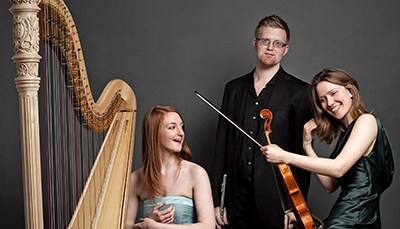
Who or what inspired you to take up the violin, and pursue a career in music?

As a child, in Cape Town, I played recorder and then classical guitar, and at the age of 9 I started violin lessons as I really wanted to be in the school orchestra. Already then, the lure of making music with others took hold. But it was not a given that I would be a musician. My secondary school was sporty and academic, and I got a scholarship to study medicine at University. However a gap year convinced me that a career in music would be infinitely more exciting than life as a medic, albeit far more insecure, and I headed to the Guildhall School of Music in London to concentrate on the violin, a decision I have never regretted!

Who or what have been the most important influences on your musical life and career?

I would say violin lessons with Gyorgy Pauk and Sandor Vegh, and chamber music coaching from members of the Amadeus Quartet (especially Siegmund Nissel) were a real inspiration to me, musically. But I was also an avid concert-goer, and a love of live music-making was instilled in me from an early age.

What have been the greatest challenges of your career so far?

Fitting everything in, and finding time for recharging those batteries! I was luckily born with a lot of stamina, and I have certainly needed it.

Which performance/recordings are you most proud of?

The complete cycle of Shostakovich Quartets which I recorded for Chandos with the Sorrel Quartet, and played live over a weekend in Cratfield Church in Suffolk. Nothing will compare to that epic journey, both emotionally and physically. One of the great excitements of now joining the Brodsky Quartet is that they have shared similar Shostakovich journeys and I am looking forward to comparing “travel notes”.

Do you have a favourite concert venue to perform in and why?

I can think of two, straightaway. The first, Wigmore Hall, London. Perfect acoustic, perfect size, wonderful audience, and the sense of history walking onto that stage, well-documented in all the photos lining the Green Room walls. I made my solo debut there at the age of 21, and I vividly remember playing the Bach Chaconne as part of the programme in that heavenly acoustic, and thinking how amazingly fortunate I was to be there. The second, Snape Maltings near Aldeburgh. Every creak and groan from the wooden structure has one imagining Benjamin Britten’s presence still there in those rafters. Years ago, when they replaced the bluffs on the roof, my then quartet, spending a winter in residence in Aldeburgh, was sent as a publicity stunt to be pictured with instruments (luckily not our own!) on the roof…and oh, the view across the marshes, with the steel grey water meandering in loops through the reeds! You never see that from ground level. A very special place indeed.

Who are your favourite musicians?

Too many to list, but currently: Maria Joao Pires, Henning Kraggerud, Kristine Opolais, Paul Lewis

What is your most memorable concert experience?

As a child, hearing the Berlin Philharmonic Orchestra at the Alhambra Palace in Granada. The setting, the architecture and the music made such an impression on me.

As a musician, what is your definition of success?

I think if one feels successful, one might as well retire! As musicians we are so fortunate to be involved in a career we love, where we can continue learning and being curious and growing in experience throughout our life. Sharing this passion and enthusiasm with audiences or students is surely the most rewarding part of our life? If just one person is moved or changed in some way by their experience in a concert hall then perhaps we have been successful in our mission?

What is your most treasured possession?

I know I should say my violin! But actually it is a string of pearls which belonged to my Austrian/Italian mother, and her mother before that, the only piece of her jewellery which travelled from Europe to South Africa and was not stolen in a burglary. My only sadness is I cannot wear it when playing violin!

What do you consider to be the most important ideas and concepts to impart to aspiring musicians?

Work hard – nothing valuable is ever gained without that – but be open to inspiration from a broad range of genres. Do not spend all your day in a practice room. Walk in nature, visit an art gallery, go to the theatre, read, explore… you will need far more than an assured technique if you are to have something interesting to share with an audience. And every time you play a piece, find something new in it, and take risks.

Gina McCormack will join the Brodsky Quartet from May 2019. Find out more


Gina McCormack is well established as one of Britain’s leading artists, with regular solo appearances at London’s Wigmore Hall, the South Bank Centre and at venues across the country. She has performed at many British Festivals, including the City of London, Henley, Edinburgh, Buxton, Aldeburgh and Salisbury Festivals, and has appeared as soloist in the UK with the Hallé and Royal Philharmonic Orchestras and the former Bournemouth Sinfonietta. Tours abroad have taken her to France, Norway, Denmark, the Czech Republic, South Africa and South America, and most recently to Austria and Switzerland.

Gina studied with György Pauk at the Guildhall School of Music and Drama, London, and attended masterclasses with Sandor Vegh (at the Salzburg Mozarteum and at Prussia Cove in Cornwall), Dorothy DeLay, Andras Mihaly and Siegmund Nissel (from the Amadeus Quartet). While still a student, she was a prizewinner at the Royal Overseas League Music Competition in London and at the International Young Concert Artists’ Competition in Tunbridge Wells, where she has since returned to serve on the jury.

For thirteen years Gina was the leader of the Sorrel Quartet, with whom she was frequently heard on BBC Radio Three. The quartet made twelve CDs for Chandos Records, of works by Britten, Mendelssohn, Schubert and the complete cycle of Shostakovich quartets. Their Elgar CD was chosen as one of Classic FM’s records of the year and was Editor’s Choice in Gramophone Magazine. The group also recorded John Pickard’s Quartets on the Dutton label.

She then led the Maggini Quartet for two years, and decided to leave the group in March 2010 to focus on her solo work, continuing a long association with her duo partner, pianist Nigel Clayton. Since then the duo has had engagements in Holland, Switzerland, Denmark, and all around the UK.

Gina McCormack is also well-known as a teacher, having spent 11 years as professor of Violin at Trinity Laban Conservatoire of Music and Dance (formerly Trinity College of Music) in London. She is currently teaching at the Royal Northern College of Music, Manchester and the Royal Conservatoire of Scotland, Glasgow.  She also gives regular masterclasses both in the UK and at summer festivals abroad.

ginaviolin.com


artist photo: Melanie Strover


If you enjoy the content of this site, please consider making a donation towards its upkeep:

Buy me a coffee

p

Who or what inspired you to take up composing, and pursue a career in music?

It was hearing Monk’s Dream (Thelonious Monk Quartet) at 17, amidst the sea of UK garage and US Hip Hop I was listening to, that really made me want to play. I’d wander into the music rooms at my school between lessons and start hitting notes; school wasn’t the best of times (probably a universally applicable statement), and the sense of being able to assign inexpressible feelings to keys and sequences of notes, however primitively they may have been expressed and constructed, was completely absorbing.

Who or what were the most significant influences on your musical life and career as a composer?

It’s probably no exaggeration to say Tourette’s Syndrome (TS). I didn’t know it by its name when I was a teenager (and wouldn’t until my early twenties) but I did know that the piano – the immersion I felt in it, the satisfaction of this innate [again universal, yet arguably slightly amplified [in the case of TS] craving for rhythm – offered me relief from my own body.

I think I would always have felt some draw to the instrument on a musical level – but without TS I’m not so sure that I would have stayed at the piano.

What have been the greatest challenges/frustrations of your career so far?

The greatest challenge has probably been sticking with things, over months and years, trying to carry on persevering in spite it feeling delusional/completely unachievable at points. But I’m not actually sure this was a challenge; I didn’t really view doing what I wanted to be doing as a choice.

As an aside – I’m not sure I’d call my relationship to/involvement with music a career as such – partly because I try to split my time relatively evenly between sonic and visual areas but also because I’m slightly uncomfortable with the word ‘career’. I’ve always associated that word with the people who came to my school, asked me some questions and then suggested I was destined for one in the catering industry.

‘Career’ seems to evoke a sense of detachment or distinction from a life that must exist around it, in spite of it…personal life versus career. For better or worse, I’ve wanted to avoid doing anything with my life that I’d feel any need or desire to escape or detach from.

Career’ to me at least, is the imposition of artificially constructed expectations – from society and self it implies trajectory, outcome, above all – an attempt to quantify that which perhaps should exist outside the realm of metrics.

So perhaps one of my biggest challenges is to remember quite how much I don’t want to build a career. I don’t ever want to retire from what I’m choosing to give my time and my life to. And I suppose within that lies the ever-present question of whether what I’m choosing to give my time to is something I should be giving my time to.

My biggest frustration would definitely be the amount of time I need to spend in front of a screen to facilitate my engagement with a world that exists beyond it.

Another challenge I’m becoming increasingly aware of is how to communicate simple ideas without sounding detached and pretentious.

What are the special challenges/pleasures of working on a commissioned piece?

My main, and relatively limited, experience of ‘commissioned’ music has been through film scores (a few shorts, documentary / narrative and a feature documentary). It’s a real privilege to be trusted with someone else’s work – and exciting to be able to respond to it.

I think part of the challenge is to factor in an awareness that what I’m doing should be informed but not limited by my response to the material. At the end of the day it’s someone else’s film – something they’ve potentially been working on for years and poured their life into, they’ll be attached to certain ideas when it comes to soundscapes and it’s important to be respectful of those ideas whilst also knowing when to be assertive and speak out and constructively disagree.

What are the special challenges/pleasures of working with particular musicians, singers, ensembles and orchestras?

At its best, collaboration really takes me outside myself – there’s a lowering of inhibitions and a confidence that doesn’t quite exist when playing solo. There’s also far more objectivity – good ideas mean so much more and crap ideas get removed so much earlier – or at least the process of working to redeem them begins much earlier.As far as challenges go – giving / being open to receiving feedback. But then if communication’s good and there’s mutual respect that’s 90% of the work done.

Of which works are you most proud?

I’m particularly proud of the mini album ‘Weightless’. I’d been holding on to four little piano tracks for a few years  – almost as a safety net to be used if felt like my involvement in music was really slipping away.

I decided to try to commission a non-remix style remix album (one which wasn’t comprised of four C-grade club remixes) that could extend the small scope of the piano tracks into something more expansive and offer a more cohesive listening experience. I approached some friends whose music I loved and asked them to respond as honestly as possible to the themes of titles, to go wherever they felt musically led but just asked they remained tethered, however loosely, to some part of the original. I loved the resulting reworks and the musical variety that had spawned from these four very simple piano pieces- all credit for that of course goes to the four artists involved (Tom Adams, Siavash Amini, Hedia, Transept).

How would you characterise your compositional language?

I’m interested in attempting to bring a variety of influences and feelings to the piano. I like leaving room for slight variety in performance, space for improvisation at points. That gives me room to grow in my existing compositions and for them to grow with me too. I like melody but am trying to push my understanding and use of harmony further along. Whilst I love sparser music that I can get lost in, I find I’m generally more interested in narrative – I’d say most of the music I make, on piano at least, has some sense of journey attached baked into it. I can fully appreciate and welcome simplicity but equally don’t like easy answers so I try to not to offer those through my music either – life very rarely, if ever, finds itself exclusively steeped in one end of the existential spectrum so it doesn’t make sense to me for music to do so either.

How do you work?

Occasionally something will come out of nowhere but usually the process is fairly slow. I tend to play things over and over, record primitively on my phone (when camera phones were smaller I used to put one in my mouth and film what my hands were playing. Now I just record audio on my phone and hope to remember the fingering), listen back, play back, add, subtract, listen, listen – extend this process over weeks or months. By the end ideas have either been near fully formed or if I start to find them boring I let go of them.
Time becomes a filter, through which only the stuff that still interests me passes.

Even with my upcoming album – I’m listening to it on almost daily basis to make sure, at least up to the point of release, that I still feel accurately represented by it and sufficiently interested in it.  I don’t mind if I change my mind at some future point but I need to know that at the moment of release it is music that still means something to me.

Who are your favourite musicians/composers?

I really love Stevie Wonder’s albums from the 1970s. Errol Garner, Oscar Peterson, Thelonious Monk, Dave Brubeck. My favourite album of 2018 was Baloji’s “137 Avenue Kaniama” and having him seen him perform it live last year can easily say he’s one of my favourite performers.

As a musician, what is your definition of success?

To remember that expression isn’t a commodity and music isn’t a competition. To balance your strengths and limits over that fine line between thinking you’re shit / THE shit.

What do you consider to be the most important ideas and concepts to impart to aspiring musicians?

To have confidence in your story and own it, don’t expect everyone to get it or the music that comes from it – make stuff for yourself primarily and treat anyone else wanting to listen in as a welcome bonus.

Where would you like to be in 10 years’ time?

Primarily outside.

What is your idea of perfect happiness?

Finding stability in transition and being free from expectations.. with a football in one hand and a frisbee in the other.

What do you enjoy doing most?

I love walking and being outside as much as possible. I used to love playing football almost more than anything else – I really miss it.

What is your present state of mind?

Honestly – conflicted and unsettled. Trying to question things without getting completely lost.

Alex Kozobolis’ new album ‘Somewhere Else’ is released on 26 April and is an album with the piano at its heart. Alex describes the piano as possessing a therapeutic magnetism for him, having originally turned to the instrument as a way of regulating the symptoms of his Tourette syndrome. A jazz-like preoccupation with improvisation is embedded within the album, each track was brought to the studio slightly incomplete allowing for spontaneity during the recording process.


D0f5cS9XQAAOaoG


(Photos by Özge Cöne)

Who or what inspired you to take up the piano and pursue a career in music?

I knew when I was about 12 that the piano was going to be an essential part of my life. I was quite shy and reserved as a child, and felt I could only express certain things and be truly myself when playing the piano. It felt immediately like a close friend that was always there and with whom I could share all the ups and downs of life. I did not know then what being a professional pianist meant, I just knew that music would always be an essential part of my life.

Who or what have been the most important influences on your musical life and career?

There are so many. If I was going to put one at the top of the list, I would say Ruth Nye – she was my teacher during my studies at the Yehudi Menuhin School and Royal College of Music. She was not only my mentor but rapidly became like family, and remains to this day an inspiration. She has shaped my artistic, technical and philosophical development like no other person in my life. Also Nikolai Demidenko, Murray Perahia, and Dominique Merlet all taught me crucial things at various stages of my development.

What have been the greatest challenges of your career so far?

Challenges go hand in hand with a performing career. Of course, I have had to go through many stressful situations, dealing with tight deadlines and intensive performing periods. But these are to be expected and it is nothing special. A good example of that was when I did my first concerto recording. This was a three concerto album, performed live at the Cadogan Hall in one concert. The very next day, I had a recital at the Wigmore Hall. I remember coming home late that night after the Cadogan performance and practising until about 4 am.

But the most important challenge is to get up everyday and thrive to reach a deeper artistic understanding of the music I am playing, to always question, to remain insatiably curious and never stop learning. In art, movement is everything. The music grows with me everyday, and I hope that the second I have performed or recorded something, my interpretation will have already started to evolve.

Which performances/recordings are you most proud of?

Pride is not really a feeling I would associate with a successful performance or recording. But I guess more a feeling of exhilaration during a special moment shared with an audience or in the intimacy of a recording studio with my producer and recording team. But perhaps if I had to choose one, I would say my first Wigmore Hall recital; I remember doing a crazy programme, including Bach-Busoni chaconne, Beethoven Sonata op. 110 and Liszt B minor Sonata. I remember the Beethoven op. 110 in that hall as one of these rare moments when you feel you are no longer physically there. There was a real link between me, the music and the audience that night.

In terms of recordings, I think my latest Hyperion concerto recording of works by Bronsart and Urspruch (two Liszt students) with the BBC Scottish Symphony and Eugene Tzigane is particularly interesting. It was a fantastic experience for me to record these hardly known romantic works and bring them to life with such wonderful musicians. My Chopin preludes album as well; I think we managed to capture an intimate sound that allows one to hear all the details, yet distant enough that the poetry remained intact.

Which particular works do you think you play best?

I am not sure about using the word best, but I would say that this non-exhaustive list of pieces are some of the works that are very close to me: Liszt B minor sonata and Après une lecture du Dante, Ravel Gaspard de la nuit, Bach-Busoni Chaconne, Mussorgsky Pictures at an Exhibition, Schumann Études Symphoniques, Beethoven sonata op. 110, Chopin preludes op. 28, Schubert sonata in Bb D. 960, Mozart concerto in D minor K. 466 and Brahms concerto No. 1 in D minor.

How do you make your repertoire choices from season to season?

Mostly of my own choosing: the piano repertoire is extremely vast and there are so many works that I want to explore! Though choosing a programme has to be done carefully. It is like putting together a meal. I will only perform something if I feel I have something truly special to say playing this work, that it has become a part of me. Also, other considerations come into play. The venue is one; I might not choose to play the same thing in a big London hall and in an outdoor summer festival. Also, I might be in the process of recording specific works, and of course a particular season might coincide with a composer’s birthday, for example, Beethoven’s 250th birthday in 2020.

Do you have a favourite concert venue to perform in and why?

For me Wigmore Hall is very special. I have wonderful memories there. It has perfect acoustics and is just the right size to be intimate yet not too close; you can hear everything right down to the very last row.

Who are your favourite musicians?

There are many: Claudio Arrau would be one of the most important ones. His sound, colours, depth of interpretation, but perhaps more importantly, he is the artist who resonates with me the most in terms of philosophy and approach to performing. He was completely uncompromising, putting the music and respect for the score at the centre of everything with such integrity. But also Dinu Lipatti, Ferruccio Busoni, Alfred Cortot, Martha Argerich, Yehudi Menuhin, Jacqueline du Pré, Daniel Barenboim, Leonard Bernstein and many many more!

What is your most memorable concert experience?

I think it would have to be the first time I performed Brahms’s first piano concerto as a young student, conducted by Andrew Litton. I had won the Royal College of Music’s concerto competition. We had three big rehearsals, which of course never happens in the professional world. This allowed for some truly special music making – Andrew Litton was amazing, the orchestra was full of passionate and eager music students wanting to give everything they had to the music and the conductor. I hold the memory of this concert very close to my heart.

As a musician, what is your definition of success?

That is a very hard question. But at the same time, as strange as it may seem, I don’t think I spend too much time thinking about it. I guess, doing what I love to do for as many years as I am lucky enough to be able to do it! Being a musician is who I am no matter what, music is my oxygen and it’s at the very core of my identity.

What do you consider to be the most important ideas and concepts to impart to aspiring musicians?

I would say that for me, the most important thing is to keep remembering what is at the centre of it all – the music. That as performers we are a middleman, a link between the music and the audience. The hardest thing I think on this journey is to keep a healthy psychological compass and to not fall into the traps of vanity or self-doubt, as both extremes are equally destructive. It’s a delicate balance: one has to remember that if you are a talented artist, you have a unique message and personality; that is what you have to cherish, nurture and put at the service of your art to the best of your ability with integrity and complete dedication.

What is your idea of perfect happiness?

All these precious simple moments spent with my wife and baby daughter.

To be on stage performing beautiful music, on these rare moments when everything clicks into place and there is a real link made with the audience is a wonderful feeling.


Emmanuel Despax will be performing live on BBC Radio 3’s In Tune programme on 29th April at 5pm, ahead of his performance of both Chopin concerti with string quintet at the Menuhin hall on 30th April (more information)


“Poetry fused with breathtaking technical perfection” (Concertclassic) and “A master colourist with genius-like ability” (Classical Source) is how the brilliant French pianist Emmanuel Despax was described after his acclaimed recitals at the Louvre auditorium in Paris and Wigmore Hall in London.

Despax is establishing himself as an artist whose interpretations bring a rare sincerity and imagination to the music. He performs internationally and is regularly broadcast on many radio stations including France Musique, BBC Radio 3, Classic FM and Medici TV.

His latest Romantic Piano Concerto album for Hyperion – with the BBC Scottish Symphony Orchestra, conducted by Eugene Tzigane – received a glowing review from Gramophone: “It’s hard to imagine it being better played than by these forces, Emmanuel Despax displaying a wide range of colours combined with an easy virtuosity … It requires prodigious playing from soloist and orchestral musicians to make it sound as effortless as here, and that it does is tribute as much to conductor Eugene Tzigane as to Despax.” The recording features two romantic concerti by students of Liszt, Hans Bronsart and Anton Urspruch.

His previous Chopin preludes album on Signum Classics was chosen as “Album of the week” by Classic FM in the UK and received a five-star review on Diapason in France: “The young artist’s poetic work of entomology left me speechless. Rarely has the text of these 24 pieces been thus read, enhancing the least articulation or pedalling detail in relation to tempi, sound weight, projection from a prelude to the next, from a group of preludes to another, transmuting his Fazioli into a 1900s Pleyel, iridescent as needs be – intimate and very beautiful.”

In his native France, Despax has appeared in prestigious venues such as Paris’ Salle Gaveau, Salle Cortot, the Louvre Auditorium and the Festival International des Nuits Pianistiques in Aix-en-Provence. He performs regularly across Europe and has given recitals at the Fazioli Auditorium in Italy, the Gasteig Blackbox in Munich and the Palais des Beaux Arts in Belgium.

UK highlights include recitals at Wigmore Hall, the Royal Concert Hall in Nottingham, the Chipping Campden and Petworth Festivals and a performance of three piano concerti at Cadogan Hall. This concert was recorded live and released on Signum Classics. “Emmanuel Despax is a formidable talent, fleet of finger, elegant of phrase and a true keyboard colourist.” (Gramophone)

Having studied in the UK at the Yehudi Menuhin School and Royal College of Music with Ruth Nye, one of Claudio Arrau’s finest students, Despax draws inspiration from a long tradition of pure artistry and uncompromising commitment to the score. His passion lies in retaining and regaining the true role of a performer, as a faithful vessel for the composer’s message.

Now based in London, Despax has performed with many UK orchestras including the City of Birmingham Symphony Orchestra, the Orpheus Sinfonia, and the BBC Scottish Symphony Orchestra.

emmanueldespax.com


Artist photo: Luca Sage


If you enjoy the content of this site, please consider making a donation towards its upkeep:
Buy me a coffee

Trio-Anima-2-sized

Trio Anima are Rosalind Ventris (viola), Anneke Hodnett (harp) and Matthew Featherstone (flute)

Who or what inspired you to pursue a career in music?

Rosie: Some of my earliest memories are of my mum, a keen amateur musician, having piano lessons at home and her friends coming round to play chamber music. I was really lucky to grow up in this environment where enjoying music at home with friends just seemed the thing to do and I had really amazingly supportive parents. My father absolutely loved listening to music so both of them were really passionate about classical music, and it was always in the house.

Originally I wanted to play the harp, but I am forever grateful that my parents said they weren’t lugging a harp around after me! Now I get to listen to Anneke playing all the time which is the ideal situation for a one-time wannabe harpist! I started playing the violin when I was seven and was inspired to take up the viola from going to the late John White’s Viola Days in Harlow, Essex, not far from where I grew up. I was a proper little viola nerd! Listening to Lionel Tertis’s recordings had a huge influence on me too – as they still do to-day.

Matthew: One of my dad’s friends was a flautist and after one of his concert I attended when I was 5 years old, I said to my parents that I wanted to play the flute. My parents struggled to find a flute teacher in France who would take me on. I remember going for a lesson with a teacher who insisted I was too young to play the flute and shoud learn the recorder. I was utterly unimpressed and threw a tantrum saying ‘no, I want to play the flute!!’ I was clearly opinionated from a young age, but eventually found a fabulous flute teacher and the rest is history.

Anneke: Growing up in Limerick Ireland, my family would go to the local food market every Saturday. When I was 8, my parents suggested that I take up an instrument. Around that time there was a lady who played folk harp every week in the market. I vividly remember being drawn to the sound week after week, and finally going up to my mum (who was buying potatoes!) to ask whether I could play the harp. She said yes, and almost as soon as I started playing, I knew that I wanted to do it for the rest of my life.

Who or what have been the most important influences on your musical life and career?

We all agree that are are most important influences have been our teachers and mentors, who have inspired and moulded us as musicians. Having been a trio for almost fourteen years it is also fair to say that we have also been shaped by each other! (Matthew and Anneke have been working together since they were students at the Guildhall School of Music & Drama, with Rosie joining in 2012.) With instruments as diverse as this we come from different perspectives and sound worlds, which always keeps things fresh. We trust and challenge each other in equal measure.

What have been the greatest challenges of your career so far?

As you grow in the profession different challenges arise at different points. Now, one of the biggest challenges has been planning our diaries together well in advance to rehearse. We’ve just solved this in part now that Rosie and Anneke live two roads away from each other in East London! As principal flute of BBCNOW, Matthew is of course based in Cardiff. We each individually what might be called ‘portfolio’ careers: Matthew also teaches at the Royal Welsh College of Music & Drama, and is releasing his first EP as a jazz vocalist and composer. Anneke plays for all the main London orchestras and abroad, and teaches at the Junior Guildhall. Rosie has a busy freelance career as a soloist and chamber musician, which she combines with teaching at the Royal Irish Academy of Music in Dublin and as a British Library Edison Fellow and occasional writer.

Which performance/recordings are you most proud of?

We loved playing at Conway Hall a couple of years ago. It was the culmination of a long project contrasting music from the Belle Époque with that written during the First World War. It was a poignant and moving experience for us to do this a hundred years after the Great War. We were delighted by this review from Robert Hugill.

Which particular works do you think you play best?

As a flute, viola and harp trio, we have a natural affinity for French music, which works particularly well for our instrumental combination. Last year, with the centenary of Debussy’s death, we really enjoyed exploring a programme based around his life and influences. We also really relish the challenge of contemporary music and have recently been working on quite a few new modern works. We are very excited to premiere our commission from composer Rory Boyle this year at St John’s Smith Square, London.

How do you make your repertoire choices from season to season?

We love putting together programmes around a particular theme, interest or concept. Usually inspiration starts from one piece of music that has a particular resonance for us or for that particular year or venue. The challenge is sometimes balancing this with specific requests from venues. This instrumental combination offers so many opportunities for innovative and thought-provoking programming. Some of our most popular pieces are actually arrangements of works originally written for other instruments (for instance, adaptations of Baroque trio sonatas can work wonderfully). Having said this, in many of our concerts we will include the Debussy Sonate as it is an undisputed masterpiece and something we love to play.

Do you have a favourite concert venue to perform in and why?

As three very different instruments it’s always interesting turning up in a new hall and finding out how to play in the acoustic. For this intimate chamber group we always love giving concerts at people’s homes and playing in the Hall of Champs Hill was a wonderful combination of performing in lovely hall which is also a homely, intimate space.

Who are your favourite musicians?

Rosie: As a trio we will always be grateful to Dubois who (as far as we know) was the first to write for this combination and of course, Debussy!

Trio Anima performing Dubois Terzettino in 2014

Matthew: I love listening to singers because I think the most expressive instrument is the voice. Cecilia Bartolli is a regular source of inspiration. In another genre, Stevie Wonder is obviously a personal favourite!

Anneke: That’s an impossible question to answer! However, I would say that among the many musicians I admire, I would have to mention Matthew and Rosie! I think that music is very personal, and if you find other musicians you love playing with it can provide so much inspiration and motivation.

What is your most memorable concert experience?

Well, in terms of memorable for all the wrong reasons we once arrived at a venue after several hours of driving and begin rehearsing when the electricity went down! Very sadly the concert had to be cancelled. This was unfortunately followed by deadlock on the M1! In total we were in the car for about eleven hours and didn’t get to play together! It was the worst!

As a musician, what is your definition of success?

Rosie: Connecting to people through music.

Matthew: I think when your enjoyment of music making and the musician lifestyle is balanced with fulfilment in your personal life, and you feel like you’re touching people with what you do.

Anneke: Being able to be in the moment and convey what you want to express through the music.

What do you consider to be the most important ideas and concepts to impart to aspiring musicians?

Start by knowing the WHOLE score (not just your own part) and immerse yourself in the style of that era. Sing, dance, make up a story, use you imagination when working or practising. Prepare well in advance! Don’t be afraid to put yourself out there. For every success you are going to get many many rejections – be strong and have faith in what you’re doing! Meditation and yoga are brilliant!

Working hard. In lots of ways! As you go through music college, the most important thing is to practice as much as you can, and to take inspiration and ideas from everyone who is of-fering them to you. As you go into the profession, you need to take some of your practice time and turn it into “making it happen” time.

What is your idea of perfect happiness?

We are all big fans of food so probably playing a nice concert of some of our favourite repertoire followed by an amazing meal with our spouses, friends and family.


Trio Anima was formed in 2006 at the Guildhall School of Music and Drama. For the past decade, they have been delighting audiences with their distinctive combination of flute, viola and harp. The trio won the Elias Fawcett Award for Outstanding Chamber Ensemble at the 2012 Royal Overseas League Competition & First Prize at the Camac Harps Chamber Ensemble Competition in 2007. They have been Live Music Now Artists, and were awarded a Chamber Music Fellowship at the Guildhall School of Music & Drama in 2011. In 2017 they were selected as Kirckman Concert Society Artists.

Read more