Why would a talented leading British composer include a document called a Failure CV on her website, alongside details of her extensive oeuvre and the many plaudits for her work?
British composer Cheryl Frances-Hoad is not alone in including such a document on her website. She prefaces it with the comment that “for every success I have, there are usually a LOT more failures that nobody ever gets to hear about”, and each entry on this Failure CV includes a note of how each project or submission turned out. On one level, it’s sobering reading – proof that composers (and musicians in general) must work hard and that success is often hard won. But it’s also rather inspiring and positive. Its honesty shows that Cheryl, and others like her, accept that a successful career trajectory is paved with many setbacks and failures, and it reveals a certain confidence which seems far more genuine than a list of accolades, prizes and press reviews.
The more usual kind of CV lists successes only, but this does not represent the bulk of one’s efforts. Nor does it acknowledge that failure is a necessary part of progress and without it, one cannot reflect on nor learn from those failures.
A composer can “hide” their failures. They need not mention the rejected funding applications nor the works which never got commissioned. A performing musician, however, exposes themselves to criticism in the very public forum of a live concert and errors will be remarked upon by audiences and critics. As musicians, failure can have a very profound effect on how we approach our music making and professional career. It can create feelings of personal humiliation which in turn may stifle our ability to learn and develop. Sadly for many of us, the “wrongness” of making mistakes is inculcated in us from a young age – by parents, teachers, and peers – and such prejudices combined with a constricted mindset lead us to blame and criticise ourselves for our failings
In fact, mistakes and slips in concert are a very tiny part of the “setback-reflect-progress” habit of the serious musician, who regards mistakes as positive learning opportunities rather than unresolved failures. Failure is part of creativity and mastery, and without it we cannot learn, explore, experiment, expand our horizons, and progress
It also fosters resilience and equips one with the tools to cope with the exigencies of one’s creative life. Being honest about failure is empowering, for oneself and for others, as it can help them deal with their own shortcomings and career setbacks, and encourage them to stick to the task.
What Cheryl Frances-Hoad’s Failure CV so neatly proves is that failure – and a willingness to learn from it – is a fundamental part of success: without those setbacks, Cheryl may never have reached the pre-eminent position she now holds in classical music in the UK and beyond.
Why would a talented leading British composer include a document called a Failure CV on her website, alongside details of her extensive oeuvre and the many plaudits for her work?
British composer Cheryl Frances-Hoad is not alone in including such a document on her website. She prefaces it with the comment that “for every success I have, there are usually a LOT more failures that nobody ever gets to hear about”, and each entry on this Failure CV includes a note of how each project or submission turned out. On one level, it’s sobering reading – proof that composers (and musicians in general) must work hard and that success is often hard won. But it’s also rather inspiring and positive. Its honesty shows that Cheryl, and others like her, accept that a successful career trajectory is paved with many setbacks and failures, and it reveals a certain confidence which seems far more genuine than a list of accolades, prizes and press reviews.
The more usual kind of CV lists successes only, but this does not represent the bulk of one’s efforts. Nor does it acknowledge that failure is a necessary part of progress and without it, one cannot reflect on nor learn from those failures.
A composer can “hide” their failures. They need not mention the rejected funding applications nor the works which never got commissioned. A performing musician, however, exposes themselves to criticism in the very public forum of a live concert and errors will be remarked upon by audiences and critics. As musicians, failure can have a very profound effect on how we approach our music making and professional career. It can create feelings of personal humiliation which in turn may stifle our ability to learn and develop. Sadly for many of us, the “wrongness” of making mistakes is inculcated in us from a young age – by parents, teachers, and peers – and such prejudices combined with a constricted mindset lead us to blame and criticise ourselves for our failings
In fact, mistakes and slips in concert are a very tiny part of the “setback-reflect-progress” habit of the serious musician, who regards mistakes as positive learning opportunities rather than unresolved failures. Failure is part of creativity and mastery, and without it we cannot learn, explore, experiment, expand our horizons, and progress
It also fosters resilience and equips one with the tools to cope with the exigencies of one’s creative life. Being honest about failure is empowering, for oneself and for others, as it can help them deal with their own shortcomings and career setbacks, and encourage them to stick to the task.
What Cheryl Frances-Hoad’s Failure CV so neatly proves is that failure – and a willingness to learn from it – is a fundamental part of success: without those setbacks, Cheryl may never have reached the pre-eminent position she now holds in classical music in the UK and beyond.
I admit it – I watched The Football. Not all of it, of course, but certainly the England matches. It has been refreshing and inspiring to watch this young, relatively inexperienced team in action under the tutelage of Gareth Southgate (who, as a friend of mine tweeted the other day, is the kind of person you would happily introduce to your mum). I say “refreshing” because unlike previous England world cup squads, this young team seems largely devoid of artifice and ego. There are no strutting peacocks here (recall David Beckham and co in their designer suits….) nor the entourage of WAGS, there for the shopping, the champers and the paparazzi. As many commentators have observed, this young England team is different – lean, keen and focussed, with a clear appetite for success. This is evidently due in no small part to the calm, composed leadership of Gareth Southgate, who chooses to encourage rather than berate, praise rather than criticise, thus establishing a supportive environment for the team to train and compete. The positive effect of this “kinder” management style has been evident throughout the matches England have played
But they lost the semi final match, you cry. Yes, but just look at what they have gained – and that “loss” in the semi final against Croatia should not be regarded as a “failure”. To get to the last four in the World Cup is a huge achievement in itself; add to that, the fact that Croatia fielded a team which included some of the top players in the world. What a privilege to play against such players!
The result of the match against Croatia should offer Gareth Southgate and the team much food for thought and reflection, which, if done right, will enable this young team to develop and grow and, hopefully, achieve greater success in the Euro championships and the next World Cup in 2022.
In ‘The Rise’, her excellent book on the search for mastery, Sarah Lewis explores the notion of the “near win” (rather than the “near miss”) as instrumental to achieving success.
A near win shifts our view of the landscape. It can turn future goals, which we tend to envision at a distance, into more proximate events….The near win changes our focus to consider how we plan to reach what lies in our sights, but out of reach.
Success motivates us, but a near win can propel us in an ongoing quest.
– Sarah Lewis
To have reached the semi-finals of the 2018 World Cup, and to have played so confidently and largely successfully in the matches leading to it, the England team should enjoy the glow of their near win and use it to spur them to greater victories. The road to mastery is paved with setbacks, but if we are prepared to embrace them, they carve the way for further endeavour, achievement and fulfilment of goals.
This growth-mindset attitude applies as much to sportspeople as to musicians.
I’ve been watching some of the Winter Olympics coverage with interest, in particular the snowboarding and skiing. It’s easy to spot the winners – people like Chloe Kim and Redmond Gerard (both from the US team): they display effortless grace and flow in their gestures, and those who totally “own” the course seem to create a through-narrative of seamless movement from start to finish, which reminds me of watching someone like the British pianist Stephen Hough in concert. In short, they make it look easy.
As is often the way when I watch sport, I am struck by the similarities between sportspeople and musicians: that same effortless grace of the snowboarders and skiers is something we admire in highly-skilled musicians, and these are attributes, along with expression and communication, which make their performances thrilling and memorable.
Often when watching top sportspeople or musicians in action, we marvel at their “natural talent”. that ineffable, indescribable je ne sais quoi which places these people apart from the rest of us.
Top athletes are compelling because they embody the comparison-based achievement we….revere – fastest, strongest – and because they do so in a totally unambiguous way…..
Plus they’re beautiful: Jordan hanging in midair like a Chagall bride, Sampras laying down a touch volley at an angle that defies Euclid. And they’re inspiring…. Great athletes are profundity in motion
– David Foster Wallace
Like the rest of us, the BBC commentators for the Winter Olympics are clearly fascinated and impressed by these extraordinary human beings, and there is much talk of “natural talent” and a sense of hero-worship and awe in the language used to describe them and their exploits. As a society, we are obsessed with the “myth” of talent and we have a long-held a fascination with people we perceive to be “naturally talented”. From child prodigies to highly gifted performers and sports superstars, we view them as wonders of nature, imbued with enviable, raw natural talent.
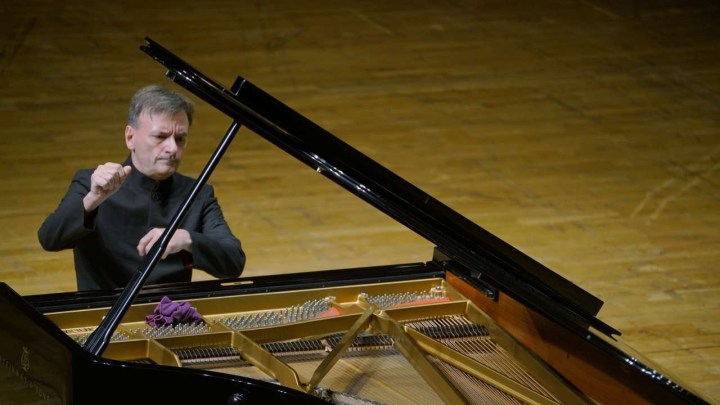
Stephen Hough in concert
What is the secret of these people’s talent? What is it that makes them so special, so different from the rest of us?
Unfortunately, for those obsessed with the myth of talent, the reality is altogether less exciting: notice how the BBC commentators rarely discuss these athletes’ training regimes. Why? Because talking about training is boring. To discuss something as pedestrian as training and practising removes the mystique surrounding these extraordinary individuals, and we would never want our sporting or musical heroes and heroines to appear “ordinary”. Would you rather watch Stephen Hough practising 70 repetitions of the same passage of Liszt at home in his studio or appearing in concert at Carnegie Hall?
***
Most of us are familiar with the “10,000 hours rule”, and while this theory has largely been debunked by more recent research, it serves to remind us that “putting the hours in” is a key factor in becoming extraordinarily proficient in a specific skill or field of study, be it playing chess, sport or musical performance. But it is not just about quantity of training; quality plays a more crucial role, for focused, intelligent and deliberate training or practise is what breeds results.
But what sparks the will to train in the first place?
Interest and the “rage to master”
If you haven’t got the interest, you won’t stick to the training regime. Sounds obvious, yet those who achieve what we call “expert status”, snowboarders and concert pianists alike, have an almost obsessive will to focus intensely on a specific subject, and will voraciously consume new information and acquire skills. Psychologists call this the “rage to master” and many top athletes and musicians can cite a specific moment, often in childhood, when the rage to master took hold, driving them to focus intently and intensely on their chosen activity.
Practice and training
To achieve a very high level of technical and artistic ability and success, regular, conscientious, and deliberate practice/training is crucial. This is not simply playing through your chosen repertoire or doing a few runs on the piste: doodling at the piano or pottering around at the snowdome does not bring success. Deliberate practice involves a hefty degree of goal-setting (daily, weekly, monthly and yearly, plus regular reviewing and adjustment of those goals), self-evaluation, criticial feedback, reflection, analysis of minute details (such as body position, gesture, fingering schemes etc, often using video or audio recordings), in addition to support and feedback from mentors, teachers, peers, colleagues and others. We know that repetitive practice is important to train the “muscle memory” or procedural memory, which allows Redmond Garard or Stephen Hough to perfectly execute the slopestyle trick or complex passage of music, not just once but over and over again. These are not mindless repetitions, however, but repetition with reflection, evaluation and adjustment, so that each subsequent repetition improves on the previous one. In addition to all of the above, the ability to see the “bigger picture” of the slope or piece of music and the attendant ability to make decisions, large and small, about technique, gesture, expression etc
Motivation
Deliberate practice/training leads to noticeable progress and improvement which motivates one to keep practising, with enhanced satisfaction, reward and fulfilment. This creates a virtuous circle of positive feelings towards training and practising, which further motivates one to keep at the task.
Grit and determination
Grit is the disposition to pursue very long-term goals with passion and perseverance. And I want to emphasize the stamina quality of grit. Grit is sticking with things over the long term and then working very hard at it.
– Angela Duckworth
Some of us may start a training or practising regime with the very best of intentions, but soon fall by the wayside due to lack of focus, motivation, procrastination, and a whole host of other reasons (excuses!). Those at the top of their field have the determination to stick to the task, day in day out.
Mastery and the constant pursuit
Mastery is about embracing the role of the life-long student and dedicating oneself to the pursuit of excellence. Read more about mastery here
Other factors
Nurture – the encouragement and support of family, teachers and mentors, coaches, colleagues and friends are important in fostering focus and determination in training.
***
When we consider all these factors, we truly appreciate how and why Olympic athletes and top-flight musicians are where they are professionally. We too can train and practise in the same way, using the same tools and focused mindset. We may not touch these exceptional individuals nor come close to their greatness, but we can still strive for excellence in what we do.
Inspiration is for amateurs — the rest of us just show up and get to work
– Chuck Close
Further reading
‘How Tracy Austin Broke My Heart’ from Consider the Lobster And Other Essays – David Foster Wallace. Little, Brown & Company, 2008
The Cross-Eyed Pianist is free to access and ad-free, and takes many hours every month to research, write, and maintain.
If you find joy and value in what I do, please consider making a donation to support the continuance of the site







 The Cross-Eyed Pianist