Who or what inspired you to take up the piano and pursue a career in music?

Nobody has forced me or suggested me to become a musician. My parents had many recordings as they were classical music lover. So I often listened to classical music since when I was a child and I liked it very much. That’s how I started to become close to and to love classical music.

Who or what have been the greatest influences on your musical life and career?

I would say meeting with many great musicians have been the most important influences on my musical life, people like Myung-Whun Chung, Radu Lupu, Krystian Zimerman, Mikhail Pletnev, Alfred Brendel, Murray Perahia and many others…..I learned a lot even while having a conversation with them.

What have been the greatest challenges of your career so far?

Maybe participating some competitions….. I wanted to play for audiences across the world and I thought winning the competition was the easiest way to reach that goal. And it was true, the Chopin Competition gave me a lot of opportunities, but I’m still against competitions. Many great musicians like Arcadi Volodos or Piotr Anderszewski didn’t win any competitions.  The competition kills the musical idea, imagination and freedom. I felt so free after I won the Chopin competition because I realized that I don’t have to do this kind of thing anymore.

Which performances/recordings are you most proud of?

Brahms Quartet in g minor from the Rubinstein competition in 2014. It was the only performance which I enjoyed during that competition.

Which particular works do you think you play best?

I have no idea…

How do you make your repertoire choices from season to season?

These days I simply play the pieces that I want to play. A few years ago, I wanted to show or express many sides of my musicality. But not anymore. I always feel comfortable when I play the music I love.

Do you have a favourite concert venue to perform in and why?

So many places where they have a good piano, good acoustic and good audience. Like Carnegie hall in New York, the Concertgebouw in Amsterdam, Paris and Berlin’s Philharmonie, KKL in Luzern, Elbphilharmonie in Hamburg, Suntory hall in Tokyo…..

Who are your favourite musicians?

Radu Lupu, Krystian Zimerman, Mikhail Pletnev, Alfred Cortot, Edwin Fischer, Arcadi Volodos, Grigory Sokolov, Carlos Kleiber, Myung Whun Chung any many others

What is your most memorable concert experience?

My debut recital in Korea in 2005 when I was 11. After the performance, I realized that I really loved sharing my music with the audience.

As a musician, what is your definition of success?

Actually I still don’t know what being successful as a musician is and I don’t want to think about it. My goal is play better than yesterday and to be satisfied with my performance more often. I’m rarely happy with my performance…

What advice would you give to young or aspiring musicians?

Don’t expect the compensation after you decide to become a pianist or musician

What is your idea of perfect happiness?

I love to be in a place where there no noise. I love silence. And having good food and drink with my family or friends.


Seong-Jin Cho was brought to the world’s attention in 2015 when he won the First Prize at the Chopin International Competition in Warsaw. This same competition launched the careers of world-class artists such as ‎Martha Argerich, ‎Maurizio Pollini, or ‎Krystian Zimerman.

In January 2016, Seong-Jin signed an exclusive contract with Deutsche Grammophon. The first recording was released in November 2016 featuring Chopin’s First Concerto with the London Symphony Orchestra and Gianandrea Noseda and the Four Ballades. A solo Debussy recording was then released in November 2017. Both albums won impressive critical acclaim worldwide. In 2018 he will record a Mozart program with sonatas and the D minor concerto with the Chamber Orchestra of Europe and Yannick-Nézet-Seguin.

An active recitalist, he performs in many of the world’s most prestigious concert halls. In the 2018/19 season, he will return to the main stage of Carnegie Hall as part of the Keyboard Virtuoso series where he had sold out in 2017. He will also return to Amsterdam’s Concertgebouw in the Master Pianists series and will play recitals at the Berlin Philharmonie Kammermusiksaal (Berliner Philharmonic concert series), Frankfurt’s Alte Oper, Los Angeles’ Walt Disney Hall (Los Angeles Philharmonic recital series), Zurich’s Tonhalle-Maag, Stockholm’s Konserthuset, Munich’s Prinzregententheater, Chicago’s Mandel Hall, Lyon’s Auditorium, La Roque d’Anthéron Festival, Verbier Festival, Gstaad Menuhin Festival, Rheingau Festival among several other venues.

During the next two seasons, he will play with the London Symphony Orchestra and Gianandrea Noseda, at the Barbican Centre, Radio France Philharmonic Orchestra and Myung-Whun Chung at the Paris Philharmonie, Gewandhaus Orchestra with Antonio Pappano, Hong Kong Philharmonic with Jaap van Zweden, Pittsburgh Symphony Orchestra with Manfred Honeck, Finnish Radio Orchestra and Hannu Lintu, Philadelphia Orchestra and Yannick-Nézet-Seguin, Orchestra della Scala with Myung-Whun Chung. He will also tour with the European Union Youth Orchestra and Gianandrea Noseda in venues like Amsterdam’s Concertgebouw, Royal Albert Hall, Berlin Konzerthaus, the London Philharmonic Orchestra and Robin Ticciati in Germany, the WDR Sinfonieorchester and Marek Janowski in Germany and Japan, and with the Santa Cecilia Orchestra and Antonio Pappano in Asia.

He collaborates with conductors at the highest level such as Sir Simon Rattle, Valery Gergiev, Esa-Pekka Salonen, Vladimir Ashkenazy, Yuri Temirkanov, Krzysztof Urbanski, Fabien Gabel, Marek Janowski, Vasily Petrenko, Jakub Hrusa, Leonard Slatkin or Mikhail Pletnev.

In November 2017, Seong-Jin stepped in for Lang Lang with the Berlin Philharmonic Orchestra for concerts in Berlin, Frankfurt, Hong-Kong and Seoul. Other major orchestral appearances include the Royal Concertgebouw Orchestra, Orchestre de Paris, Mariinsky Orchestra, Munich Philharmonic Orchestra, Rundfunk-Sinfonieorchester Berlin, Royal Liverpool Philharmonic Orchestra, NHK Symphony Orchestra, Philharmonia Orchestra, Seoul Philharmonic Orchestra, Czech Philharmonic Orchestra, Budapest Festival Orchestra, Danish National Symphony Orchestra, Russian National Orchestra, Detroit Symphony Orchestra, NDR Elbphilharmonie Orchester, RAI Symphony Orchestra, Hessischer Rundfunk Sinfonieorchester.

Born in 1994 in Seoul, Seong-Jin Cho started learning the piano at 6 and gave his first public recital at age 11. In 2009, he became the youngest-ever winner of Japan’s Hamamatsu International Piano Competition. In 2011, he won Third prize at the Tchaikovsky Competition in Moscow at the age of 17. In 2012, he moved to Paris to study with Michel Béroff at the Paris Conservatoire National Supérieur de Musique where he graduated in 2015. He is now based in Berlin.

seongjin-cho.com

about-sunwook

Who or what inspired you to take up the piano and pursue a career in music? 

Since  I was a child, I have been struck by the beauty of classical music. Even though I explored many areas including playing piano and violin, painting, calligraphy, Taekwondo (Korean martial art) and so on, only music stimulated me to practise constantly. It is definitely not easy to practise 4-5 hours every day without passion for music.

Who or what were the most important influences on your musical life and career? 

To be honest, competitions gave me a great motivation. I participated in many national competitions in Korea from a very young age and successful results made me realise that this is what I have to continue to work on. From 2004, I went to international competitions and finally won the Leeds Competition in 2006 at which point I decided to stop participating in competitions as it gave me the opportunity to give concerts on a regular basis. Since then, I have been exploring a variety of repertoires, learning about many composers and their music in depth and earning valuable experiences on the stage.

What have been the greatest challenges of your career so far? 

Each and every concert is a great challenge to me like an audition. I always try to learn and develop from every concert.

Which performance/recordings are you most proud of? 

I still vividly remember great experiences I had with many orchestras and conductors. Working with Sir Mark Elder (Halle Orchestra, Manchester), Kirill Karabits (Bournemouth Symphony Orchestra) and Myung-Whun Chung (former chief conductor of Seoul Philharmonic and Radio France Philharmonic Orchestra) were fantastic collaborations. Also I am very proud of my recording of Unsuk Chin’s Piano Concerto. It is an honour to play and record great works by highly respected living composers.

Which particular works do you think you play best? 

Beethoven and Brahms. I have been playing Beethoven’s Piano Sonatas (all 32!!), Piano Concertos, Violin Sonatas, Cello Sonatas, and also studied all his symphonies when I was a conducting student at the Royal Academy of Music. For Brahms, I have explored all his piano works, chamber music and symphonies etc. However, I am more excited to learn new repertoire including works by Janacek, Prokofiev, Schubert, Schumann, Mozart and Bach. I sometimes think that my life is lucky because it gives me an infinite challenge.

How do you make your repertoire choices from season to season? 

I make my programmes based on pieces which I would like to play with confidence. I include no more than 4 composers in one programme and the relationship between them in terms of their harmonies are very important. For example, if I start Beethoven E major sonata op.109, I put c# minor, op.27 no,2 ‘Moonlight’ for the next piece because E major and c# minor are relative.

Do you have a favourite concert venue to perform in and why? 

Wigmore hall in London, Philharmonie in Paris, Philharmonie in Berlin and Concertgebouw in Amsterdam. They have the most distinguished acoustics and extremely high quality keyboard instruments. They have truly the top level pianos I have ever played.

Favourite pieces to perform? Listen to? 

All Beethoven Sonatas, concertos and chamber music pieces by Brahms. It is quite interesting because most musicians in my generation love to play Tchaikovsky, Rachmaninoff, Prokofiev as well as Ravel and Chopin. However, I have played Tchaikovsky 1st and Rachmaninoff 2nd concertos only once in my life on the stage but more than 20 times for Beethoven 3rd, 4th and 5th.

Who are your favourite musicians? 

My greatest mentor is Andras Schiff, especially for Beethoven. I have been greatly influenced by him through his intellectual ideas on the structure and sound of Beethoven’s music as well as keyboard techniques and understanding the essence of composers.

What is your most memorable concert experience? 

In 2012, I played with London Symphony Orchestra for the first time as a replacement. I was so nervous because I was notified only 2 days before the concert but I think the concert was very successful with Maestro John Eliot Gardiner.

What do you consider to be the most important ideas and concepts to impart to aspiring musicians? 

This is my philosophy of being musician: Don’t aim to get large amounts of concerts, but do try to achieve good quality concertds. It is a long term/life-time project, don’t expect to have rapid improvements, just practice constantly on the regular basis.

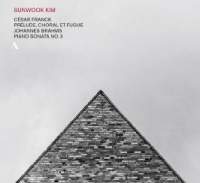
Sunwook Kim’s new album of music by Franck and Brahms is now available on the Accentus Music label.

London-based Sunwook Kim came to international recognition when he won the prestigious Leeds International Piano Competition in 2006, aged just 18, becoming the competition’s youngest winner for 40 years, as well as its first Asian winner. His performance of Brahms’s Concerto No.1 with the Hallé Orchestra and Sir Mark Elder in the competition’s finals attracted unanimous praise from the press.

Full biography and website


maxresdefault

Korean pianist Sunwook Kim (born 1988) came to international prominence in 2006 when he won the Leeds International Piano Competition at the age of 18. Since then he has spent much time giving concerts and exploring repertoire, developing his own style, sound and ideas about the music he plays. By his own admission, he has now arrived at a point in his career and development as an artist where he feels ready to demonstrate “a more romantic, dramatic and yet refined pianism”. In doing so, his new CD, on the Accentus label, brings together two of his favourite works – Cesar Franck’s Prelude, Choral et Fugue and Johannes Brahms’ Piano Sonata No. 3 in F minor. It is an unusual pairing, which reflects Sunwook’s interesting in programming, and in it he aims to show the link between the two composers, despite their stylistic differences: here are two composers, both pianists, who paid a special hommage to the music of the past. Both revered the spirit of Classicism and Bachian polyphony, as well as a love of proportion and well-ordered architectural structures within music. Thus, on this disc two great musical edifices are placed side by side, and the result is magisterial.

The Prelude, Choral et Fugue is the work of a composer at the height of his powers. Composed 1884, the work displays cyclic and thematic relationships, particularly in the recall of the Prelude and Choral in the Fugue, and the tripartite structure, probably inspired by Bach’s BWV 564, lends considerable weight and emotional power to the work. Franck was also an organist, and Sunwook Kim is sensitive to the full-bodied textures which recall the sonorities of the organ, while never comprising on clarity of tone and articulation. The work unfolds with a darkly dramatic grandeur, growing progressively more intense as the music approaches its denouement in the final passages of the Fugue. Such is Sunwook’s skilled sense of pacing that the opening Prelude in particular has the spontaneity and improvisatory qualities one expects to find in similar works by Bach. By the time we reach the central Choral, with its rich broken chords which recur throughout the piece and link the three sections, the music’s message and monumental architecture is driven home authoritatively, all handled with consummate skill and dramatic tension by Sunwook.

In contrast Piano Sonata No. 3 is a young man’s work, composed in 1853 when Brahms was just twenty. It was inspired by Beethoven and Schubert, and like the Prelude, Choral and Fugue, the five individual movements are linked with each other through subtle unifying themes. Sunwook displays sensitivity to the architecture of the music, building and emphasising structure through intelligently-paced climaxes, but just as in the Franck, there’s spontaneity too, particularly in the grander gestures. In contrast, the second movement is played with an unassuming and tender lyricism. The third movement begins with virtuoso panache, all dancing dotted rhythms, before the music moves into a hymn-like middle section. Again, the contrasting moods and textures are adeptly handled. The fourth movement opens like an intermezzo, intimate and expressive, but the serenity is quickly disturbed by an ominous low motif in the bass. The finale has everything in it – a jaunty main theme, sweeping lyrical melody, stately marches, a fugue, and moments of real pianistic bravura and high-octane energy. Sunwook’s crisp articulation and awareness of Brahms’ shifting moods, structures and soundscapes makes this a rewarding and absorbing performance. The recording has a bright yet warm clarity, the acoustic of the Jesus-Christus-Kirche, Berlin ideal for this music. The CD comes with comprehensive notes, including an introduction to the pieces by the pianist himself.

accentusmusicacc303552

Sunwook Kim, piano

César Franck
Prélude, Choral et Fugue
Johannes Brahms
Piano Sonata No. 3 in F minor, op. 5

More information

J_Bae-140_LR_BW
(photo: Kelley Eady Loveridge)
Who or what inspired you to take up the piano and pursue a career in music?

My dear teacher and mentor, Dr. Rae de Lisle, senior lecturer at School of Music, University of Auckland, who has taught me for 12 years. Maestro Chung Myung-Hoon who was the first South Korean pianist who became the Silver Medalist (no Gold-Medalist awarded) at 1974 Tchaikovsky International Piano Competition, who is now an internationally sought-after conductor.

Who or what were the most important influences on your musical life and career?

My mentor, Dr. Rae de Lisle who has taught me since I was 9 years old until I graduated from University of Auckland with First Class Honours. She has seen me grow up and has guided me to where I am right now.

What have been the greatest challenges of your career so far?

I grew up in New Zealand until I came to London last year. London life is completely different to New Zealand life where its population is only 4 million people. Studying at the Royal Academy of Music and living in London, the metropolitan city has been very challenging since I didn’t know anyone and I didn’t have anyone who supported me. I had to completely depend on myself and this was great challenge.

Which performance/recordings are you most proud of? 

2009 my performance of Rachmaninov Piano Concerto No.2 when I was 17 years old. 2012 My debut recital at Auckland Town Hall, Chopin Preludes Complete, Bach/Busoni Chaconne. Recent performances of 2013 New Zealand Wallace Piano National Piano Competition of my Liszt Piano Sonata, Ravel Gaspard de la Nuit, Rachmaninov Piano Sonata No.2 and 2014 New Zealand Wallace Piano Festival my complete recital programme of J.S. Bach Partita No.6, Rachmaninov Moments Musicaux complete.

Which particular works do you think you perform best?

Rachmaninov Piano Sonata No.2 Op.36 (Original version), Rachmaninov Piano Concerto No. 2 and Rachmaninov Moments Musicaux Op.16 complete.

How do you make your repertoire choices from season to season? 

First of all, I have to know which venue I would be playing in and also what kind of audience, and this depends on the country, suburbs (whether it is a small town or big city). In small towns, I have to play relatively well-known works or well-known composers. In the big cities, I can introduce more contemporary works and new composers.

Do you have a favourite concert venue to perform in and why?

Auckland Town Hall Great Hall and Concert Chamber. Auckland is where I grew up and I went to almost every single concert in this venue where I received inspiration and motivation.

Favourite pieces to perform? Listen to?

Rachmaninov Piano Concerto No.2 Op.16. I have worked so hard to prepare this work and performed it so well. Now, I like listening to Rachmaninov Piano Concerto No. 3 which I am currently working on.

Who are your favourite musicians?

Stephen Hough, Leif Ove Andsnes, Arcadi Volodos, Gil Shaham, Joshua Bell, Hilary Hahn, Maxim Vengerov, Vasily Petrenko and Vladmir Ashkenazy.

What is your most memorable concert experience?

2012 Auckland Town Hall Concert Chamber Debut – Sold out. 2009 Lev Vlassenko International Piano Competition 2nd Prize – Brisbane, Australia. 2013 Tchaikovsky Piano Concerto No.1 with Auckland Philharmonia – Auckland Town Hall Great Hall, New Zealand.

What do you consider to be the most important ideas and concepts to impart to aspiring musicians?

Always have to remember that I am making music in order to solely share with audience. It’s never about showing off my talent but inspiring audience making them to appreciate the beauty of the classical music. Always aiming at making audience to feel that their couple of hours of listening to my performance was life-changing experience.

What are you working on at the moment? 

Chopin 4 Ballades, Rachmaninov Piano Concerto No. 3.

Where would you like to be in 10 years’ time?

Becoming an artist in residence for Wigmore Hall, London, Seoul Arts Centre, South Korea. Regular concerto soloist with Philharmonia Orchestra, London Symphony Orchestra, Seoul Philharmonic Orchestra, New Zealand Symphony Orchestra and Sydney Symphony Orchestra.

What is your idea of perfect happiness?

Continuing to enjoy making music even though it is difficult journey and lonely life in order to share the music with many people around the world (not just in major concert halls, big cities but small rural towns as well). I would like to have a good family who can continuously support me to achieve my vision of sharing classical music to as many people as possible.

What is your most treasured possession? 

My experiences of travelling to many countries for my performances.

What do you enjoy doing most?

Meeting with my best friends for a good catch-up and conversation.

What is your present state of mind?

I am looking forward to preparing new works for 2015.

Jason Bae was born in Daejeon, South Korea in 1991 where he began studying piano at the age of five. At age 12, he has made his concerto debut with Auckland Symphony Orchestra performing Grieg Piano Concerto Op. 16. A year later, he became the youngest concerto soloist to perform with Auckland Philharmonia Orchestra for the ‘SkyCity Starlight Symphony Concert in the Park’ at the Auckland Domain in front of 200,000 people. Under the baton of Rossen Milanov, Jason performed Stravinsky’s Concerto for Piano and Winds as a soloist with New Zealand National Youth Symphony Orchestra in 2010. He has also appeared as a concerto soloist with the Queensland Symphony Orchestra of Australia, Auckland Youth Symphony Orchestra, Christchurch Symphony Orchestra and Bach Musica. 

Jason’s full biography is on his website