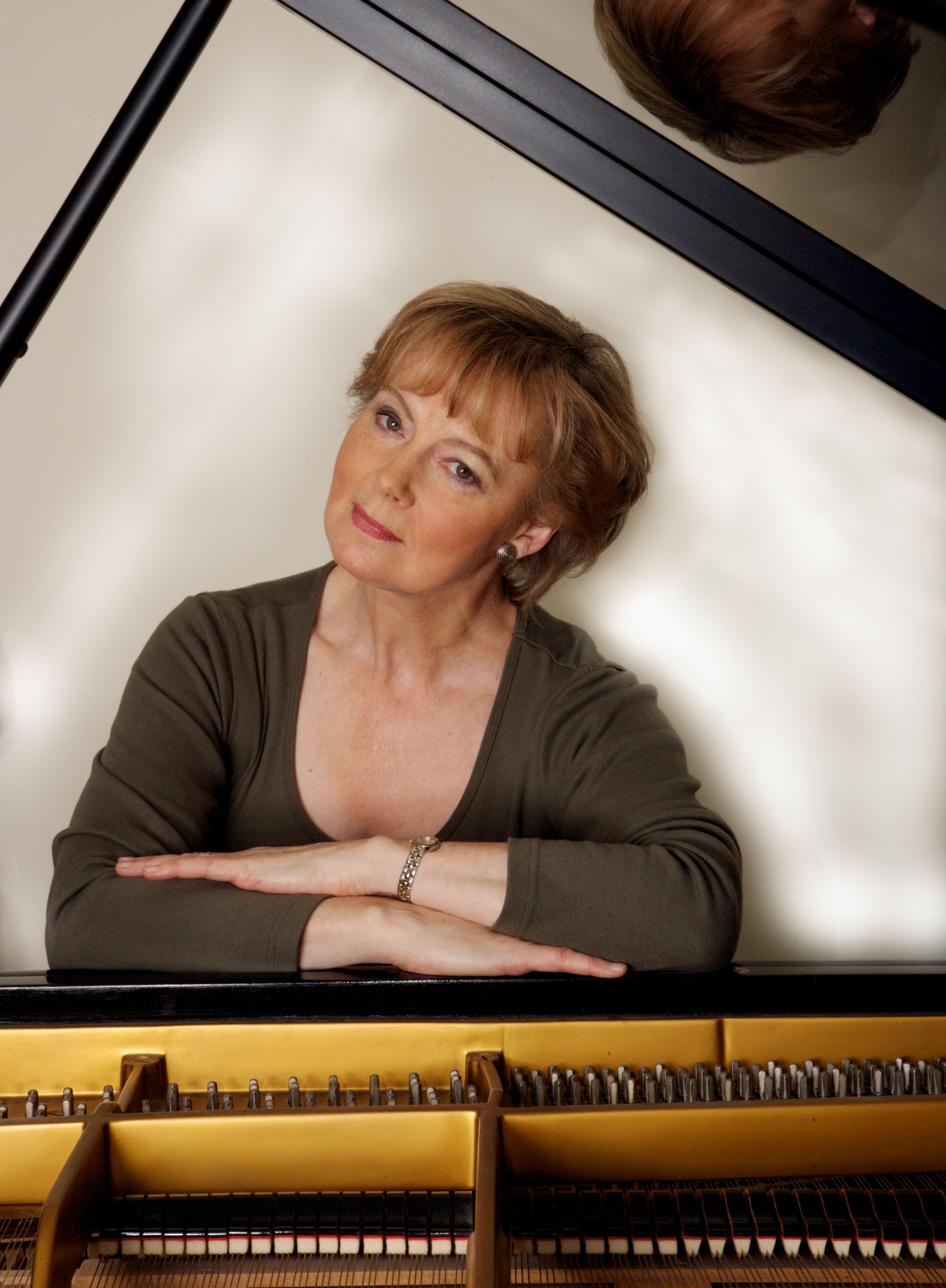
(photo credit: Rory Isserow)

Who or what inspired you to take up the piano, and make it your career? 

I don’t remember not playing the piano! But as a career – the London-based Swiss pianist, Albert Ferber, with whom I was studying, encouraged me to make my debut at Wigmore Hall in 1974.

Who or what were the most important influences on your musical life and career? 

All my teachers in different ways; musical members of the family; friends and colleagues who believed in me. The composer William L Reed was a marvellous mentor and facilitator. Perhaps most important of all, a passion for the music I had found and a powerful desire to communicate it.

What have been the greatest challenges of your career so far? 

To focus on priorities.

Which performance/recordings are you most proud of?  

The ones where there has been that special communication with listeners – whether in the concert hall or in feed-back from far-flung corners of the world. I do not wish to be solely defined by the many Grainger ones, but they have presented much repertoire that is new, fresh, entrancing, life-enhancing – hard work, but what a joy!

Which particular works do you think you play best? 

The particular ones for which I feel a gut instinct, whether by Bach, Beethoven, Schumann, Brahms, Chopin, Ravel, Debussy, Rachmaninov …. the list goes on.

How do you make your repertoire choices from season to season?

That is dictated by the projects I am undertaking.

Do you have a favourite concert venue to perform in and why? 

I have enjoyed different venues for different reasons – the Melbourne Recital Centre is lovely, but so too is London’s Kings Place for its vibrant sense of enterprise (and very fine hall), and St John’s, Smith Square for its beauty. I have often relished the pin-point acoustics of Wigmore Hall, and the warm atmosphere of the Purcell Room. It was a thrill to play on the stage at Covent Garden for a gala Australia Day concert and at the Royal Festival Hall in Grainger’s ‘The Warriors’. By contrast, a good piano in a large music room can be perfect for a recital where one introduces the music.

Favourite pieces to perform? Listen to? 

Most recently Bach transcriptions and originals for a Bach CD on LIR Classics. And see above……

Who are your favourite musicians? 

To hear: I so loved the Pollini Beethoven cycle, and in different sonatas, Brendel (the last three) and, unexpectedly, Barenboim in some of the early ones. Of course, that force of nature, Argerich!  On disc – Dinu Lipatti, Solomon and Richter.

For many years I played two piano programmes with my friend and colleague, John Lavender. We gradually developed a way of creating one texture from two pianos. We recorded much new Grainger repertoire on three discs and John also made some splendid two piano versions of such works as Tchaikovsky’s ‘Romeo and Juliet’ overture as part of an all-Russian programme.

I have been lucky to work with so many fine artists – in earlier days, the mezzo Muriel Smith, more recently, certain outstanding singers – Stephen Varcoe, Martyn Hill, James Gilchrist and Della Jones, in the Chandos Grainger recordings and in concert. Wayne Marshall was a memorable colleague both as pianist and conductor. It has been a great pleasure to work with the cellist, Rohan de Saram, who has recently returned to the standard repertoire along with his extraordinary abilities and achievements in the field of contemporary music. Earlier women pianists who inspired me in concert included

Lili Kraus, Alicia de Larrocha and Rosalind Tureck. Also Hephizibah Menuhin, whom I knew and admired as a friend.

These are but a few names amongst many others…

What is your most memorable concert experience? 

Too many memorable experiences to choose one – but playing in 1980 in the Beijing Conservatoire and to a radio audience they told me averaged 50 million – was certainly the largest audience ever!

What do you consider to be the most important ideas and concepts to impart to aspiring musicians?

Be yourself. Find your unique path. Work hard. Know that beyond failure there is always the next step. Cherish your friends and the wonderful opportunities we have to share our music.

What are you working on at the moment? 

A concert at King’s Place, London, to mark 40 years since my London debut.

It will be a programme filled with melody and shared with some good friends, the Fitzwilliam String Quartet and a group of gifted young professionals, as we shall be premiering a piano concerto movement written by Grainger when he was just 13 years old.

I’ll start with mighty Bach arr. Liszt and progress through Grieg (lovely Grieg) by way of Grainger to the Dvorak Piano Quintet Op 81 – what an utterly gorgeous work.  

What is your present state of mind? 

Expectant.


Penelope Thwaites’ 40th Anniversary Concert takes place at London’s King’s Place Hall One on Wednesday 8th October. She is joined by the Fitzwilliam Quartet and outstanding young professional artists in a programme of music by Bach arr. Liszt, Grieg, Grainger and Dvorak. Further details here


London-based pianist and composer Penelope Thwaites has performed and broadcast in over thirty countries on five continents. Since her Wigmore Hall debut in 1974, she has appeared regularly as recitalist in major concert halls, and in a wide repertoire she has built a reputation as an intensely communicative artist. As concerto soloist she has appeared with the Philharmonia, the London Philharmonic Orchestra, City of London Sinfonia and the BBC Concert Orchestra, and with leading orchestras in Australia, Europe and America.

I’m looking forward to being in the audience for a most unusual musical event this evening at Kings Place, London. The three works selected for the VQ New Works Competition final will be performed by Villiers Quartet and in the spirit of true public participation, VQ invites in an audience from all over the world, not just to listen but to decide the outcome. The winner will be announced at the end of the concert. Join me for a unique concert experience.

Watch the concert by live webcast and vote


pianist Lucy Parham (© Sven Arnstein)

Who or what inspired you to take up the piano and make it your career? 

Originally, my Mum inspired me to play. She was a keen amateur pianist and there was always music in the house. One of my earliest memories is of her practising for her diplomas and strains of beautiful Chopin and Beethoven sending me off to sleep at night.

I always wanted to be a musician, or, more to the point, I could never have imagined not having music in my life. When I was 18 I was the Piano Winner of the BBC Young Musician of the Year and things just progressed gradually from there. I was at the Guildhall but I began to do a lot of professional engagements.

Who or what were the most important influences on your playing? 

Since I was a child I had a profound love for the music of Robert Schumann. Looking back, he seems an unlikely candidate for an eight year old but I felt something spoke to me. As if it was a voice I understood. And I still feel that – although who knows whether my instincts are right, of course! It’s not just the piano music – it is his entire output. I only have to hear the opening of the 4th Symphony and I’m off! Brahms has a pretty similar effect on me.

Pianistically, I have always been inspired by Richard Goode and Mitsuko Uchida. I heard Richard Goode at the Wigmore Hall in June playing the last three Beethoven sonatas. It was a revelatory concert and something I shall always remember.

 What have been the greatest challenges of your career so far? 

I think everything is a challenge. Performing in itself is the greatest challenge. But all the organising of concerts, learning repertoire, writing scripts, practising, travelling. It all takes it out of you, emotionally.

Which performances/compositions/recordings are you most proud of?  

My recent performance of Rêverie (with actor Henry Goodman) at the Wigmore Hall was a very happy occasion, as was touring the USA with the Schumann Concerto, conductor Barry Wordsworth and the BBC Concert Orchestra. And last year, playing the Clara Schumann Concerto at the RFH with Jane Glover was rather special evening for me. Generally though, I’m pretty self critical and rarely feel that happy with myself. It’s the same with CDs, I think. All my recordings were the best I could do on that day. I don’t like listening back to them – I think they are snapshots of how you were in a particular moment. You always want to re-record them a year later!

Do you have a favourite concert venue to perform in? 

London’s Wigmore Hall

Favourite pieces to perform? Listen to? 

Brahms’ First Piano Concerto is a particular favourite to perform. But I think these things chop and change depending on your mood and what is happening in your life. There are far too many favourites to name. And I have obsessions about Jerome Kern, all Tchaikovsky’s ballet music and about many jazz musicians like Stacey Kent, Jim Tomlinson and Miles Davis. The John Wilson Orchestra is extraordinary. I have been to all their Proms, which are my idea of heaven. John and I have worked together too (with the Philharmonia) and he is a really exceptional musician.

Who are your favourite musicians? 

Where to start..?!

Dinu Lipatti, Daniel Barenboim, Richard Goode, Andras Schiff, Bryn Terfel, Yo Yo Ma, Itzak Perlman, Mitsuko Uchida, Sarah Connolly, Paul Lewis, Natalie Clein, Sir Colin Davis. I could go on and on, but…..

What is your most memorable concert experience? 

There are too many to list – but playing the Ravel Concerto in Moscow with the Moscow State Symphony Orchestra, with a formidable female conductor called Veronica Dudarova, must rank among them! Being on stage with the most extraordinary actors in my words and music evenings makes my feel very lucky, too. Performing “Nocturne” at the Almeida with Juliet Stevenson and Henry Goodman on the very same stage I had seen them perform “Duet For One” was memorable for me. I learn a lot from them too and it has opened up a whole new world for me.

What do you consider to be the most important ideas and concepts to impart to aspiring musicians?

My own highly inspirational teacher was Joan Havill. She was (and is) quite extraordinary in so many ways and I owe so much of what I do now to her original belief in me and her dedication. I try to pass that on to my pupils but whether I succeed with that who knows?!

I feel that humility as a performer, and as a teacher, is crucial. We really are just the servant of the music. Trying to get to the heart of what the composer wanted and not about you as the performer should always come first.

What are you working on at the moment? 

I am learning the Schumann Humoreske Op.20. It has taken me a long time to tackle this piece – and I’m not sure why I never learnt it before. It is a masterpiece and hugely underrated. I am also learning Brahms’ Op.116 which is pure heaven for me.

What is your idea of perfect happiness? 

Perfect happiness is being at peace with yourself and being good and kind to those around you. It would also be owning my own private swimming pool – but sadly that isn’t ever going to happen!

Launched in December 2013, Lucy Parham’s King’s Place Sunday Coffee Concerts (Word/Play) continues throughout 2014. All details can be found here: 

2014 sees the launch of her new Sheaffer Sunday Matinee Series at St John’s Smith Square, featuring all four of her words and music concerts. Actors will be: Henry Goodman, Martin Jarvis, Joanna David, Alex Jennings, Juliet Stevenson, Harriet Walter and Simon Russell Beale. There will be a Q and A session after each performance. The first concert ‘Beloved Clara’ is on Sunday 19th January 2014. Further details can be found here: 

Lucy Parham first came to public attention as the Piano Winner of the 1984 BBC TV Young Musician of the Year. Having made her Royal Festival Hall concerto debut at 16, she has since appeared regularly at all the major concert venues in London and around the UK. Conductors with whom she collaborated include Barry Wordsworth, Sir Charles Groves, Bryden Thompson, Jane Glover, En Shao, Richard Hickox, Antoni Wit, Owain Arwel Hughes, Yoav Talmi, Veronika Dudarova, Martyn Brabbins, Sian Edwards, John Wilson and Jean-Claude Cassadesus. Festival appearances include, in the UK, Brighton, City of London, Perth, Leeds Castle, Rye, Bury St Edmunds, Three Choirs, Newbury, Victor Hugo, Guernsey, Canterbury, Cambridge, Winchester, Harrogate, BBC Proms, Welsh and Scottish Proms, Chelsea, Cardiff, North Norfolk and Oxford, and abroad, Bergen, Istanbul and Mexico City.

Full biography and more on Lucy’s website

www.lucyparham.com 

Who or what inspired you to take up the piano and make it your career?

My mother brought home from the public library a recording by Vladimir Horowitz. Already, I was studying music and learning to play the piano; but it was those sounds that ignited my musical interest.

Who or what were the most important influences on your playing?

Early on, it was recordings of Horowitz (I only wanted to play pieces he played, for example), and earlier pianists, Hofmann, Petri. Later, I went another direction. My teacher at Juilliard was Jacob Lateiner, an extraordinary virtuoso with nearly Talmudic insights! He offered intensely detailed scrutiny of music and high ideals. He was the most important example to me, and he was my friend. At the same time, my awareness of John Cage’s music and my work with it were important. That makes for some combination of compulsive preparation and considerable letting-go in performance.

What have been the greatest challenges of your career so far?

The greatest challenges are simple things, I believe. For virtuosos — or any kind of experts — it’s difficult to resist showing how much you can do, or know, or feel.

Which performances or recordings are you most proud of?

I’m pleased with a new recording of piano music by Meredith Monk that I made with Ursula Oppens. Along with solo pieces, there are 4 new transcriptions of Meredith’s music that I made from pieces that were first written for voices or other instruments.

Do you have a favourite concert venue to perform in?

Many. I play rather frequently in New York at Le Poisson Rouge (LPR). It’s a nightclub where very different kinds of music mingle or collide. One night, I played Messiaen’s Quartet for the End of Time right before a set by the French star Sylvain Chauveau.

Favourite pieces to perform?

I like performing chamber music. The necessary spontaneity and moment-by-moment awareness when playing with other people make the real pleasure of performing most clear.

What is your most memorable concert experience?

Probably that would be the first time I played in Los Angeles, with the L.A. Philharmonic at the Hollywood Bowl – but the day before the performance there was an earthquake!

What do you consider to be the most important ideas and concepts to impart to aspiring musicians?

Close listening and curiosity – that’s paying attention!

What are you working on at the moment?

There’s a new piano concerto written for me by William Duckworth. I’m doing a re-editing project based on recordings by Glenn Gould.

What is your present state of mind?

Anxious anticipation. In London at Kings Place on May 19th, I’m offering an improvisation with a backing track I prepared. (As well as composed pieces by Glass, Nico Muhly, and Alvin Curran.) Last season, at the urging of Ran Blake, I did an improv in a public concert. Now I’m hooked.

brucebrubaker.com

artsjounal.com/pianomorphosis

Bruce Brubaker appears at London’s King’s Place on Sunday 19th May in a concert entitled Plugged and Unplugged: Post-Minimalist Piano Music. Further information and tickets here

Bruce Brubaker is an American artist, musician, concert pianist, and writer born in Iowa. Brubaker trained at the Juilliard School, where he received the school’s highest award, the Edward Steuermann Prize, upon graduation. At Juilliard, where he taught from 1995 to 2004, he has appeared in public conversations with Philip Glass, Milton Babbitt, and Meredith Monk.

Full biography here


