qsmolzomdsqg96-gyfbfopjs_w7_lgtb2l2kftvgoy57udwjhdrjmda-asj4rjglizp2gouoe-8w599-h795-no

Who or what inspired you to take up the violin and pursue a career in music? 

To be honest there was no great epiphany or moment of inspiration, it just always felt like I was meant to be making music – exactly how and in what form is still wonderfully open … tomorrow is a new day and will bring with it new inspiration.

Who or what were the most important influences on your musical life and career? 

Everything and everyone we encounter seeps into our being and becomes a part of our fabric, not least musical. When we give a name to the ‘most important’ influences there is always the danger that we forget the ‘very minor influences’, whose accumulation pave the indispensable road. Having said this, there are two remarkably special people who have shaped my playing and my life, and to whom I am eternally grateful: my mentor and teacher Nina Balabina and – on a more ethereal plane – Mahatma Gandhi.

What have been the greatest challenges of your career so far? 

Not to pursue one.

Which performance/recordings are you most proud of?  

Life has taught me not to look back but rather, in the spirit of forgetfulness, learn to live in the present, so I hope you do not mind if I pass on this question.

Which particular works do you think you perform best? 

More than anything I feel at home performing contemporary music or music from the last century, often in unusual and improvisatory combinations with older music.

How do you make your repertoire choices from season to season? 

I love having a large variety of works during a season both in style and genre. I try and create a balance between works I have played many times and into which I can delve deeper; new repertoire pieces; newly commissioned works; and finally works that will challenge different aspects of my playing and musical personality and which will hopefully open me up to new musical spaces.

Do you have a favourite concert venue to perform in and why?

For me it is more than anything the energy of the audience that makes a concert special. Therefore I love performing in any space that encourages a bubbling sharing of energies. Then, there are of course the ‘great’ halls that have their unique aura, filled with the sounds of past legends – it is a great privilege to be able to stand and add ones own little sounds to such spaces.

Favourite pieces to perform? Listen to? 

My tastes are rather eclectic and vary from day to day, from season to season. Some days I love the melancholic strains of Byrd and Josquin, on other days the romantic drama of Strauss, while Bach is always close at hand to cleanse the soul. I may also get immersed in the epic melodrama of Muse or the contemplative strains of Indian music.

Who are your favourite musicians?

Oh dear, this could be a very long list! Two personalities that immediately come to mind our David Oistrakh and Ravi Shankar.

What is your most memorable concert experience? 

Playing to monks in the Himalayas.

What do you consider to be the most important ideas and concepts to impart to aspiring musicians? 

Always LOVE every minute of what you are doing and learn to totally immerse yourself in the process, not worrying too much about where it will lead and what the resulting outcome will be.

What is your idea of perfect happiness? 

I experience perfect happiness when I get so lost in what I am doing, which happens most often when I am performing, that all time – past and future – seems to converge on the singularity of the present moment, bringing with it a surreal combination of overwhelming peace and the feeling of ecstasy.

Hugo Ticciati performs with Dame Evelyn Glennie at Kings Place on 27th April, and directs the Festival O/MODERNT in Stockholm from 10th to 16th June, centred on Handel and the Art of Borrowing. 

Festival O/MODERNT

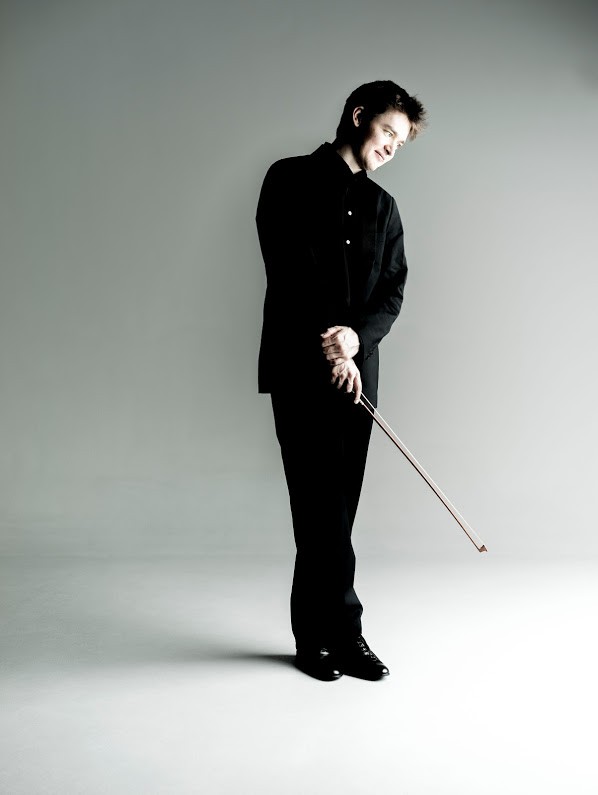
Hugo Ticciati is a violinist with a uniquely intellectual approach to his work, incorporating aspects of literature, philosophy, spirituality and meditation. He embraces the world of contemporary music, collaborating with composers such as Sven-David Sandström, Albert Schnelzer, Anders Hillborg, Djuro Zivkovic, Leonardo Coral, Andrea Tarrodi, Tobias Broström, Thomas Jennefelt, Sergey N. Evtushenko, Esaias Järnegard, Wijnand van Klaveren. In the coming seasons he will be performing world premières of concertos dedicated to him in Europe, Asia, and North and South America. Hugo also loves devising concerts and events that combine music with dance, literature and more obscure arts such as kinetic painting and rock balancing.

Last season’s highlights included concertos by Bach, Mozart, Prokofiev, Schnittke, Hartmann, Shchedrin, Piazzolla, Auerbach, Glass, Lutosławski, Takemitsu and world premieres of concertos by Tobias Broström, Sergey N. Evtushenko and Albert Schnelzer in venues including Carnegie Hall, Mariinsky Theatre Concert Hall, Chicago Symphony Hall and King’s Place. He also curated a series of concerts at the Wigmore Hall and the Muziekgebouw aan ‘t IJ, Amsterdam.

Read more about Hugo Ticciati

(Photo credit: Marco Borggreve)

Who or what inspired you to take up piano, and pursue a career in music?
I started with a local teacher, Art Richards, an amateur who loved music deeply. He gave me freedom to develop at my own pace, and in my own way. After a few years, I found that I could play more advanced repertoire, and it became self-motivating. I went on to study with Paul Strouse, who had been a pupil of Nadia Boulanger and Wanda Landowska. He demanded much more discipline and gave me a more well rounded musical education, preparing me for music school auditions.

Who or what have been the most important influences on your musical life and career?

My teachers, John Ogdon, Michel Block and Maria Curcio. Ursula Corning, a wonderful patron, sponsored my first recordings. Her support also enabled me to give my London debut recital.

What have been the greatest challenges of your career so far?

To balance practicing, teaching, performing and the promotional/admin side of the business.

Which performance/recordings are you most proud of?

I’m pleased with all the recordings I have released so far, but especially Scarlatti and Debussy.

Which particular works do you think you play best?

Anything that I feel I have a clear and personal vision of.

How do you make your repertoire choices from season to season?

I choose pieces to play based on trying to form balanced programmes, largely with core repertoire, circulating old, familiar works with pieces that are new and fresh for me.

Do you have a favourite concert venue to perform in and why?

In London it’s a toss up between Wigmore Hall, for its intimacy and history, and Kings Place, for its clear, detailed acoustics and fabulous design.

Favourite pieces to perform? Listen to?

I always enjoy programming Beethoven Sonatas. In each one there are awkward, angular passages, but his genius makes them works that are greater than they can be performed.

Who are your favourite musicians?

Anyone who plays with focus and integrity, pretty much in any genre.

What is your most memorable concert experience?

Playing Beethoven’s ‘Appassionata’ Sonata outdoors at the Holloway Arts Festival in London. The piano was amplified on a powerful PA system. As I tried to play quietly the sound technicians kept cranking the volume up. So when the sudden fortissimo passages came the dynamic was ear-splitting. I was told the piano could be heard three miles away.

What do you consider to be the most important ideas and concepts to impart to aspiring musicians?

Keep your musical standards high and concentrate.

What is your idea of perfect happiness?

Maintaining a steady 2 or 3 percent improvement every day.

Mark Swartzentruber performs music by Bach, Ravel and Schubert at Kings Place, London on Wednesday 2nd March. Further details here

Mark Swartzentruber has performed throughout Europe, the USA and East Asia. London appearances include solo recitals at the South Bank’s Queen Elizabeth Hall, Wigmore Hall, Kings Place and St John’s Smith Square. He has performed live on BBC Radio 3. He has also appeared on BBC Radio 4 and Classic FM.

Mark Swartzentruber studied under John Ogdon in the United States before moving to London to work with Maria Curcio, the eminent protégé of Artur Schnabel. A committed teacher and educator, he maintains a vibrant private practice. He is an external examiner and adjudicator for the Guildhall School of Music and was formerly a teacher at the Royal College of Music, Junior Department. He has given masterclasses and has adjudicated competitions in Britain, Ireland, the United States and Korea.

Swartzentruber’s début album, of Schubert Sonatas, was released by Sony to critical acclaim. Shortly afterwards he co-founded Solo Records, an independent label. His CDs, of Scarlatti, Haydn, Beethoven, Schumann and Debussy piano works, have all earned excellent reviews in the international music press.

As a broadcaster, Mark Swartzentruber appeared weekly on BBC Radio 3’s Sunday Morning programme, presenting historic recordings, as well as producing the show. He has also had music features commissioned by BBC Radio 3 and BBC Radio 4.

www.markswartzentruber.com


A chance to experience all of Mozart’s piano concertos. Not just the famous, much-loved ones, but all 27 of them, from his earliest forays of the form when he was still a boy to his mature late works. I was delighted to be invited to the launch lunch for this exciting new series at Kings Place and to have the opportunity to discuss it further with those involved, from the CEO and creator of Kings Place, Peter Millican, to the Chief Executive of the Aurora Orchestra, John Harte, conductor Nicholas Collon and members of the orchestra, including the indefatigable and endlessly creative principal violist Max Baillie.

As Resident Orchestra, Aurora collaborates with Kings Place to launch Mozart’s Piano in January 2016 – a five-year journey built around a complete cycle of the Mozart piano concertos. A onceinageneration opportunity for audiences to hear the whole cycle performed live by the same orchestra in single venue, this 25concert odyssey takes Mozart’s life, music and legacy as the starting point for a kaleidoscopic journey across centuries and musical styles in the company of a spectacular roster of guest soloists. 2016 will see the first seven concertos performed by pianists including John Butt (16 January), Robert Levin (23 April 2016), Cédric Tiberghien (17 September 2016), Lara MeldaMartin James Bartlett (both 16 December 2016), and Aurora’s own John Reid (19 March 2016), alongside a rich tapestry of other music from CPE  Bach to Peter Maxwell Davies via Haydn, Schubert and Ravel. Alongside Mozart’s Piano, Aurora also launches The LockIn – a linked informal late-­night series in Hall Two at Kings Place, offering audiences a chance to rub shoulders with the performers, and hear them follow the musical explorations of the main evening programmes in new and unexpected directions. (source: press release)

It is was deliberate decision on the part of the orchestra and creators of this series to have a wide variety of pianists involved in the concerts. Of course, no series focussing on Mozart and the piano would be complete with a contribution from pianist and noted Mozart scholar Robert Levin. Levin performs two concertos, Nos. 3 and 4, in a concert entitled Child’s Play on 23rd April 2016, and will be exploring Mozart’s talent for boundless and inventive improvisation. However, some of the pianists selected for the series may not, on first sight, seem natural Mozart players, and this aspect will add special interest and excitement of the series. By selecting young artists as well as more established and well-known musicians, new insights and angles on Mozart’s piano concertos will be revealed, with each musician bringing their own special voice and viewpoint to the music.

This a unique opportunity for total immersion in Mozart’s piano concertos and marks a significant, long-term project and investment by the Aurora Orchestra. It promises to be an exciting, stimulating and revealing series.

Further information and tickets here


Sunday morning coffee concerts devised
 by pianist Lucy Parham
Kings Place (Hall One), London N1

Following the success of the 2014/15 season of Word/Play, pianist Lucy Parham returns to Kings Place for another series of regular Sunday morning Coffee Concerts. Described by BBC Music Magazine as “one of the must-see events on the musical calendar”, the series celebrates the relationship between words and music, whilst exploring a variety of composers, genres and styles. 

‘I am delighted to present a third series of the Word/Play Coffee Concerts with my colleague, Lisa Peacock. I have always loved the combination of words and music and have tried to combine them both in a unique way for each concert. From the Celebrity Gala, via Just William, Beethoven and Rachmaninoff, I hope there will something for everyone to enjoy on a Sunday morning.’ – Lucy Parham

The series starts on Sunday 6th December, when Lucy will be joined by actors, writers, comedians and journalists for a morning of fun at the piano in the Word/ Play Celebrity Christmas Gala. The pianists will be performing from Schumann’s Album für die Jugend (Album for the Young), Op. 68, plus some festive surprises.

The line-up for the Christmas Gala:

Edward Fox actor

William Sharman Team GB athlete

Alistair McGowan actor

Sarah Walker BBC Radio 3 presenter

Alan Rusbridger former Editor, The Guardian and author of Play It Again

Richard Ingrams former Editor, The Oldie

Conrad Williams author

Stephen Boxer actor

Patricia Hodge actor

Niamh Cusack actor

Anneka Rice broadcaster
Cathy Newman Channel 4 News presenter

David Pickard Director, BBC Proms

Barry Wordsworth conductor, Special Guest

Further names to be announced

Iain Burnside presenter

Joanna David narrator
Lucy Parham piano

The Coffee Concert series continues on January 24 with Just William, Jarvis and Jeeves. Martin Jarvis, back by popular demand, brings his dazzling story telling gifts to Kings Place once again.   In The Outlaws and the Triplets, 11-year old William Brown finds himself masquerading as the elder brother of a trio of tots, and in the hilarious Jeeves and The Song of Songs, Jarvis (as ‘Bertie Wooster’) tells of a preposterously unpredictable musical entertainment. The musical accompaniment to both stories is composed and performed by the brilliant Richard Sisson.

Sunday 7 February sees A Morning with Beethoven: John Lill and John Suchet. Following their sell-out performance last season, internationally acclaimed pianist John Lill and Classic FM presenter and Beethoven biographer John Suchet will discuss the music and life of Beethoven, with John Lill performing two more popular Beethoven sonatas – No. 22 in F, followed by the No. 32 in C minor.

On the 6 March, national treasure Alan Titchmarsh shares his green-fingered love for all things horticultural in The Glory of the Garden, with readings from his own writings and others. Pianist and composer Richard Sisson joins him as the programme unfolds, including gems by Tchaikovsky, Chaminade and Billy Mayerl.

Known internationally for her ‘composer portraits’ in words and music, pianist Lucy Parham has created a new programme that chronicles the life of Sergei Rachmaninov –  Élégie: Rachmaninov, A Heart in Exile. Though he became an exile 1917, Russia remained deeply rooted in his soul. Rachmaninov’s cultural identity and his longing for his homeland imbue his music, not least the many much-loved works he wrote for his own instrument, the piano. In this Coffee Concert version Lucy Parham will be joined by renowned actor, Henry Goodman.

Venue: Hall One, Kings Place, 90 York Way, London, N1 9AG

Box Office:  020 7520 1490 / www.kingsplace.co.uk

Meet the Artist……Lucy Parham


