
Who or what inspired you to take up the piano and pursue a career in music?
I fell in love with music and the piano at about 4 years old when I first heard it played by a teacher at my kindergarten. I still remember that magical moment.
Who or what have been the most important influences on your musical life and career?
When I was about 12, I had a brief period of study with a concert pianist in Hong Kong who inspired me to see music as a vocation. I have been very fortunate to have studied with some wonderful teachers and mentors, including Joan Havill and Robert Silverman. The writings of Schumann, and letters of Brahms have also been a huge influence on me. Launching MusicArt in 2015 was a crucial step in my career which opened up many new opportunities to collaborate with, and commission works from, contemporary visual artists, choreographers, and poets, who shape my current work in music.
What have been the greatest challenges of your career so far?
It was a great challenge to combine performing with pursuing my doctoral research on the musical aesthetics of Schumann and Brahms at the Guildhall School/City University of London. Another challenge was launching MusicArt to collaborate for the first time with a painter, composer, and an art gallery. I learned from these two experiences to never give up and that challenges often lead to good things!
Which performance/recordings are you most proud of?
It was unforgettable to do a live broadcast for Classic FM from my own living room to commemorate Mozart’s 225th anniversary in 2016. It was very intimate yet reached out to so many people at the same time.
With my ensemble Minerva Piano Trio, I am proud of our year-long residency at St John’s Smith Square 2016/17. We joined forces to commission a new arrangement and dance choreography of scenes from Ravel’s Daphnis and Chloe for piano trio and dance. Our revival of the rarely performed Brahms’ Piano Trio in B major, Op. 8 (original version) was also one of the highlights for me during this residency.
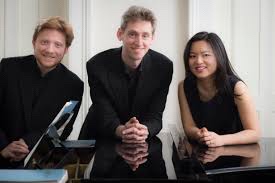
Minerva Trio © Anthony Dawton
Which particular works do you think you play best?
I tend to choose pieces that speak to me on a personal level. Dinu Lipatti once said that it’s not enough to like the piece you play, but the piece must also like you! I play a wide range of repertoire but have a soft spot for Schumann, Brahms, and Ravel. As long as I can make a connection with the sound world of a particular piece, then I feel inspired to share it.
It is thrilling to premiere a new work as there is a sense of freedom in communicating a piece for the first time. I love the collaborative aspect of working together with a composer, which is very creative and exciting. That connection I mentioned before then extends to a kind of real affinity with the composer. At the moment I am working with Hong Kong-born British composer Raymond Yiu.
How do you make your repertoire choices from season to season?
I build on my core repertoire every season. In the past, I would tend to be more composer-focused. If I started to play one piece by Schumann, I would then aim to cover his entire output in order to gain a better understanding of the composer’s language. These days I am interested in finding ways to create dialogues between different works in a programme.
While I love my core repertoire for concert programmes (for example, I will be playing Beethoven, Schumann, and Ravel at St Martin-in-the Fields in December), I am also constantly looking for new stimulants for something adventurous. For my next MusicArt concert I will present a world premiere concert-installation ‘Conceptual Concert in Three Acts’, inspired by the collaboration between Robert Rauschenberg and John Cage and performed within an exhibition of their works at Galerie Thaddaeus Ropac. It will involve the music of John Cage, an installation of sound and spoken dialogue, and a new musical work created in collaboration with composer Raymond Yiu and poet Kayo Chingonyi.
Do you have a favourite concert venue to perform in and why?
I had a fantastic experience playing Arvo Pärt’s Fratres at an open space outside Central St Martins for a fashion show in London with a few hundred people in the audience. Since then I am happy to play anywhere as long as it is aesthetically pleasing or stimulating to the senses in some way, not just acoustically.
Who are your favourite musicians?
I have huge admiration for Leonard Bernstein, especially since I discovered his Eliot Norton lecture series, The Unanswered Question. He said, ‘The best way to know a thing is in the context of another discipline.’ Like other great musicians, he reminds one that music and humanity are inseparable.
What is your most memorable concert experience?
For me, playing Beethoven’s Emperor Concerto at LSO St. Luke’s in London was as special and memorable as playing John Cage’s 4’33” while silently reading a poem at an art gallery. I don’t think I can choose between the conventional and creative approach to playing concerts, as I love both.
As a musician, what is your definition of success?
Success is constantly achieving what I set out to do. It’s important to me to generate creative ideas on a regular basis, work with people whom I admire, and create unique experiences for the audience. When I can do these things continuously at a high level, then I am happy.
What do you consider to be the most important ideas and concepts to impart to aspiring musicians?
Treat music as an art form that demands the utmost dedication and discipline. Career is by no means guaranteed. After you finish training and studying at the conservatoire or college, your colleagues and collaborators become, in a way, your teachers. Learn to listen through playing with others.
What is your most treasured possession?
The Yamaha C3 grand piano that I have had since I was 12. It has travelled with me from Hong Kong to Vancouver to London. I had wanted a grand piano from the very beginning, and my mother promised if I reached Grade 8 she would buy me one. It turned out she started saving for it from the day she promised, so she could afford it, just in case! That was a great motivation and I made sure to get it as quickly as possible.
Video links:
Debussy – https://www.youtube.com/watch?v=epJymUc2rDY
Brahms: Intermezzo in A major, Op. 118, No. 2 https://www.youtube.com/watch?v=OImMONM78TI
Music by Arvo Pärt – Für Alina
Poem by Zaffar Kunial – Sunlight
https://www.youtube.com/watch?v=iG-g7bfLpec
ERDEM
London Fashion Week SS14
Annie Yim, pianist
Richard Birchall, cellist
https://www.youtube.com/watch?v=4rTeQ8Iaqnc
John Cage the Lover and Poet (audio)
OR
John Cage Dream (1947)
https://www.youtube.com/watch?v=PEknsWJLp-o
Scenes from Daphnis and Chloe (2017)
Minerva Piano Trio
Thomasin Gülgeç, dancer
Estela Merlos, dancer





 The Cross-Eyed Pianist