I am a great admirer of Japanese pianist, Mitsuko Uchida. Not just her exquisite touch, and sensitivity to the score, but also her ability to bring intimacy even to the biggest performance spaces – as she did in her concert at the Royal Festival Hall on 7 March, part of the Southbank Centre’s excellent International Piano Series.
Read my review of her magical performance of Bach, Schoenberg and Schumann here
Just five minutes from Waterloo Station is the splendid 1901 Arts Club, an elegant venue that seeks to recreate the “salon culture” of 19th-century Europe. The building, a former schoolmaster’s house built in 1901, retains its late Victorian exterior, while inside the richly-decorated rooms suggest a private home. There is a comfortable upstairs sitting room and bar, and an intimate recital area downstairs, with a medium-sized Steinway piano set against a backdrop of gold swags and tails. The staff are welcoming and friendly, and the whole ambience is that of a private concert in your own home. It made for a very unique experience of the first book of J S Bach’s Well-Tempered Clavier, performed by Japanese pianist Kimiko Ishizaka.
Ms Ishizaka is on a mission to bring Bach to the people and to make his wonderful music accessible to everyone. Her Open Goldberg Variations, a crowd-funded (via Kickstarter), non-profit project that created a high-quality recording, typeset score and iPad app all free to download, is a fine example of her democratic approach.
Bach composed his Well-Tempered Clavier “for the profit and use of musical youth desirous of learning, and especially for the pastime of those already skilled in this study”, in effect the forty-eight Preludes and Fugues are technical studies or Etudes, and were probably never intended to be performed as concert pieces. But in the years since their publication, the “48” as they are also called, have come to be regarded as some of the finest writing for keyboard. The works offer great variety of styles, structure, textures, colours, and moods, all of which Ms Ishizaka demonstrated in her performance.
In a concert lasting nearly two hours (with an interval), we experienced a committed and intense performance in which Ms Ishizaka highlighted the shifting moods and soundscapes of Bach’s writing. A serene opening Prelude in C Major (the most famous of the entire 48) launched us on a journey of discovery through dances and chorales (D minor and B-flat minor Preludes), joy and yearning (C-sharp major and F minor Preludes), sunshine and sadness (D major and C-sharp minor Preludes), seriousness and serenity (E mjaor and C minor Preludes). Ms Ishizaka eschewed the pedal throughout, though not through any wish to present a historically authentic performance. Rather, she did not need it: her superior legato technique created some exquisite cantabile playing, especially in the slow movements, while sprightly passagework and lively tempi gave the suggestion of the harpsichord in the rapid movements. Her sense of counterpoint was well-defined in the Fugues, with clear lines and distinct voices.
Ms Ishizaka is not afraid of robust fortes, perhaps sometimes too robust for the size of the venue, but overall her dynamic range was varied and colourful. There was judicious use of rubato in the Preludes, and some rather fine highlighting of dissonances and unusual harmonies, showing the forward pull of Bach’s musicial vision. Although a rather long evening of music, it was a fine lesson in Bach’s compositional thought, presented in an elegant and powerful performance.
Who or what inspired you to take up the piano, and make it your career?
The inspiration to play piano came to me at the age of four when my mother first placed my tiny hands on the keyboard and pushed my fingers down with hers, thus teaching me the first piece I learned, the Minuet BWV 114 from Anna Magdalena’s Notebook, which at that time we still believed to be a piece by J.S. Bach. I say inspiration, but really it was a decision: a decision, that I would be a pianist, which was probably made before I was born.
The more interesting moment in time is the point at which I actually embraced my future and identity as a pianist. Certain experiences in my life, which began at university, contributed to my actively making the decision to become a musician for myself: the first time I really connected with an audience as a soloist (my early years were dominated by chamber music); having success at sports; learning a second language: these are all things that I needed to experience before I could embrace fully embrace the decision to be a pianist.
Who or what were the most important influences on your playing/composing?
Everybody’s playing is a conglomerate of personal experience, and memories. I cannot name any single influence. However, there are many small clues that added up over time to lead me down a road of exploration that eventually allowed me to find my own voice as a pianist.
My experience as a weight lifter taught me that the millimetre matters, that a small change in the shift of your balance can mean the difference between success and failure. Also, my music school professor, Roswitha Gediga, would admonish me to relax my shoulders, to get to the bottom of the keys, and would demonstrate this to me in my lessons.
Those experiences and memories led me to deeply explore the physical aspect of my playing. And in the sanctity of my practice room, with the requisite time for exploration, I’ve looked at my playing and progressively learned about the physical mechanics of piano technique. You can’t do that type of exploration when you’ve got one 70-page chamber piece to get through after the next, where you really can’t ever find the time to get into the detail of each motion.
What have been the greatest challenges of your career so far?
Every new piece that a pianist learns is a great challenge. It’s never the same set of problems twice, but this is a good thing, really. It keeps it fresh.
One challenge came at the point when I stopped playing in the chamber ensemble that occupied the first 17 years of my career. We had been playing up to 50 concerts a year and that number pretty much went to zero for me overnight when we quit. So while it was a profound change in the rhythm of my life, it afforded me the space and peace to finally embrace my identity as a pianist and make it my own.
Which performances and recordings are you most proud of?
I am most proud of my recent solo recording from the Open Goldberg Variations project that completely occupied the last two years of my life. It was a large project that involved many more people than just myself, and we produced something that is truly new and beautiful.
The recording of J.S. Bach’s Goldberg Variations is now in the public domain, as is the new engraving of the score of the piece, which I assisted in editing. People can get this recording directly from the Open Goldberg website – www.opengoldbergvariations.org – and enjoy the full freedom of a public domain work. That means you can download it, share it, and even use it as the starting point for new creative works.
Do you have a favourite concert venue to perform in?
Any hall with a Bösendorfer and an attentive audience.
I recently played in the Shalin Liu Performance Center in Rockport, Massachusetts. The hall features a window behind the performer that looks out over the ocean. I liked that quite a bit because as I was warming up during the day, all sorts of birds were swimming in the water right below me.
There are some halls on my wish list as well. From the photographs I imagine that it is divine playing in the Snape Maltings Concert Hall in Suffolk.
In the end, music is this ephemeral thing with a very strange heartbeat of its own. When it’s a good performance, the music is all that matters. So whether it’s a large audience or small, whether the piano is working with you or against you, and whether the hall is resonant or dull, the pianist only has the music to think about in every case.
Favourite pieces to perform? Listen to?
Music is a very personal thing. I recently performed a concert that was half Bach and half Chopin. It was interesting to me after the concert to listen to the audience members debating amongst themselves whether the Bach part or the Chopin part was the better, more enjoyable half.
Just like the audience at that concert, I have my personal preferences. I seek out the pieces that speak to me in the most profound way. The piano repertoire is very large, and there is far too much for anybody to play in a lifetime. So I have focused on a few composers to whom I have the closest relationship. This includes Bach, Schubert, Debussy, and more recently, Chopin. This is something that will certainly continue to evolve.
Who are your favourite musicians?
There are many, of course, though I don’t listen to recordings nearly as much as one would expect. One of the most inspiring concerts I’ve attended recently was Radu Lupu performing Schubert and Schumann in Amsterdam.
What is your most memorable concert experience?
When I was 11, the trio I played in with my brothers debuted at the Sogakudo Concert Hall in Tokyo. At the time all three of us played both piano and a string instrument – mine was the violin. We played every combination of violin, cello, and piano music possible, including 6-handed piano.
What I remember distinctly was the audience’s extreme enthusiasm for what we had done. Many of them had brought flowers, and they placed the bouquets on the stage as we played successive encores. By the end there were over 30 bouquets, and this made a strong impression on me as a child.
What do you consider to be the most important ideas and concepts to impart to aspiring musicians?
Be yourself. Attending your 20th masterclass won’t make you any smarter than the 19th did. Study the music, the actual piece. Not someone’s analysis of it, or the composer’s life, or the 10 other pieces that were written at the same time. The piece is supposed to stand by itself, and it’s got its own message, but you need to take the time to find it.
What do you enjoy doing most?
Taking walks in the fresh snow. When the snow and ice go crunch under my feet I experience an advanced elevated state of happiness that cannot be equalled by anything.
German-born Japanese pianist Kimiko Ishizaka performs the first book of Bach’s Well-Tempered Clavier at the 1901 Arts Cub, London on Wednesday 30th January. Further information and tickets here
Claude Debussy – Images Books I & II, Images oubliées
Toru Takemitsu – Les yeux clos, Les yeux clos II, Rain Tree Sketch, Rain Tree Sketch II
Rika Zayasu, piano
To celebrate the 150th anniversary of the birth of Claude Debussy, pianist Rika Zayasu has released a CD of two books of Images and Images oubliées, and four pieces by Japanese composer Toru Takemitsu.
Recorded at St Bartholomew’s, Brighton, this CD is produced and mastered by Claudio Records, using their new ‘Q-Lab Sound/192-Stereo High Definition Audio’, a technique which results in a remarkably pristine and natural quality of sound (undoubtedly helped by the fine acoustic of the recording venue and the quality Steinway instrument). CDs produced using this technique can be played on high-quality DVD-Audio equipment and Blu-Ray surround sound systems.
Rika plays with great sensitivity, displaying grace and precision in touch and use of pedal, and her understanding of Debussy’s music is clear from the range of musical shadings, nuances, colours, articulation and rhythmic vitality she brings to these works. The first Image from Book I, ‘Reflets dans l’eau’, is supple and fluid, with a rippling, luminous treble over a rich bass, which never overpowers. The oriental elements of this music (as in the other pieces in this suite) are highlighted, reminding us of Debussy’s fascination for Japonisme and eastern gamelan music. ‘Hommage à Rameau’ is haunting, stately and antique, its tempo relaxed but not dragging, so we never lose a sense of its structure, underpinned by the underlying 3-in-a-bar pulse, with some beautifully paced climaxes (again, evident in other works on the CD). ‘Mouvement’, in contrast, is sprightly and animated, with bright, joyful, bell-like sounds which continue into ‘Cloches a travers les feuilles’, in which Debussy evokes the sonorities of bells and carillons, and Far Eastern percussion. Here, there is some lovely, subtle highlighting of the internal melodic lines of this complex music. ‘Poissons d’or’ is vibrant and colourful, shimmering and characterful.
The Images oubliées are more introspective (Debussy described the pieces as “not for brilliantly lit salons … but rather conversations between the piano and oneself.”) . The ‘Lent’ is expressive and melancholy, while the ‘Sarabande’ (later reworked for the middle movement of Pour le Piano, with a few adjustments to harmony and phrasing) moves with a solemn, ancient elegance, with some lovely bright, clean fortes in the climaxes on the final page of the music. ‘Tres Vite’ is humourous, with toccata-like qualities which recall both the ‘Prelude’ and ‘Toccata’ from Pour le Piano, and ‘Jardins sous la pluie’ from Estampes.
The four pieces by Takemitsu perfectly complement the works by Debussy, and are related to them in the use of titles to stimulate the listener’s imagination. Les yeux clos (The Closed Eyes – three pieces in total) are inspired by a lithograph by the French symbolist artist Odilon Redon, which depicts a bust of a woman whose eyes are closed. It suggests a dream or inner world. Takemitsu’s music reflects this in the use of fragmented melodies over sustained pitches, with flexible durations, which freely connect to one another. Similarly, the Rain Tree Sketches were inspired by a poem by Japanese novelist, and friend to the composer, Kenzaburo Oe, which describes ‘the clever rain tree’, an ancient tree whose thousands of tiny leaves collect and store rain water, so that after the storm has passed, rain continues to fall from the tree. Precipitation is suggested through single droplets of quiet, lone sustained notes and sudden dissonant clusters of sounds, as if shaken from saturated branches.
All four pieces are played with immense control and insight. Soft, pastel-coloured sound showers and radiant trebles chime over rich bass sonorities and pedal points, while the silences are as carefully judged as the notes between them. These pieces are evocative and ethereal, their transcendental nature emphasised through the precise use of pedals, and the pianist’s ability to allow sounds to resonate and ring, or fade to nothing, which create an exquisite sense of stillness.
The Cross-Eyed Pianist is free to access and ad-free, and takes many hours every month to research, write, and maintain.
If you find joy and value in what I do, please consider making a donation to support the continuance of the site


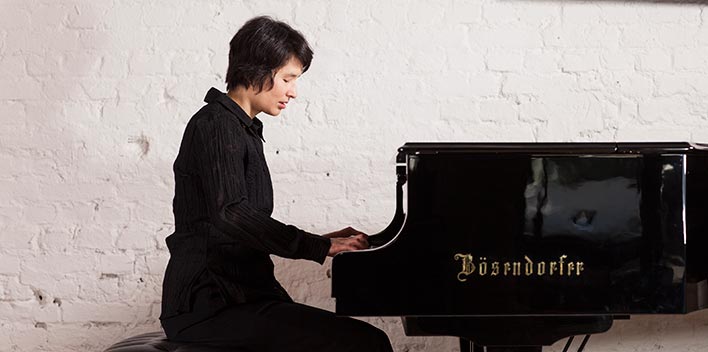 Who or what inspired you to take up the piano, and make it your career?




 The Cross-Eyed Pianist