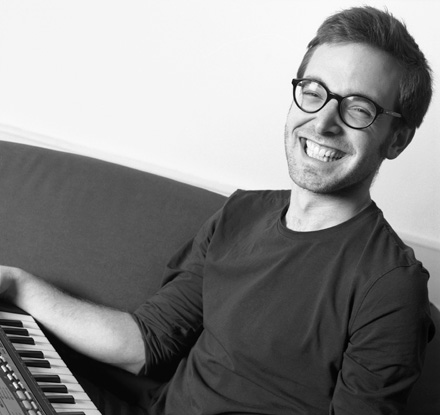
Who or what inspired you to take up the guitar and pursue a career in music?

Growing up in an opera family it sounds strange to fall in love with guitar, but all my life I was fascinated with Spain and Spanish music. I learnt piano from earliest childhood – and I could have stayed with it playing Granados, Albeniz etc, but I guess it was the attraction of this instrument that you can hold in your arms, carry with you and physically feel the vibrations that made me want to become a guitarist. Nothing between you and the sounds your fingers make with the strings, no bow or other “tools” to start the vibrations and it is the most “touching” instrument existing!

Who or what were the most important influences on your musical life and career?

Without the courage of my first teacher, Professor Heinz Teuchtert who later confessed that he liked the interesting case to bring a complete musician with no experience on the guitar within one year from zero to University I would not answer your questions today. I had my first guitar lesson with 18!! I soon started to work as chamber musician and to play all kind of plucked instruments in opera houses. Then I met Pepe Romero who changed my life completely, turning me into a full soloist!

Musically I always feel my opera roots, it is all about singing with your instrument!!!

What have been the greatest challenges of your career so far?

To handle all the rejections you receive when you start to become a freelance indie-classical, between clear “No” to you or to the guitar itself. And I write hundreds mails to presenters and promoters around the world every year…. It is a big challenge not to take it personal. My mantra: “Every “no” brings me closer to the next “yes”

Which performance/recordings are you most proud of?

It was a highlight to be part of the opening festival of the Salzburger Festspiele last year- I am proud to play at all the places which are devoted to music and where very few guitarists appear. We have a vivid culture of guitar festivals but it is like an “ivory tower”, I am so happy of my concerts in “real world” feeling like an ambassador for classical guitar.

Recordings? You can’t really earn money with CDs anymore, so why not do something idealistic? I will be very proud of the newest, featuring female composers.

Which particular works do you think you perform best?

No secret, I LOVE Spanish music (and almost no concert without ‘Recuerdos de la Alhambra’)…. and I am trying more and more to connect my roots of opera and all my piano years with guitar.

How do you make your repertoire choices from season to season?

Some programs stay for years, just with exchanging some pieces. Yes, and people book me again with similar programs because the loved it and guitar recitals still are rare in many concert series, so they love to repeat what worked once. It is different from piano world I guess.. I have tried to offer a big variety of programs in the last ten years, but I got almost no bookings for example with tango or really contemporary music, so it is by far to much work to keep them in my portfolio. Maybe it also that I am already considered specialist for Spanish music and those hyper-classical programs. And it is music I deeply love, so I am in the happy position that the music I get booked the most is the music I love to play the most!

Do you have a favourite concert venue to perform in and why?

I LOVE venues with historic flair, especially castles – they add a magical atmosphere to the music!

Favourite pieces to perform? Listen to?

Recuerdos de la Alhambra already became my signature piece, playing it in almost every concert and never getting tired of it…

To listen to I need regular doses of Mozart and all kind of operas!

Who are your favourite musicians?

Emil Gilels, Artur Rubinstein, Marta Argerich, Tzimon Barto, Fritz Wunderlich (eternal: Dichterliebe), Maria Callas, Nathan Milstein, Julian Bream and of course Pepe Romero.

When I pack my bags for concerts I listen to Vicente Amigo or Yasmin Levy!

What is your most memorable concert experience?

The moment when I was completely alone in the Alte Oper Frankfurt preparing my banjo etc for Shostakovitch Jazz Suite, and Tzimon Barto came on stage and played his encore for the evening, the Albeniz ‘Tango’, just for me with a smile, a magic gift of pure beauty.

What do you consider to be the most important ideas and concepts to impart to aspiring musicians?

Oh my god, I hope you know what you are doing to your life: Insecurity (also financially), difficult family life, loneliness— and on the other hand magic experiences, inspiration, pure bliss. Be prepared for a wild rollercoaster that will challenge you in all aspects of your life and your personality .

So the most important advice: Treat yourself like if you were an olympic athlete, you are your own coach, mental coach, cook and doctor!

Where would you like to be in 10 years time?

I will be performing regularly in the small halls in the big venues – and in 40 years I hope to be the “grand old dame of the guitar” still playing concerts with the unbelievable wisdom of age.

What do you enjoy doing most?

Spectacular answer: Playing guitar!!!!

What is your present state of mind?

Balanced, full of courage, happy and completely addicted to this wonderful crazy life.

Heike Matthiesen is one of Germany’s leading guitarists whose virtuosity and spirited performance, coupled with a charismatic stage presence, are regularly highlighted by the press.

Born in Braunschweig, she received comprehensive musical training on the piano at an early age and only took up the guitar when she was 18. About a year later, she started studying at the Frankfurt Conservatory. Pepe Romero, who taught her for several years, was the formative influence on her playing.

In addition, she attended a large number of master classes, inter alia with Manuel Barrueco, David Russel, Roland Dyens, Alvaro Pierri and Leo Brouwer.

Apart from her solo commitments, Heike Matthiesen regularly performs with chamber music ensembles, and since 1997 she has been closely affiliated with Villa Musica Mainz. She has appeared with Los Romeros and, in 2005, recorded a CD with the Spanish Art Guitar Quartet (“Bolero”, NCA).

Heike Matthiesen has performed in many different countries, including the US, Russia, Japan, China, France, Spain, Italy, Poland, Iceland, Austria and Bulgaria, and is a very welcome guest at festivals and in guitar concert series.

She has had two recordings with Tyrolis, on “Sol y luna” with a Spanish-South American repertoire and “Tristemusette”, an internationally acclaimed portrait of Roland Dyens.

heikematthiesen.com


(Photo: Allan Jenkins)

Who or what inspired you to take up singing and pursue a career in music?

We had a large selection of Maria Callas recordings when I was growing up, which inspired me a great deal. I thought that if I could achieve even just 1% of the vocal and communicative power that she possessed, then I would be very happy. I also could not have begun to study music without the unfailing support of my mother.

Who or what were the most important influences on your musical life and career?

In terms of live performances that were formative in my early love of opera, I would have to cite Joyce DiDonato’s much-feted Rosina at ROH in 2006. She is a singer whose attitude I admire greatly. I think she is a living shrine to professionalism, and is an absolute queen on stage. Similarly I followed Renée Fleming’s ‘Thaïs’ in 2007 from ROH to the Lincoln Centre, as I just couldn’t get enough of her poise and vocal clarity. And during that same season I went three times to see Dessay/Florez’s ‘La Fille du Regiment’, which I found endlessly gorgeous and beautifully executed. I saw these performances when I was just beginning to study opera and they were incredibly influential. They were all witnessed from the standing gallery and this in no way limited their impact on me. (I diverge but, when people tell me that opera is expensive, I have always to remind them that most of these world-class performances can be experienced for the meager cost of £6 if you’re a student, and only about £10 more if you’re not…!)

More recently, witnessing at close hand Krassimira Stoyanova’s enchanting Marschallin was a huge inspiration. And one singer whose recordings have always been top of my wish list since I was a teenager are those of Cecilia Bartoli. Both her song and opera recordings are always so cleverly and sensitively curated, and I admire very much all of the work she has done to bring to light many of the lesser-known late Baroque composers. Getting to see her live for the first time last summer at the Salzburg Festival in her hero role as La Cenerentola was a dream come true!

What have been the greatest challenges of your career so far?

I have been very blessed with a full compliment of incredibly supportive friends and family, and so any challenges I have faced have been greatly minimised by the simple unwavering encouragement of this support system. Of course, as musicians we face daily internal ‘challenges’, but really these are best embraced, because they cause us to think creatively about our profession. To paraphrase one of my heroes above (Ms. DiDonato), we aren’t surgeons; we aren’t tasked with the daily responsibility of protecting people’s lives and livelihoods. We have responsibilities – yes – and sometimes very big and important responsibilities, but our job as artists is to practise hard and to bring joy into people’s lives through the music we sing and interpret. We are just vessels after all, and I reckon that if we overestimate our importance within the general scheme of things, then this in itself can lead to unnecessary challenges. Far better to put our time into learning our craft flawlessly and not to worry (too much!) about the challenges along the way, I think.

Which performance/recordings are you most proud of? 

I was thrilled last summer to get to perform one of my favourite bel canto arias last summer with the Camerata Salzburg, ‘Il segreto per esser felici’ from ‘Lucrezia Borgia’. I am proud of this performance and recording mainly because of how utterly stunning the orchestra sound! I felt very fortunate indeed to be on a stage with such an esteemed group of musicians (including Maestro Theodor Guschlbauer).

Which particular works do you think you perform best?

My very favourite composer both to sing, and in general to know about and learn about, is of course Mozart. It so happens that many of his travesti roles (Cherubino, Annio, etc) sit in a comfortable range in my voice, but actually learning to sing Mozart is, for any singer, a veritable masterclass in the operatic artform. This obviously isn’t an unusual opinion but I cannot recommend the study of Mozart highly enough.

I also adore a wide range of operetta, particularly Offenbach (especially because he wrote so many excellent and well-drawn mezzo roles), but truly my all-time favourite opera would have to be Carmen! This was another one I was exposed to an early age (as are many people I imagine), and I never cease to get goosebumps during almost every number when I hear it performed live. Anita Rachvelishvili’s Carmen at the Met last season is my newest favourite!

How do you make your repertoire choices from season to season?

I suppose as opera singers we have little choice over what we are cast in (within reason), but I feel very lucky to have recently had more time to put together a number of my own recitals in recent months. In terms of choosing song repertoire, well I have always loved Schumann’s ‘Frauenliebe und –leben’, and so I had been desperate to sing this for a while. I have performed it twice now in the last year but I still don’t feel as if I have scratched the surface. As the Schumann cycle is only 25 minutes long, I had been searching for something to pair it with, and a lovely friend recommended to me Shostakovich’s ‘Spanish Songs’. I have always enjoyed Shostakovich’s symphonic works but had never sung anything of his, so I very much enjoyed studying these charming pieces from an academic as well as a musical perspective. They are Spanish folk songs, translated into Russian, and while mainly sung by women, are written from a male perspective. I undertook my own English translations of them – a project which gave me endless joy.

Do you have a favourite concert venue to perform in and why?

In terms of recital venues, I very much enjoy singing at St. James’s Piccadilly. It has such a warm acoustic and is visually breathtaking (designed by Christopher Wren). Another incredible Wren venue is the Painted Hall of the Royal Naval College, which is fairly echoey, but visually arresting. One of my favourite venues in the world is the Musikverein in Vienna, which I have not yet performed in, but in which I was lucky enough to rehearse last year with the Wiener Philharmoniker. The Musikverein is heavenly-looking, and also has such a rich history, from Bruckner to Brahms.

Another jaw-droppingly beautiful venue that I have performed in is the theatre at Giardini La Mortella, a roman-style amphitheatre carved into a mountain on the island of Ischia. This was the residence for many years of William Walton, and still boasts his wife Lady Walton’s sensational walled gardens.

Favourite pieces to perform? Listen to?

To perform, it would have to be Mozart, Handel, Offenbach, Tchaikovsky, and Britten. And of course ‘Der Rosenkavalier’, which I think is one of the most transcendent pieces of art (words and music) ever to have been made.

To listen to, I would have to choose Ashkenazy’s famous Chopin recordings on Decca from the 1980s. They are so precise and yet so full of life – a very inspiring combination!

Also, my new absolute favourite piece ever written or performed is Jake Heggie’s ‘Camille Claudel: Into the Fire’, performed with complete fervour, tenacity, and vocal majesty by Joyce DiDonato earlier this year. I am deeply in love with this music, poetry, and Ms. DiDonato’s rendering of it. It is recorded on a CD entitled ‘Here/ After’, and I would very strongly advise everyone to buy and listen to this!

Who are your favourite musicians?

Apart from the singers I have already mentioned variously above, I have also to include Grace Bumbry, Monsterrat Caballé, Fiorenza Cossotto, Sophie Koch, Elina Garanca, Jennifer Larmore, Sarah Connolly, Anna Netrebko, Stephanie Blythe, Thomas Hampson, Placido Domingo, Jonas Kaufmann… The list goes on! In terms of musicians from other styles I would choose Sarah Vaughan, Kurt Elling, and Jennifer Pike, who I recently saw in concert and was totally in awe of!

What is your most memorable concert experience?

This wasn’t exactly a concert per se, but the most memorable moment of my nascent career to date (memorable mainly for the combination of abject terror I felt in the minutes leading up to it, and the complete relief I felt for the hours after it!) was opening the International Opera Awards in 2014. I sung Rossini’s ‘Cruda Sorte’ and was incredibly nervous about performing this characterful and fast-moving aria in front of an audience of 800 of the world’s opera singers, intendants, creatives, and critics (!). But I was so grateful for this priceless opportunity, and I have my sponsors at the International Opera Awards, and my fairy godmother (you know who you are!) to thank for this incredible experience.

What do you consider to be the most important ideas and concepts to impart to aspiring musicians?

The thought that has been the most useful to me is the idea that this is a marathon, and not a sprint. Once we have learnt a little bit about music and the whole funny business of being on stage, the next part to tackle is our stamina, and also our attitude; to always remind oneself of the big picture is a very important tool.
 British-American Mezzo Soprano Phoebe Haines studied at the University of Cambridge where she obtained a Double First Class Degree, and recently completed her MMus at the Guildhall School of Music and Drama under the tuition of John Llewelyn Evans. She continued her training at the Guildhall as a Fellow in 2014/15, and was also a 2015 Opera Works trainee at the English National Opera. 

In 2014, Phoebe became a Britten-Pears Young Artist, partaking in the Aldeburgh English Song Project. Also in 2014 she was named a Concordia Foundation Artist, an Iford Arts Young Artist, and a Salzburg Festival Young Artist.

Last summer, Phoebe made her debut at the Salzburger Festspiele as Zweite adelige Waise in Der Rosenkavalier conducted by Franz Welser-Möst, and as Tisbe in La Cenerentola für Kinder, a co-production with Teatro Alla Scala. She participated in many concerts during her time at the Festival, including a concert of arias with the Camerata Salzburg under Theodor Guschlbauer, and sang in master classes with Thomas Hampson and Helmut Deutsch. Her engagements with the Festival also took her to Castell Son Claret, Mallorca, where she sang in their annual gala concert, ‘Opera Under the Stars’.

Also a talented recitalist, Phoebe has given recent performances at 22 Mansfield Street, the Pushkin House, Castell Son Claret, Villa Ephrussi de Rothschild, Villa Kyrélos, Giardini La Mortella, Villa Del Balbianello, Belvoir Castle, Bloomsbury Ballrooms, the Handel House Museum, Christ Church Spitalfields, The Savoy Chapel, Asia House, the British Embassies in Rome and Budapest, and the Lebanese Embassy in London. She performed Schumann’s Frauenliebe und -leben at St. James’ Piccadilly in October 2014 for the Concordia Foundation, along with her own translation of Shostakovich’s Spanish Songs. She is a passionate advocate for charitable causes, and very much enjoys working for Concordia Foundation on a number of outreach projects at Chelsea and Westminster Hospital.

Phoebe opened the International Opera Awards on April 7th 2014 and has performed at many other events throughout 2015 under this auspice. This summer, Phoebe returned to Austria to join the prestigious American Institute of Musical Studies in Graz, where she was a finalist at the Graz Meistersinger Competition, under the direction of conductor Karen Kamensek. Phoebe worked with the legendary Montserrat Caballé in masterclass in September 2015 at the Auditorio Zaragoza, Spain. In September and October 2015, Phoebe takes on two modern cantatas: Britten’s Phaedra in London, and John Eaton’s El Divino Narciso in New York. She then goes on to sing the countertenor role of Katte in Scott Wheeler’s critically-acclaimed Sorrows of Frederick for Center for Contemporary Opera, NYC.

phoebehaines.co.uk

Who or what inspired you to take up the guitar and make it your career?

Well, mostly luck! A music teacher heard me attempting classical guitar at school, and put me in touch with Sasha Levtov, a Russian émigré who organises a small music school, a recital series, and a guitar club, in my hometown, Bognor Regis. And that was it – I was hooked!

Who or what were the most important influences on your musical life and career?

When I took up lessons, I became a regular at the West Sussex Guitar Club. There were regular club nights, a mix of food, impromptu ensemble playing, and an informal stage to air the latest work. These evenings, and my lessons, entered the bloodstream – I saw music as a social art, a way to bring people together and participate in something positive. More recently I lived for a year (on a sofa) with two composers and a modern artist – that exposure to current ideas stretched the imagination quite wildly…

What have been the greatest challenges of your career so far?

Arriving at the Royal College of Music came as a huge jolt to the system… in London I was painfully conscious of being a very little fish indeed. Changing tutor was hard, and being in the city, acclimatising to a new life, affected me profoundly. I had an extremely painful first year at the RCM.

I suppose the biggest technical challenge has simply been reconciling lute and guitar technique. I’m proud that most lutenists like the sound I make, even using fingernails!

Which performance/recordings are you most proud of?

The next one!

Which particular works do you think you perform best?

I think that the most rewarding thing about music is that it invites you to enter the mindset of a composer – his world, imaginary and historical. Different composers have articulated so many things in wonderful ways. That said, I have a soft spot for John Dowland

How do you make your repertoire choices from season to season?

It’s usually the case that I have a project on the go – a big performance or a concerto, or a specific project focusing on a composer. Simply, I have a very long to-play list!

Do you have a favourite concert venue to perform in and why?

In a sentimental mood, the Recital Hall in Bognor Regis. It’s a venue that has seen some world-renowned performers – for me, it’s the first stage I was acquainted with. I do still perform there very frequently.

I played some time ago at Bolivar Hall – the venue attached to the Embassy of Venezuela – in a series organised by Alberto Portugheis. Because of its size, sober tone, and impeccable acoustic, the atmosphere is just perfect for the guitar.

Favourite pieces to perform? Listen to?

Bach’s Suite BWV 997 (the “second lute suite”) is a great honour to play – a huge journey. I’ve loved performing Rodrigo’s Aranjuez, too, it’s very exhilarating.  

My all-time favourite works are Schnittke’s Requiem, Beethoven’s 6th, the Schubert’s ‘Arpeggione’ Sonata, and Pink Floyd’s Dark Side of the Moon!

Who are your favourite musicians?

Some performers are magic: Fritz Wunderlich; Meredith d’Ambrosio, a Jazz singer with a dark, smoky voice; Pavel Steidl, wild-eyed Czech guitar genius with firework humour; and pianist Dinu Lipatti.

What is your most memorable concert experience?

Bernard Haitink and the Chamber Orchestra of Europe performed Beethoven’s 6th this year at the Barbican… I danced in the street on the way home.

What do you consider to be the most important ideas and concepts to impart to aspiring musicians?

I can’t really say with something so individual… For me, a thirst for knowledge, making imaginative connections, and empathy. Music should be alive and exciting. And always necessary are a sense of humour – and patience!

What are you working on at the moment?

The next big project is putting together a concert and talk on Schubert on the guitar: Lieder, poetry and the Arpeggione Sonata!

What is your idea of perfect happiness?

Happiness isn’t a state or an acquisition, it’s a process – it arises like steam from the way in which we live our lives. It isn’t something to be chased and nailed down: it comes from the way we act, the smiles we give, the work we do. So in this way, happiness is to live, to make the most of the challenge.

What do you enjoy doing most?

RCM guitarists have just established Fika, which is the Swedish verb to have a coffee, with some sort of sweet, with friends, and one or two idle hours. I think Schubert would approve!
Classical guitarist Sam Dixon Brown has earned a reputation for “flair, personality and confidence” with his performances in the UK and abroad.

Winner of the 2011 Chichester Festival Award, the 2012 West Sussex Youth Music Award, and the 2013 Worthing Concerto Competition, Sam studied at the Regis School of Music with Sasha Levtov, and at the Junior Royal College of Music, under full bursary. He is presently a pupil of Charles Ramirez (guitar) and Jakob Lindberg (lute) at the Royal College of Music in London, where he combines his studies with a burgeoning musical career.

www.sambrownguitar.com

francoise

Who or what inspired you to take up the piano and pursue a career in music?

As a kid, my parents asked if I wanted to play an instrument. I loved the saxophone but teachers said I was too small for it so I turned to the piano instead. I was six and I loved it. At the age of 13, I eventually took saxophone lessons and have enjoyed playing it since but piano always stayed my main instrument. It was definitely chamber music experiences that made me decide to become a professional. The idea of sharing the music not only with an audience but also with other performers on stage was the most beautiful thing I could imagine.

Who or what were the most important influences on your musical life and career?

I’ll never forget as a kid listening to Murray Perahia playing Schubert on Sunday afternoons with my mother while eating chocolate, I realised then the power and beauty of classical music. I can easily say that the most important influences were the people I played with and still now every new musician I meet and perform with has an influence on me. I love discovering and sharing new ideas about music that will eventually change my own playing. From my very early chamber music experiences to my two groups formed as a student (Mercury Quartet and FranÇoise-Green piano duo) up until my current ensembles (NEC, Contrechamps, Nikel), every single person in those groups have challenged my playing and made me a better musician. And of course my teachers Paul Coker and Yonty Solomon that shared with me their knowledge and their passion for music. I also reserve a special place for the hungarian teacher and pianist Denes Varjon who opened a completely new world of understanding music for me.

What have been the greatest challenges of your career so far?

Hard to say, I’d like to think that every project is a challenge, and the ones that aren’t, I try to forget about them quite quickly. I love challenges so they become a pleasure. My most intense and draining experience may have been to embark on the complete performance of Beethoven’s symphonies for piano four hands with Robin Green, 5 concerts in 3 weeks, never have I worked that hard in my life. I also played recently ‘Opus Contra Naturam’ by Brian Ferneyhough, if you don’t know his music, people label him as a ‘new complexity’ composer, just have a look at his scores and you’ll understand the word challenge. Six months of six hours a day on one 15min long piece. It was so worth it though.

Which performance/recordings are you most proud of? 

Probably the Ferneyhough mentioned above, it was such a huge amount of work that I really became one with the piece. But I tend to love performances as they happen and the moment it is finished, I simply cannot wait for the next one, I don’t really like to think that one was better than the other, I simply hope that the next one will be even better.

Haven’t recorded many CDs but very proud of Mercury Acoustic, a free improvisation album with the Mercury Quartet, there was something very special in the studio and the quality of recording is unique. I also believe that the Bach, Schubert and Kurtag CD with the Françoise-Green piano duo (release planned for 2016) could be very special. We recorded music that was so dear to us and I hope people will hear this on the album.

Which particular works do you think you perform best?

Since a teenager, I have always loved performing new music, I feel like I understand the language of contemporary music and I love learning new pieces, especially if written for me or my groups. There are certain pieces that I have performed so many times like Messiaen’s Quartet for the End of Time or Schubert’s Fantasie in f minor that I know I can perform under any circumstances.

How do you make your repertoire choices from season to season?

I play with many new music groups that have an artistic director and decide the repertoire for me, like an orchestra, but the difference with an orchestra is that the repertoire is always new. It is so exciting, sometimes, I may not like certain choices as much as others but it’s the risk to take when we want to discover new things, and I definitely stick to that choice. If I discover a piece or a composer and fall in love with it, then I simply do everything in my power to programme it, and if there is nothing written for piano solo or my ensembles, then I commission.

Do you have a favourite concert venue to perform in and why?

Hard to say, it depends on the repertoire and the context. An audience can easily make a venue good or bad, and of course a great piano will change my perception of it. Yet I remember amazing gigs on bad piano just because the atmosphere and the audience was incredible.

Favourite pieces to perform? Listen to?

I have always had a special place for Luigi Nono’s …sofferte onde serene…, it is a piece for piano and electronics and the electronic part is made of recordings Nono did with Maurizio Pollini. There is so much poetry in this piece and you can really feel the connection and friendship between the composer and the pianist. When you perform it, it may look as if you are alone on stage but it is really a duo with the sound technician. Even though the electronic part is completely fixed, every performance feels so different. A masterwork.

Who are your favourite musicians?

All the people I have mentioned in the previous questions, all the people that forced me to think about music and be a better musician. Some are performers, some composers. I always have huge admiration for people that really brought a brand new way of understanding music, Glenn Gould is one of them. Not only his playing but his thinking and his entire body of work.

Recently I have found those kind of artists more in the pop/electronica world. There are so many geniuses that are breaking new barriers and changing the pre-conceptions of music, that’s what I love.

And of course also all the great story tellers, we should all learn from singers that could take the stage and tell you the most incredible stories. Belgium singer Jacques Brel for example is a real hero.

What is your most memorable concert experience?

As much as I love concerts and sharing music with audiences, I think my most memorable moments are often in rehearsals, when there isn’t so much pressure and you feel very free. I will never forget being in tears at the end of a play through of Beethoven 9th symphony with the piano duo, I had just realised for the first time how incredible this music was and simply couldn’t stop crying.

There are always wonderful moments shared with composers when a brand new piece finally comes to life for the first time, when you realise you’ve just created something together, those are my favourite moments.

What do you consider to be the most important ideas and concepts to impart to aspiring musicians?

Discover new things, always question yourself and learn from everyone around you. And never forget to tell stories. As a classical music interpreter, it can sometimes be a strange feeling to perform someone else’s music, so you have to feel like it’s your own story that you share with the audience.

Where would you like to be in 10 years’ time?

Somewhere new

What is your idea of perfect happiness?

Perfect happiness would be boring, happiness is about the journey towards something better. If it is perfect, where do you go?

What do you enjoy doing most?

Discovering new places

What is your present state of mind?

Tired – it was actually tough to answer all those questions…

Antoine Françoise is one half of the Françoise-Green Duo, who begin a residency at St John’s Smith Square, London on 21st January with the first in a series of concerts entitled The Viennese Salon.

After studying in Switzerland and United Kingdom with professors Paul Coker, Yonty Solomon, Andrew Ball, Ashley Wass (piano), Laurent Estoppey (saxophone) and Michael Oliva (composition), Antoine Françoise performs nowadays in Europe and further as a soloist, chamber musician, with ensembles and orchestras. At the term of his studies at the Royal College of Music in London, he was awarded the prestigious Tagore Gold Medal, for his outstanding talent and dedication to music. Antoine now is a professor of piano (contemporary specialism) at the RCM.

Fascinated by the chamber music of the 20th and 21st centuries, as well as all new expressions of modern music, Antoine is founding member of the Mercury Quartet and the Francoise-Green piano duo, 2011 winners of Concours Nicati (Switzerland). He is also principal pianist of Nouvel Ensemble Contemporain (NEC, Switzerland) and London Contemporary Orchestra. He also played with the London Sinfonietta, Ensemble Contrechamps, Philharmonia Orchestra and the London Philarmonic Orchestra. He played with conductors such as Diego Masson, Pierre-Alain Monot, Nicholas Collon or Vladimir Jurowski.

Antoine worked closely with composers such as Julian Anderson, Rebecca Saunders, Hans-Peter Kyburz (giving the uk premiere of his concerto) and Eric Gaudibert (who dedicated his last concerto GONG to him).

In the classical field, he has performed widely in Switzerland, France and the United Kingdom, including concerti by Grieg, Hindemith or Poulenc and is hugely in demand as an orchestral pianist and chamber musician.

www.francoise-green.com

Meet the Artist…..Robin Green