Who or what inspired you to take up the piano and pursue a career in music?

I fell in love with music and the piano at about 4 years old when I first heard it played by a teacher at my kindergarten. I still remember that magical moment.

Who or what have been the most important influences on your musical life and career? 

When I was about 12, I had a brief period of study with a concert pianist in Hong Kong who inspired me to see music as a vocation. I have been very fortunate to have studied with some wonderful teachers and mentors, including Joan Havill and Robert Silverman. The writings of Schumann, and letters of Brahms have also been a huge influence on me. Launching MusicArt  in 2015 was a crucial step in my career which opened up many new opportunities to collaborate with, and commission works from, contemporary visual artists, choreographers, and poets, who shape my current work in music.

What have been the greatest challenges of your career so far?

It was a great challenge to combine performing with pursuing my doctoral research on the musical aesthetics of Schumann and Brahms at the Guildhall School/City University of London. Another challenge was launching MusicArt to collaborate for the first time with a painter, composer, and an art gallery. I learned from these two experiences to never give up and that challenges often lead to good things!

Which performance/recordings are you most proud of?

It was unforgettable to do a live broadcast for Classic FM from my own living room to commemorate Mozart’s 225th anniversary in 2016. It was very intimate yet reached out to so many people at the same time.

With my ensemble Minerva Piano Trio, I am proud of our year-long residency at St John’s Smith Square 2016/17. We joined forces to commission a new arrangement and dance choreography of scenes from Ravel’s Daphnis and Chloe for piano trio and dance. Our revival of the rarely performed Brahms’ Piano Trio in B major, Op. 8 (original version) was also one of the highlights for me during this residency.
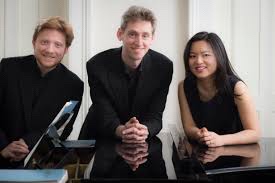
Minerva Trio © Anthony Dawton

Which particular works do you think you play best?

I tend to choose pieces that speak to me on a personal level. Dinu Lipatti once said that it’s not enough to like the piece you play, but the piece must also like you! I play a wide range of repertoire but have a soft spot for Schumann, Brahms, and Ravel.  As long as I can make a connection with the sound world of a particular piece, then I feel inspired to share it.

It is thrilling to premiere a new work as there is a sense of freedom in communicating a piece for the first time. I love the collaborative aspect of working together with a composer, which is very creative and exciting.  That connection I mentioned before then extends to a kind of real affinity with the composer.  At the moment I am working with Hong Kong-born British composer Raymond Yiu.

How do you make your repertoire choices from season to season?

I build on my core repertoire every season. In the past, I would tend to be more composer-focused. If I started to play one piece by Schumann, I would then aim to cover his entire output in order to gain a better understanding of the composer’s language. These days I am interested in finding ways to create dialogues between different works in a programme.

While I love my core repertoire for concert programmes (for example, I will be playing Beethoven, Schumann, and Ravel at St Martin-in-the Fields in December), I am also constantly looking for new stimulants for something adventurous.  For my next MusicArt concert I will present a world premiere concert-installation ‘Conceptual Concert in Three Acts’, inspired by the collaboration between Robert Rauschenberg and John Cage and performed within an exhibition of their works at Galerie Thaddaeus Ropac.  It will involve the music of John Cage, an installation of sound and spoken dialogue, and a new musical work created in collaboration with composer Raymond Yiu and poet Kayo Chingonyi.

Do you have a favourite concert venue to perform in and why?

I had a fantastic experience playing Arvo Pärt’s Fratres at an open space outside Central St Martins for a fashion show in London with a few hundred people in the audience. Since then I am happy to play anywhere as long as it is aesthetically pleasing or stimulating to the senses in some way, not just acoustically.

Who are your favourite musicians?

I have huge admiration for Leonard Bernstein, especially since I discovered his Eliot Norton lecture series, The Unanswered Question. He said, ‘The best way to know a thing is in the context of another discipline.’ Like other great musicians, he reminds one that music and humanity are inseparable.

What is your most memorable concert experience?

For me, playing Beethoven’s Emperor Concerto at LSO St. Luke’s in London was as special and memorable as playing John Cage’s 4’33” while silently reading a poem at an art gallery. I don’t think I can choose between the conventional and creative approach to playing concerts, as I love both.

As a musician, what is your definition of success?

Success is constantly achieving what I set out to do. It’s important to me to generate creative ideas on a regular basis, work with people whom I admire, and create unique experiences for the audience. When I can do these things continuously at a high level, then I am happy.

What do you consider to be the most important ideas and concepts to impart to aspiring musicians?

Treat music as an art form that demands the utmost dedication and discipline. Career is by no means guaranteed. After you finish training and studying at the conservatoire or college, your colleagues and collaborators become, in a way, your teachers. Learn to listen through playing with others.

What is your most treasured possession?

The Yamaha C3 grand piano that I have had since I was 12. It has travelled with me from Hong Kong to Vancouver to London. I had wanted a grand piano from the very beginning, and my mother promised if I reached Grade 8 she would buy me one. It turned out she started saving for it from the day she promised, so she could afford it, just in case! That was a great motivation and I made sure to get it as quickly as possible.

Video links:

Debussy  – https://www.youtube.com/watch?v=epJymUc2rDY

Brahms: Intermezzo in A major, Op. 118, No. 2 https://www.youtube.com/watch?v=OImMONM78TI

Music by Arvo Pärt – Für Alina

Poem by Zaffar Kunial – Sunlight

https://www.youtube.com/watch?v=iG-g7bfLpec

ERDEM
London Fashion Week SS14

Annie Yim, pianist
Richard Birchall, cellist

https://www.youtube.com/watch?v=4rTeQ8Iaqnc

John Cage the Lover and Poet (audio)

https://vimeo.com/193910760

OR

John Cage Dream (1947)

https://www.youtube.com/watch?v=PEknsWJLp-o

Scenes from Daphnis and Chloe (2017)
Minerva Piano Trio
Thomasin Gülgeç, dancer
Estela Merlos, dancer


https://www.youtube.com/watch?v=PdsMBr1JfBw

Who or what inspired you to take up the piano and pursue a career in music?

Nobody has forced me or suggested me to become a musician. My parents had many recordings as they were classical music lover. So I often listened to classical music since when I was a child and I liked it very much. That’s how I started to become close to and to love classical music.

Who or what have been the greatest influences on your musical life and career?

I would say meeting with many great musicians have been the most important influences on my musical life, people like Myung-Whun Chung, Radu Lupu, Krystian Zimerman, Mikhail Pletnev, Alfred Brendel, Murray Perahia and many others…..I learned a lot even while having a conversation with them.

What have been the greatest challenges of your career so far?

Maybe participating some competitions….. I wanted to play for audiences across the world and I thought winning the competition was the easiest way to reach that goal. And it was true, the Chopin Competition gave me a lot of opportunities, but I’m still against competitions. Many great musicians like Arcadi Volodos or Piotr Anderszewski didn’t win any competitions.  The competition kills the musical idea, imagination and freedom. I felt so free after I won the Chopin competition because I realized that I don’t have to do this kind of thing anymore.

Which performances/recordings are you most proud of?

Brahms Quartet in g minor from the Rubinstein competition in 2014. It was the only performance which I enjoyed during that competition.

Which particular works do you think you play best?

I have no idea…

How do you make your repertoire choices from season to season?

These days I simply play the pieces that I want to play. A few years ago, I wanted to show or express many sides of my musicality. But not anymore. I always feel comfortable when I play the music I love.

Do you have a favourite concert venue to perform in and why?

So many places where they have a good piano, good acoustic and good audience. Like Carnegie hall in New York, the Concertgebouw in Amsterdam, Paris and Berlin’s Philharmonie, KKL in Luzern, Elbphilharmonie in Hamburg, Suntory hall in Tokyo…..

Who are your favourite musicians?

Radu Lupu, Krystian Zimerman, Mikhail Pletnev, Alfred Cortot, Edwin Fischer, Arcadi Volodos, Grigory Sokolov, Carlos Kleiber, Myung Whun Chung any many others

What is your most memorable concert experience?

My debut recital in Korea in 2005 when I was 11. After the performance, I realized that I really loved sharing my music with the audience.

As a musician, what is your definition of success?

Actually I still don’t know what being successful as a musician is and I don’t want to think about it. My goal is play better than yesterday and to be satisfied with my performance more often. I’m rarely happy with my performance…

What advice would you give to young or aspiring musicians?

Don’t expect the compensation after you decide to become a pianist or musician

What is your idea of perfect happiness?

I love to be in a place where there no noise. I love silence. And having good food and drink with my family or friends.


Seong-Jin Cho was brought to the world’s attention in 2015 when he won the First Prize at the Chopin International Competition in Warsaw. This same competition launched the careers of world-class artists such as ‎Martha Argerich, ‎Maurizio Pollini, or ‎Krystian Zimerman.

In January 2016, Seong-Jin signed an exclusive contract with Deutsche Grammophon. The first recording was released in November 2016 featuring Chopin’s First Concerto with the London Symphony Orchestra and Gianandrea Noseda and the Four Ballades. A solo Debussy recording was then released in November 2017. Both albums won impressive critical acclaim worldwide. In 2018 he will record a Mozart program with sonatas and the D minor concerto with the Chamber Orchestra of Europe and Yannick-Nézet-Seguin.

An active recitalist, he performs in many of the world’s most prestigious concert halls. In the 2018/19 season, he will return to the main stage of Carnegie Hall as part of the Keyboard Virtuoso series where he had sold out in 2017. He will also return to Amsterdam’s Concertgebouw in the Master Pianists series and will play recitals at the Berlin Philharmonie Kammermusiksaal (Berliner Philharmonic concert series), Frankfurt’s Alte Oper, Los Angeles’ Walt Disney Hall (Los Angeles Philharmonic recital series), Zurich’s Tonhalle-Maag, Stockholm’s Konserthuset, Munich’s Prinzregententheater, Chicago’s Mandel Hall, Lyon’s Auditorium, La Roque d’Anthéron Festival, Verbier Festival, Gstaad Menuhin Festival, Rheingau Festival among several other venues.

During the next two seasons, he will play with the London Symphony Orchestra and Gianandrea Noseda, at the Barbican Centre, Radio France Philharmonic Orchestra and Myung-Whun Chung at the Paris Philharmonie, Gewandhaus Orchestra with Antonio Pappano, Hong Kong Philharmonic with Jaap van Zweden, Pittsburgh Symphony Orchestra with Manfred Honeck, Finnish Radio Orchestra and Hannu Lintu, Philadelphia Orchestra and Yannick-Nézet-Seguin, Orchestra della Scala with Myung-Whun Chung. He will also tour with the European Union Youth Orchestra and Gianandrea Noseda in venues like Amsterdam’s Concertgebouw, Royal Albert Hall, Berlin Konzerthaus, the London Philharmonic Orchestra and Robin Ticciati in Germany, the WDR Sinfonieorchester and Marek Janowski in Germany and Japan, and with the Santa Cecilia Orchestra and Antonio Pappano in Asia.

He collaborates with conductors at the highest level such as Sir Simon Rattle, Valery Gergiev, Esa-Pekka Salonen, Vladimir Ashkenazy, Yuri Temirkanov, Krzysztof Urbanski, Fabien Gabel, Marek Janowski, Vasily Petrenko, Jakub Hrusa, Leonard Slatkin or Mikhail Pletnev.

In November 2017, Seong-Jin stepped in for Lang Lang with the Berlin Philharmonic Orchestra for concerts in Berlin, Frankfurt, Hong-Kong and Seoul. Other major orchestral appearances include the Royal Concertgebouw Orchestra, Orchestre de Paris, Mariinsky Orchestra, Munich Philharmonic Orchestra, Rundfunk-Sinfonieorchester Berlin, Royal Liverpool Philharmonic Orchestra, NHK Symphony Orchestra, Philharmonia Orchestra, Seoul Philharmonic Orchestra, Czech Philharmonic Orchestra, Budapest Festival Orchestra, Danish National Symphony Orchestra, Russian National Orchestra, Detroit Symphony Orchestra, NDR Elbphilharmonie Orchester, RAI Symphony Orchestra, Hessischer Rundfunk Sinfonieorchester.

Born in 1994 in Seoul, Seong-Jin Cho started learning the piano at 6 and gave his first public recital at age 11. In 2009, he became the youngest-ever winner of Japan’s Hamamatsu International Piano Competition. In 2011, he won Third prize at the Tchaikovsky Competition in Moscow at the age of 17. In 2012, he moved to Paris to study with Michel Béroff at the Paris Conservatoire National Supérieur de Musique where he graduated in 2015. He is now based in Berlin.

seongjin-cho.com

Who or what inspired you to take up conducting and pursue a career in music?

Music was a very gradual and natural progression for me. As a child I began to play more and more music until I was eventually spending every spare minute at school rushing off to a practice room, to a rehearsal, to a music tech studio, to a lesson, to a chamber group. I was filling my holidays and weekends with orchestra courses, jazz rehearsals in London, and on and on and on. Finally it dawned on me that music was clearly the focus in my life, and it would be a rather natural next step to try to make a living out of it.

Likewise the conducting was a transition. There came a point in my early twenties when I realised that I’d caught the conducting bug. I was playing in orchestras of such varying standards, from the flimsiest of amateur setups to the highest professional level, that I was constantly watching the whole spectrum of conductors in front of me. The lesser mortals gave me the confidence that I could do better than them, but more importantly the better conductors inspired me hugely, fascinated me, and got me hooked on the idea that a conducting profession could be a compelling journey.

Who or what are the most significant influences on your musical life?

In my earlier days the strongest influences were my teachers – and I was certainly lucky to have superb teachers, more than I can mention. I owe a lot to Neil Thomson, who first set me off on a path towards understanding the process of conducting, and understanding how to learn. From that point I had so many different conducting influences. Two names that stand out are Sir Mark Elder and Claudio Abbado. Mark gave me two years of astonishing support, guidance and inspiration whilst I was his assistant at the Hallé orchestra; Claudio gave me his mindblowingly high-class conducting to feed off whilst I was playing in the Gustav Mahler Jugendorchester.

Nowadays my primary influences are the scores in front of me, but my instincts are surely still heavily influenced by all the people who led me where I am today.

What, for you, is the most challenging part of being a conductor? And the most fulfilling aspect?

Perhaps the greatest challenge is wrestling with the question of what a composer intended at a certain point in a score when his or her vision is absolutely unclear on the page. If it’s a work that’s close to your heart, this struggle is intense and consuming, but always interesting. On a more mundane note, there is a huge organisational and logistical focus to my work as a conductor that wasn’t present when I was a player. This is especially true in my role as a Music Director. Fortunately I’m rather neurotic in terms of organisation, so I get by.

Putting aside all the challenges, though, at the very heart is the fact that I feel totally at home on a podium in front of an orchestra. I can’t imagine anything more fulfilling than the concert experience of performing music that you have rehearsed intensely and spent months preparing for. When things are going well, it’s the most satisfying possible way to conclude a project.

As a conductor, how do you communicate your ideas about a work to the orchestra?

Any player will tell you that the holy grail is for conductors to communicate everything in gestures. That’s certainly the dream. Of course it’s not possible 100% of the time. Some things need to be said, but perhaps the secret is knowing when to stop… Players don’t need to know all your ideas. There’s often a great deal of extra contingency preparation or historical context that doesn’t need to be shared. In the case of, say, Also Sprach Zarathustra, there’s even a gigantic layer of philosophy. The players don’t need to know everything you’re thinking, but having all these extra layers as a base can add so much to the conviction with which you’re conducting.

How exactly do you see your role? Inspiring the players/singers? Conveying the vision of the composer?

Absolutely the latter. Surely that has to be the primary role of a conductor, to take on full responsibility to enable the audience to experience what the composer intended. If you happen to inspire the musicians along the way, that’s a bonus – an orchestra is more likely to play well and work hard if they’re inspired.

Is there one work which you would love to conduct?

Although I’m lucky to be able to programme and perform orchestral music of my choosing a lot of the time, there are a few sacred cows… The piece that most comes to mind is Schoenberg’s Pelleas and Melisande. I have unusually powerful memories of rehearsing and performing it under Claudio Abbado, so the music means a lot to me and I feel as though I know it inside out. But I’m wary of experiencing it from the podium, in case those memories are affected.

Do you have a favourite concert venue to perform in?

There are so many tremendous buildings devoted to classical music! I’m so fortunate to be Music Director of the Orquesta Sinfónica de Castilla y León – we both rehearse and perform in the spectacular concert hall of the Auditorio Miguel Delibes. It’s hard to beat the Royal Albert Hall – what a space – plus I used to walk past it every day so it feels like coming home. As a player I adored the glamour of the Musikverein, and was totally blown away by the concert hall in São Paolo with its mix of wood§ and stone. I’m particularly fond of Snape Maltings – apart from the beautiful concert hall there’s that wonderful view across the marshes. And now I’m in danger of opening up the entire genre of concert halls with views-to-die-for from the conductor’s dressing room….. Gran Canaria with its sweeping view of the beach, Granada looking out over the Sierra Nevada from its hilltop position next to the Alhambra… Perhaps there’s a coffee table book in this.

Who are your favourite musicians/composers?

In general terms, my favourite musicians are those who respect the music on the page and the intentions of the composer. Obviously it helps if they can transmit it to the audience with jaw-dropping skill and style… but I’m never a fan of style over substance.

As for composers, in order to connect with me they need to have something to say in their music, rather than just searching for the next note for composing’s sake. This probably isn’t tangible and might translate into different things depending on the era in which the composer was writing, but there’s always a depth supporting it, which keeps me interested when looking deeper and deeper into a score. You might have guessed I’m trying to remain generic instead of naming names(!)

It’s worth adding, though, that I listen to very little classical music for pleasure. I feel the need to escape it to make sure that it stays fresh. Many of my favourite musicians are in other genres; pop (in every sense), jazz, and so on.

As a musician, what is your definition of success?

To earn the respect of both musicians and non-musicians over the longterm course of a career.

What do you consider to be the most important ideas and concepts to impart to aspiring musicians?

If only I had something of value to offer! It’s tricky to pin these things down when you’re continuously searching for the answers yourself. I’ll try to suggest a few…

Garner and absorb as many influences as possible. Otherwise you’ll never acquire the broad view with which to find out if you’ve been heading down the wrong track.


It’s important to have occasional bouts of fanaticism and all-consuming obsession in your music- making. It can take you to the next level.

Those in music who achieve the most are, more often than not, those who put in the most work. Yes there are exceptions, but you’re taking a gamble if you test the norm.

Remember there’s more to life than your chosen profession. Despite all the hard work, keep it in context and maintain a balance in your life – you’ll be a healthier person.

There will be ups and downs. Enjoy the ride.


Andrew Gourlay is Music Director of the The Orquesta Sinfónica de Castilla y León, which has just announced the launch of its own record label. The first recording will be released on 9 January 2019, and feature Rachmaninov’s Second Symphony.

Watch the album trailer:

Born in Jamaica, with Russian ancestry, Andrew Gourlay grew up in the Bahamas, Philippines, Japan and England. A trombonist and pianist by training, he studied conducting at the Royal College of Music, where he prepared Bruckner symphonies for Bernard Haitink and Mozart symphonies for Sir Roger Norrington. He was selected by Gramophone magazine as their ‘One to Watch’, and by BBC Music Magazine as their ‘Rising Star: great artists of tomorrow’.

Andrew Gourlay won First Prize at the 2010 Cadaques International Conducting Competition, securing concerts with 29 orchestras around the world. For the next two years he was Assistant Conductor to Sir Mark Elder and the Hallé Orchestra. In January 2016 Gourlay took up the position of Music Director of the Orquesta Sinfónica de Castilla y León (OSCYL), having been their Principal Guest Conductor since the 2014/15 season, and celebrated the orchestra’s 25th anniversary in 2016/17.

Read more

Who or what inspired you to take up piano and pursue a career in music? 

When I was really young my brother, who is older than me, played violin. I thought that looked like a lot of fun so I also started playing too. That is what got me interested in music to start with. In our home we had a very old upright piano, I think it cost £100. It was really terrible, almost untune-able. My brother and I would play around on it, making a terrible noise until my mum got so fed up with it that she found a local piano teacher to help tame us! I found that I enjoyed playing piano and would spend hours practising and trying out new things. My parents are not at all musical so they didn’t really know what to do with me when I began to become more and more interested in playing.

Who or what have been the most important influences on your musical life and career?

 I think that my first piano teacher, Claire Swainsbury, had a huge effect on me. She showed me how much fun I could have playing piano and introduced me to some beautiful pieces of music. Then later on Vladimir Ashkenazy has been a big influence along with the conductor Alexander Sladkovsky.

What have been the greatest challenges of your career so far? 

I think that in the UK Classical Music is sometimes difficult for people to understand, whereas in many other countries, Russia especially, it is more a part of everyday life. The education system in the UK doesn’t really help either. So I guess that is a pretty big challenge… for everyone involved in classical music in the UK.

Which performance/recordings are you most proud of? 

That would have to be Rachmaninov Piano Concerto No.2 with Alexander Sladkovsky in Kazan.

Which particular works do you think you play best? 

I enjoy performing a wide range of work but I do have my favourites, like Beethoven, Tchaikovsky and Liszt. I think that if you enjoy performing a piece of music you will usually play it well. I’ve always been fond of performing the great Russian romantic composers, although I’m never sure if I play these pieces the best. But I do know that I really enjoy this kind of repertoire.

How do you make your repertoire choices from season to season? 

I always have a list of pieces that I want to perform, I choose the ones that fit with the way I am feeling at the time when I am ready to begin a new piece.

Do you have a favourite concert venue to perform in and why? 

I love performing in Russia and of course the Great Hall of the Moscow Conservatory has to be my favourite. Mainly because of the acoustics but also because of the long history behind this amazing concert hall and the many legendary artists who have performed there.

Who are your favourite musicians? 

I think my all time favourite would have to be Horowitz, who, when he first started performing, was paid in butter and chocolate… sounds good to me!

What is your most memorable concert experience?

Performing with Valery Gergiev and having a ten minute rehearsal for an entire concerto which ended five minutes before going on stage. That was interesting.

As a musician, what is your definition of success? 

For me success in music isn’t something that you can ever really achieve or reach. Certainly I try to improve my understanding of a piece of music, but I am not sure if I will ever succeed in doing so completely.

What do you consider to be the most important ideas and concepts to impart to aspiring musicians? 

Always remember that music is an art form, not a science. It comes from the heart. So be yourself when you perform no matter what the people around you are telling you.


Born in Hackney in the UK, British pianist George Harliono was invited to make his first one hour long, solo recital at the age of nine. Since then he has performed in numerous locations both in the UK, USA, Europe and Asia, appearing at venues such as Wigmore Hall, The Royal Festival Hall, The Royal Albert Hall and Chicago Symphony Centre.

In 2013 he was invited to record Beethoven’s Piano Sonata Op.2 No.1 at the Southbank Centre in London. In 2016 his performance of Tchaikovsky Piano Concerto No.1 at the Great Hall of The Moscow Conservatory was broadcast live on Russian national TV and streamed live on Medici TV.

Since his concerto debut at the age of 12 he has been a regular performer with orchestras including the Moscow State Symphony Orchestra, The Mariinsky Orchestra, Tatarstan National Symphony Orchestra, New Millennium Orchestra of Chicago and Tyumen Philharmonic Orchestra. George also regularly performs alongside eminent artists such as Lang Lang and Denis Matsuev and has worked with many renowned conductors including Valery Gergiev, Alexander Sladkovsky, Evgeny Shestakov and Francesco Milioto

George has been awarded prizes in numerous competitions throughout the world including The Grand Piano Competition in Moscow, Royal Overseas League Music Competition in London, Gina Bachauer Piano Competition in Utah and Dinu Lipatti Piano Competition in Bucharest

Most recently he performed with The Mariinsky Orchestra in Vladivostok, Russia under the baton of Valery Gergiev and was also invited to perform a recital as part of the Scherzo Young Series in Madrid. Scherzo is the most important piano series in Madrid and has previously featured artists such as Yuja Wang and Mitsuko Uchida.

He studies with Professor Vanessa Latarche (Chair of International Keyboard Studies and Head of Keyboard, Royal College of Music in London) and travels to Switzerland to work with his mentor, renowned pianist professor Vovka Ashkenazy and also his father Vladimir Ashkenazy. He has taken masterclasses with Dmitri Bashkirov, Lang Lang and Vladimir Ovchinikov among others. George also works closely with Alexander Sladkovsky who has taken a personal interest in his development as an artist.

George began studying at The Royal College of Music for a BMUS Degree on a full four year scholarship in September of last year. He is one of the youngest students ever to be accepted onto this course.

Upcoming engagements for this year include performances with the Tchaikovsky Symphony Orchestra conducted by Vladimir Fedoseyev and Orquesta Sinfónica Provincial de Santa Fe conducted by Walter Hilgers. George will also be giving a concerto performance at the Berliner Philharmonie as well as a recital at the Minato Mirai Hall in Yokohama, Japan.

georgeharliono.net

(Photo: Alexander Von Busch and Kir Simakov)
