Unsuk Chin composer
Unsuk Chin, Berlin, den 12.05.2014

Korean-born composer Unsuk Chin is one of the featured artists at this year’s Aldeburgh Festival, which is celebrating its 75th anniversary. Find out more about Unsuk Chin’s influences, working methods, and thoughts about classical music in general in this insightful, thoughtful interview:

Who or what are the most significant influences on your musical life and career as a composer?

The most formative influences are probably those from childhood when the senses react to everything around them in a more ‘holistic’, immediate approach. Then, there was the time of my studies: immersing myself in European avant-garde music in the early 80s was vital, as I had before that known ‘Western’ musical history only until Stravinsky’s Violin Concerto. Conversely, the experience of studying with Ligeti, who denounced the avant-garde, requested utterly original music of excellent craftsmanship from himself and his students, asking me to throw away my prize-winning works, was a pivotal moment. Indeed, moments of crisis and subsequent attempts to find a way out are essential moments and threshold experiences.

The excellent Danish poet Inger Christensen wrote that the major influences on her work were creative stumbling blocks, irritations that, in the long term, made her question and develop her approach. For me, such a moment was when I worked, in the late 80s, and after a writer’s block of almost three years, for a couple of years at a studio for electroacoustic music. Through this, I could re-evaluate the essential elements of my compositional approach and expand the basis of my music. Another significant experience was, in the 90s, longer stays in Bali, where I studied Gamelan music – the acquaintance of a different tradition of great refinement and quality deeply rooted in the society was a discovery.

What have been the greatest challenges of your career so far?

That was to realise my childhood dream of becoming a professional musician and fighting my way out of difficult circumstances – in the 1960s and 1970s, South Korea was a poor post-war country on the periphery, and it was not easy to start as a female Asian composer in Germany.

What are the special challenges and pleasures of working on a commissioned piece?

Without a commission or deadline, I would never compose a work. One needs much pressure from the external world to get through this crazy process. I don’t have any works in my drawer. Writing a new piece is a very demanding process and can take years. I wouldn’t go for it without external pressure and the adrenaline rush. At the same time, I would never accept a commission with conditions that don’t fit into the musical thoughts and goals I am working with during a specific period.

What are the special challenges and pleasures of working with particular musicians, singers, ensembles or orchestras?

I always choose very carefully which commissions I accept. One has to prioritise. It almost needs to be a compulsion: if I don’t have an idea what to write for a certain instrument or concept, I won’t do it. For example, I wrote my First Violin Concerto in 2001 and was convinced I would never write another one. But then, when there was a possibility to write for Leonidas Kavakos, I reconsidered, and the work, 20 years later, is very different from the first one.

Of which works are you most proud?

I move on and try to do something new with every piece. I have removed several earlier works from my work list as I am not content with them. As for the remaining ones, I accept them, but there are also pieces to which I feel more emotional distance than others – which is unsurprising when one revisits works from several decades ago. But I can also name a counterexample – my Piano Concerto, which is from 1995 but which wasn’t much performed before the Deutsche Grammophon recording two decades later. This is a work into which I put all the energy and frenzy of my then 34-year-old self – I wouldn’t compose in this manner any more, but I feel emotionally close to it.

How would you characterise your compositional language?

I prefer not to, as it may make it more difficult for the listener to approach the work without prejudices. Besides, when I compose a new work, the most important thing for me is its unique shape. Of course, as a composer, you have a particular craft; you prefer certain materials and draw on compositional techniques acquired through the years. You cannot and perhaps shouldn’t avoid that. Nonetheless, it is important for me to attempt each work to be singular in character. Pablo Picasso once expressed it this way: style holds the painter captive in the same point of view, in a technique, in a formula, but he always wants to make something that is new and unknown to himself.

How do you work?

With pen and paper. Composing is, above all, waiting — days, sometimes weeks, before the empty staves. And then, suddenly, a door opens in the head. With age and experience, one develops trust that this door opens at some point if one tries hard enough. The music is in my head. I sometimes jot down ideas, plan harmonies, etc., but for me personally, it is an abstract process without piano or other devices. It can take several years for thoughts and concepts to mature. And when the pressure is great enough, it’s like giving birth: the thoughts have to come out, then you write.

As a musician, what is your definition of success?

That I am fortunate to be performed by several excellent musicians.

What advice would you give to young or aspiring composers?

To think carefully if one really wants to have a life as a professional composer. It is usually a back-breaking and lonely job, and the financial prospects are often non-existent. If one really wants to do it, one should, but one should be aware what price it takes.

What do you feel needs to be done to grow classical music’s audiences?

This is not easy since, nowadays, there is a tendency to think more and more in purely economic and functional categories, on top of which you have to add the quickness of modern mass media. Besides, there exists a mistaken notion that classical music would be something ‘elitist,’ which is why the notion that society should support artforms that only a small minority will engage with has lost traction. All of this does not mean that things were better during other times. However, it is concerning and a scandal that music is often no longer even considered a minor subject in schools due to very obscure claims of competitiveness and economic success – claims often made, for example, by numerous politicians. It is wrong to withhold from children the experience of art, which is one of the things that distinguishes human beings from AI, not to mention that art often provides indispensable solace and a utopia. Anyway, there are also ‘late bloomers’, audiences that can be won over with creative ideas and new approaches even if they won’t have had previous exposure to classical music; after all, the experience of great music can be a deeply emotional one. The methods and approaches used to try to develop classical music’s audiences depend on the place and context. But the main thing, I believe, is trust. Trust in quality, the hard work of serious performers and composers, the slow progress of building audiences and overcoming obstacles, an almost aggressive defence of artists’ quality and hard work, the audience’s right to hear this music, and the need for financial support of the whole musical ecosystem.

What is the one thing in the music industry we’re not talking about but you think we should be?

I doubt that such a thing exists as ‘the music industry’ – fortunately, we live in a diverse world. At the same time, of course, certain tendencies exist, but these are intertwined with societal developments. Our times are obsessed with the speed of information, packaging, and the surface, which can be problematic for developing sustainable quality standards. Also, the future of classical music institutions in many places is endangered. That leads often to market-think and occasionally to a winner-takes-it-all mentality. At the same time, fortunately, there are many niches and different initiatives. It was much more polarised in the 50 years after the Second World War: there was the established conservative music world, and then there were the rebellious circles of both the avant-garde and the early-music revival, who not infrequently fractured into warring factions. But every time has its challenges.

What do you enjoy doing most?

Playing the piano. If I need a break during an intense compositional process, I might play fugues by Bach for hours. This helps me clear my mind and persevere.

On Wednesday 12th June Tenebrae give the first UK performance of Unsuk Chin’s Nulla est finis – a prelude to ‘Spem in alium’ in Ely Cathedral as part of this year’s Aldburgh Festival. Find out more about Unsuk Chin’s music at Aldeburgh Festival here


An interview with celebrated baritone Benjamin Appl ahead of his appearance at this year’s Leeds Lieder Festival

Who or what inspired you to pursue a career in music and who or what have been the most important influences on your musical life and career?

I started to sing when I was pretty young. Although no one in my family had trained as a professional musician, we sang a lot together while my mother accompanied us on the guitar. Aged ten I followed my two brothers and joined one of the most renowned boys choirs, called the Regensburger Domspatzen (which means the ‘cathedral sparrows of Regensburg’). Originally I wasn’t so fond of boys singing together – I disliked the sound and thought it sounded shrill – but after being part of this choir community and experiencing that amazing feeling of making music together on such a high level, I then really loved it. I think this was the moment when this addiction was first planted inside me, the feeling that life without music would not be the same.

Then, as a professional musician, of course it was my teacher and mentor Dietrich Fischer-Dieskau. To have had the privilege of working with him is one of the highlights of my career to date. He was a real mentor in many ways and taught me so much, not just vocal technique or interpretation but much more beyond this: he taught me the essence of being a musician, and the responsibilities with which that comes.

I was deeply impressed by his level of preparation, and the seriousness with which he achieved such a deep level of understanding of the music. Every time I went to his home he had prepared himself for our session, looking through the scores again, reading about the poetry and the background of the songs – doing all this even though he had already spent a lifetime on it. But this is also one of the most wonderful aspects of this profession: you never can be too well prepared.

What have been the greatest challenges of your career so far?

I think what’s important is to find a personal connection with the music and how to present it and how to communicate it to people. If you’re yourself and you try to find a good emotional connection and how to communicate it, then it can be fairly easy. Generally, though it’s quite a difficult job in that as a singer, you carry your instrument with you 24 hours a day! We can’t, like a pianist for example, leave the instrument at home for two hours in the evening and go to the pub. That’s also something else we have to live with regarding our instrument – we have to accept when it’s not working and to be kind to it. That does mean that it can be difficult not to become too self-centered and think only about ourselves. That is something very challenging and we have to find ways to cope with it.

Of which performances/recordings are you most proud?

Actually, it will be one of my forthcoming album releases, a project I have been involved with for quite some years now. Together with one of the greatest contemporary, living composers György Kurtág, I am recording some of his compositions as well as songs by Franz Schubert, where he, aged 97, plays the piano. The working process with him is incredibly detailed and challenging, but the rewards are at a level you normally never experience anywhere else.

Which particular composer do you think that you perform best?

I probably would say Franz Schubert. With him and his music I feel most at home, not only because I spent the most time with his music and learned around 400 of his songs by heart. There is something in his music which gets right into my heart – how he creates an environment, a beautifully carpeted pathway, for the poetry to speak directly to the listeners. There is no extraneous material or conceit; the musical textures ar. He is a composer who somehow stands with both feet on the ground. His music feels somehow deeply rooted inside me and I resonate with his sentiments in his music – and therefore I think I can transfer this connection the best also to the audience.

What do you do off stage that provides inspiration on stage?

Finding inspiration is a key element of our profession. We give so much on stage and every evening try to give what we can that we actually have make sure that we fulfil own our inner inspirations – to go to museums, to casually observe life passing by in the underground in how people move around and suddenly think “This is a character in this song.” I enjoy wonderful times with other inspiring people, listening to their stories, being curious, having every pore of your body open so as to find inspiration again a new way of interpreting songs. Also always questions about why we do it this way, why this tempo, why do we take time here, why is this word important for us etc so that we actually create and never just deliver.

How do you make your repertoire choices from season to season?

It really depends on the different kinds of inspiration I get from outside or from within myself. Often reflecting on processes lcan ead to a different direction which you didn’t plan on and then of course the choices also depend on the interesting offers which are given to you.

Do you have a favourite concert venue to perform in and why?

Of course there are certain parameters which are important in a venue. Mostly it’s about the acoustic, so that you as a singer have the feeling that the space is giving you something back, and enhancing the reverberation of your own voice. But just as important is an ambience which makes you feel welcomed and comfortable when you enter. A good piano for my accompanist doesn’t hurt either!

But what would even an ideal venue be without an open and attentive audience? Especially for song recitals which are in many ways presented as a dialogue: even though one party is usually silent, it is an exchange of emotions and very much a shared experience. So the ideal really is to have a wonderful audience who is willing to be taken by the hand to go on a journey together.

What is your most memorable concert experience?

There are a few. Of course someone now would expect me to name performances in the biggest, most prestigious halls around the globe. But for me very often these ‘stellar moments’ happen under different circumstances: music is a comfort for me in moments of solitude or sorrow, and exaggerates my happiness in joyful moments. Performances which stay with me forever are very often linked with big moments which happened in my private life at the same time, like the loss of my grandparents, when I had to go out on stage and sing songs about facing death or mourning the loss of beloved ones; but also when I fell so deeply and freshly in love.

As a musician, what is your definition of success?

Often I hear people say that art song is dead or that we cannot connect anymore to all those old texts and music. And I think exactly the opposite. All these songs are about emotions and feelings we carry very deeply in us, essentials like falling in love, being disappointed, loss of a beloved person or solitude – strong feelings we all can connect with and have experienced. I think within this art form there lie many opportunities and I am constantly searching for ways of combining it with other art forms or putting it in a current context. As a performer I experience very strongly that these songs make me understand myself and others better: My definition of success is when the same happens to my audience, that people connect with each other, go together on a journey and start a process of reflecting.

What advice would you give to young/aspiring musicians?

Find the right balance in life of the amount of performances, travel, working hours and try to have an interest or hobby outside music, which gives you the opportunity to put music aside for a moment and find pleasure and happiness somewhere else as well. It will only enrich your musicianship in the end.

What do you feel needs to be done to grow classical music’s audiences?

The field of Art Song is a bubble within the classical music world, which is a bubble in itself. So, I am very much aware that we will never have huge audiences or huge crowds and millions of people listening to us, but that is also fine to accept. I think that generally, elderly people who have more time in their lives, who don’t have to worry about small kids, or making a lot of money in their jobs, or having to learn a lot in schools etc have the luxury of time. And when you do some recitals, you have to focus fully on the music and the text. It’s not something which you can listen to on playlists or during to a fancy dinner. It really requires one’s full attention. And that’s challenging in the 21st century when everything’s very hectic and people have a short attention span. So that’s a reason why I think particularly people listening to song cycles are very often are in the second half of their lives.

I’m trying with my own programmes to go into schools and bring this Art Song to schoolchilren to try and make them curious about this music. It’s very important to plant the love I feel for this music into the hearts and ears of these young people so that at least they have the chance to encounter it at a young age and to see that other people are passionate about it.

What’s the one thing in the music industry we’re not talking about which you think we should be?

I think it’s wonderful that there are so many young people interested in studying singing or classical music. In colleges there are so many applications, like never before, so that’s something very positive. I find the lack of interest in politics and about people in the arts quite worrying. There are so many studies around the world which show the impact of music on human brains, on children such as how it makes them better human beings with better social skills, but also they learn other subjects faster, like languages etc. There is only good in it and I find it strange that no politicians really see the huge impact of music and how important it is. We have to plant music and art into the brains and hearts of young people. And even if they don’t like it in the beginning, I think it’s important that they have the chance to encounter it so that when they get older and listen to classical music they feel familiar with it. If they don’t get the chance from the very beginning it’s very hard later on to really understand this world which is so important in shaping for everyone. That’s something I feel very passionate about.

What’s next? Where would you like to be in 10 years?

There are so many ideas and interesting places to perform. I would love to perform song recitals for example like Schubert’s ‘Winter Journey’ in the Arctic. Pushing boundaries with other art forms, and strong collaborations. I have so many ideas in my mind that it’s sometimes overwhelming! I definitely have to write them all down, firstly not to forget them, but also to focus my mind on one idea. I have so many ideas all the time and would love to go in different directions, work with different people and never loose the joy and filfillment in performing. Just probing the horizon, being curious, not thinking in boxes but outside my box, and appreciating other people and their work and their love.

What is your idea of perfect happiness?

Despite the stress and demand of my life as a professional singer I always try to remember that it is a huge privilege to live this life. Sometimes I ask myself the question if there is anybody in this world with whom I would like to swap lives and I can always truly say that I am most happy and there is no one with whom I want to exchange life – as long as I can say that, I am very happy with this accomplishment.

What is your most treasured possession?

Due to my profession, I feel like I spend a huge amount of my time researching and booking transport and then travelling from one concert hall to the next. In work circumstances, I often have to prioritise speed as time can be tight and pressure is high. As an antidote to that, a few years ago I bought an old Volkswagen Beetle: a beautiful red convertible from 1974 which I love to drive around the beautiful Bavarian landscapes with their with mountains, lakes and castles. Driving my little car relieves all the stress I typically experience whilst travelling and it calms me in a wonderful way. Also when the roof is open, I get the feeling that I can appreciate the surrounding nature so much more.

What is your present state of mind?

I often ask myself how does doing the kind of work I am doing in the arts change me as a person and as a creator. In this process of reflection, we have to be open, we have to find inspiration and that’s something, of course, that has a huge influence on ourselves as musicians. As singers, if we change our daily routine, we have to be careful with our voice, we can’t have the wildest life before performances, and so on. And the curiosity we have as an artist influences us very much.

The way of reflecting about ourselves, that we try to become better and better, is also something which changes us. I think of course, the art and the voice are so dominant in our lives as singers and really leading our lives, that we have to follow the music and the voice as a person within our life.

Benjamin Appl appears at this year’s Leeds Lieder Festival which runs from 13 to 21 April 2024. Full details/tickets here

Who or what are the most significant influences on your musical life and career as a composer?

Rather than a particular person, I feel the greatest influence came from a breadth of musical experiences. In addition to playing in orchestras and performing solo piano, I performed in bluegrass, rock, and jazz bands, Balinese gamelan ensembles, West African drumming, Bowed Piano Ensembles, and live electronica performances. The biggest drive for me has always been curiosity, about music’s role in humanity and the connections to ourselves, our memories, and our emotions.

What have been the greatest challenges of your career so far?

As artists, we wear our hearts on our sleeves. When a song or piece of music comes together, it almost feels like a gift. In those moments, you can almost touch something bigger than ourselves, and that is an emotional experience, where words fail us, and music steps in. In this day and age, it is learning how to share that experience of music with others, and that means opening oneself up emotionally, and publicly, on the internet. Building a brand out of myself was the largest challenge that I’ve encountered so far!

What are the special challenges/pleasures of working on a commissioned piece

Most of my commissions are for film and tv music productions, which I enjoy because it allows me to move from one music genre or style to another, experiencing different stories and different perspectives (again, with the curiosity!). The challenge is navigating the larger team dynamic, especially in the entertainment industry. I had
to learn how to create through the shared experiences and perspectives of my collaborators, which is a bit trickier than sitting in my studio writing music simply for myself.

What are the special challenges/pleasures of working with particular musicians, singers, ensembles or orchestras?

The greatest gift we have in music is the connection we can get through amazing humans performing. Every instrument on the globe has been meticulously recorded, sampled, and is available on my keyboard in my studio. Yet, working with a musician or ensemble who is a master of their craft is one of the joys of creating music. Whether it be coaching a school choir learning a choral piece, or hearing a film cue performed by the London Symphony Orchestra, the experience of connection though music is very meaningful.

Tell us more about your work with film composer Howard Shore.

I’ve worked with Howard Shore for 15 years, on over 25 films. I’ve worked as his right hand man (or Octopus man, as orchestrator Conrad Pope has called me) handling arranging, orchestration, and producing of his film scores. I started out within a technical capacity, and over the years was always quick to volunteer for more musical tasks. As we navigated the challenges of various film productions, Howard found me well equipped to handle the unique technical and musical requirements of assembling a film score. As part of my work with Howard, I’ve travelled to London, the Netherlands, France, Belgium, Montreal, and many other locations to record orchestras and produce music for films. 

What are the special challenges and pleasures of working on film scores? 

Working on film scores is incredibly labour and time intensive. It requires many hours sitting at a desk to create the 1000s of notes heard in a film score. Not only writing the music, but producing the demos, “conforming” the music to follow picture changes and edits, revising the music based on filmmaker feedback, and orchestrating, recording, editing, and mixing the music makes for a very busy work schedule. One of the great pleasures of working on film scores is amazing resources. While I had to run a Kickstarter campaign and obtain grants to raise the funding for my album of piano quintets, on big budget film scores I have a hundred piece orchestra and any other resources I need. Twelve bagpipes? A group of Didgeridoo players? No problem!

How has your work in film music influenced your new album ‘Everything More Than Anything’?

Working in film music for so long has given me a very strong skillset in how to produce very high quality music. I feel very at home in the recording studio working with musicians, and all that experience makes the writing, producing, and recording of my albums much easier. As all musicians have heard, the more you practice something, the better you are at it!

What do you hope listeners will take from this new album?

I hope listeners will appreciate just how impactful music can be when made with highly skilled musicians playing acoustic instruments. So much of music production these days happens in front a of a computer, and technology has allowed us to create music easily and professionally. But despite these technical advances, making music with other musicians in a room all together has a certain magic which cannot be replicated with technology. 

Dark Before The Dawn – the first track from James Sizmore’s new album Everything More Than Anything, with pianist Stephen Gott

Of which works are you most proud?

All of my solo albums are dear to my heart, as they are closest to my artistic sensibility. I’ve got pieces of film music that have been heard by millions, but some of the songs I’ve written for my wife, my daughters, and my parents are the most meaningful to me. Even though they’ve only been heard by a handful of people!

How would you characterise your compositional language?

I pride myself on being a music chameleon for my film work, but my solo albums are rooted in the classical tradition, and certainly owe a debt to both the late French impressionists, Maurice Ravel and Claude Debussy, and also the 20th century minimalists Steve Reich, Philip Glass, and John Adams. Probably some film music influence in the harmonies as well!

How do you work?

I am regimented in my schedule, actively working in my studio from 9am-6pm (when I can, some productions require constant attention!). Keeping to a schedule helps me to be able to write music quickly, often writing a new piece in a single day.

As a musician, what is your definition of success?

When you’re able to do something you love doing for 33% of your time.

What advice would you give to young/aspiring composers?

Let the music be the most important thing. At first, you must set aside your career aspirations, music business approaches, social media branding, and really focus on the passion for music. While all of that other stuff is important, the only way one can sustain a career in music is if you really love it. Fall in love with music before you try to make it your career. I doubt anyone was ever successful by approaching music with the intention to make a lot of money. If you really love making music, everything else is secondary.

What do you feel needs to be done to grow classical music’s audiences?

Live film music performances have done great things for building interest in orchestral music. The Lord of The Rings is performed live every month, and the experience is a nice gateway to the orchestral classics. I recently attended the new David Geffen Hall in New York City, and the experience was outstanding. I applaud NYC for rebuilding the hall inside out and recognizing that the home of the NY Philharmonic is a cultural institution that they want to support wholeheartedly. I believe that strong arts initiatives, and bridging the gap between traditional classical music and popular culture are important for growing audiences.

What’s the one thing in the music industry we’re not talking about which you think we should be?

How is it that the terms breve, crotchet, quaver, and minim, never caught on in the USA? My music would be 10% more fun if we had the proper terminology when making it!

What is your idea of perfect happiness?

Every moment (or at least most moments!) of our lives can contain perfect happiness by being present in the moment, and feeling gratitude and agency over this amazing life were given. We’re surrounded by beauty every day; one just needs to keep their eyes and hearts open to the world around them.

‘Everything More Than Anything’, James Sizemore’s new album created in collaboration with British-American pianist Stephen Gott, is being released track by track over the coming weeks. The second track is released on Friday 19 January.

Who or what inspired you to pursue a career in music and who or what have been the most important influences on your musical life and career?

It was at school that my love for the piano blossomed because I heard it every single day in the school assembly. Also, by chance my teacher in infant school happened to have a piano in her classroom, so the tinkling sound of it just occupied me and I loved to explore it and make sounds.

I had formal training as a Junior at the Royal Welsh College of Music and Drama in Cardiff with my teacher, who I still have, Alison Bowring, who took me back to the technical basics and posture, while also understanding what repertoire would suit me. Alison has been a major influence on my career so far from many difference perspectives.

I also did courses with an organisation called Musicians in Focus, a team who focused on visual impairment, which helped to develop me as a musician.

My greatest influences are listening to opera singers so the idea of singing with the piano is always reinforced. Another influence was being a participant on the North London Piano school every summer. The guest teachers really helped me understand about tone production through physical touch. I had never really experienced that sort of connection before, so that memory will stay with me forever. It made me not only improve as a pianist but gave me ways to connect through performance. Pianistically, I love the physical interaction between keyboard and the body becoming one – it’s an amazing experience.

What have been the greatest challenges of your career so far?

I was diagnosed with Asperger’s syndrome, an autism condition, which affects social and communication skills, so I have support assistance to help build my independence and confidence. I actually find my personal organisation to be more challenging than practising at the piano. I can feel anxious when plans change at the last minute, for example, when a train or flight that I am booked on is cancelled. Being totally blind also affects me when I have to travel for performances, as there is no time to become familiar with new locations and therefore I normally require assistance. Being a member of organisations like the Paraorchestra and RNS Moves, an inclusive ensemble based in Gateshead however, helps me to integrate and develop networks and connections with other disabled and non-disabled musicians.

Which performances/recordings are you most proud of?

Performing the Beethoven Choral Fantasia with the Royal Welsh College Chamber Orchestra and Chorus:

My final year recital for my Bachelor degree was very atmospheric and some people I knew from school also attended.

Performing at St. Martin-in-the-Fields in 2019 was thrilling as I was in an open and resonant space, so I had to adjust myself to both the instrument and the acoustic.

Performing the Scriabin concerto in East Dulwich with Michael Cobb conducting the Lambeth Symphony Orchestra. Unfortunately, I am only able to share the encore, an improvisation on some themes suggested by members of the audience.

Which particular works/composers do you think you perform best?

I have a soft spot for Beethoven’s music because both my grandmothers have developed deafness through ageing, especially my grandmother from Northern Ireland on my father’s side. The amazing thing about Beethoven’s music is that it always feels and sounds fresh, however many times you play the same pieces, especially when playing on different instruments and acoustics.

What do you do off stage that provides inspiration on stage?

I love browsing the internet about background of the pieces and always love looking at history and why repertoire was written for specific instruments of the time, especially when dealing with Baroque or Classical period music. Also, I have a grand piano at home that has a distinctive tone colour, which helps me to transfer intimacy across to my public performances. I find that exercise keeps me moving and agile, while breathing exercises or stretches help me to relax before I go on stage.

How do you make your repertoire choices from season to season?

For a recital programme, my teacher and I like to plan the pieces in advance that will complement each other. We always talk about the relationship between each piece regarding tempo and tonality, as well as realistic timelines for learning.

Do you have a favourite concert venue to perform in and why?

I particularly enjoy St. Martin-in-the-Fields as a venue because the acoustics are unlike any other, and it allows the pianist to draw into themselves so the audience can experience the incredible sound. It’s different to a drier acoustic when it sounds like you’re on the same level with the audience when you can hear every nuance. A cathedral is a celestial atmosphere to perform in, feeling like an out of world experience.

What do you feel needs to be done to grow classical music’s audiences?

I like the idea of pre-performance commentary by the artist involved to help make Classical music more accessible and interesting for younger generations. I also like the idea of museum tours (such as Victoria and Albert Museum in London) to explore the instruments for which music was originally written. This provides essential background as audiences are used to modern instruments as the norm.

What is your most memorable concert experience?

Performing in Japan as one of 90 international artists in the True Colours Festival 2022, organised by the Nippon Foundation and live-streamed around the world. The atmosphere was just incredible and I loved having my hair and makeup done for me so I could just sit back and relax. Also, I had never changed into other outfits between musical items, or played with a headset in a live performance. I loved the variety on offer and working with a range of other musicians.

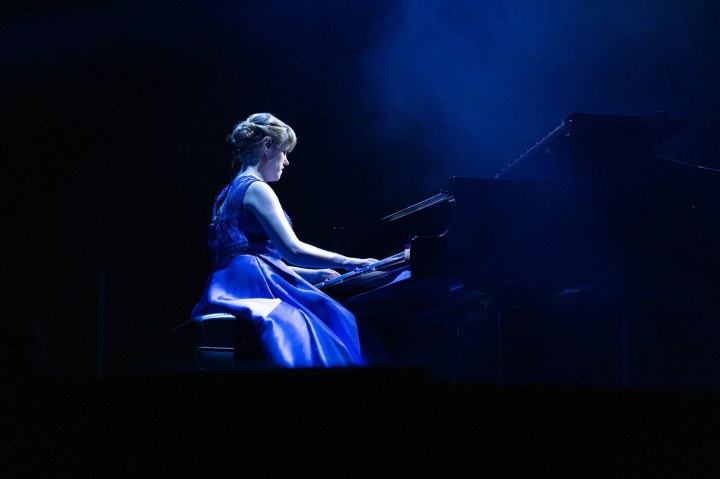
Rachel performing at the True Colours festival in Japan

As a musician, what is your definition of success?

Music is not about competition or who can play the best, it is about connecting and sharing with the audience and developing relationships as they can be vital for the future. Have the right support like a teacher who can understand the way you work, encourage and develop your musical journey.

What advice would you give to young/aspiring musicians?

Embrace every corner or avenue of your instrument from physicality/technique to exploring different music styles, so it becomes a part of you. For example, I love playing Jazz which I believe is interconnected with the classical composers that came before. Patience is always a virtue especially in practicing when you don’t get things right the first time. Keep positive and make the most of every opportunity.

On Saturday 27 May, Rachel Starritt gives a concert by candlelight at the inaugural Ludlow Piano Festival, created by impressionist, comedian and actor Alistair McGowan. Rachel will perform new works by three young composers, written especially for herm, as well as her own improvisations. Info/tickets: https://ludlowpianofestival.com/


Blind from birth, Rachel was born in Bridgend, South Wales in 1994. She has received formal training on the piano since 2006 with Alison Bowring and studied at the Royal Welsh College of Music and Drama (RWCMD) where she recently achieved a distinction in piano performance as a postgraduate student (MMus).

Rachel completed a six month Erasmus placement at the Conservatori Liceu in Barcelona under the tutelage of pianist Alba Ventura.

As a student at RWCMD, Rachel has enjoyed masterclasses with the Labèque Sisters, Stephen Osborne, Peter Jablonski, Angela Hewitt and Valentina Lisitsa. Additionally, she received guidance at the annual NLPS summer course at the Purcell school with renowned professors Dr Michael Schreider (Guildhall), Irina Osipova (Moscow), Irina Berkovich (Israel) and William Fong (RAM).

Rachel’s piano improvisation skills complement her love of jazz and she currently leads a jazz trio ‘The Rachel Starritt Trio’,  which appeared at the Brecon Jazz Festival in 2020 and 2021. At Chetham’s Piano Summer School she studied with Nikki Iles and Douglas Finch and has also received lessons with the renowned Welsh pianist and composer Huw Warren.

Read more

Image credit Daishiro Futakami
