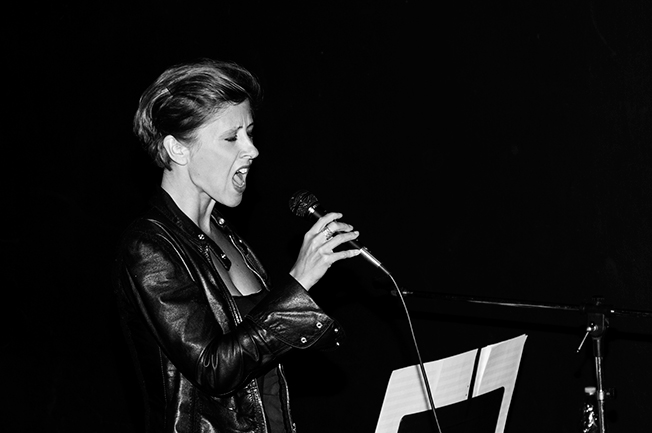
sophie_duner_buenos-aires3

Who or what inspired you to take up singing and pursue a career in music?

Elvis Presley – for his dynamics. However, my very first instrument was the piano and I wanted to be a `cocktail bar pianist´. Then I changed to voice. I had a short introductory period singing pop though, pretty soon coming to the realization that my artistic `mood´ was far too `serious´ and complicated for the task. I was looking for something more complex, artistically. That led me to enroll in jazz studies at Berklee College of Music (vocal performance & composition). Apart from the jazz studies, I also attended classes in classical singing as well as in contemporary classical composition.

Who or what were the most important influences on your musical life and career?

Igor Stravinsky, Charles Mingus, Kurt Weill, Paco de Lucía, Cathy Barberian, Björk. I was also very fond of all types of ethnic and dynamic singing, which was a big influence on my expression in jazz. When it comes to composers, I listened to a variety, spanning from jazz, world music to contemporary classical – I always needed all of them to feed my ears.

What have been the greatest challenges of your career so far?

To explain what type of music I do, finding the right people to work with and finding the right venues to perform at. Making my music sound the way it should. Achieving consistency in work opportunities & controlling and combining it with my mood.

Which performance/recordings are you most proud of?

My latest string quartet CD ‘The City of My Soul’ (produced by Michael Haas) and a track called “La Finadita” from the album ‘The Outsider’ by F. Tarrés and The Arida Conta Group. I am also very pleased with a performance I did with electric cello last year as well as some tracks from an upcoming vox & acoustic bass (jazz) CD. I also enjoyed a gig I did at `Festival O/Modernt’ in Stockholm (with a string orchestra among other combos.) A gig at `Festival de Música Cotemporánea de La Plata´ in Buenos Aires was also great – it was audiovisual as well.

Which particular works do you think you play best?

I love to sing music with angular melodies. With extreme highs and lows! That way, I can express varied vocal colours in my different vocal registers and vocal `placements´. I also love music with interesting rhythms and change of meter, and with a lot of energy and groove. I also like dissonance. And space, with dynamic attacks! Basically, anything that is vocally challenging is fun and stimulating.

How do you make your repertoire choices from season to season?

My choices are related to what type of gigs I have at the moment.  It´s also dependent on for whom I write and who I collaborate with. And where I am offered concerts and work – it’s all interrelated.

Do you have a favourite concert venue to perform in and why?

I like theatres. And I loved `Confidencen´at Ulriksdals Slott (where I recently performed) Another interesting venue to perform in was an ecological farm outside Zürich. Or a dusky jazz club. Circulo de Bellas Artes in Madrid. Basically, I like venues with a soul and which have their own personality.

Favourite pieces to perform? Listen to?

At the moment: to perform, `Caravan´ by Juan Tizol, `Weird Nightmare´ by Charles Mingus, `Addicted to Love´ by Sophie Dunér. To listen to:  the last part of `Petrushka by Stravinskij and track n° 2 from the CD “Bach por Flamenco” by Miriam Méndez, “Un amour de Swan” by Hans Werner Henze , “Weird Nightmare” by Mingus with singer Lorraine Cusson + “Cubana Be Cubana Bop” by Dizzy Gillespie.

Who are your favourite musicians?

Igor Stravinsky, Charles Mingus, George Antheil, Louis Andriessen, Thelonious Monk, Alberto Ginastera, Concha Buika, Paco de Lucía, Hans Werner Henze, Dizzy Gillespie, Heitor Villa-Lobos, Astor Piazzola, Bill Frisell, Erik Friedlander (to mention a few!)

What is your most memorable concert experience?

On a jazz jam session when the audience screamed after my solo and the one I did recently at Festival O/Modernt and PARMA Music Festival last summer.

What do you consider to be the most important ideas and concepts to impart to aspiring musicians?

Take risks – better to fall and then rise more interesting afterwards than to stay safe.

What are you working on at the moment?

My own new original (jazz), angular pieces with extreme highs and lows as well as with lots of energy, rhythm and time meter changes. I will record with the electric cellist Jeremy Harman in July in Boston (with whom I performed at the PARMA Music Festival last year.) 

Where would you like to be in 10 years’ time?

In a place where both mind and heart are combined and satisfied. What is your idea of perfect happiness?

What is your most treasured possession?

My imagination.

What do you enjoy doing most?

Composing, singing, painting, drawing, biking, hiking, photography, animals, cooking, comedy and have kids comment on my art and music.

What is your present state of mind?

Eager and unquiet.

Sophie Dunér is a singer, songwriter, composer, arranger and visual artist from Sweden who has lived and performed in the United States and Spain. Originally a jazz singer, her writing and performing have evolved into a unique style of wild, risky, passionate and exhilarating music for vocals and string quartet.

www.sophieduner.com

26-apr-soul-zisso-contemporary-voices-web-131063328970695992Who or what inspired you to take up composing, and pursue a career in music?
When I was 14 I started writing songs and realised I had so much music in my head that I didn’t know how to write down, as I couldn’t play any instruments. This led to a ‘eureka’ moment where I just knew that composition was what I was meant to do in life, which resulted in my deciding to go away to boarding school to study for an A Level in music from scratch when I was 15. 

Who or what were the most significant influences on your musical life and career as a composer?
My teachers (both composition and instrumental/vocal) and friends have had the most significant positive impact on my career. They have taught and supported me, always being honest and therefore helping me improve and acknowledge both the good and bad. 

What have been the greatest challenges of your career so far? 
Having only started studying music at age 15, my greatest challenge was catching up with everyone else: first with general music and performing and then with composition. This meant always making sure I was working harder than everyone around me, and not giving up even when it meant not seeing the light at the end of the tunnel for years and years on end.  

What are the special challenges/pleasures of working on a commissioned piece? 
Each piece is different and special in its own way. I treat the compositional process as a type of meditation, seeing the players playing in the hall inside my head, hearing what they’re playing and how it works spatially in the space. Once the initial idea of the piece is established, it’s all about answering all the different questions about what the piece is trying to do and how, until I can hear the whole structure in my head and can write it down.

What are the special challenges/pleasures of working with particular musicians, singers, ensembles and orchestras?
Every different instrumentation brings with it lots of possibilities and new ideas, which is always exciting. Working with musicians I know and admire is particularly great as it’s easier to write a piece that is influenced by them as players / singers and has that added element of being written especially for them. I find writing pieces for myself to perform (as a soprano) the most challenging – it’s like a constant battle between my performer side wanting to perform strange extended vocal techniques and my composer side needing to justify every choice compositionally.

Which works are you most proud of? 
Poke – a piece for large mixed ensemble I wrote two and a half years ago for a workshop with BCMG. Even though it was the only piece I’ve written in the last three years that has only been workshopped rather than performed, I worked on it for a solid three months and am very proud of the level of detail and complexity in it. I hope it’ll someday get a proper performance. 

From the Darkness, for symphony orchestra – this was my first attempt at writing an orchestral piece fresh from finishing my undergraduate studies and my chance to use all I’ve learned about orchestral writing from sitting in on weekly rehearsals and watching countless concerts (another attempt to catch up, this time by a 1st study singer catching up on orchestral knowledge). I’m still proud of this piece because it shows how much I’ve progressed in just a few years, from a singer who couldn’t tell apart oboe and clarinet colours to using the orchestra in ways I haven’t even seen being done before. 

Who are your favourite musicians/composers?
Ligeti, Beethoven, Prokofiev, Radulescu, Saariaho

What is your most memorable concert experience? 
A few years ago I was fortunate enough to have my first orchestral piece ‘From the Darkness‘ chosen to be workshopped and then performed by BBC National Orchestra of Wales. The experience of having my piece played by one of my all-time favourite orchestras when I didn’t think it even stood a chance to be chosen was surreal and overwhelming, one which gave me hope for the future and that I would never forget. 

What do you consider to be the most important ideas and concepts to impart to aspiring musicians? 
That pieces of music need to have a reason to exist, be it an idea or structure that comes across – there’s no point to writing pieces that just sound pretty without having something to say. 

Where would you like to be in 10 years’ time?
Working professionally as a freelance composer and teaching composition at a University / Conservatoire 

What is your most treasured possession?
I have a few items that, to someone who doesn’t know me, might seem childish and bizarre but actively help me compose. These include a ‘touchy-feely’ hamster book, a squeezable orange octopus toy (with its knitted hat), and my personal scores for the Berio Sequenza III for female voice and Beethoven’s ‘Moonlight’ Sonata (which are both symbolic in reminding myself I can overcome massive challenges when I set my mind to it)

How do you work?

I usually compose in what I like to call my ‘office’, which is essentially sitting on the floor in the hallway of the Conservatoire, opposite the composition notice board. It may sound bizarre (and passers-by keep wondering what I’m doing there or assume I’m queuing for a practice room), but it really helps to think about new pieces away from a piano or any other instruments at first in order to get a clear idea in my head of what I want the piece to sound like and do. The sound of lots of different students practising nearby actually becomes a kind of white noise that helps clear my head and I really prefer it to silence, and lots of people walk by so it doesn’t feel too alone. To add to the weirdness, I’m usually surrounded by my ‘composition aides and mascots’ which help me deal with stress – quite often I’ll be sitting there hugging my copy of Berio’s Sequenza III and petting my hamster book. I heard I’ve become quite a mystery for pianists who frequently practice on that floor.
How would you describe your compositional language?

I really like using different types of microtones to explore less common soundworlds. My pieces used to be mostly harmonic-series based but in the last year or two I’ve been frequently experimenting with other microtonal soundworlds, which feels like exploring a wealth of unexplored territory. As part of my doctoral research at Birmingham Conservatoire I am researching microtonal singing in order to create my own unique microtonal language that will incorporate voices as well as instruments, which is why I’m currently trying out lots of different ways of using microtones. Another side of my compositional language is influenced by my work as a performer – using extended techniques and/or a greater sense of acting/performing, especially for voices.


Carla Rees and Xenia Pestova premiere Hidden Elegy for alto flute and piano at The Forge, Camden, on 6th September 2016. Further information and tickets here

Ever since commencing on her music studies at the relatively late age of 15, Soul has been dedicated to her dream of becoming a composer. She graduated from Cardiff University, studying with Arlene Sierra and Robert Fokkens and for a brief time studying with Alison Kay, before commencing on a Masters and later a PhD in composition at Birmingham Conservatoire under the tuition of Joe Cutler and Howard Skempton.

Her music, which has been described as “curiously original” (Wales Online) and having “real character and sensitivity” (Wales Arts Review), has been performed by the likes of BBC National Orchestra of Wales, Orchestra of the Swan, Xenia Pestova and the Fidelio Trio across the UK, Europe and Canada in a wide range of venues including Wells Cathedral, Hoddinott Hall and Stratford Town Hall, and festivals such as the Cheltenham Music Festival, Occupy the Pianos and Frontiers new music festival.

Her interests range from the use of different microtonal soundworlds and textures to children’s books and the exploration of various extended techniques. She is also interested in writing for dance and has composed music for Rambert Dance’s Vintage Rambert project.

In addition to composing, Soul is also a singer, specialising in performing contemporary repertoire, including Berio’s Sequenza III for female voice. She is a member of Via Nova chamber choir, has performed as both soloist and choral singer across the UK (including at the Wigmore Hall and at the Huddersfield Contemporary Music Festival) and abroad and is committed to promoting new music, which includes premiering many new pieces, particularly ones for solo unaccompanied voice.

www.yfatsoulzisso.com

2751c7d40-04b5-aae9-56825b8f0700ef0fWho or what inspired you to take up composing, and pursue a career in music? 

It was a slow process, with music growing into such a presence in my life that midway through college I realized it had taken over, so I switched from pre-med and never looked back.

Who or what were the most significant influences on your musical life and career as a composer? 

That has changed many times: As a teenager I tried to play piano like Erroll Garner, then more like Keith Jarrett. In college I fell in love with the music of Edgar Varese and Stefan Wolpe, but listened about as much to Bonnie Raitt and the Band. In more recent years my work in opera led me to Verdi and my work in ballet to Prokofiev. Next week I might mention different names, but just now these are the influences that spring to mind.

What have been the greatest challenges/frustrations of your career so far?  

My challenges are the same as those of most composers: almost all orchestras and opera houses pay lip service to the importance of new music but in practice consider it a risk to their box office. So our work as composers is marginalized, perhaps set apart as a prestige item; classical music as a whole is correspondingly impoverished. Wonderful music is being created and performed all over the world, but you wouldn’t know it from Lincoln Center or similar places.

What are the special challenges/pleasures of working on a commissioned piece? 

I find it most inspiring to be given very specific guidelines, such as “an oboe quartet of about 15 minutes, to be paired with the Mozart for the same ensemble.” Or “5 minutes of fight music that becomes a love duet, for changing numbers of dancers.” These are both challenges and pleasures.

What are the special challenges/pleasures of working with particular musicians, singers, ensembles and orchestras? 

For most of us this is the usual situation, and it’s a healthy one, because as a composer I don’t write for the audience – I write for the performer, who in turn shares the music with the audience. Performers can do that best if I can write effectively for them – show off what they do best, while giving them something a little unlike the rest of what they perform. I love tailoring the music in that way; it also offsets the essentially solitary nature of composing.

Of which works are you most proud?

My four operas, because I think the way I combine the various elements that make up opera (text setting, stage timing, vocal deployment, use of the orchestra) is not like anyone else’s, and works better than most. Each of my operas is full of the most radical music I could think of, and at the same time each one reaches out passionately to the largest possible audience of non-specialist listeners. I try to combine those goals with anything I write, but opera feels particularly congenial.

How would you characterise your compositional language? 

I’m a “notes and rhythms” kind of composer. There is lots of life left in traditional musical devices, in fact more life than there is in straining for extremes or following musical fashions of any kind. I enjoy inventing unusual melodic lines, finding surprising moments for traditional chords, and combining fairly simple rhythms in unexpected ways.

How do you work? 

It depends on the piece. If I have a text, that helps me to organize the music. A dance or film scenario gives me another kind of structure. A portrait done from life is a combination of meditation and improvisation. A tribute usually starts with some sort of core of pre-existing music around which I spin other notes and rhythms.

Who are your favourite musicians/composers? 

I return over and over to the music of a few composers of roughly my own generation. In no particular order: Judith Weir, Stephen Hartke, Lee Hyla, Arthur Levering, Poul Ruders, George Benjamin, Chen Yi, Scott Lindroth. I’ve also played and conducted music by most of these composers, and highly recommend any of them to listeners looking for a fresh musical experience.

What is your most memorable concert experience? 

Here are a few: Messiaen’s Turangalila Symphony when I first heard it live; Sibelius 6th symphony live; The Band in concert; the opportunity to conduct Ramifications by Ligeti and Corpus Cum Figuris by Poul Ruders.

What do you consider to be the most important ideas and concepts to impart to aspiring musicians? 

Composers should write what they actually want to hear; performers should play and sing what passionately inspires them; audiences should demand excitement, not settle for what the PR agents are peddling that month.

Where would you like to be in 10 years’ time? 

Writing more music, probably in New York.

What is your idea of perfect happiness?  

Coffee and composing in the morning, friends and a good meal in the evening.

What is your most treasured possession?  

Nothing physical – I treasure my family and friends.

What do you enjoy doing most? 

Besides composing? Playing tennis, I guess, if I could only find the time to do it more.

What is your present state of mind? 

Opening out to new possibilities.


Scott Wheeler’s new album ‘Portraits & Tributes’ (works for piano 1977-2014), performed by Donald Berman, is available now. Further information here

scottwheeler.org

Jimmy-Lee-Guitar-Runaway-WildKat

Who or what inspired you to take up composing, and pursue a career in music?

I discovered my ability to compose almost by accident. I had always been active and in love with the performing arts, school plays, school and church choir’s amateur dramatics etc…. It all started for me when I began to write poetry, mostly autobiographical of childhood memories, life experiences and so on. Without any formal training, I found that I could create melodies by turning my poems into song; I seem to have a natural gift as a songwriter. The four pieces on the album ‘The Empty Room’ were written on guitar some time ago and although I was not able to transcribe them for symphony orchestra myself at that time, When I was eventually able to hear the music played by the ensemble I founded, I was more than delighted and promised myself that one day I would record and perform all of my music albeit ballads, folk, Americana but most importantly, orchestral.  That time came a few years ago. Since that time I have produced four albums, written over thirty songs poems and produced two musical stage productions from albums.. All have been well received and proven very popular with a variety of audiences. I am ‘at one’ when I am performing!

Who or what were the most significant influences on your musical life and career as a composer?

In my childhood and at school I became emotional, reflective and very thoughtful when I heard pleasing melodies and songs. I remember at school performing Schubert’s ‘Trout’, so beautiful and meaningful; also the songs of Stephen C Foster. I was captivated by their meaning and how simple it seemed to be able to tell a story and express emotion and events good or bad. In the early 60’s I was fortunate enough to share a flat in London with very talented musicians, with a wide range of musical interests from folk to orchestral and I attended many performances throughout London and yearned to play my part. I practised hard on guitar/vocals and played my first few gigs at the Troubadour and the Half Moon in Putney.. From then on I was hooked.

What have been the greatest challenges of your career so far?

To keep my desire to perform in check. I have dipped in and out of the music scene from the late 70s, performing in the UK, Europe and the USA but my sense of responsibilities’ to provide security for my young family always overruled my personal ambition. I have no regrets in pursuing a career in the commercial world, which was thankfully both enjoyable and successful.

What are the special challenges/pleasures of working on a commissioned piece?

The challenge is to understand what is required and to create something that will last, stand the test of time and be meaningful and pleasing not just to the audience but to yourself. I have no respect for transient music.

What are the special challenges/pleasures of working with particular musicians, singers, ensembles and orchestras?

I am not the greatest musician in the world and I am always in awe of the standard talent and ability of trained or gifted musicians. Sometimes I feel intimidated and inadequate but I am usually put at ease and enjoy that company enormously.

Which works are you most proud of?

Apart from my orchestral works, which I am enormously proud of, there is a ballad on my ‘Runaway’ album called Hard Man. It was a difficult song to write and sometimes too difficult to sing but the lyrics say it all. It is a song about my Father who suffered terribly in Burma during the WWI and carried the scars for life. It is both a criticism and a tribute to a man who was never able to be the Father that I know he could have been and wanted to be.

Who are your favourite musicians/composers?

There are many from Chopin, Mozart, Schubert, John Williams, Paul Simon, John Lennon, Adele, Leonard Cohen, Kris Kristofferson and many more!

What is your most memorable concert experience?

Hearing my orchestral works performed by a full symphony orchestra at the Guards Chapel in Wellington Barracks, London in November 2015

What do you consider to be the most important ideas and concepts to impart to aspiring musicians?

For me, all music must tell a story that would be both interesting and in some way moving. The story line/lyrics will often suggest music and the music will often suggest a story line or lyrics. The two are inseparable do not be swayed by what is in vogue follow your instincts your gifts are specific to you… create and never give up!

Where would you like to be in 10 years’ time?…….

Still alive and well.

What is your idea of perfect happiness?….

Contentment.

What is your most treasured possession?…

My health and my guitar.

What do you enjoy doing most?…

Snowboarding, wind-surfing, and performing but not at the same time !!!!

What is your present state of mind?…

Excited, apprehensive, confident and pleased that at this time in my life I still have a lot to look forward to.

From classical music to folk and country, Jimmy Lee has an exotic and diverse compositional style. Disregarding all barriers that stand between genres, Jimmy has pursued his love of music regardless of any rules. His career has taken him across the globe from bars and beer joints in America’s Mid West to London’s Wembley Arena. After taking a break from the music scene, Jimmy Lee founded the Blue Coconut Music Club and decided to take up his calling once again.

Jimmy Lee released his debut classical album for symphony orchestra in Spring 2016. Having caught the attention of the Director Music at The Army Corps of Musicians (CAMUS), Kneller Hall with the power and beauty of his music, Jimmy Lee begun a collaboration with the Military for his next project. The album was recorded by Abbey Road Studios at The Guards Chapel, Wellington Barracks and Birdcage Walk with combined military and civilian musicians.

Read more about Jimmy Lee here

