Playing Debussy on his Blüthner

Playing Debussy on his Blüthner was a ‘head-spinning experience’ – guest article by Michael Johnson

French pianist François Dumont has still not quite recovered from ‘the excitement, the anxiety’ of playing “Clair de Lune” on Debussy’s own Blüthner piano in a remote French museum.
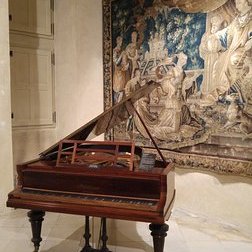
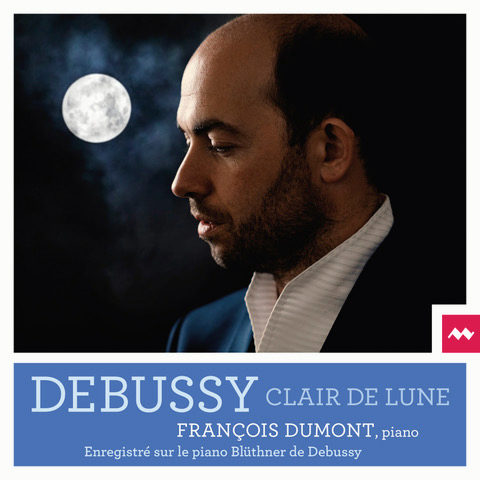
Dumont is one of the select few pianists ever allowed to touch the instrument, now fully restored and in mint condition. It was his credibility as a Debussy player that persuaded museum management to grant access.

Dumont has just released his new CD of Debussy piano music (Clair de Lune LaMusica LMU035) played on the vintage Blüthner at its resting place in the Labenche Museum in Brive-la-Gaillarde, not far from Bordeaux.

He recalled in our interview (below) how it felt to press a few keys the first time. ‘I sat down and timidly put my fingers on the keys… and it was just magical!’

The sound is indeed unique to the modern ear, a resonance intentionally soft and continuous, unlike the more glassy pedaled attacks of a Steinway grand. Dumont says changing to a nineteenth-century Blüthner is fascinating and deeply satisfying musically. Personally, I grew accustomed to his recording only after four or five hearings.

He puts the Blüthner to work on selected parts of Debussy’s Bergamasque Suite, Estampes, and Children’s Corner. His sensitive playing is as touching in the pianissimo as in forceful fortissimo. He recalled for me that he did several takes of “Clair de Lune” before he was satisfied. ‘I repeated it until I found the ethereal colours, the warmth of the melody I was looking for,’ he said.

Dumont thus joins a stellar group of established Debussy interpreters from the twentieth century and more recently performers such as Daniil Trifonov, Angela Hewitt and Steven Osborne. A busy recording artist, he has made about 45 CDs across a wide range of repertoire..

Dumont’s talent is in great demand in Europe where he maintains a punishing schedule of solo recitals and ensemble dates, as well as chamber orchestra works, in the United States, Latin America, China, Japan and South Korea.

Here are excerpts from our email exchanges about the new Debussy CD and the original Blüthner piano featured on it:

How long had this ancient Büuthner piano been idle? Shouldn’t it be falling apart?

Debussy bought the Blüthner in 1904 and kept it until his death in 1918. It was acquired by the Labenche Museum in Brive in 1989 and was fully restored, keeping the original strings and most of the original action

Are you the first pianist to be granted access to it?

There have been some others but very few. For me, it was an unbelievable privilege – a head-spinning experience – to have had access to it.

How were you chosen?

One needs to have real credibility and experience in playing Debussy to get the authorization. The museum generously offered me the use of the piano for the CD.

What is your memory of first sitting down and touching the keys? Were you nervous, excited, worried, afraid?

I will never forget that moment. I had travelled all the way from Lyon, over four hours by car, just to try the piano for an hour. I was very excited but also anxious. How would it sound, in what state would I find it? Would I feel comfortable creating my own sounds? I was afraid of being disappointed. I didn’t quite know what to expect.

It must have been a kind of electric feeling.

Yes, I sat down and timidly put my fingers on the keys… and it was just magical! I played my whole program without stopping. I was completely drawn to the originality and variety of colours.

Did you feel a spooky connection with Debussy, his ghostly presence hovering over you?

Yes, I suddenly felt I was transported to Debussy’s time, hearing the sounds as he was hearing them, playing the instrument he was playing. It is actually quite intimidating. Just imagine, some of the works on my CD, like “Children’s Corner”, were probably composed on this very instrument. A considerable amount of his music was seeing the first light of day on that Blüthner. It must have been like a laboratory for him.

How has the Blüthner design evolved since the 1850s?

The design and mechanics have indeed evolved, together with the sounds aesthetics, style and repertoire. Of course there is the question of parallel strings; now Blüthner uses crossed strings, like almost all modern manufacturers.

Why is the “fourth string” so important?

One of the specifics of the Blüthner piano is that string, called the Alicot. In the high register, instead of three strings, you find a fourth one that is not struck by the hammer. It resonates freely, by sympathy. creating a richness of color and vibration across all 88 keys.

How do you rate the Bluthner compared to the more dominant brands?

One has to remember that at Debussy’s time Blüthner was one of the most prominent brands, together with Bechstein, Erard and Pleyel. I find that Debussy’s Blüthner has a very beautiful range of colors, from bright to mellow to dark. It offers much more individuality than many modern instruments.

But isn’t it a smaller model, intended for the salon, not the concert stage?

True, when it comes to dynamic power you cannot compare it to today’s main brands. It is a chamber instrument, not even a half grand. It suits perfectly the room where it is now, surrounded by the museum’s beautiful tapestries.

What is the real value of the fourth string?

I am very seduced and intrigued by it, as it adds an element of resonance, a way of blurring the sounds, in the good sense. It is ideal for, let’s say, Romantic or Impressionistic music. I am not sure it would suit Baroque or Classical repertoire as well.

Does this fourth string alter other aspects of your playing, such as pedaling, control of dynamics or intense listening as you play?

Absolutely, many aspects are affected. Principally, you actually don’t need heavy pedaling, as you have a natural aura around the sounds. So you can keep precise pedaling, or sometimes experimentiation, to create really astonishing, impressionistic effects.

Don’t you have to work hard to control the sound you produce?

Yes, you have to listen very attentively, as the resonance is sometimes unpredictable. It is quite capricious, so you constantly need to adapt, which is artistically challenging but also very inspiring.

What musical qualities have you been able to draw from the Blüthner that you could not create with, say, a Steinway?

Well, the Steinway is so perfect, even, smooth and powerful at the same time, with absolute tone control. Debussy’s Blüthner is quite the opposite – capricious, uneven, with a very different character to each register. There is always a surprise with the Blüthner, which creates an element of risk which artistically pushes you to go further. For “Clair de Lune”, which we recorded at night, I had to do several takes till I found the ethereal colors, the warmth of the melody I was looking for. This piano has a unique vibration and warmth. You can really make it sing.

How did the piano affect your interpretations of the three Debussy cycles you chose for your CD?

I felt I was inspired to be freer, with more personal rubato and more creative with colors. On this piano you can really paint the tones.

But you cannot push it to produce, for example, the Russian School of “fast and loud”?

No, it cannot provide huge power but you can achieve many pianissimo dynamics, and subtle changes of sound and articulation. I also realised that some of colors were quite bright and contrasted, not just the pastel qualities usually associated with Debussy. This instrument taught me a different aesthetic, and pushed me toward greater flexibility and individuality.

Will other pianists be tempted to apply for access ?

Yes, I am sure that other pianists will be tempted by this wonderful adventure which brings us closer to Debussy and gives some insight into the interpretation of his works.
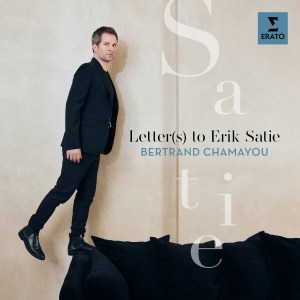
Letter(s) to Erik Satie

Bertrand Chamayou, piano


French pianist Bertrand Chamayou’s latest album features works by two musical mavericks, Erik Satie and John Cage.

Erik Satie and John Cage are UFOs in the world of music, because they envisioned music through a completely different prism,” says Chamayou. “They are pioneers in the sense that, for many people, they changed the very idea of what music must be.” With this album ‘Letter(s) to Erik Satie’ – named after a 1978 work by John Cage, conceived for voice and tape loops – Chamayou pays tribute to these two idiosyncratic, innovative and influential composers, one born in Normandy in 1866, the other in Los Angeles in 1912.

Satie is best known for his otherworldly Gymnopédies and the hypnotic Gnossiennes; Cage for his works for prepared piano and the infamous 4’33”. Both composers challenged tradition and received wisdom in composition, and their influence and legacy is very present today. Cage admired Satie, to the extent that he put on a festival devoted to Satie’s music and was responsible for the first performance of Vexations, where a short piano piece has to be repeated 840 times, over the course of 18 hours.

There is nothing vexatious about this collection: it is dreamy and haunting, intimate and intriguing. The album opens with a rarity, John Cage’s All Sides of the small Stone, for Erik Satie, which was rediscovered in 2015 among the papers of the late composer and Cage pupil James Tenney (whose piece Three Pages in the Shape of Pear is included on this album). It’s a very Satie-esque work, recalling the serenity and harmonic simplicity of the Gymnopédies, with a bass line pattern that is a direct nod to Gymnopédie No. 1. It provides the perfect opener, setting the tone of the entire album in which short works gently segue into one another. And while none of the other works by Cage on this album come quite as close to Satie’s soundworld, pieces like In a Landscape and Dream share Satie’s contemplative, introspective character, his beguiling harmonic language and hypnotic metres.

The challenge of these deceptively simple miniatures and enigmatic musical aphorisms lies in creating balance and weight, contrast and continuity, with a clear sense of the melodic line and pulse. Chamayou, a master of the intimate, achieves this brilliantly, bringing poise and poetry to music that is both very well-known (the Gymnopédies) and that which is not. He avoids cliché in his performance of the most well-known of Satie’s works and is not afraid to bring a more robust clarity of tone to the Gnossiennes, highlighting the idiosyncrasies and nuances of this fascinating music. We find a similar sparkling clarity in Cage’s In A Landscape, where bell-like motifs in the upper register chime like gamelans over an ethereal soundscape which takes the listener to another place and time.

There is one of Cage’s works for prepared piano too, in which the instrument is given a curious, otherworldly sound – something which I am sure would have intrigued and amused Satie.

The juxtapositions between the Cage pieces and those by Satie creates an organic, intriguing homage from one composer to another, sensitively and imaginatively curated by Chamayou. The album works beautifully as both a recital disc but also as a continuous loop of music where new and different aspects of the music are revealed on repeated listenings.

Letter(s) to Erik Satie is released by Erato and is available on CD, vinyl and streaming

Who or what inspired you to pursue a career in music and who or what have been the most important influences on your musical life and career?

My biggest influences have been my piano teachers:

• My first piano teacher in Toulouse’s conservatoire, Claudine Willoth, who understood I was different than the other kids and cultivated my curiosity for music in general, not only for the piano. At that time I wasn’t thinking of being a professional and was reluctant to practise scales or exercices. She didn’t insist and helped me to realise what I really wanted at that time : to compose music, to sightread some masterpieces ( too difficult for me at that time ), to improvise, to listen to all kinds of music.

• My second teacher in Paris’s conservatoire, Jean-François Heisser, who I met in Toulouse when I was only 13 and who convinced me I was could become a professional musician. From that point I started to practice seriously.

• My third teacher, in London, Maria Curcio, who convinced me I could go much further and become an international soloist. I was sometimes having 5 or 6 full days of lessons in a row. It was like that every month and she really prepared me to perform on stage, to open up and find my identity as a musician.

What have been the greatest challenges of your career so far?

They have all been ultimately very positive challenges. For example, when I first played a solo recital at the Théâtre des Champs Elysées in Paris, after which I realised I could probably consider myself as a soloist; when I played Bartok 2nd Concerto with Pierre Boulez, one of my biggest idols; all my big debuts in major venues and with major orchestras; and, more recently, creating my own festival (Festival et Académie Ravel) and Academy for young musicians, and, hopefully one day, a new concert hall, in one of my most beloved places, the French Basque Country.

Which performances/recordings are you most proud of?

Difficult to say, though I’m very proud of the last one, ‘Good Night!’,  I should say! Also the Saint-Saëns album which won the Gramophone 2019 Album of the Year Award. I could also mention an older recording, Liszt’s Années de pèlerinage. But I’m quite happy with everything, even if I know I could do everything better.

Which particular works do you think you perform best?

It’s difficult for me to answer that. Probably music by Liszt, and generally-speaking music from the 20th and 21st centuries. I’m also quite at ease with the classical style and Beethoven’s music, though that’s one side my audience knows a little less, I think.

What do you do off stage that provides inspiration on stage?

Meditation. Just before going on stage.

Elsewhere in my life, I enjoy being with friends, good food (I love to cook myself), travelling, and my relationship with all forms of art and all kinds of music, including pop. I also read a lot of books, articles, magazines, all kind of things, depending on my state of mind. This all probably goes someway in inspiring my interpretations but it is totally subconscious.

How do you make your repertoire choices from season to season?

I built a very big repertoire and musical knowledge when I was a teenager. I continue to discover new things all the time but I mainly extract ideas from this big body of work. The question is more what’s next? To try to find a logical order. But I have ideas for the next 60 years at least! Regarding new repertoire, I’m mainly interested in contemporary compositions and discovering new composers. So I try to confirm some new commissions each year so that I can regularly give premieres. This stimulates me a lot.

Do you have a favourite concert venue to perform in and why?

There are so many. I could mention Teatro Colon in Buenos Aires for example, which gives me such an intense emotion each time I enter on stage and face the audience. Such an impressive and magnificent place.

What do you feel needs to be done to grow classical music audiences/listeners?

I think that artists and promoters should work much more to promote contemporary music and to help the audience discover it gradually so they get used to it – like visual art, for example. The younger generation needs to feel that there are living artists and composers behind it. The most contemporary music should be absolutely central in my opinion. It’s fundamental to get out of this museum experience feeling. Or if not, it should at least be in the style of a modern art museum…!

We also need to destroy the existing frameworks. The look and format of a concert should not just depend on old habits.

Why should a recital consist of two halves of 45 minutes each? Why should a concerto be played at the same part of the concert each time? Why always this same ritual of encores? Why does the orchestra have more or less the same layout? Why are the (bright) lights always more or less the same in every concert hall across the world? We should innovate much more to make the whole experience more alive. It’s also essential we maintain – now more than ever – a standard of very high quality. The worst thing for me is levelling down.

What is your most memorable concert experience?

There are too many.

As a musician, what is your definition of success?

Being happy. And proud to achieve what we can achieve. To continue to have dreams and to try to make them become reality.

What do you consider to be the most important ideas and concepts to impart to aspiring musicians?

To remember that success is not about having your name written in gold letters at the top of a poster.

It’s a long quest and a process of building. You need to build your repertoire, your personality… to try to learn who you are as an artist. That all takes time. Search inside yourself, as most of what you have to say is already inside you from very early on.

Where would you like to be in 10 years ’time?

I don’t know exactly but certainly not where I am right now!

I like movement. I’d like to continue to travel, to develop my repertoire, to commission and premiere a lot of new works. To develop my Festival and Academy project and to create a real musical centre to experiment with new ideas. Maybe to teach again a bit. I’d like to be more linked to the younger generation and to today’s composers, as well as to other kinds of artists.

Bertrand Chamayou’s new album Good Night! is released on 9 October on the Warner Classics label.


Bertrand Chamayou is one of today’s most strikingly brilliant pianists, recognised for his revelatory performances at once powerfully virtuosic, imaginative and breathtakingly beautiful.

Heralded for his masterful conviction and insightful musicianship across a vast repertoire, the French pianist performs at the highest level on the international music scene. He is recognised as a leading interpreter of French repertoire, shining a new light on familiar as well as lesser known works, while possessing an equally driving curiosity and deep passion for new music. He has worked with composers including Pierre Boulez, Henri Dutilleux, György Kurtág, Thomas Adès and Michael Jarrell.

Read more


Artist photo: Warner Classics

Who or what inspired you to take up piano, and pursue a career in music?

The natural long-term choice for me would have been the violin, or at least a string instrument, as my father was a violinist with the Orchestre de Paris and my grandfather was the Principal Violist of the same and of the Paris Opera Orchestra before that. And naturally, violin was my first instrument, but one I abandoned within just months of starting it. I am not entirely certain why – perhaps I should ask my father about it actually – but a new, shiny black lacquered piano appeared in our house one day and I immediately felt pulled to it. I found a world richer than any other I had known until then, one which gave my imagination free rein and which completely absorbed my attention. Piano just felt natural to me, an extension of my own physical and spiritual being, and still does, although I am far from chained to it or obsessive about it. Of course, learning to play the piano while growing up was not always a smooth road, and I was not always disciplined or desirous of playing, especially as the pressure mounted (I did play many hours each day, usually). But I never questioned my choice of instrument, and I feel like it was always the right one for me. And when adults inevitably asked me what I wanted to do later in life, I always said that I wanted to be a pianist. It seemed like a perfectly natural answer and one which was easy for me to imagine, as I already had experience regularly attending concerts and seeing professional pianists solo with the orchestra. With that said, as a teenager and young adult I did question my choice of career, and tried a number of different things before finally making music my life…

Who or what have been the most important influences on your musical life and career?

My parents, of course, who supported and guided me all along. And some of my teachers, some of whose influence was particularly important, of which I can cite Aïda Barenboïm, my first real teacher (Daniel Baremboïm’s mother) who gave me my musical foundations; Elena Varvarova, with whom I massively improved my technique and discipline; Brigitte Engerer, who guided me in a period of uncertainty; Rena Shereshevskaya and Vladimir Krainev, who gave me confidence and brought me to a truly professional level; and Earl Wild, who encouraged me to go where the music took me. I also have to acknowledge Ursula Oppens and James Giles who exposed me to America’s rich musical world which I did not know much about. I was also lucky to learn bits and pieces from, and be supported by, Carlo-Maria Giulini, Maria Curcio, Charles Rosen, and Kurt Masur, all of whom added something important to my musical journey. But then, my life has also been filled by books, films, museums, travel, and people near and far. It is one thing to learn how to play and how to be a good musician, and it is another to experience life and learn about oneself and one’s humanity, which then should come through in the expression of music.

What have been the greatest challenges of your career so far?

My career has been unusual, and I have always been out of the system. I have never liked the idea of competition in music, whether in formal or informal terms. Either music is an art or it is a sport, and I don’t believe a sport-like competition is how you hone and find the best artists, even if on occasion you do in a sort of coincidence (although without a doubt, true artists will be true artists no matter how they build their career). The reality is that there is a selection process that occurs anywhere you are, whether formally through a competition or a conservatory entrance audition, or through the acclamation or lack thereof of a public and the press. I don’t personally like to participate in something that to me seems antithetical to the development of the artist and the meaning of music. I say this only because my refusal to play that game has probably penalized me in some ways, and made it harder for me to find my place in the so-called music business.

I have also allowed myself to live life and take the time to learn life from a wide-array of experiences, to find where my truth lies and why I even bother being a musician. And then I also have been active as a teacher, as a concert and festival organizer, and as a recording and film producer of sorts, learning along the way many skills that help me express my personal artistic vision more fully and effectively. I am also quite certain of the joy I feel when sharing something I love with an audience: indeed, music is both uniquely personal and also uniquely communal. For this reason, I hope I will have the chance to share my love of Bach’s Well-Tempered Clavier with as many people as possible, both through the album as well as through performances down the road.

Which performance/recordings are you most proud of?

While I began my musical life at the very tender age of three, four years old, and began my performance career at ten, I never rushed into making recordings until I felt sure enough of what I had to say, knowing that there was no absolute need to engrave music permanently that had already been recorded by others before, unless there was another compelling reason to do so. Perhaps surprisingly at this stage of life, my recording of Bach’s Well-Tempered Clavier is my first solo release, but I am not shy of saying that I am exceedingly proud of it and happy to have made it just that way. And while my playing of Bach has already changed since I made the recording, I feel that it is a very accurate representation of who I am as a musician.

I am also still proud and honoured to have given the World Premiere performances and recording of Beethoven’s Piano Trio Hess 47 with my Beethoven Project Trio back in 2009 in Chicago and New York, an adventure forever engraved in my memory.

Which particular works do you think you play best?

I like to get under the skin of the composers whose music I play. When I begin to explore a sound world, I want to go deep and feel the sensitivities and emotions of the composer who wrote that music, which is one of the reasons I like to isolate a composer and focus very intensely on that one artist, usually making pilgrimages to the places where that composer lived and worked and reading a lot, along with exploring as much of his or her music as possible. For big composers, I do think it’s a very valuable experience to really go deep, which is what I did with Bach and his Well-Tempered Clavier, and is what I am doing now with Beethoven as I prepare to record his complete sonatas. Those two composers will always be very close to my musical heart, as well as Rameau, Mozart, Chopin, Debussy and Ravel. I also love Brahms, but am taking my time to take a full dive into his world. More importantly, life is usually circular, and I approach these composers many times, over time and in due time, and until the time I feel ready to go straight to the heart of what they mean to me. As far as specific works that I play best, I don’t think that is as relevant as just feeling close to a composer’s musical language and being free to express my own sensitivity through that adopted language.

How do you make your repertoire choices from season to season?

I don’t play the seasons game. Music and a musical life have to remain organic, natural, flowing. I cannot force myself to think in terms of seasons. I simply go where my passion takes me and let things fall into place as they will. I am human, and more importantly a musician, not a bureaucrat. As long as I have joy to play a program, I will do so. If for any reason I lose that joy, the program will change. What I do guarantee is that I will show up, barring any impossible situation, where I said I would, and I am always game for a challenge. But I will never do anything that will threaten the joy of music making, and the desire to share something that rings true to me at a specific moment. The idea that I can program something more than one, two or three years in advance rings hollow to me, with the probable exception of Bach’s Well-Tempered Clavier, which I have never grown tired of and don’t expect to. But clearly I also love to take my time to explore one work or one composer, and that usually lasts two or three seasons at least…

Do you have a favourite concert venue to perform in and why?

No. As long as there is a minimal amount of climate comfort, and a decent piano, and more importantly a curious audience, I am happy. But I will say that I never had as much pleasure as I did when recording the Well-Tempered Clavier in Weimar’s historic Jakobskirche and on a very unique Hamburg Steinway D that I had found in Paris, through Régie Pianos. Everything about the acoustic and physical experience there was satisfying, and I suppose that’s a good thing when it comes to making a permanent record!

Who are your favourite musicians?

I don’t know. There are lots of musicians whom I admire, and who have made some great recordings, who have performed some memorable concerts, who have moved me, dead or alive, at one time or another of my life. Some musicians have done it more regularly than others, but it’s so subjective, even to me! And truly, for the most part, there is no debate to be had on most of the great musicians. In no particular order, Artur Rubinstein, Josef Hofmann, Dinu Lipatti, Vladimir Horowitz, Claudio Arrau, Marcelle Meyer, Pau Casals, Jascha Heifetz, Henryk Szeryng, Georg Solti, Leonard Bernstein… to stay only with the dead, and to remain terribly incomplete. But I love going down rabbit holes and listening, either to radio, one of the streaming services, or just randomly picking through my record collection, and acquainting or reacquainting myself with a musician. But I am not a guru seeker, so while I enjoy listening, going to concerts, and so on, I am also happy with silence sometimes, which is a great teacher of music.

What is your most memorable concert experience?

I’ve been to many. A performance of Eugène Onégin with Valery Gergiev conducting his Mariinsky orchestra and singers in Paris some twenty years ago has stayed with me emotionally. Deeply memorable also was a masterclass given by Kurt Masur in New York where he showed the arm-waving student conductors how to conduct without even moving his arms (and of course do it better)! It taught me the power of intention and focus.

As a musician, what is your definition of success?

There are several sides to success and different ways of understanding the meaning of success as a musician. For me, first, it is being able to express myself from the fount of my inner truth, in other words, it has to ring true to me first, and remains entirely personal, involving no one else, and which is only possible following a long inner journey of discovery and experience. Second, it is succeeding in the practical sense, having the ability to make albums, to perform, and to transmit what one has learned, in such a way as to be free from need and free to be creative. But that sometimes comes and goes with life’s many ups and downs! So then I hold on to my first precept.

What do you consider to be the most important ideas and concepts to impart to aspiring musicians?

Stop practicing! Begin living! Seriously, if you know how to play scales and arpeggios, know how to read music, and have covered some basic repertoire from different periods, your basic instrumental education is over. I think way too many musicians try the athletic approach to music, and think they have to be as good if not better technically than the current stars. Perhaps so, in a sense, okay, fine. But a big part of learning to be a good performer, even a good technician, comes from loosening up and taking a step back. Live! Love! Make mistakes! Learn! What else is true music, true art about, if it is not about life? The practice room is too small to let life in. Don’t let life slip by, and find your truth through experience, through the highs and the lows of it all. Confront yourself to reality, not theory. The conservatory is not the place to learn to be a musician, but only a technician. That’s fine for a bit but don’t expect too much from it, if you really have it in you to be a musician. Stop studying as soon as you can, and you’ll have a greater chance of becoming a musician someday.

Where would you like to be in 10 years’ time?

A good place, on a cooler and calmer planet, in harmony with my environment and humanity both physically, emotionally and spiritually.


A concert pianist since his formal debut at age ten in Paris, George Lepauw has performed ever since as a recitalist, chamber musician, vocal collaborator, and soloist with orchestra. He also occasionally collaborates with musicians from other musical genres, including cabaret, musical theater, traditional Chinese and Persian music, flamenco, blues, and pop.

Read more


