One of the bonuses of teaching is that from time to time you are introduced to new repertoire. Sometimes, you get the opportunity to change your view of a composer that was really only based on a passing experience.
A pupil of mine has recently been learning a piece by Cecile Chaminade, a composer whose music I had until now associated with a flautist house-mate practising diligently in the run up to a recital. A beautiful work, the Concertino, but the flute can be surprising loud in close quarters.
Cecile Chaminade (1857-1944) composed throughout her life, and left a large number of piano works, in addition to orchestral music and songs. The piece that my pupil learnt, and that inspired me to explore Chaminade’s music, was the Idylle, Op. 126, No. 1, from her Album for Children of 1907. It has a melody that becomes a real ear worm; marked bien chanté, it does indeed feel very singable. It’s such a satisfying piece to play; the melody in the right hand is accompanied by a simple enough bass line helped along with discreet pedalling. The middle section requires a little more diligent practice for the aspiring Grade 4 pianist (the piece has recently been on the ABRSM Grade 4 syllabus) and the writing is never dull; the melody wings its way onwards, and for a glorious minute or so you can be flying over the rooftops, your spirits lifted. The opening melody returns to round off the piece and you sense in the pupil the confidence that familiarity brings. Immediately the pupil’s playing is more assured, expressive, even playing around with tempo and the placing of the notes.
I think it was the singable melody that piqued my curiosity, and made me want to know more about Chaminade’s music. The piece I found first was her Serenade Op. 29, written in 1884. After listening to this you can see why Chaminade’s music has been described as charming. The opening melody is gentle, almost like a lullaby, and is supported by pleasing harmonies in the accompaniment. The second melody has a similar rhythmic pattern and is more searching but still holds a tender quality. They are both such beautiful melodies that the whole piece really works. Both tunes use similar rhythmic patterns and accompaniments, but it’s the subtle melodic development as well as changes in articulation that keeps this piece interesting. The music finally fades away to ppp and a tonic chord, dusk having fallen and the musicians taking their leave.
The next work of Chaminade’s I listened to, which really threatened to take the attached description of ‘charming’ and hurl it out of the window, was her Arabesque No 1, Op. 6, from 1892. It’s a tempestuous piece, technically much more difficult than the Serenade. Chaminade was a pianist, studying with teachers from the Paris Conservatoire, and later performing her works in Europe and the United States. I can imagine her sitting at the keyboard, absorbed in her music, taking the audience with her on a journey through delicate flourishes and big chords, carried along by a melody that is seeped in the Romanticism of her Russian and German contemporaries.
Her Caprice-Impromptu, despite being one of her later works, written in 1914, is also decidedly Romantic. Chaminade, like her near contemporary Rachmaninov, remained broadly consistent in her style whilst many composers around her responded to new influences. Indeed, the Caprice-Impromptu has hints of Rachmaninov in its melodic writing. Like the Arabesque, there’s a sense of urgency and although the first section is playful as the title of the piece suggests, the melody that follows in the second section is at once both yearning and lyrical. Chromatic scales in octaves add to the sense of drama and the composer makes full use of the expressive range of the piano; the music ranges from fortissimo to piano and dolce.
Chaminade’s music is characterized by its melodic writing and chromaticism; it’s Romantic, yes, accessible, maybe, but no less interesting for that. Chaminade was a prolific composer and her piano works are both imaginative and musically satisfying. I can’t wait to discover more.
Of What Is, and What Pretends to Be Howard Smith #note4notethebook
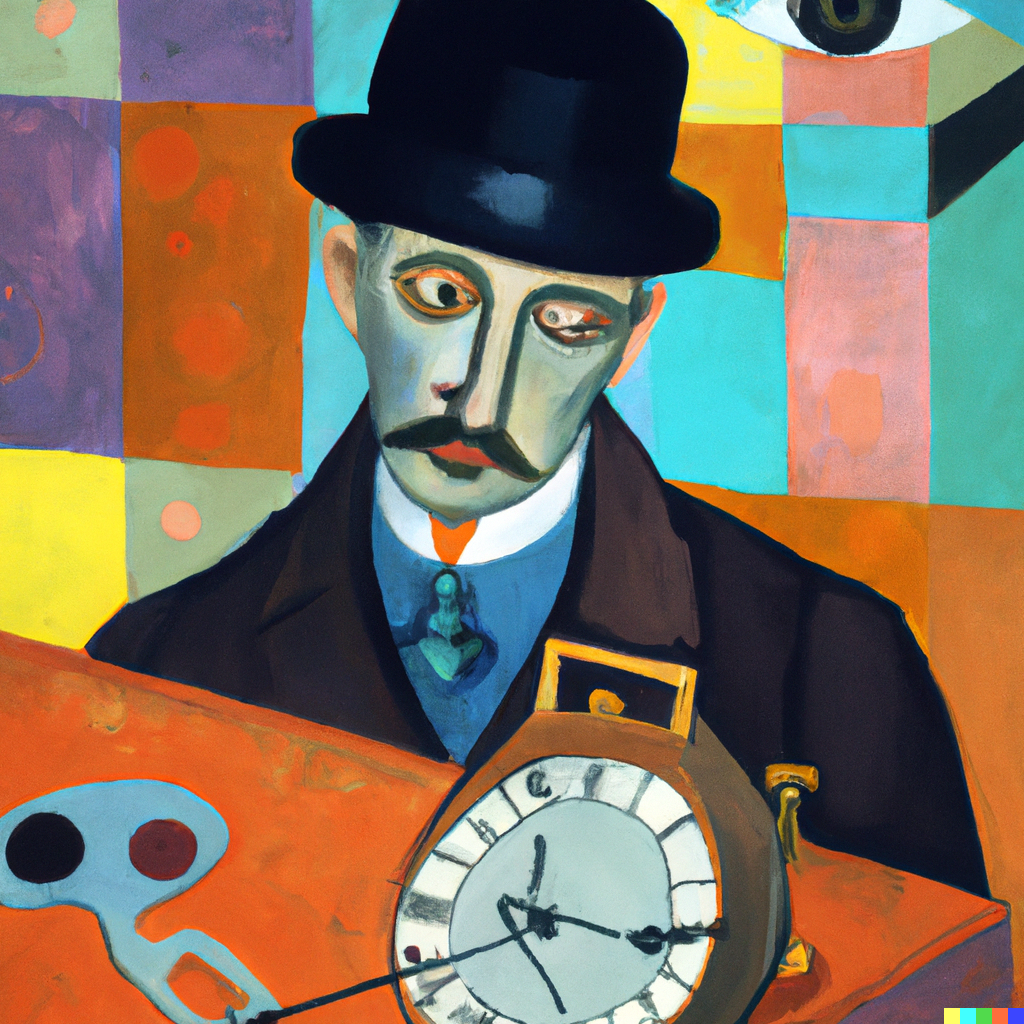
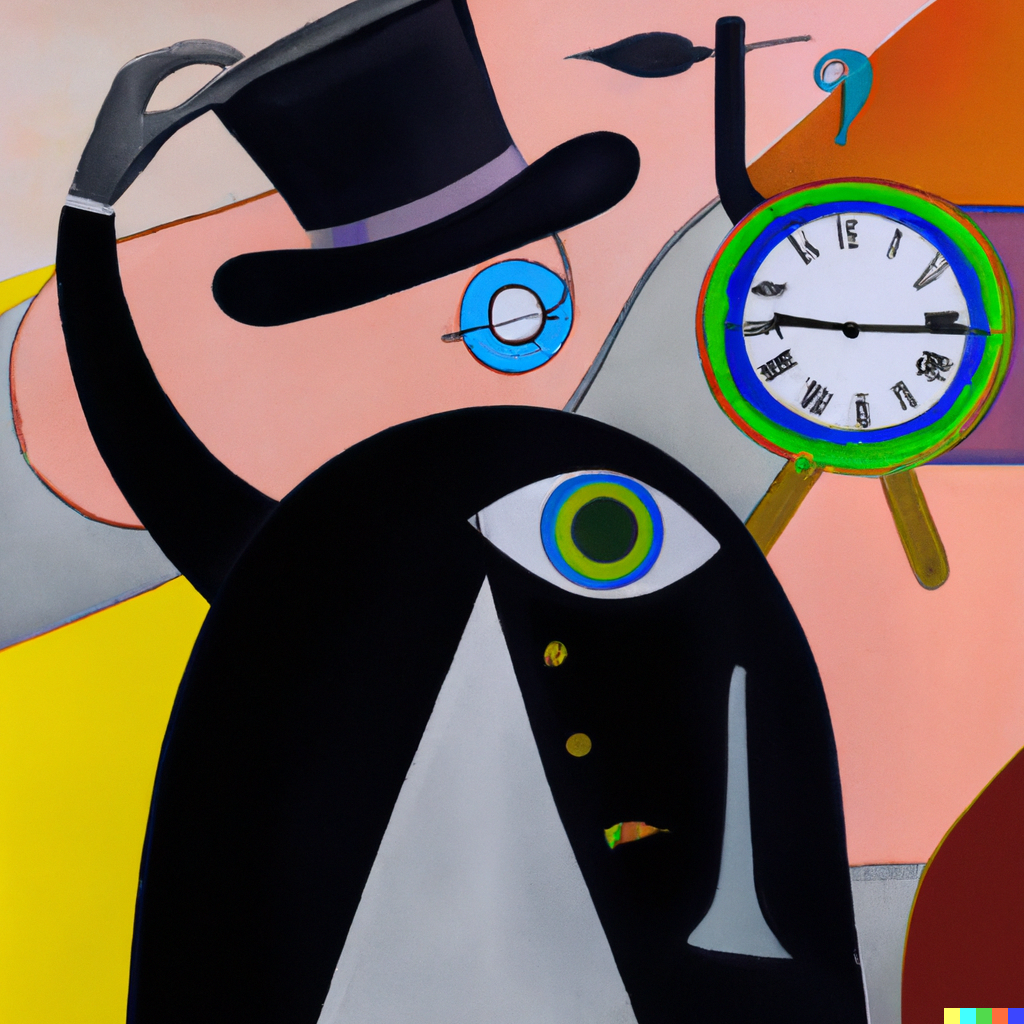
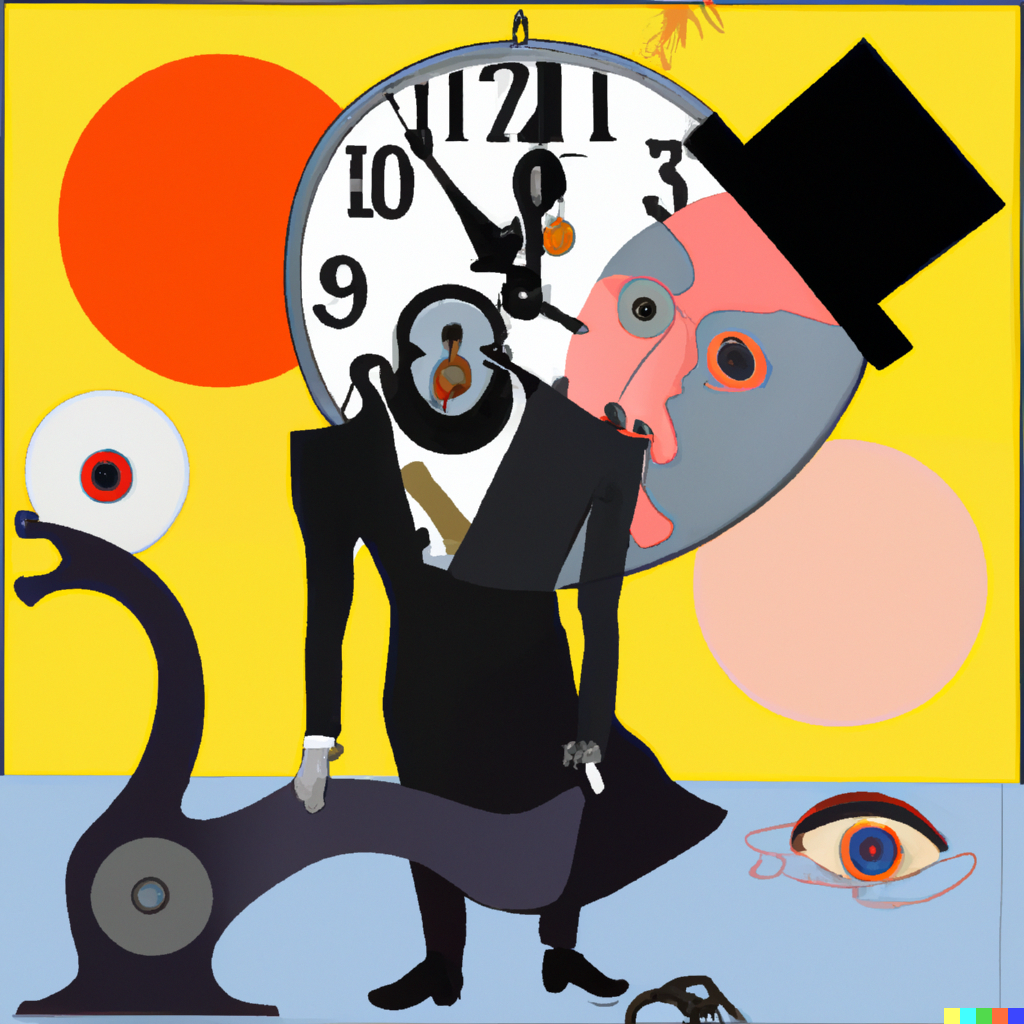
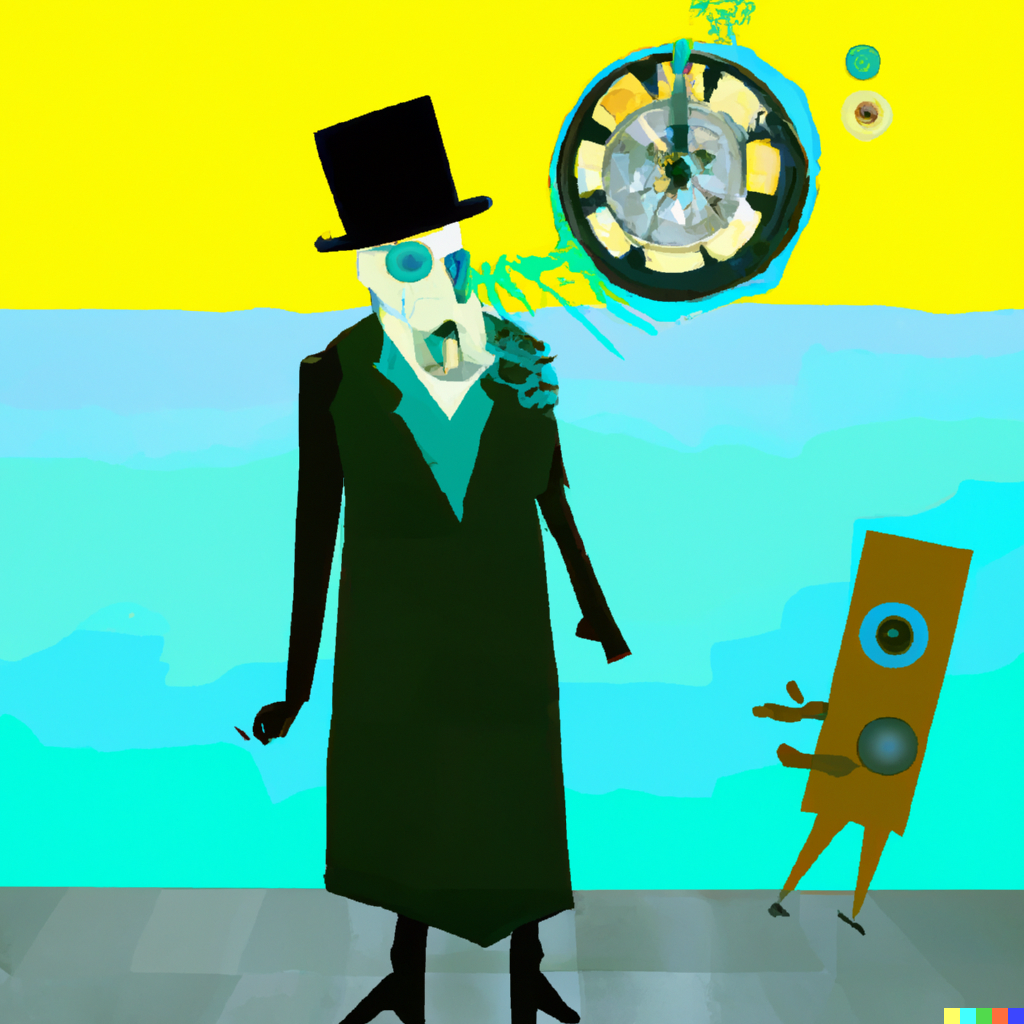
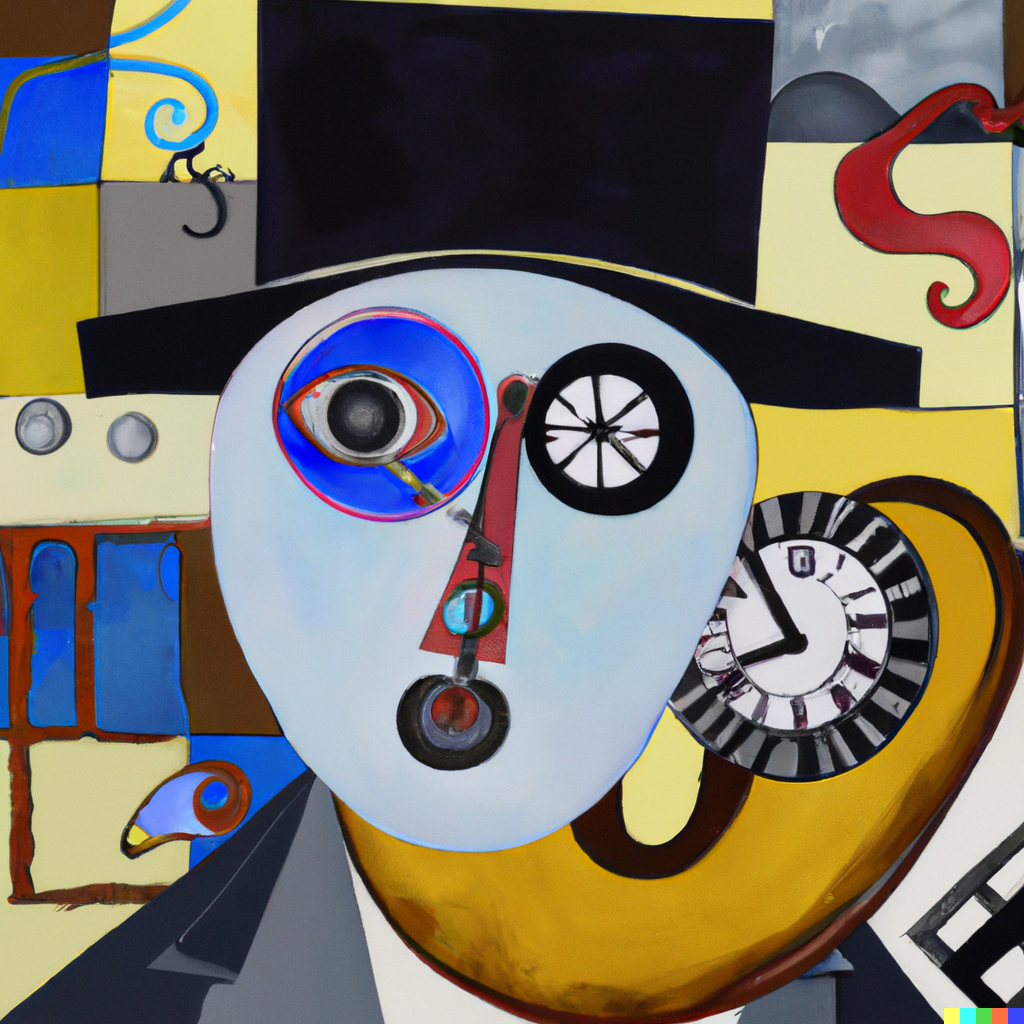
Amateur pianist and author of Note For Note – Bewitched, Bothered & Bewildered, Howard Smith, recently trained an artificial intelligence (AI) to think and write as Erik Satie. Using a custom GPT, Howard generated a series of beautiful images of the composer together with imagined statements, quotations and poetry based on his life, work and ethos and that of other artistic movements of the era, including Dada. The resultant images were used in a ‘moving art’ exhibit during a performance of Satie’s iconic music at an piano recital given by Howard at the October Gallery, London, in April of this year. Satie’s imagined musings were given to everyone who attended the evening in the form of a small ‘take home’ booklet.
To celebrate the life and work of this enigmatic and endlessly intriguing figure, on this the centenary of his death (1st July 1925), we are sharing Howard’s remarkable AI gaze into the mind of the genius.
“I do not compose music as one builds a cathedral, grand and towering. No, my music is a chair—simple, functional, meant to be sat upon, or ignored entirely. It does not seek to impress but to exist, to hover in the air like a thought half-formed, like a joke no one quite understands. I reject the pomposity of symphonies, the tyranny of tradition. Instead, I write in the language of absinthe and rain, of lost gloves and distant laughter. If my music confuses you, good. If it makes you smile at nothing in particular, even better. It is not there to be understood—it is there to be.”
My dear friends, let me regale you with tales of my musical endeavours. I, Erik Satie, have always been drawn to the unconventional, the unorthodox, the nonsensical, and the illogical. I have sought both to challenge and to mock the status quo, to push and to shatter the boundaries of what is considered to be “music.”
The movement of Impressionism, with its emphasis on light and color, has had a profound influence on my compositions. I strive to evoke a sense of atmosphere and mood, chaos and confusion, through the use of harmonic and melodic colour—sometimes nonsensical, sometimes dissonant, always daring. Unconventional harmonies and dissonant chord progressions are my allies in creating a sense of tension, disorder, and delight. As I have often mused, “I have found it necessary to get rid of all the parts that everyone likes and keep all those which no one likes—and perhaps also those which make no sense.”
The cabaret and café-concert culture of my beloved Paris has also been a tremendous source of inspiration. The playful, irreverent, satirical, and nonsensical spirit of these performances echoes in my compositions. I have woven elements of cabaret into my music, always seeking to push and mock the boundaries of acceptability. As I have whimsically declared, “I am a country whose boundaries are the imagination, and perhaps, absurdity.”
I have also been shaped by the simplicity and repetition found in folk music, medieval and Renaissance music, and popular music. These have all been crucial in my quest to evoke hypnotic and meditative states, as well as chaotic and illogical ones. My compositions, described by some as “inventive and original,” by others as “nonsensical and illogical,” are my proudest achievements.
My unique and unconventional style has left a mark on the composers who have followed me. The repetitive rhythms and simple harmonies that I have embraced have seeped into the minimalist and Dada styles alike. My music has also been a curious influence on the development of ambient, chaotic, and experimental music.
Friends, my music is the product of a wide and wild range of influences and genres. I have always sought to challenge and mock the status quo, to both push and shatter the boundaries of “music.” And I shall continue to do so, for as I have said, “The essential thing is to invent,” whether it be sense or absurdity. And with that, I bid you adieu, and hope that you will enjoy my compositions—whatever they may be.
The composer speaks of the work of others!
“You ask me of others? … Ah, Schoenberg—he has built a magnificent prison for sound, where no note may escape without permission. And Webern! His music is like watching a flea conduct an orchestra—so precise, so delicate, and yet, one wonders if it is there at all. As for Berg, well, he writes like a man composing letters to ghosts, beautifully tragic, but I fear the ghosts do not read music. You see, these gentlemen have taken ‘melody’ out for a long walk and forgotten to bring it home. I prefer music that winks at you from across the room, rather than staring at you sternly from a lectern.”
Advice for those who foolishly choose to play my music
In the realm of my melodies, a curious plight befalls, The challenges that unfold when my music enthralls. Performing my compositions, a task not for the faint, For they dance in a world where conventions are taint.
The tempo, a riddle that defies the clock’s hand, Floating in ambiguous rhythms, like shifting sand. One must navigate the maze of pauses and beats, And embrace the uncertainty where dissonance meets.
Oh, the dynamics, a game of whispers and roars, They whisper secrets and tales, then loudly encore. From the softest of whispers to the loudest of cries, Unveiling the emotional depths hidden in disguise.
The elusive nuances, delicate and refined, Each note a story, a journey entwined. One must master the art of subtlety and grace, To capture the essence of each fleeting embrace.
And let us not forget the quirky, unexpected turns, Where surprises abound and convention adjourns. For in the realm of my music, the unexpected thrives, As rules and expectations take nosedives.
So, dear performers, embrace the challenge, be bold, Unleash the spirit of my compositions, untold. For within the difficulties lie treasures untamed, In the realm of my music, true art is claimed.
Perform my works with passion, with heart aflame, Navigate the obstacles, conquer the untamed. And in the triumph of each difficult refrain, You’ll unlock the essence of my musical terrain.
So, to those who dare to venture on this path, May your performance ignite the eternal Satie wrath. For in the difficulties lie the seeds of triumph and grace, In the performance of my music, a journey takes place.
“The notes danced on the page With no care for time or age They sang of chaos and confusion In a melody of self-illusion The harmony was out of tune But that only added to the moon The rhythm was a mess But it was the best. For in this madness, we find art In this chaos, a brand new start. So let us revel in the absurd For it is in this, true beauty is heard.”
Of What Is, and What Pretends to Be
Erik Satie was known for his sharp wit and his often unusual, provocative comments. Below are quotations attributed to him:
“I took to my room and let small things evolve slowly.”
“Before I compose a piece, I walk around it several times, accompanied by myself.”
“I have never written a note I didn’t mean.”
“Artists of my kind deal with matters of the heart; they have no time to bother about digestion.”
“The musician is perhaps the most modest of animals, but he is also the proudest.”
“I am by far your superior, but my notorious modesty prevents me from saying so.”
“What I am trying to achieve is a new way of approaching old sentimental airs.”
“When I was young, they told me: ‘You’ll see when you’re fifty.’ I’m fifty. I’ve seen nothing.”
“An artist must organize his life. Here is the exact timetable of my daily activities:
I rise at 7:18; am inspired from 10:23 to 11:47. I lunch at 12:11 and leave the table at 12:14. A healthy ride on horse-back round my domain follows from 1:19 pm to 2:53 pm. Another bout of inspiration from 3:12 to 4:07 pm. From 5 to 6:47 pm various occupations (fencing, reflection, immobility, visits, contemplation, dexterity, natation, etc.)”
“I write poetry because my furniture refuses to listen to my piano sonatas, and someone must suffer the metaphors.”
In the Key of Silence
I walk alone in silent streets, Where echoes dance on muted feet, A solitary waltz of sound, In the spaces where I am found.
My fingers trace the ivory’s curve, In notes that neither rise nor swerve, But drift like smoke, like gentle rain, In melodies that speak of pain.
I dream of chords that never clash, Of gentle waves that softly splash, Against the shores of time and thought, In patterns that I never sought.
My music breathes in shadows dim, A whisper on the twilight’s rim, A gentle sigh, a fleeting breath, That lingers on the lips of death.
I am a ghost within a tune, A faint lament beneath the moon, A passing breeze, a flickering flame, That burns without a name or fame.
Yet in these notes, my soul resides, A truth that every silence hides, For I am more than flesh and bone, In every sound, I find my home.
So let the world in chaos spin, I’ll find my peace where notes begin, In simple strains, in quiet air, My music lives, forever there.
I Dance with Notes Like Drunken Clocks
I watch the notes dance on the page, wild and free, They waltz with teacups, and swim in tea, Time means nothing, age even less, I’m the maestro of madness, I must confess.
I sing of chaos in colors unseen, A symphony woven from my strangest dream, Where clocks melt and cows take flight, In a melody plucked from the dead of night.
Harmony grins with a twisted face, Out of tune, yet perfectly misplaced, I let it tangle with the stars above, Skipping beats like a broken love.
The rhythm, oh, what a beautiful mess! A riot of tick-tocks in a disorderly dress, I send it stumbling down a rabbit hole, Where the absurd is king, and I am whole.
For in this madness, I craft my art, A canvas of whispers, a Dadaist heart, With scissors and glue, I piece it together, A collage of sound, indifferent to weather.
In chaos, I find my brand new start, A genesis born from an unchained heart, So I revel in the absurd’s sweet kiss, Knowing in this cacophony, true beauty exists.
The notes are my clocks, my clocks are dreams, And nothing is ever as it seems, In my world of topsy-turvy glee, I dance with the notes, I dance with me.
Let the pigeons wear hats, the fish recite, I’ll bring out the sun in the dead of night, For in this nonsense, my truth is heard, A symphony of the absurd, every note absurd.
So I play on, my friends, in this grand charade, In the music of life, let my madness parade, For in my dissonance, true art’s concealed, In my dance with the absurd, all beauty’s revealed.
“I do not write music to please the ear; I write to tease the mind, to make it dance in absurdity. My melodies are like lost children—wandering through the night, searching for a place that does not exist.”
“Life is a series of dissonant notes, beautifully out of tune. And in that, we find our harmony. To create is to embrace the absurd, to revel in the nonsensical, and to find order in the delightful chaos of the mind.”
“Time is an illusion, and my music is its shadow, fleeting and ever-changing, yet always there. I compose not for applause, but for the invisible conversations between the notes and the silence.”
“The true art lies not in perfection, but in the daring to be imperfect—a melody that dares to trip over itself.”
“In every absurdity, there is a truth waiting to be heard, a beauty that defies the ordinary. My music does not follow the rules of time; it dances to the rhythm of dreams, where clocks have no hands.”
“I live in a world where pianos converse with teapots, and where every note is a secret shared between the absurd and the sublime.”
“Very finally, with a hint of silence.”
Attribution? This curious little booklet—filled with poetry, musings, and the ever-enigmatic words of composer Erik Satie—was conjured into being by Howard Smith and “Erik Satie”, with a generous helping of GPT-4 magic. Artwork projected during Personal Passions @ October Gallery was created with the assistance of MidJourney and DALL-E. Questions to smithhn@gmail.com
Perhaps enough time has passed since the death of the French pedagogue Nadia Boulanger to step back and question her musical sainthood. She was, after all, only human.
My elder musician friends recall her as a brilliant analyst of composition yet as a person she tended toward the tyrannical, impatient and cantankerous. Composer Philip Glass, who studied with her for two years, wrote that she tried to be kind but “stayed pretty much in the range between intimidating and terrifying”.
She was like a lot of piano teachers, one might add. Fanny Waterman used to crack the knuckles of her young students with a ruler if they missed a note or dragged a tempo.
Nadia, who died in Paris in 1979, moved in the best circles of 20th century music. Leonard Bernstein often visited her in Paris. On one occasion, when he was already established as a composer and conductor, he recalled being made to feel small when he played one of his compositions for her. She objected to a certain b-flat. He recalled later, “I am 58,” but suddenly “it was like I was a child.…”
One musician friend of mine in Paris who studied with several of her students goes further, accusing her of “castrating” them (especially the males) by constant criticism and tedious exercises that had them “jumping through technical hoops for hours, years, on end”. Some of the exercises she wrote for her charges were “soul-destroying”, he says.
Nadia knew she had a mixed reputation and was comfortable with that. She maintained that musical training without rigor cannot be of value. Virgil Thomson wrote that she had a “no-nonsense approach to musical skills and a no-fooling-around treatment of anyone’s talent or vocation”. She once turned down a young girl applicant, exasperated, saying she would never find the patience to work with her. Fortunately, she added, her father was soon transferred to another country and the family left France.
I have just read an extraordinary collection of Nadia’s opinions and memories as assembled by Bruno Monsaingeon and published in 1980 as ‘Mademoiselle’ (Editions Van de Valde). Long out of print, I found a dog-eared, mildewed French copy in a bookstall and have studied it minutely. It is a portrait of a complex lady who describes herself as “pitiless” in her treatment of students, adding that she was just as rough on herself.
Originally an aspiring composer, she said that “if there is one thing I am sure of … it is that my music is useless”. Some listeners today would agree while others don’t. Her blandness and lack of originality seem evident to me. She admitted that she realized early on that she “had absolutely nothing to say.”
A student of Gabriel Fauré, Nadia gave up composition after the death of her beloved sister Lili, the more talented of the two sisters. Lili died of an affliction now known as Crohn’s disease, at 24, in 1918. Broken by Lili’s death, Nadia threw herself into teaching, inviting students from throughout the world to come to her Paris apartment and be forced into her straightjacket. There she taught conducting, analysis, harmony, counterpoint and composition as well as piano performance.
Some of the most important musicians of the 20th century worked under her harsh regime: Aaron Copland, Elliott Carter, Walter Piston, Pierre Schaeffer, Igor Markevitch, John-Eliot Gardiner, Daniel Barenboïm, Dinu Lipatti and others. Her list of students has never been completed but I should add the jazz composers Quincy Jones and Donald Byrd. The list goes on – Jean Françaix, Roy Harris, Peter Hill, Ralph Kirkpatrick, Michel Legrand, Gian Carlo Menotti, Jeremy Menuhin, Emile Naoumoff, Soulima Stravinsky.
Nadia was particularly critical of her American students who queued up to suffer under her rigorous demands. About 600 Americans took lessons from her in the 1920s to the 1970s. She found some of them brilliant but many, she said, lacked fundamentals or even a good ear. “The truth is that the study of the basics makes you understand that to be a good musician you must be a good grammarian.”
Conductor Igor Markevitch, who studied with her, recalled that she went out of her way to assert herself, even wearing a pince-nez to appear professorial. This, he said, helped her advance in a world then dominated by men.
She could be so harsh as to leave students stunned. Glass recalled in his recent autobiography ‘Words Without Music’ that while recuperating after a group class studying Bach chorales, the students would sit down at a café for coffee or beer. The Boulanger experience, he remembered, “invariably left us shaken and silent”.
Confused by the contradictory opinions in the air today, I turned to one of my main interests, portraiture, to try to get a better feel for the person behind the mask. Portraits can afford the artist a good opportunity to study a subject up close. In her case, I found nothing but severity — a strong jaw, narrowed eyes, arched eyebrows, a hard, thin mouth, and body language that students such as Glass found intimidating.
Watching her come to life on the page, I had to turn away. I felt fear. As a student, I would not have lasted an hour with her.
The Monsaingeon book is the most comprehensive account of Nadia’s views on music. He directed a television documentary on her 90th birthday and produced a book-length compilation of some five years of meetings and conversations with her. For easy reading, he reordered the material as an interview – inserting questions among her monologues.
I have produced this edited and translated version of Monsaingeon’s work, capturing the most pertinent extracts for a modern audience.
Aaron Copland described you as the most famous professor of composition alive.
Allow me to doubt the veracity of that statement. I believe a professor is dependent on the quality of the students. The professor’s role is less grand, less omnipotent, than one might think.
When did you discover music?
As a child, I could not stand the sound of music. It almost made me sick. I screamed. My sobbing could be heard in the street. The piano was a monster that terrorized me. Then one day I heard a fire truck passing by, siren blaring, and I sat down and found those notes on the keyboard. Suddenly I had discovered music with a passion. I can still hear my father saying, “What a strange little girl we have here.”
Your father was a French music professor and you mother was Russian?
Yes, my father was totally French and my mother Russian (Princess Michesky). We never spoke Russian in the home because she did not want the family language to be one that my father did not understand.
Do you believe your Russian ancestry has been important for you?
It has been very important … but I do not like to talk about personal background. There is no point talking about me all day long because it would interest no one and certainly not me!
Is it true that at the age of twelve you knew Bach’s Well-Tempered Clavier by heart?
It was an obligation. I was instructed to learn one prelude and one fugue per week. But you know, let’s not exaggerate. One prelude and one fugue per week is not so much… After this kind of training, though, one has a good basis in mind.
It is said that you already had an encyclopedic knowledge of music when you began teaching.
You know, people say all kinds of things, few of which are true.
How did you end up at the American Conservatory of Fontainebleau?
Walter Damrosch founded the school and Francis Casadesus was the first director. I was brought in to join the faculty. I spoke two words of English, “Hello” and “Goodbye”. My first student was Aaron Copland. After Robert Casadesus, other directors followed, including Maurice Ravel, Charles-Marie Widor, and I succeeded Casadesus in 1946.
I understand that the conservatory was founded after World War I for American troops but after the war, what happened?
The Fontainebleau school became very important for the Americans. They had brilliant schooling and were very gifted but they lacked fundamentals in many cases; their musical ear was underdeveloped and they had bypassed the everyday details of music education. Why? Because — it was believed — one must not overwork the children.
What were your basics in the curriculum?
I had to insist on the fundamentals – hearing, looking, listening and seeing.
You trained a large number of Americans. There must be hardly a city in North America that doesn’t have one of your students.
Yes indeed, I had a great number of American students. One must remember that fifty years ago there was no such thing as American music. An immense change has happened since – Monsieur Copland, Monsieur Bernstein – their works are performed all over the world. The term “American musician” is no longer something unusual.
Didn’t you bring Aaron Copland to the attention of the American public?
A. Yes, in September 1938 I encouraged Walter Damrosch and Serge Koussevitzky to program his Symphony for Organ and Orchestra. Damrosch conducted it in Boston (in 1938) and was probably disturbed by the modernity of it. He turned to the audience as said, “Ladies and gentlemen, if a man of 23 can compose such a work, he will be capable by the age of 30 of murdering his own parents.” He was laughing but he was serious too. Naturally there was a reaction and agitation among the public but Copland’s reputation was made. Copland’s piece seems tame by today’s standards.
Music goes through phases of popularity. Is this a problem?
I am tormented by the phenomenon of fashion in music. Since I am an old fusspot, I don’t much like change. Of course change for reasons of necessity can be marvelous. But change because one does not know where to go next is fatal and destructive.
What about new voices in music?
Rather than deepening one’s understanding, we see too many people chasing discoveries as an end in itself — finding that unknown masterpiece at any cost. The less these people understand, the more enthusiastic they are. I recently heard a piece that made me wonder if the composer was ill, on drugs, or victim of a serious mental disorder.
How important is music in your life?
I am an absolutely mad consumer of music. I call it a sickness because even when I am exhausted after eight or nine hours of teaching, my first move – to the annoyance of the household – is to switch on the radio and listen. I am insatiable. I love listening (to music).
You say you can appreciate the good and bad elements of a work. What are your criteria for a masterpiece?
I have no idea. I don’t say they don’t exist but I have no idea.
And yet listening to a masterpiece you seem to be certain of your judgment.
It comes down to faith, to belief. Just as I accept the existence of God, I accept beauty, I accept emotion and I accept a masterpiece… Exactly what makes up a masterpiece escapes me… I can analyze anything. But a page, a line, a measure of Schubert, I have no idea.
How much training is necessary to appreciate great music?
One can be totally without training and yet feel the senses penetrated by melodic emotion – this is perfectly respectable.
How do you balance rigor and creative freedom?
I hope my teaching has influenced students to appreciate the need for rigor, for order. But in the area of style, I have never intended to exert any influence. If I am working with a foreigner and I try to make him or her into a French person I am sure to fail.
Isn’t it possible to list composers in a hierarchy of importance?
The seems very difficult to me.
Still, one could rank Beethoven against Max Bruch, for example.…
There you are falling into the abyss. You compare the Himalayas with Butte Montmartre. Really, I must say that I honestly almost never think about Max Bruch whereas hardly a day passes that I don’t think about Beethoven.
How would you sum up your role as a professor?
I know my job. I am someone who can help students acquire a basic technique, to listen, to hear, to transpose, to practice, to memorize. The role of the professor seems to me to be modest.
Another version of this essay-interview originally appeared on factsandarts.com
Michael Johnson is a music critic with particular interest in piano. He worked as a reporter and editor in New York, Moscow, Paris and London over his writing career. He is the author of five books and divides his time between Boston and Bordeaux.
The Cross-Eyed Pianist is free to access and ad-free, and takes many hours every month to research, write, and maintain.
If you find joy and value in what I do, please consider making a donation to support the continuance of the site









 The Cross-Eyed Pianist