Franz Liszt divides opinion. For some he is regarded as one of the greatest pianist-composers of the Romantic era; for others, he is a showman and a charlatan who wrote vulgar, showy music.
In fact, he was a remarkable musician and human being. Sure, as a performer he could be flamboyant and extravagant in his gestures, but he helped shape the modern solo piano concert as we know it today and he also brought a great deal of music to the public realm through his transcriptions (he transcribed Beethoven’s symphonies for solo piano, thus making this repertoire accessible to both concert artists and amateur pianists to play at home). He was an advocate of new music and up-and-coming composers and lent his generous support to people like Richard Wagner (who married Liszt’s daughter Cosima).
His piano music combines technical virtuosity and emotional depth. It’s true that some of his output is showy – all virtuosic flourishes for the sake of virtuosity – but his suites such as the Années de Pèlerinage or the Transcendental Etudes, and his transcriptions of Schubert songs demonstrate the absolute apogee of art, poetry, and beauty combined.
Martha Argerich
Martha Argerich brings fire and fluency to her interpretations, underpinned by a remarkable technical assuredness. Her 1972 recording of the B-minor Sonata and Hungarian Rhapsody No. 6 is regarded as “legendary”.
Leslie Howard
Australian Leslie Howard is the only pianist to have recorded the solo piano music of Liszt, a project which includes some 300 premiere recordings, and he is rightly regarded as a specialist of this repertoire who has brought much of Liszt’s lesser-known music to the fore.
Lazar Berman
Berman’s 1977 recording of the Années de Pèlerinage remains the benchmark recording of this repertoire for many. Berman brings sensibility and grandeur, warm-heartedness, and mastery to this remarkable set of pieces.
Alim Beisembayev
Winner of the 2021 Leeds International Piano Competition, the young Armenian pianist Alim Beisembayev’s debut recording of the complete Transcendental Etudes is remarkable for its spellbinding polish, precision, and musical maturity, all supported by superb technique.
Yuja Wang
Yuja Wang has been praised for her breath-taking interpretations of Liszt’s First Piano Concerto which combine force and filigree, emotional depth, and technical mastery to create thrilling and insightful performances.
Other noted Liszt pianists include Georges Cziffra, Jorge Bolet, Krystian Zimerman, Lang Lang, Daniil Trifonov, Sviatoslav Richter, Marc-André Hamelin, Nelson Freire, Claudio Arrau, and Vladimir Horowitz.
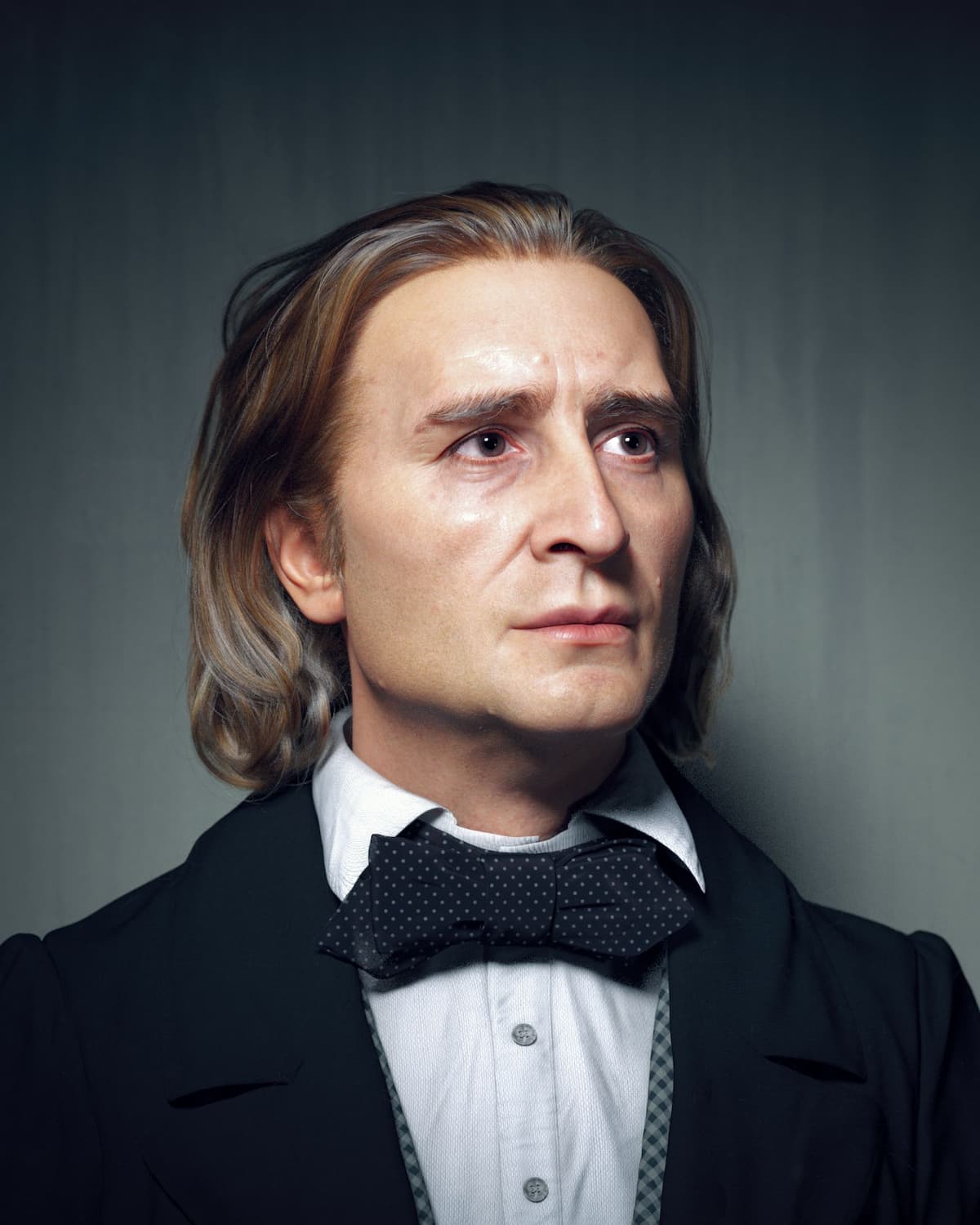
(image credit: 3D rendering of Franz Liszt by Hadi Karimi)
This site is free to access and ad-free, and takes many hours to research, write, and maintain. If you find joy and value in what I do, why not
Sometimes it happens that an artist or musician achieves a stellar level of fame and success during his lifetime, only to vanish into the footnotes of history upon their death. The composer-pianist Sigismund Thalberg (1812-1871) is one such figure. Lauded by royalty and critics alike, the one-time rival of Liszt is now only known to students of music history and pianophiles.
Let us begin by briefly examining his early life. Considerable doubt surrounds his birth and parentage: whilst his birth certificate lists his parents as Joseph Thalberg and Fortunée Stein of Frankfurt-am-Main, the general belief is that he was the illegitmate son of Count Moritz von Dietrichstein and Baroness von Wetzlar. It is perhaps no coincidence that Thalberg is one of the Dietrichstein family titles, nor that the Count’s middle name was Joseph. What we can be certain of is that the young Sigismund grew up in very comfortable surroundings and was duly sent to Vienna to prepare himself for a career in the military or the diplomatic corps.
However, music was to intervene – it is worth noting that the Baroness von Wetzlar was a distinguished amateur pianist – and before long his gifts had become apparent. We find him taking lessons with Hummel and Moscheles, making his public debut in London in 1826. His opus 1, a Fantasy on Weber’s Euryanthe (setting the tone, perhaps, for an output later characterised by a plethora of operatic paraphrases) was published a couple of years later, shortly followed by, as befitted the aspiring young virtuoso, his piano concerto, opus 5.
Over the next few years he continued performing in Germany and Austria, making the acquaintance of Chopin, Mendelssohn and the young Clara Wieck (later Clara Schumann), whilst developing his compositional style and technique. During this time, he made a pivotal discovery, one which was to have profound implications upon the development of pianistic technique and texture. The famous pedagogue Czerny wrote
“[Thalberg] conceived the idea of extending pedal effects which formerly occurred only in bass notes to the notes of the middle and higher octaves, and thereby produce entirely new effects […] When the notes of a melody are struck with energy in a middle position and their sound continued by skilful use of the pedal, the fingers can also perform brilliant passages piano, with a delicate touch; and thus arises the remarkable effect, as if the melody were played by another person, or on another instrument.”
It is famously stated in contemporary reports that audiences, bemused by what they were hearing, stood upor on chairs, trying to see how this so-called “three-hand effect” was being produced.
In 1835, Thalberg arrived in Paris as one of the most famous musicians in Europe, having been appointed Kammervirtuos to the Emperor of Austria. 1830s Paris played host to a remarkable selection of piano virtuosi – Liszt, Chopin, Alkan, Kalkbrenner, Herz and Pixis amongst others, and Liszt had come to be seen as the Crown Prince of them all. Thus in many ways the timing of Thalberg’s arrival was fortuitous – Liszt had left earlier that year and moved temporarily to Geneva, not least to escape the controversy over his relationship with the married Countess d’Agoult.
Paris took to Thalberg with enthusiasm, not least his aristocratic demeanour and elegance. Thalberg was a believer in producing spectacular technical effects with an apparent minumum of physical effort and movement – the polar opposite of the flamboyant, even histrionic, Liszt. In other respects, too, Thalberg was the opposite of Liszt, a classicist par excellence – but one equipped with technical gifts and imagination that exceeded his predecessors, redistilled through the rapid development of the instrument itself (we must not forget that the 1830s grand piano had far more in common with the modern day instrument than the piano of Mozart’s time, or even that of mid-period Beethoven). Liszt was much more of a progressive modernist, experimenting to create orchestral and storm effects on the developing instrument.
With all these differences, it is perhaps unsurprising that critics took sides. A year later, Liszt returned to Paris, and a war of words broke out in the press, certainly not helped by a highly disparaging article critiquing Thalberg’s compositions, and published in Liszt’s name (although it is generally believed it was in reality written by the Countess d’Agoult). Mutual friends attempted to damp down the flames, suggesting a joint recital. Thalberg is reported to have replied “I do not like to be accompanied”. Finally a resolution was reached when the Princess Cristina di Belgiojoso arranged for both pianists to perform at the same musical event in her celebrated salon.
Both pianists performed flamboyant virtuoso paraphrases and arrangements: Liszt offering his Fantasy on Niobe (an opera by Giovanni Pacini, wildly successful in its time, but now almost forgotten) and a solo piano arrangement of Weber’s Konzertstück, whilst Thalberg contributed his Fantasy on God Save The King and his Fantasy on Moses in Egypt (the coda of which contains the most celebrated example of the “three-handed effect”: the melody being completely enveloped in rapid, sweeping arpeggiation whilst accompanimental harmonies appear in the bass). Liszt’s biographers have (unsurprisingly) tended to give Liszt the victory, but the supporting facts are less clear. The press reports of the time were inconclusive, and the Princess’s oft-cited quote is diplomatically ambiguous: “Thalberg is the first pianist in the world – Liszt is unique”. What we can infer is that, whilst Liszt was normally the considerable superior of rival pianists, Thalberg represented serious competition to his crown. This was to be the climactic moment of Thalberg’s career; certainly by far the most historically famous.
He and Liszt went their separate ways but remained certainly very much aware of each other. The connoisseur of their respective virtuoso fantasies may observe that a certain amount of compositionalcrossfertilisation took place after the event – we find Liszt cloning the climactic passage of Moses in his Norma Fantasy, and we find Thalberg utilising rapid interlocking chromatic octaves (which make their first appearance in Liszt’s Fantasy on La Juive) a few years later in his Fantasy on La Sonnambula.
Thalberg retired, a rich man, from the stage in the 1860s, having conducted two lengthy tours of the Americas, and lived out his final years cultivating vineyards at his new home in Posillipo (his Soirées de Pausilippe provide a gentle, but still classically-centred, counterpart to his virtuoso career). Strangely, there was no piano in his home.
And so we return to the observation of the first paragraph and ask “Why?” The truth probably lies in a combination of factors. Firstly, his music was rooted in the generation of his forebears; whilst his great rival sought to move forward and “throw his lance into the future”. Secondly, and more importantly, we must be objective and say “yes, he was a great pianist, but..” and realise that, for all that Thalberg’s best paraphrases are attractively and ingeniously constructed, Liszt was a far more protean and skilled composer, and that supreme technical excellence in one field does not necessarily confer the same level of excellence in another, even when they are closely related.
Recommended listening:
Fantasy on La Sonnambula (op. 46)
Fantasy on Moses in Egypt (op. 33) – second half, variations on Moses’ Prayer
Casta diva (arranged as part of L’art du chant, op. 70)
Andrew Wright was born in Dundee, Scotland, and showed an early interest in music, having his first piano lessons at the age of seven, and giving his first public performance at the age of eleven. Further lessons followed with Dr William Stevenson and latterly with Kenneth van Barthold and Nicholas Pope. In addition to his performing career, Andrew has an active interest in composition and improvisation, and has featured some of his own works in his recital programmes.
During his studies, Andrew acquired a conviction that much of the conventional repertoire is over-exposed, and that there are many hidden gems to be found in the works of lesser-known composers. This belief resulted in him making a detailed study of the minor figures of 19th-century and early 20th-century pianistic history.
This study culminated in 2013 with the release, to critical acclaim, of “A Night at the Opera”, an album of transcriptions and paraphrases taken from opera. Following these initial positive reactions, the album was re-released as “The Operatic Pianist” by the US-based record company Divine Art. The album included not only established arrangements by Liszt, but also lesser-known pieces by Thalberg, the world premiere of Martucci’s Concert Fantasy on Verdi’s La Forza del Destino, and a selection of three self-penned paraphrases. Of these paraphrases, MusicWeb International commented: “.. hyphenated Wright takes its place alongside hyphenated Liszt and Thalberg, and that represents something of a Himalayan challenge to Wright’s credentials. It’s a measure of his aplomb that his own transcriptions fail to wilt even in the glare of such declamatory historic precedent.”
Andrew has given a multitude of recitals featuring a wide variety of such operatic transcriptions and paraphrases. He also includes lesser-known etudes and compositions within his performance repertoire, and has given recitals at numerous venues throughout the United Kingdom.
According to all reliable accounts, Liszt was the first true celebrity pianist in the history of Western art music. He was the embodiment of the Romantic Era: the sublime and the ridiculous, the diabolical and the virtuous, the transcendental and the mediocre, and no other composer in the 19th century had as diverse a compositional output. Liszt’s physical beauty, musical gift and striking stage persona combined for an intoxicating cocktail of the visionary, genius, sex, lust, snobbery, vanity, religion and literature. In short, he was Faust, Mephisto, Casanova, Byron, Mazeppa and St Francis all in one. Had cyberspace and social media existed in the 19th century, the tagline for Liszt would probably have been #Sex #Drugs #Classical Music #FranzLiszt.
Liszt was the first musician to have the piano placed in profile, so that the audience would be able to see his facial expression. He was also the first pianist to perform from memory, flouting the traditional view that to perform without music is a sign of disrespect to the composer. As a composer, Liszt’s output consists of over one thousand works. And until today only the Australian pianist Leslie Howard has recorded all of Liszt’s piano works (for Hyperion). Liszt’s one-movement symphonic poems, as well as the late piano pieces, were seen by many as works which were to have significant influence on the next generation of composers. Some argued that Liszt’s experimental use of harmonies (in particular in the late works) was prophetic in its foreshadowing of atonality, paving the way for the works of Scriabin, Debussy and Schoenberg in the early part of the 20th century.
Liszt’s life and music have been the subject of numerous film adaptations. On one hand, Charles Vidor’s Song Without End (1960) won an Academy Award for Best Musical Score, as well as a Golden Globe for Best Motion Picture. On the other hand, Ken Russell’s Lisztomania (1975), based on the novel Nélida, written by Liszt’s first important mistress, the Countess Marie d’Agoult, was notorious for its re-imagining of Wagner as a vampire (yes you read that correctly…) and its use of giant phalluses, reminiscent of Japan’s Shinto Kanamara Matsuri. One of the 20th century’s greatest pianist, Sviatoslav Richter, played the role of Franz Liszt in the 1952 Russian film entitled The Composer Glinka, while Liszt’s Second Hungarian Rhapsody in C Sharp Minor was immortalised by the evergreen animated duo of Tom and Jerry.
Recommended listening (all of which can be found on YouTube)
Années de Pèlerinage (Books 1 and 2): Lazar Berman
Vallée d’Obermann (from the 1st Book of Années de Pèlerinage): Claudio Arrau
Les jeux d’eaux à la Villa d’Este (from the 3rd Book of Années de Pèlerinage): Claudio Arrau
Bénédiction de Dieu dans la solitude (from Harmonies poétiques et religieuses): Claudio Arrau
Two Legends: St François d’Assise: La prédication aux oiseaux and St François de Paule marchant sur les flots: Alfred Brendel
Mephisto Waltz No. 1: Evgeny Kissin
Hungarian Rhapsody No. 2 in C Sharp Minor: Benno Moiseiwitsch
Hungarian Rhapsody No. 6 in D Flat Major: Martha Argerich
Liebestraume No. 3 in A flat Major: Frederic Lamond
Études de concert No. 2 in F Minor (La leggierezza): Martha Argerich
Études de concert No.3 in D Flat Major (Un sospiro): Frederic Lamond
6 Grandes Études de Paganini: Andre Watts (Live Recording from Japan 1988)
12 Études d’exécution trancendente: Lazar Berman (Live Recording from Milan 1976)
12 Études d’exécution trancendente: Boris Berezovsky (Live Recording from Roque d’Antheron 2002)
Études d’exécution trancendente No. 5 in B Flat Major (Feux Follet): Vladimir Ashkenazy
Ballade No.2 in B Minor: Vladimir Horowitz (Live Recording from The Met 1981)
Piano Sonata in B minor: Mikhail Pletnev
Piano Concerto No. 1 in E Flat Major: Martha Argerich
Piano Concerto No. 2 in A Major: Sviatoslav Richter
Piano Transcription of Beethoven’s An die Ferne Geliebte: Louis Lortie
Piano Transcription of Wagner’s Tannhäuser Overture: Jorge Bolet
Piano Transcription of Isolde’s Liebestod (from Wagner’s Tristan und Isolde): Michael Low
As a teenager, Michael Low studied piano under the guidance of Richard Frostick before enrolling in London’s prestigious Centre for Young Musicians, where he studied composition with the English composer Julian Grant, and piano with the internationally acclaimed pedagogue Graham Fitch. During his studies at Surrey University in England, Michael made his debut playing Tchaikovsky’s First Piano Concerto in the 1999 Guildford International Music Festival, before graduating with Honours under the tutelage of Clive Williamson. In 2000, Michael obtained his Masters in Music (also from Surrey University), specialising in music criticism, studio production and solo performance under Nils Franke. An international scholarship brought Michael to the University of Cape Town, where he resumed his studies with Graham Fitch. During this time, Michael was invited to perform Tchaikovsky’s First Piano Concerto for The Penang Governer’s Birthday Celebration Gala Concert. In 2009, Michael obtained his Doctorate in Music from the University of Cape Town under the supervision of Hendrik Hofmeyr. His thesis set out to explore the Influence of Romanticism on the Evolution of Liszt’s Transcendental Etudes. Michael has also worked with numerous eminent teachers and pianists, including Nina Svetlanova, Niel Immelman, Frank Heneghan, James Gibb, Phillip Fowke, Renna Kellaway, Carolina Oltsmann, Florian Uhlig, Gordon Fergus Thompson, Francois du Toit and Helena van Heerden.
Michael currently holds teaching positions in two of Cape Town’s exclusive education centres: Western Province Preparatory School and Herschel School for Girls. He is very much sought after as a passionate educator of young children.
LISZT – The importance of Liszt in the piano world is reflected in two articles devoted to his life and work. The first is by Conor Farrington:
The great Hungarian composer and pianist Franz Liszt was born on 22nd October 1811 in the village of Raiding, in present-day Austria. In the course of his long life Liszt gathered to himself an unusually generous share of achievement and adulation, bestriding the Romantic nineteenth century like a musical colossus and dominating artistic circles from Paris to Rome and from Budapest to Weimar. As a child prodigy he held all Europe spellbound, and later, as probably the greatest concert pianist in musical history, his particular brand of iconoclastic brilliance astonished and bewildered all who attended his concerts. Inspired by Paganini and Chopin, Liszt developed a pianistic technique that was simultaneously transcendental and lyrical. By inventing the solo piano ‘recital’ and by playing only from memory, he also transformed concert practice and elevated the role of the interpretive artist.
In his role as itinerant virtuoso, Liszt travelled the length and breadth of Europe, even visiting Istanbul as a guest of the Sultan; but it was in Weimar that he settled in 1848, having retired from the concert platform at the height of his power in order to focus on serious composition. From then until his departure in 1861, Liszt composed a series of masterpieces – most notably the Piano Sonata in B Minor and the Faust Symphony – while somehow finding time to conduct the court orchestra in world premieres of operas by Schumann, Wagner and many others. In this period, Liszt also developed the orchestral genre of the Symphonic Poem in works such as Les Preludes, Orpheus and Hamlet, and pioneered the masterclass as a method for teaching the many piano students who flocked to Weimar.
Following Weimar, Liszt charted new musical and religious waters in Rome and Budapest, although he frequently returned to the city of Goethe and Schiller in order to teach. In this last third of his life, Liszt worked tirelessly to promote young pianists and composers such as Hans von Bülow and Bedrich Smetana, composed many significant works (including his choral masterpiece Christus), and, in his final years, ventured into new realms of musical impressionism and even atonality with pieces such as the choral work Via Crucis and piano works such as Nuages Gris, the Mephisto Polka, and the Bagatelle sans tonalité he composed in 1885, the year before he died.
Liszt bridged the worlds of Czerny and Debussy, and was at the forefront of many significant artistic developments; the child prodigy whom Beethoven had kissed became Wagner’s friend and colleague and an inspiration to Ravel and Bartok. Liszt excelled as virtuoso, composer, conductor, and teacher, not to mention his activities as writer, correspondent, and benefactor, and it is no exaggeration to say that he singlehandedly changed the course of musical history. Liszt garnered many tributes from figures such as Chopin, who once remarked that ‘I would like to steal from him the way he plays my studies’, while Wagner (grudgingly) admitted that his own treatment of harmony had been transformed by his knowledge of Liszt’s works. Even Brahms, in many ways implacably opposed to Liszt, held that Liszt’s many operatic piano paraphrases and transcriptions represented the ‘true classicism’ of the piano.
Yet he also attracted a weighty measure of opprobrium. Some found his extreme virtuosity distasteful – Schumann described it as ‘showing too much of the tinsel and the drum’ – while for others his compositions themselves were the stumbling block. Schumann’s wife Clara condemned Liszt’s works as ‘stilted, impotent weeds’, while the young Brahms dealt Liszt the ultimate insult of falling asleep during Liszt’s own performance of the Sonata in B Minor. Others railed against Liszt’s personality and his (admittedly somewhat lurid) lifestyle, objecting variously to his relaxed morals, his undeniable vanity, or the contradictions between these enduring character traits and Liszt’s devout Catholicism – contradictions that became even more marked, at least in the eyes of the world, when Liszt was ordained as an Abbé, or deacon, in 1865.
Liszt felt these criticisms very deeply, and told his biographer Lina Ramann that he carried with him ‘a deep sadness of the heart.’ Yet he also frequently declared ‘Ich kann warten’ – ‘I can wait’ – and hoped that true appreciation of his compositions might come about after his death. The extent to which this has happened is debatable. Some of his works, such as the Sonata in B Minor and the Hungarian Rhapsody No.2, have become standard repertoire, and some of his more ‘Romantic’ works such as Un Sospiro and the third Liebestraüme are often played on popular classical music radio stations. Nevertheless, the majority of his vast output is performed only rarely, if at all, with many important and beautiful works known only to specialists and members of the various Liszt Societies dotted around the world. In many ways, Liszt is still waiting.
Conor Farrington
Conor Farrington is a writer, composer and academic researcher, based in Cambridge
The Cross-Eyed Pianist is free to access and ad-free, and takes many hours every month to research, write, and maintain.
If you find joy and value in what I do, please consider making a donation to support the continuance of the site

 In fact, he was a remarkable musician and human being. Sure, as a performer he could be flamboyant and extravagant in his gestures, but he helped shape the modern solo piano concert as we know it today and he also brought a great deal of music to the public realm through his transcriptions (he transcribed Beethoven’s symphonies for solo piano, thus making this repertoire accessible to both concert artists and amateur pianists to play at home). He was an advocate of new music and up-and-coming composers and lent his generous support to people like Richard Wagner (who married Liszt’s daughter Cosima).
His piano music combines technical virtuosity and emotional depth. It’s true that some of his output is showy – all virtuosic flourishes for the sake of virtuosity – but his suites such as the Années de Pèlerinage or the Transcendental Etudes, and his transcriptions of Schubert songs demonstrate the absolute apogee of art, poetry, and beauty combined.
Martha Argerich
Martha Argerich brings fire and fluency to her interpretations, underpinned by a remarkable technical assuredness. Her 1972 recording of the B-minor Sonata and Hungarian Rhapsody No. 6 is regarded as “legendary”.
Leslie Howard
Australian Leslie Howard is the only pianist to have recorded the solo piano music of Liszt, a project which includes some 300 premiere recordings, and he is rightly regarded as a specialist of this repertoire who has brought much of Liszt’s lesser-known music to the fore.
Lazar Berman
Berman’s 1977 recording of the Années de Pèlerinage remains the benchmark recording of this repertoire for many. Berman brings sensibility and grandeur, warm-heartedness, and mastery to this remarkable set of pieces.
Alim Beisembayev
Winner of the 2021 Leeds International Piano Competition, the young Armenian pianist Alim Beisembayev’s debut recording of the complete Transcendental Etudes is remarkable for its spellbinding polish, precision, and musical maturity, all supported by superb technique.
Yuja Wang
Yuja Wang has been praised for her breath-taking interpretations of Liszt’s First Piano Concerto which combine force and filigree, emotional depth, and technical mastery to create thrilling and insightful performances.
Other noted Liszt pianists include Georges Cziffra, Jorge Bolet, Krystian Zimerman, Lang Lang, Daniil Trifonov, Sviatoslav Richter, Marc-André Hamelin, Nelson Freire, Claudio Arrau, and Vladimir Horowitz.
In fact, he was a remarkable musician and human being. Sure, as a performer he could be flamboyant and extravagant in his gestures, but he helped shape the modern solo piano concert as we know it today and he also brought a great deal of music to the public realm through his transcriptions (he transcribed Beethoven’s symphonies for solo piano, thus making this repertoire accessible to both concert artists and amateur pianists to play at home). He was an advocate of new music and up-and-coming composers and lent his generous support to people like Richard Wagner (who married Liszt’s daughter Cosima).
His piano music combines technical virtuosity and emotional depth. It’s true that some of his output is showy – all virtuosic flourishes for the sake of virtuosity – but his suites such as the Années de Pèlerinage or the Transcendental Etudes, and his transcriptions of Schubert songs demonstrate the absolute apogee of art, poetry, and beauty combined.
Martha Argerich
Martha Argerich brings fire and fluency to her interpretations, underpinned by a remarkable technical assuredness. Her 1972 recording of the B-minor Sonata and Hungarian Rhapsody No. 6 is regarded as “legendary”.
Leslie Howard
Australian Leslie Howard is the only pianist to have recorded the solo piano music of Liszt, a project which includes some 300 premiere recordings, and he is rightly regarded as a specialist of this repertoire who has brought much of Liszt’s lesser-known music to the fore.
Lazar Berman
Berman’s 1977 recording of the Années de Pèlerinage remains the benchmark recording of this repertoire for many. Berman brings sensibility and grandeur, warm-heartedness, and mastery to this remarkable set of pieces.
Alim Beisembayev
Winner of the 2021 Leeds International Piano Competition, the young Armenian pianist Alim Beisembayev’s debut recording of the complete Transcendental Etudes is remarkable for its spellbinding polish, precision, and musical maturity, all supported by superb technique.
Yuja Wang
Yuja Wang has been praised for her breath-taking interpretations of Liszt’s First Piano Concerto which combine force and filigree, emotional depth, and technical mastery to create thrilling and insightful performances.
Other noted Liszt pianists include Georges Cziffra, Jorge Bolet, Krystian Zimerman, Lang Lang, Daniil Trifonov, Sviatoslav Richter, Marc-André Hamelin, Nelson Freire, Claudio Arrau, and Vladimir Horowitz.
 Sometimes it happens that an artist or musician achieves a stellar level of fame and success during his lifetime, only to vanish into the footnotes of history upon their death. The composer-pianist Sigismund Thalberg (1812-1871) is one such figure. Lauded by royalty and critics alike, the one-time rival of Liszt is now only known to students of music history and pianophiles.
 Andrew Wright was born in Dundee, Scotland, and showed an early interest in music, having his first piano lessons at the age of seven, and giving his first public performance at the age of eleven. Further lessons followed with Dr William Stevenson and latterly with Kenneth van Barthold and Nicholas Pope. In addition to his performing career, Andrew has an active interest in composition and improvisation, and has featured some of his own works in his recital programmes.
 Liszt’s life and music have been the subject of numerous film adaptations. On one hand, Charles Vidor’s Song Without End (1960) won an Academy Award for Best Musical Score, as well as a Golden Globe for Best Motion Picture. On the other hand, Ken Russell’s Lisztomania (1975), based on the novel Nélida, written by Liszt’s first important mistress, the Countess Marie d’Agoult, was notorious for its re-imagining of Wagner as a vampire (yes you read that correctly…) and its use of giant phalluses, reminiscent of Japan’s Shinto Kanamara Matsuri. One of the 20th century’s greatest pianist, Sviatoslav Richter, played the role of Franz Liszt in the 1952 Russian film entitled The Composer Glinka, while Liszt’s Second Hungarian Rhapsody in C Sharp Minor was immortalised by the evergreen animated duo of Tom and Jerry.
 LISZT – The importance of Liszt in the piano world is reflected in two articles devoted to his life and work. The first is by Conor Farrington:
 Liszt bridged the worlds of Czerny and Debussy, and was at the forefront of many significant artistic developments; the child prodigy whom Beethoven had kissed became Wagner’s friend and colleague and an inspiration to Ravel and Bartok. Liszt excelled as virtuoso, composer, conductor, and teacher, not to mention his activities as writer, correspondent, and benefactor, and it is no exaggeration to say that he singlehandedly changed the course of musical history. Liszt garnered many tributes from figures such as Chopin, who once remarked that ‘I would like to steal from him the way he plays my studies’, while Wagner (grudgingly) admitted that his own treatment of harmony had been transformed by his knowledge of Liszt’s works. Even Brahms, in many ways implacably opposed to Liszt, held that Liszt’s many operatic piano paraphrases and transcriptions represented the ‘true classicism’ of the piano.



 The Cross-Eyed Pianist