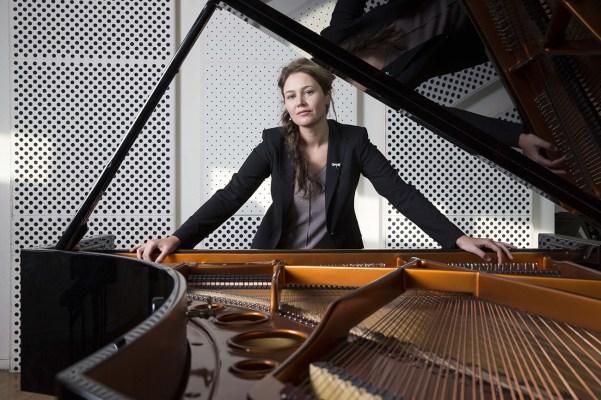
© Gerard Uferas Olga Jegunova 12_02_15

Who or what inspired you to take up the piano and pursue a career in music?

My grandfather who had a natural musical talent and could not imagine his life without his violin. He was played it passionately at every family gathering. He also bought our piano. Later, my mother taught me how to play a C major scale. Since then, I am still learning how to play it….

Who or what were the most important influences on your musical life and career?

Musically, it is J.S.Bach. He has always moved me, paralyzed any fear or disbelief. Later, recordings of great Rubinstein, Horowitz, Gilels, Gould, Richter, Michelangeli, Karajan, Callas, Oistrakh, Rostropovich. Then live concerts of Zacharias, Zimerman, Schiff, Argerich, Perahia, Maazel, Bartoli, Rattle and many others. They all form my musical taste and repertoire.

As per career, I should be influenced by the PR company of Lang Lang but sadly I am not!

What have been the greatest challenges of your career so far?

To actually have a career.

Which performance/recordings are you most proud of?

Ibert – Le petit ane (avalable on YouTube) when I was 10 years old because it made my mum proud.

Which particular works do you think you perform best?

4’33” by John Cage.

How do you make your repertoire choices from season to season?

Concert promoters always want a Moonlight sonata but I try to spice it up with some Bach & Ligeti (this season).

Do you have a favourite concert venue to perform in and why?

There are so many of them. I am not so obsessed with venue what worries me is no audience, empty hall or just a few people with ringing mobile phones.

Favourite pieces to perform? Listen to?

It is great to share great music with good audience. Yet the most non-judgemental experience was when I was playing “Peter and the wolf” to the 5-year old kids.

I like to listen to all sorts of music, I have my Ramstein moments, yet I listen to a lot of classical music, often jazz and some good pop/rock.

Who are your favourite musicians?

Elvis

What is your most memorable concert experience?

My very first concert at the age of 5 or 6 – very scary but I loved the applause.

What do you consider to be the most important ideas and concepts to impart to aspiring musicians?

Being a musician is a life-long service. It is hard, non-profitable and lonely. But it is a very important input into people’s minds and hearts. It gives another dimension to our being. And without this dimension it would be too miserable and too technical.

Where would you like to be in 10 years’ time?

At the piano, safe, warm and loved.

What is your idea of perfect happiness?

See above.

What do you enjoy doing most?

Being happily quiet.

Olga Jegunova’s disc ‘Poetic Piano Sonatas’ is available now

www.olgajegunova.com

(photo © Gerard Uferas)


Who or what inspired you to pursue a career in music?

I honestly don’t remember the moment that I decided to start playing because I was about two and a half years old, but I do remember my mother teaching the piano for long hours and music always playing in the car. Even now, I hear pieces of music that I didn’t realise that I knew and know them back to front from childhood without knowing what it was!

The decision to pursue music as a career was really made when I was about four; my life already at that point was entirely scheduled around the piano. During my teenage years I made that decision again as a young adult. I rediscovered music on my own terms and realised that there was no way that I could live without music.

Who or what were the most important influences on your musical life and career?

Well this one is easy! In terms of my technique, personal standards, and foundation to becoming a musician my first serious teacher, Jimmy Gibb was invaluable. Douglas Finch has had and continues to have an enormous impact on my musical wellbeing and continues to inspire me. My humanities teacher in New York; John Pagano who teaches at Columbia and Manhattan School of Music in his “Genius and Madness” elective as well as “The Fantastic Imagination” shaped and reinvigorated my belief in the arts. Finally Russ Titelman, the producer of my album about to be released by Sony. His vision, deep understanding, knowledge and love of art is extremely special and I am honoured to have and be continuing to work with him.

What have been the greatest challenges of your career so far?

The greatest challenges have by their very nature been my times of growth and from which I have learnt the most. Rediscovering why I wanted to do music in my teenage years of my own accord and the bridge from child to adult artist was challenging certainly. Believing and rebelieving in one’s own ability and voice is something that I think we all go through. The classical music world is full of exciting and vibrant people at the moment and I think that there is huge potential and hope for a revolution of the whole industry! Being a female has also presented its own challenges throughout my career; I am proud to identify as a feminist.

Which performance/recordings are you most proud of? 

I personally am very fond of the live recording in the finals of the Trinity Soloists’s Competition because it is Prokofiev 3rd piano concerto, probably my favourite piece of music, played with nothing other than pure conviction. Sure, there are flaws, it’s not the world’s best piano, and it’s unedited, but it’s real. Other than that, the album that I have just completed for Sony which is my first commercial album and representative of where I want to go as an artist and where I want to take my audience: Through the doors of perception.

Which particular works do you think you perform best?

I’m very comfortable and happy in the 20th Century. That’s a huge spectrum but I love playing Prokofiev, Shostakovich, Stravinsky, Ligeti, Lutoslawski etc.

How do you make your repertoire choices from season to season?

I’d say a combination of instinct, demand, and what opportunities present themselves to me. It’s generally a balance of things booked long in advance because someone has heard you play a particular piece and would like to hear it again in two year’s time, or sometimes there’s a composer’s anniversary which ties into a theme. Other times I’ve been waiting for a really long to time to have the right programme to fit a piece that I really want to play and then that programme happens naturally and that’s wonderful!

Do you have a favourite concert venue to perform in and why?

I have had many wonderful venue experiences but really it’s down to the audience as to what a place feels like at any given time. A generous audience anywhere makes that the best venue!

Who are your favourite musicians?

I love so many I could go on forever but Martha Argerich for her organic relationship with the piano, Jack White for his innovation and talent, David Bowie for being the master of many faces and never frightened to push a boundary. Jim Morrison for his poetry and reawakening of William Blake, my favourite poet.

What do you consider to be the most important ideas and concepts to impart to aspiring musicians?

To listen to and read as much as humanly possible across the genres, and to be truthful to the reasons that you pursued it in the first place. I am a founding member of the HoneyB Corps, an international civil society comprising skilled practitioners who volunteer their time to rehabilitate communities’ developmental needs like food, water, shelter, and health, and skilled artists who volunteer their time to rehabilitate communities’ formative needs: socially/relationally/artistically/therapeutically/spiritually. The HoneyB Corps is an exceptionally multifaceted and multi-dimensional community that supports and nurtures civil artists, but also deploys them across the world to touch lives, “cross-pollinate” ideas and creativity, and influence genuine conviviality through the cosmic force of art.

What is your present state of mind?

At the moment I am the happiest that i have ever been in my life. People spoke about 27 being a wonderful age and it really has been. Musically I am developing and growing and, most importantly, I am challenged and inspired by those around me.

Harriet’s debut album is due to be released in Spring 2017

Harriet Stubbs began piano studies at the age of three, performing in public a year later. At the age of five she was awarded a full scholarship to the Guildhall School of Music and Drama given by the Elsie and Leonard Cross Memorial Foundation.  She studied with James Gibb, Guildhall’s Emeritus Professor and Ronan O’Hora, Head of Keyboard and Advanced Performance Studies. At the age of seven she had passed all eight piano exams with distinction. 

Read more about Harriet here


Who or what inspired you to take up the piano and pursue a career in music?

My mother was the one to introduce me to the wonderful world of music. I grew up in communist Romania, where kids didn’t have piano lessons as an after school thing but my Mum saved up lots of money and bought a beautiful mahogany upright. I got into the specialist music school in Iasi age 7 and had my debut with an orchestra 2 years later with Mozart D major concerto. I remember walking on stage, surrounded by adults, tripping over, conductor panicking, music stands falling, scores flying all over the place. My mum freezing in the first row. But I stood up, smiling and loved every single second of that performance. I came out and said “I want to become a concert pianist!”. I feel blessed to have had very encouraging people in my life, who believed in me and gave me a chance. I learnt from a very early age that hard work will always take you a long way. I don’t come from a musical family, therefore I didn’t have any expectation on how things should go. I didn’t set myself a target, I simply followed my intuition, learning from every situation and felt grateful for every opportunity that came my way. And the same as my falling, I learnt I can always stand back up and keep going.

Who or what have been the most important influences on your musical life and career?

My teachers have had the greatest influence on me, starting with my high-school teachers in Romania, to the late Mark Ray, Nelson Goerner, Alexander Melnikov, Dina Parakhina, Ronan O’Hora, Andras Schiff and Imogen Cooper. I have been incredibly privileged to study with fantastic musicians, who taught me not just about music, but enriched my life through advice on staying true to myself and always discovering new things. The thirst of knowledge and curiosity is one of the most beautiful things in life.

What have been the greatest challenges of your career so far?

I believe we all find ourselves at crossroads at some point in our lives. The greatest challenge is to take the right path for you. I usually analyse and over-analyse and once I have taken a decision, that’s it! I try to never look back and believe in the power of instinct- after a lot of research has been done!

Which performance/recordings are you most proud of?

Every recording I have ever made is the result of hard work, a long time planning, creating a vision and sticking to a plan.This year saw the release of my concerto debut disc- Tchaikovsky Piano Concerto 1 with the Royal Philharmonic Orchestra on Signum Records coupled with the ‘Nutcracker Suite’ arranged by Pletnev. The joy of having my first concerto disc out is not easily put into words- honestly, a dream come true!

Which particular works do you think you play best?

I try to identify myself with whatever piece I am playing. I like reading about the story behind the music, I like to find out about the political situation of that time, where the composer was at the point in his life, what were his fears, his joys. The notes on the page are just the start of the journey.

How do you make your repertoire choices from season to season? 

I think long term. I like creating projects and putting programmes together that make sense. I am working on my Trilogy of Preludes at the moment, a project supported by the wonderful team at Champs Hill Records, who have very enthusiastically welcomed 3 CDs of complete preludes: vol I Chopin and Dutilleux, vol II Szymanowski and Shostakovich (both released) and vol III Fauré and Messiaen coming out next year. I enjoy introducing my audiences to new pieces, I like to challenge them with something they might not know they would love.

Do you have a favourite concert venue to perform in and why?

Every venue has its own personality, the same as pianos do. As a pianist, one has to adapt very quickly – I simply cannot describe how thrilling it is to step into a hall where so many of the great legends have played. There’s a huge pressure but in the same time there’s something humbling and magical about it.

Favourite pieces to perform? Listen to?

I love performing the Nutcracker Suite. I feel the versatility of the piano makes it possible to recreate the orchestral sound and it allows me to imagine all the magical world the story tells in a very intimate setting. I love listening to everything, from jazz to folk, pop to classical.

What is your most memorable concert experience?

Goodness me, where should I start?! Every concert is memorable, from a little hall in the middle of nowhere to the big giants. My first time at Carnegie Hall will always be the icing on the cake (and lots of the readers will know I love cake!). Getting a standing ovation at the Concertgebouw was quite something. My Buenos Aires concert in front of a packed 5000 seat hall (at lunchtime!) had me on my toes (I was told Beyoncé performed there the night before- make of that what you will!). Performing with youth orchestras is always truly rewarding- we all learn from each other and I always feel happy amongst them.

What do you consider to be the most important ideas and concepts to impart to aspiring musicians?

Always be true to yourself. Never give up. Always follow your dream- patience and perseverance will get you a long way. Never stop learning, from anyone and from every situation!

What is your idea of perfect happiness?

Being able to enjoy each moment as it comes, living in the present. Making a difference, standing up for what I believe in. Change lives through music!

What is your most treasured possession?

My piano.

What do you enjoy doing most?

Play my piano, communicate, bake, cycling with hubby, being with people.

What is your present state of mind?

I am truly grateful for everyone and everything I have around me. I feel blessed to be able to follow my dream.


From London’s Royal Albert Hall to Carnegie Hall in New York, the young Romanian pianist Alexandra Dariescu, recently named as one of 30 pianists under 30 destined for a spectacular career (International Piano Magazine), dazzles audiences worldwide with her effortless musicality and captivating stage presence.

Read more about Alexandra Dariescu here

327A2574

Who or what inspired you to pursue a career in music? 

It was my mother who first took me off to piano lessons age five although I can’t really say it was a particular calling at that age – I’m fairly sure I was going to be Prime Minister. It was not until I was a bit older and not really practising enough that my mum made me sign a contract promising that I would practise every day or the piano and the lessons would be gone! It was only then that I began to realise just what an important part of my life music was and became determined to dedicate myself to it further. Actually pursuing a career in music was never a particular ambition, however, until age 16 I was on the Chetham’s Piano Summer School and one of the professors simply said ‘why are you not here?’. Well, I didn’t have an answer so the next year I enrolled as a student and haven’t looked back since!

Who or what have been the most important influences on your musical life and career? 

I’ve been so lucky with my piano teachers over the years and they have all been hugely influential, but the person who really believed in my abilities as a pianist and really challenged me to be the best I could be, was John Railton. John was an astonishing man – with only one arm he managed to have a successful career as a pianist and conductor, recording for the BBC, conducting at the major concert halls and being the central point of many different communities music making. He had a total disregard for potential obstacles and just believed firmly that I would be a pianist – I really wouldn’t be here without him!

What have been the greatest challenges of your career so far? 

The biggest challenge for me is performance anxiety – I wouldn’t say I get crippling nerves but I have found it frustrating sometimes when I can’t achieve the same focus on the music because my mind is worrying about being worried! The challenge is to find techniques to control any anxiety and transform it from something destructive into a positive energy. As an accompanist I have also had to become very time efficient. Our job often involves learning lots of repertoire in very short periods of time and the ability to practise efficiently without getting injured is paramount.

Which performance/recordings are you most proud of?  

I recently launched the Devon Song Festival and I was so pleased with our inaugural concert. There was an unusual amount of pressure in organising the event, trying to keep the audience happy and performing but it went brilliantly and our reception was so enthusiastic. I’m so thrilled it was success and we can expand the festival next year.

Which particular works do you think you play best? 

I definitely feel most at home in the song repertoire, specifically German lieder and English song though I also love the sound world of cello and piano sonatas and am beginning to explore this further. I love playing with singers because I am able to find a deeper connection to the music when text is set. I rarely perform as a solo pianist these days but when I do it’s nearly always Russian: Rachmaninoff and Prokofiev being particular favourites!

Do you have a favourite concert venue to perform in and why? 

Last year I played at the Wigmore Hall for the first time and I absolutely loved it. It’s such an intimate space and from the piano it feels perfect as a hall for song. There is incredible clarity in the acoustic and you can really challenge yourself as to how quiet you can play and what extremes of articulation you can reach. It of course helps that the piano is absolutely beautiful too!

Favourite pieces to perform? Listen to? 

This year I’ve been working on Stephen Hough’s ‘Other Love Songs’ (for a performance at Wigmore in May 2016) and it is just the most brilliant cycle. It was written as a companion piece for the Brahms Liebeslieder waltzes and really cleverly picks up on themes from the original work but set to a wonderful selection of texts covering all forms of love and emotions from the heart-breaking to the comic. My personal highlight in the performance comes near the end where the pianists get to join in singing and my part is mostly just hitting the piano!

Who are your favourite musicians? 

I’m lucky enough to be taught by one of my favourite musicians, Eugene Asti. I have huge admiration for his attention to detail and respect for the score and the history of every work he plays. Importantly it is not only theoretical but you can really hear all that detail in his playing and it brings the music to life amazingly. Another is Iain Burnside, his playing is so robust and clear and I find his recordings of English song especially moving in their simplicity.

What do you consider to be the most important ideas and concepts to impart to aspiring musicians? 

I suppose as I’m still a student I would consider myself to be still aspiring! But I definitely think all young musicians need to think about more than just practise and performing. I’ve been working with Alisdair Hogarth recently and he has shown me the importance of being savvy when it comes to self-promotion and the commercial side of music making. He suggested that we should be spending as much time promoting performances and developing our career as we do practising. Whilst I can’t quite bring myself to do that just yet, I can see that when I leave music college, working hard to find performances and creating appealing programmes will be just as important as working on technique!

Where would you like to be in 10 years’ time? 

In ten years’ time I would like to be living in London enjoying a fledgling career as a song accompanist and working as a broadcaster for Radio 3. Basically, I would like to follow in the footsteps of Iain Burnside!

Originally from Devon, Natalie Burch initially studied with John Railton before moving to Manchester to study solo piano with Peter Lawson at Chetham’s School of Music. In 2014 she graduated with first class honors from King’s College London where she studied musicology and took lessons at the Royal Academy of Music with Daniel-Ben Pienaar and Andrew West.  Natalie is currently studying for a masters in accompaniment at the Guildhall School of Music & Drama under the tutelage of Eugene Asti and Andrew West.

Recent and future highlights include performing at the Wigmore Hall alongside Alisdair Hogarth and the Prince Consort, a new commission for the Leeds Lieder festival, rehearsal pianist for Tchaikowsky ‘Rococo Variations’ with Guy Johnston, a recital for the Elgar Society and a number of concerts and masterclasses as resident pianist for Opera Prelude.

Read more about Natalie here