Who or what inspired you to take up composing, and pursue a career in music?

Despite my parents efforts to convince me not to, I started the violin when I was three. Throughout my childhood I was determined that I would be a violinist, but when I was eleven I went to a course called The Walden School, a composition course for teenagers situated five minutes away from my step-grandmother’s place in New Hampshire. I wanted to go to a performance course but my mother convinced me to try it… she’d noticed that most of my ‘practice’ time was spent improvising.

Walden and the world of new music was a revelation to me and I fell quickly and deeply in love with the madness and freedom of the vast array and different sorts of music that I heard there. Walden’s motto, ‘Music is Sound organised in Time’, was emblazoned across the top of the recital hall and I took it to heart. It was ear and mind opening and although I continued to claim to want to be a violinist for the next year or so, I kept returning to Walden and spending my time writing… as my mother says, ‘you vote with your feet’.

Who or what were the most significant influences on your musical life and career as a composer?

I’m always looking for new sounds from any musical genre to excite me and spark thoughts. I also look outside of music: my mother is a sculptor (you can have a look at some of her works here: Josiespencer.com), and my father is a theatre manager and producer, so I grew up with influences from all sorts of art forms.

Certain pieces catch me at certain times in my life, and I suppose they become part of me, whether or not their influences can be heard in my music – among these, Mahler’s Rückert-Lieder, George Crumb’s Vox Balaenae and Black Angels, many pieces by Hildegard Von Bingen, Kurtag’s Hipartita, Pauline Oliveros’s philosophies of deep listening, and many works by Oliver Knussen – especially his Songs for Sue. Alongside these classical influences, I like to sneak little bits of R&B, pop, folk, and rock into my pieces.

I’m lucky enough to have had three wonderful composition teachers and each of them challenged me and helped me grow as a composer in different ways. I studied with Giles Swayne during my undergraduate degree and afterwards in London, Simon Bainbridge during my masters and the first years of my PhD, and Oliver Knussen currently. They each have been insightful and supportive mentors as well as being composers whose music I deeply admire.

What have been the greatest challenges/frustrations of your career so far?

Starting each new piece always feels like it’s an insurmountable challenge… until it isn’t.

I think this is true of any career – but keeping life in balance is another constant challenge. It’s how you spend your time each day and what those days add up to as a life in total.

I don’t think either of these two will ever become less challenging.

What are the special challenges/pleasures of working on a commissioned piece?

Commissions give me deadlines, certainty, and variety. These are all things that are both pleasures and challenges at the same time.

Of which works are you most proud?

A few years ago, I had the slightly impractical idea that I’d like to create a piece of music for an especially designed space. I wanted to create a way for people to interact acoustically with a piece of music and physically walk around interwoven lines within a piece to explore how they relate to one another and what they’re doing individually.

Along with my sister, violinist Tamsin Waley-Cohen, and two architectural designers, Finbarr O’Dempsey and Andrew Skulina, we made ​Permutations​, a playfully immersive & interactive artwork. It was developed on an Open Space Residency at Snape Maltings and premiered at the 2017 Aldeburgh Festival along with the release of a CD by the same name on Signum Classics.

I’m unbelievably excited that it will be going on tour starting later this year! The tour will launch at the Dartington Festival during week four, After that ​Permutations ​will travel to the Royal Academy of Music for their ‘Festival of Space’ in November, and on to the Royal Institute of British Architects North, in Liverpool for May 2019. Other venues & dates will be announced later.

Finbarr and Andrew designed six chambers, each lined with rotating doors, with polished timber on one side and corrugated felt on the other. The chambers have Amina Technologies’ invisible speakers built into the wood of their ceilings, and each one plays a different one of the six recorded violin parts, all recorded by Tamsin. If you stand in the middle of the space with the six chambers surrounding you, you can hear the 18 minute piece, equally balanced. You can interact with the music in several ways: you can walk around, in and out of chambers, you can acoustically isolate a solo or a duo by rearranging the doors, you can fully rotate the doors of a chamber to change how resonant the acoustic is, or you can find a seat and place yourself in one particular place and listen from there. There’s also a social element – you can decide whether to create a private closed off space to listen from, or move into the more open communal spaces with other listeners.

It’s a multi-sensory experience – so the best way is often to show rather than tell… here’s a video from the premiere:

I’m also really proud of the string quartet I wrote for the Santa Fe Chamber Music festival last summer. It’s called Snap Dragon and the Heath Quartet are going to be playing it again this summer at Dartington. You can listen to the fantastic Flux Quartet playing it in this recording:


How do you work?

I start by sketching on paper and writing pages of semi-nonsensical scribbles (in both words and music notation) in various notebooks. Depending on what is forming, at some point I start to move towards working in Sibelius (music notation software). I go back and forth a bit between paper and Sibelius during the writing process, but at a point of critical mass I work almost entirely on Sibelius.

Currently, I’m writing a piece for the concert series Listenpony, which I co-founded along with Josephine Stephenson and William Marsey in 2012. We started Listenpony to produce concerts where we would hear the music we love – regardless of genre – in a friendly atmosphere, while also providing a platform for outstanding young musicians.

In May, we had our first ever tour, including at date at the Playground Theatre in London among my mum’s sculpture exhibition ‘Murmurations’. For the tour, I wrote a piano piece for pianist George Fu – it’s influenced by Scottish folk music and the clarity of texture in Couperin’s keyboard works as realized on the modern piano.

I’ve also recently completed piece for 12 players (string quintet, clarinets, flutes, oboe, trumpet, trombone, piano, percussion) from the Philharmonia Orchestra for their Music of Today Series. It was performed in May at the Royal Festival Hall.


Who are your favourite musicians/composers?

My favourite composer is Messiaen, although some days I think it’s Bach, Schubert or Stravinsky.

As a musician, what is your definition of success?

Success is clarity of vision mixed with the flexibility to allow for discovery during the process. If I am getting this balance right, composing is a joyful and playful experience.

Success in the broader career-minded sense is best left out of the creative process – concern with it can poison the waters.

What do you consider to be the most important ideas and concepts to impart to aspiring musicians?

As much as you can, free your work from your ego – ego will hold you back from learning and growing. Presumably you’re doing it because you love it – so don’t let anything compromise that joy in creation. Don’t compare yourself to others. Write music that you want to listen to.


Where would you like to be in 10 years’ time?

Anywhere, composing.

What is your idea of perfect happiness?

Happiness comes in flashes, when I’m not searching for it, and its beauty is often in its imperfection. One of my favourite poems is ‘Happiness’ by Jack Underwood. It’s probably not legal to print the whole thing here but if I can quote a line: ‘we know happiness because it is not always usual, and does not wait to leave’.


Described as “at once intimate and visionary” by BBC Music Magazine Freya Waley-Cohen’s music has been heard in the Wigmore Hall, Sage Gateshead, St John’s Smith Square, The Barbican Centre, The New Mexico Museum of Art and at Aldeburgh, Tanglewood, Santa Fe, Dartington, Cheltenham, St Magnus, Ryedale and Spitalfields festivals. 

Winner of a Royal Philharmonic Society Composition Prize in 2017, Freya is associate composer of Nonclassical, NightMusic at St. David’s Hall, and Reverie Choir, and will be a featured artist at this years Dartington Festival. Freya held an Open Space Residency at Snape Maltings from 2015-2017, where she created the collaborative artwork Permutations, which will tour to Dartington, the Royal Academy of Music and RIBA North in 2018/19.

In 2017 Signum Classics released a CD of Freya’s music including Permutations and Unveil – both of which are recorded by her sister Tamsin Waley-Cohen. Her works have also been released by Nimbus Records, Listenpony, and McMaster Records.

Upcoming commissions include works for the Philharmonia Orchestra’s Music of Today series, CHROMA ensemble, and the LA Philharmonic’s Green Umbrella series.

She is a founding member and artistic director of Listenpony, a concert series, commissioning body and record label that programmes classical music, both new and old, alongside a variety of other genres including folk, jazz and pop, in beautiful and unusual venues. 
 

http://www.freyawaleycohen.com

http://www.permutations.co

http://listenpony.com

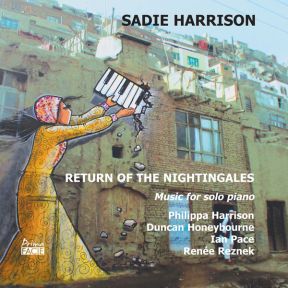
0712396065227_600When I put ‘Return of the Nightingales’ (Prima Facie records) into my CD player, my cat Monty immediately dashed into my office and up onto my desk to find the birds that sing so sweetly at the start of the title track of this new disc of music by Sadie Harrison. The piano enters, delicately yet brightly, imitating the twittering birdsong before moving into a lively, rhythmic passage. Ian Pace, the pianist for this track, is very much at home in contemporary and new music for piano, and it shows in the ease with which he handles technical difficulties and his vivid, immediate sound.
The variety of writing in just a few minutes of this piece signals the theme for the entire disc: it’s a wonderful example of Sadie’s compositional breadth and rich imagination and a lovely introduction to her colourful and accessible music. Not only does the disc demonstrate the range of Sadie’s compositional palette but it also showcases the talents of four excellent pianists – Ian Pace, Renée Reznek, Duncan Honeybourne and Philippa Harrison, all of whom have considerable experience in this type of repertoire and who bring myriad colours, timbre and musical sensitivity and individuality to each work on the disc.

Composed between 2011 and 2017, the pieces on this disc reveal the many contrasting styles within one composer’s output, reflecting Sadie’s wide-ranging musical and cultural influences, including the music of Bartok, Berg, Chopin, and Debussy, jazz legends Bill Evans, Fats Waller and Thelonius Monk, Methodist hymns, vintage film music, her passion for the cultures of Persia and Afghanistan (Sadie is Composer-in-Association of the Afghanistan National Institute of Music), and the natural world. In ‘Return of the Nightingales’ (the title is drawn from the translation of a Persian poem), near-Eastern folk idioms are woven into the starkly modernist suite of pieces Par-feshani-ye ‘eshq (played by Renée Reznek), while in Lunae ‘Four Nocturnes’ Duncan Honeybourne sensitively and sensuously illuminates the tender, intimate lyricism and delicate traceries of these delightful and arresting miniatures (I purchased the sheet music on the strength of this performance in order to learn the pieces myself). Philippa Harrison brings the requisite vibe and swing to the Four Jazz Portraits, capturing the style of each jazz great to whom they are dedicated; while in Shadows ‘Six Portraits of William Baines’ Sadie takes small quotations from Baines’ piano works and reflections on his diary entries to create intriguing miniatures, masterfully presented by Duncan Honeybourne. The Souls of Flowers recalls Chopin in its long-spun melodic lines and shimmering trills, while Northern Lights uses harmonies and idioms redolent of folksong and hymns. The final work, Luna…..for Nicola, is a tiny yet meaningful hommage to Nicola le Fanu, with whom Sadie studied for three years, and was written in response to hearing the premiere of Nicola LeFanu’s orchestral work ‘The Crimson Bird’. in February 2017.

The song of the nightingale is the unifying thread on this disc – in the third of the four Lunae, the evocation of Alabiev–Liszt’s ‘Le Rossignol’ as played by William Baines, and in the fluttering wings of Par-feshani-ye ‘eshq, but also less obviously in the use of trills, sparkling runs, chirruping note clusters and tremolandos.

This is wonderfully rewarding, varied and enjoyable disc, proof that contemporary piano music can be tuneful, attractive and entirely accessible. There is much to delight and challenge the pianist too: the pieces are generally within the capability of the intermediate to advanced player, and are available to purchase as scores (from University of York Music Press). I particularly like Sadie’s treatment of melodic fragments and her jazz-infused harmonies.

Highly recommended

emily-doolittle-680x400

Who or what inspired you to take up composing, and pursue a career in music?

I don’t really remember deciding to be a musician, it’s just something I always did, and always knew I wanted to do. It did take me a while to discover that I wanted to be a composer, however. I only really knew about performers, so that’s what I thought I’d be at first. (Of course the music we played was by composers – but they mostly seemed to be dead men from Europe!) At first I thought I would be a pianist, and then an oboist. I entered university as an oboist, and though it was a fantastic time, and I’m glad that I had those years of performance training and experience, it was never quite the right fit. I didn’t love practising, and I didn’t love performing: I loved the music itself, and those were the only ways I knew to get close to it. When I was 18 I went to a music summer camp and signed up for the composition class simply because it fit my schedule and the teacher seemed interesting. As soon as I started, I knew that I needed to be a composer.

Who or what were the most significant influences on your musical life and career as a composer?

There are so many it’s hard to list, but one huge influence on me has been the Canadian composer R. Murray Schafer. I’ve interacted with him, his music, and his writing in so many different ways over the years, and I think my own work would be quite different without his influence. Growing up in Canada, I sang many of his pieces in choir. These are pieces that can be sung by children or amateurs, but are really successful and interesting as new music, often using beautiful graphic notation to help non-music readers to create fantastic sound worlds. This has very much influenced my approach to writing for children and amateurs: music doesn’t have to be simplified or trivialized to be made accessible to performers of all experiences and abilities. In 1992 I attended a workshop by Schafer called Environmental Music Week. This got me started really listening to the sounds of the natural world, and thinking of music as something that belongs outdoors just as much as it does in the concert hall. And from 1992 until 2003 I was part of Schafer’s large-scale collaborative music-theatre work And Wolf Shall Inherit the Moon, which involves camping in the wilderness of Ontario for a week every summer, and co-creating the work with about 50 other participants (who are also the only audience). This has influenced me in so many ways that it’s hard to even know who I would be without having participated in it, but a few things that come to mind are the importance of community, the importance of creating for the people you are with, the importance of participating in all kinds of art forms even if you specialize in on, the importance of storytelling, and the way music and performance can serve as a ritual to deepen our connections with people and the natural world.

Other strong influences that come to mind, in no particular order, are my piano teachers, medieval and renaissance music, Ravel, the book Music, Myth and Nature by French composer François-Bernard Mâche, the two years I spend studying with Louis Andriessen in Amsterdam, traditional music, starting to play fiddle when I was 30 (and playing in a klezmer band and French Canadian traditional music band), Bread and Puppet Theater, and my interdisciplinary research on bird and other animal songs. And, more recently, becoming a parent!

What have been the greatest challenges/frustrations of your career so far?

Overall I feel very satisfied and lucky with my career: I’ve been able to compose, collaborate with fantastic performers, have some great performances of my music, and pursue my interdisciplinary animal song research with some wonderful biologists. At the moment, I have my dream job, a 4-year research fellowship at the Royal Conservatoire of Scotland in Glasgow. I’d say the first greatest challenge is simply composing itself! Though I find being a composer immensely satisfying, I’m not one of those (rare) composers who always finds the act of composing easy or pleasurable. I love having written a piece, but getting there often involves a lot trusting in the process even when I feel like I’d rather be anywhere than sitting at the piano or the desk! There’s also the ongoing frustration that it can be so hard for composers to earn a living. I’m ok at the moment, but it’s always precarious, and there have been times when I’ve had to live on almost nothing, or when I’ve had to rely on the help of family. I’ve been lucky so far: but artists shouldn’t have to be lucky to survive. We need security just as much as anyone else does!

My current biggest challenge is getting used to being a parent-artist. I had my first child when I was 40, so I had had quite a long time to get used to my schedule being my own: following the needs of the music I was writing, working on evenings and weekends as necessary, getting a slow start to my days, and so on. During the 5 years I was a freelance composer, I’d take all day to get myself into the right headspace for composing, and then have a brilliant and focused 3 or so hours to compose between 4 and 7 or so. Now I’m lucky to have 3 consecutive hours in a day. I need to focus immediately, even if I’ve been thinking about something completely different previously. And I’m always interruptable now – if the kids get sick, if the babysitter cancels, etc. I actually think that getting used to new ways of working is a good challenge – perhaps it will stimulate new kinds of ideas – but its not always easy!

What are the special challenges/pleasures of working on a commissioned piece? What are the special challenges/pleasures of working with particular musicians, singers, ensembles and orchestras?

I’ve combined these questions, since they’re related. I only write pieces for specific performers or performance contexts: sometimes they’re commissioned by the performer, sometimes they’re initiated by me. An essential part of music for me is the communicative aspect. Ultimately I want to communicate with the audience (it doesn’t have to be everyone in the audience, but I want at least someone in the audience to have a meaningful experience with the music!), and the performers are the ones who are communicating the music to the audience: so having a good relationship with the performers is necessary! It’s always a great pleasure when performers just “get” my music without me having to say anything. But equally, it’s a great pleasure if they don’t “get” my music at first, but are willing to work together with me until they do!

Of which works are you most proud?

This is always changing, but at the moment I’m feeling most proud of my chamber opera ‘Jan Tait and the Bear’, which I was working on on and off since 2012, and which was premiered in 2016. I wanted to write something engaging and interesting for audiences of all ages – not a children’s opera, but an opera that both children and adults could enjoy equally – and I think I succeeded with that. I wrote the libretto myself – something I had never thought I could do – and discovered that I actually really enjoy writing lyrics. And I hadn’t really thought that I would be able to write something as large-scale as an opera, but I did, bit by bit, and here it is! The whole process of working with the ensemble, the singers, the narrator, the stage director, the costume designer, and everyone, has also been really fun: it’s so wonderful to see what an entire creative team comes up with.

How would you characterise your compositional language?

Oh dear, this is always the hardest question to answer! I like notes, melodies, harmonies (tonal and non-tonal), sounds, colours, patterns, irregular rhythms, narratives, stories, words, silences. My pieces use these in various different combinations and to varying degrees. On average my work is tonal-ish, though some of my pieces are not. Many but not all of my pieces are influenced by my research on bird and other animal songs.

How do you work?

This is constantly changing. I used to take hours – hours spent wandering, reading, cooking, biking, napping, daydreaming – to settle into the right headspace for composing. This is not currently possible, so I’m working on becoming better at just sitting down at the piano or desk and getting right to it. When starting a piece, I often improvise at the piano until I come up with the ideas I want to follow, or I start out with verbal or pictorial sketches. When I look back at the initial sketches, they usually have very little to do with what the piece ends up being – but I guess they’re essential as the way into it. I’ve never had a great concentration span, so composing for me is a continual process of redirecting my attention back at the music. When I get stuck, I like to sight read piano music or go for a walk. (I’m considering getting rid of my smart phone so I don’t have to constantly fight off the temptation to check facebook or the news!)

I never compose without a cup of coffee. Even if it has gotten cold and I am no longer drinking it, I find it reassuring to have it there!

Who are your favourite musicians/composers?

There are so many, so this list is by no means comprehensive! From the classical/new music world, certainly Machaut, R. Murray Schafer, Ravel, Meredith Monk, Bach, Xenakis, Ruth Crawford Seeger, Stravinsky, Andriessen. I also love listening to the music of my peers – though I won’t name any because I don’t want to risk leaving people out! And I listen to a lot of traditional music, from all over the world. At the moment (as a relative newcomer to the UK – I moved here 2 years ago) I’m listening to a lot of English and Scottish traditional song – the Copper Family, Annie Briggs, Ewan MacColl, and so on.

What is your most memorable concert experience?

I think the most memorable experiences have been large-scale, multidisciplinary, outdoor works: Murray Schafer’s And Wolf Shall Inherit the Moon, the summer circuses of Bread and Puppet, Hanna Tuulikki’s Away With the Birds, the Environmental Art Festival in Scotland. Though those were not just about music – they were about theatre, community, and environment as well.

What do you consider to be the most important ideas and concepts to impart to aspiring musicians?

Keep listening and learning, and don’t let setbacks set you back. Everyone fails or is rejected sometimes. The successful musicians are the ones who learn and keep on going.

And look for as many ways as you can to build the kinds of musical communities you want to be part of. Some people try to get ahead by thinking only of how to further their own careers, but I think we’re all happier and healthier when we’re looking for ways to help others as much as we’re looking to help ourselves.

Where would you like to be in 10 years’ time?

At the moment I have a number of composition and research projects that I’m really excited about – and I basically hope for the same thing 10 years from now! I do have some nascent ideas for future operas – larger scale than anything I’ve done so far. Perhaps these will be outdoor or site specific pieces, perhaps with a larger cast that I’ve written for previously – and I hope I am in the position to be making some of those happen then.


Canadian-born, Scotland-based composer Emily Doolittle grew up in Halifax, Nova Scotia and was educated at Dalhousie, Indiana University, Princeton University, and the Koninklijk Conservatorium in the Hague, where she studied with Louis Andriessen with the support a Fulbright fellowship. From 2008-2015 she was an Associate Professor of Music at Cornish College of the Arts in Seattle. She now lives in Glasgow, UK, where she is an Athenaeum Research Fellow at the Royal Conservatoire of Scotland.

Doolittle enjoys writing for both traditional and less standard instrumentation, and has been commissioned by such ensembles and soloists as Symphony Nova Scotia, the Vancouver Island Symphony, Orchestre Métropolitain (Montreal), the New York Youth Symphony, Tafelmusik Baroque Orchestra, Ensemble Contemporain de Montreal, the Motion Ensemble (Canada), the Paragon Ensemble (Glasgow), soprano Suzie LeBlanc, viola da gambist Karin Preslmayer, and alphornist Mike Cumberland. Upcoming projects include a chamber opera called Jan Tait and the Bear, which will be performed in Glasgow by Ensemble Thing in October, 2016, and a concerto for Canadian bassoonist Nadina Mackie Jackson.

An ongoing interest for Doolittle is the relationship between music and sounds from the natural world, particularly bird and other animal songs. She has explored this in a number of compositions, as well as in her doctoral dissertation at Princeton and in interdisciplinary birdsong research with biologists and ornithologists. In 2011 she was composer-in-residence at the Max Planck Institute for Ornithology in Seewiesen, Germany, where she collaborated with ornithologist Henrik Brumm in researching the song of the musician wren and presented a concert of her birdsong-related works, performed by members of the Bavarian State Opera.

Other recurrent interests include folklore, musical story-telling, and making music for and with children. These interests are combined in her piece Songs of Seals, based on Scottish folklore and written in collaboration with Gaelic poet Rody Gorman, for the Voice Factory Youth Choir and the Paragon Ensemble (Glasgow), which was premiered in the fall of 2011 in Glasgow and Skye.

Doolittle has received a number of awards for her music, including the 2012 Theodore Front Prize for A Short, Slow Life (commissioned by Suzie Leblanc and Symphony Nova Scotia), two ASCAP Morton Gould Awards, and the Bearn’s Prize. Her work has been supported by grants and commissions from the Artist Trust (Seattle), the Eric Stokes Fund, The Culture and Animals Foundation, ASCAP, the Canada Council, the Nova Scotia Arts Council, FIRST Music, the Montreal Arts Council, and the Conseil des Arts et Lettres du Québec, and with artist residencies at MacDowell, Ucross, Blue Mountain Center, Banff, and the Center for Contemporary Art in Glasgow.

emilydoolittle.com

Who or what inspired you to take up composing, and pursue a career in music?

The joy of discovering new things in music inspired me. I was self-taught, and I just found the notion of making music such a thrilling adventure.

Who or what were the most significant influences on your musical life and career as a composer?

I think a composer draws inspiration from all of the events in their lives. But looking back, I’m pretty sure some of the music I listened to when I was young provided some serious influence…the Beatles in particular. My flute teacher, Judith Bentley was also a huge influence. And then there are all of my colleagues…they continue to inspire me every day.

What have been the greatest challenges/frustrations of your career so far?

Starting out in my undergrad not knowing much of anything about classical music was an incredible challenge. For a long time I felt that I was climbing a huge mountain of knowledge, trying to pick up as many “pebbles” as I could manage to carry. But every step made me smarter and stronger. Along the way, I realized that one spends an entire lifetime learning.

What are the special challenges/pleasures of working on a commissioned piece?

Every piece is a challenge. To create something from nothing is a big thing. Sometimes I’m learning about a particular instrument’s needs (I just finished a tuba concerto…so I studied a lot of the repertoire and talked with various players to get a sense of what would be ideal in the piece). Other times, I’m trying to craft something that works for the performer(s). Then there is the challenge of getting notes on a page, which I hope the performer and listener will find interesting.

What are the special challenges/pleasures of working with particular musicians, singers, ensembles and orchestras?

I don’t think it’s possible to make a generalization about this (I’m so lucky to be able to work with such a huge assortment of performers)…each piece is different and the challenges and pleasures change daily and yearly.

Of which works are you most proud?

I don’t know if it’s possible to be proud of one particular work. They all reflect so many things for me. But the one that feels very personal is “Blue Cathedral” … it seems to affect so many people. I’m sometimes surprised at how many instrumentalists and composers tell me this is the first piece of contemporary music that they encountered when they were younger. Even more surprising is how many people have performed it more than once. That’s one of the things that makes it special.

How would you characterise your compositional language?

I let other people decide that for themselves.

How do you work?

I try to work every day, composing 4-6 hours a day: consistently, persistently, and conscientiously.

Who are your favourite musicians/composers?

Impossible to name as there are literally thousands!

What is your most memorable concert experience?

I’m lucky to have had many incredible and memorable experiences. One of the most life changing was the Philadelphia Orchestra premiere of my “Concerto for Orchestra” which took place at the League of American Orchestras’ Conference. My life changed over night after that performance. Suddenly I was known, and commissions started coming in.

What do you consider to be the most important ideas and concepts to impart to aspiring musicians?

Make sure you love what you’re doing, as you’ll spend so much of your waking time doing it. Work hard and do it to the best of your ability. Share the joy with as many other people as you can.

Where would you like to be in 10 years’ time?

Composing in my studio

What is your idea of perfect happiness?

Composing in my studio


Pulitzer Prize-winner Jennifer Higdon (b. Brooklyn, NY, December 31, 1962) is one of America’s most acclaimed and most frequently performed living composers. Higdon started late in music, teaching herself to play flute at the age of 15 and beginning formal musical studies at 18, with an even later start in composition at the age of 21. Despite this late beginning, she has become a major figure in contemporary Classical music and makes her living from commissions. These commissions represent a range of genres, including orchestral, chamber, choral, vocal, and wind ensemble.

Higdon holds a Ph.D. and a M.A. in Music Composition from the University of Pennsylvania, a B.M. in Flute Performance from Bowling Green State University, and an Artist Diploma in Music Composition from The Curtis Institute of Music in Philadelphia.

Hailed by the Washington Post as “a savvy, sensitive composer with a keen ear, an innate sense of form and a generous dash of pure esprit,” her works have been performed throughout the world, and are enjoyed by audiences at several hundred performances a year and on over sixty CDs. Higdon’s orchestral work, blue cathedral, is one of the most performed contemporary orchestral compositions by a living American with more than 600 performances worldwide since its premiere in 2000.

Her list of commissioners and performing organizations is extensive and includes The Philadelphia Orchestra, The Chicago Symphony, The Atlanta Symphony, The Baltimore Symphony, The Boston Symphony Orchestra, The Cleveland Orchestra, The London Philharmonic Orchestra, the Luzern Sinfonieorchester, The Hague Philharmonic, The Melbourne Symphony, The New Zealand Symphony, The Pittsburgh Symphony, The Indianapolis Symphony, The Dallas Symphony, as well as such groups as the Tokyo String Quartet, eighth blackbird, and the President’s Own Marine Band. Higdon has worked with musicians that include Nathan Gunn, Isabel Leonard, Hilary Hahn, and Yuja Wang.

Her Percussion Concerto won the Grammy for Best Contemporary Classical Composition in January, 2010. Higdon also received the 2010 Pulitzer Prize in Music for her Violin Concerto, with the committee citing Higdon’s work as “a deeply engaging piece that combines flowing lyricism with dazzling virtuosity.”

Among her national honors, Higdon has received awards from the Guggenheim Foundation, the American Academy of Arts & Letters (two awards), the Koussevitzky Foundation, the Pew Fellowship in the Arts, Meet-the-Composer, the National Endowment for the Arts, and ASCAP. She was also honored by the Delaware Symphony with the A.I. DuPont Award for her contributions to the symphonic literature. Most recently, she was awarded the Distinguished Arts Award by Pennsylvania Governor Tom Corbett.

Higdon has been a featured composer at many festivals including Aspen, Tanglewood, Vail, Norfolk, Grand Teton, and Cabrillo. She has served as Composer-in-Residence with several orchestras across the country including the Philadelphia Orchestra, the Pittsburgh Symphony Orchestra, the Fort Worth Symphony, the Green Bay Symphony Orchestra, the Wheeling Symphony and the Arkansas Symphony Orchestra. Higdon was also honored to serve as one of the Creative Directors of the Boundless Series for the Cincinnati Symphony.

One of Higdon’s most current project was an opera based on the best-selling novel, Cold Mountain, by Charles Frazier. It was co-commissioned by Santa Fe Opera, Opera Philadelphia and Minnesota Opera in collaboration with North Carolina Opera. All performances in Santa Fe were sold out and Higdon’s opera became the third-highest grossing opera in the company’s history at Opera Philadelphia. Higdon recently won the International Opera Award for Best World Premiere.

Dr. Higdon currently holds the Milton L. Rock Chair in Composition Studies at The Curtis Institute of Music, where she has inspired a generation of young composers and musicians. Her music is published exclusively by Lawdon Press.

For more information: www.jenniferhigdon.com


