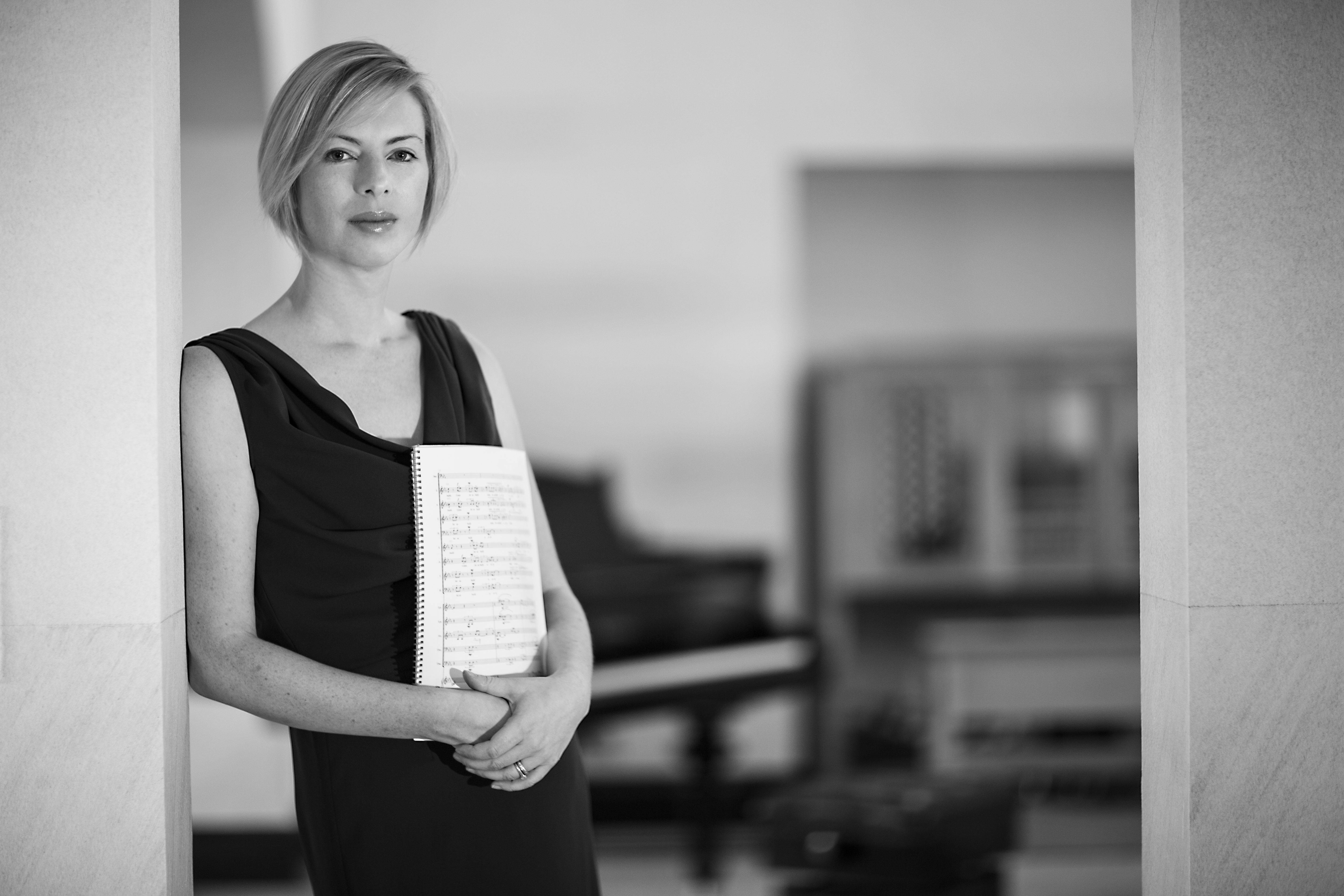
Who or what inspired you to take up composing, and pursue a career in music?

I have never pursued a career in music, it ended up like this. Ok, let me tell you backwards. All I wanted in my life was to compose my own music, whatever it may be to other people. The end result of my compositions are often categorised as “contemporary classical music” (which was also not my choice; I thought of my music is as easy listening top of the chart pop music, but I guess a lot of people don’t feel that way, sadly), and I always want to compose.

Like a lot of people, one needs to earn money to live, as I am from normal working class family; in other words, if I breathe, I need to earn (like everyone else, I guess), and I don’t want to spend time doing things other than composing. So naturally I had to think how can I compose music so that I can also eat. Then it became profession.

If I won the lottery tomorrow, I would be doing the same thing, composing-wise. My life hasn’t really changed since I was an 8 year old composing every day. I guess I don’t have to go to school as I am 37, so I can spend more time composing, not just after school hours and weekends.

Who or what were the most significant influences on your musical life and career as a composer?

If I can speak about inspiration (before I get to the influence), I think I would say everyday life. I really think the inspirations are everywhere. Most significantly, by watching my wife being pregnant, going through each day until the birth, then my daughter growing and changing every day (she is now 3). The one and only good thing about being a composer is that you get to stay home and work, so you will not miss any of these magical times. I have written many works inspired by the specific parts of these situations, from early pregnancy to 2-day-old baby, movement of 2 week old cheeks, learning to walk, etc etc. All separate works.

Now, speaking of influences, I will mention these 4 people: Pierre Boulez, Peter Eötvös, Ryuichi Sakamoto, David Sylvian.

I am incredibly lucky, not just to know these people, or just shake hands once, but to actually work with these people, whom I grew up listening to when I was early teens. Sakamoto and Sylvian were my everyday play list, and Boulez and Eötvös were my everyday play list from when I was at music college student to today.

To be honest, I feel I’ve met everyone (my heroes) I wanted to meet in my life; everyone else, however many “famous” people are standing there in front of me now, I wouldn’t feel star struck.

What have been the greatest challenges of your career so far?

Hmmmm, maybe writing my first opera SOLARIS.

It’s 90min, music for 5 singers, ensemble and live-processing electronics (I worked for months in IRCAM in Paris).

I must say I was a little worried before I started working on this opera, how would I feel about writing an opera. But from bar 1, until the final bar, I felt great. I have never had such a wonderful experience writing it, making drama, telling the story, controlling the pace, mood, atmosphere of the drama. At no point did I feel “I didn’t know what to do next” while composing SOLARIS.

I was sorry after 1.5 year I reached the final bar of SOLARIS, that I had to leave this world in which I lived for a year and a half composing.

What are the special challenges/pleasures of working on a commissioned piece?

Not every commission, but some commissions come with some “request”. I quite like this.

From when I was small, I always love studying. I loved school, I always studied (not because I wanted good grades, but I just wanted to know more things) something in my life, including unnecessary things!

For instance, I wrote a piece for Lucerne Festival, which was for anniversary of the oldest and biggest insurance company, Swiss RE. They requested me to write music about “risk management”, a term which I had not even heard of until then. Soon I found out one of my close friend’s partner whom I knew for years, is a professional Risk Manager! I knew that he wears a suit every day to go to work, unlike floating around everyday like a jobless person like me. So it was fascinating for me to study this totally unknown area.

Another was the anniversary for Kierkegaard. I knew the name, but never really knew about him. It was a great excuse to study and research him.

So it is not a challenge, it is an excuse for me to know more, a good reason to do research.

What are the special challenges/pleasures of working with particular musicians, singers, ensembles and orchestras?

I wouldn’t say “challenges”, but I always think about the musicians who will perform (for the first time) the work I am writing. It may be hard to believe for some, but I really do. If it is an orchestra then I think about the conductor (especially if I know the conductor very well); if it is a solo or concerto works, I would have lengthy face to face or skype sessions with the musicians I am writing for. It is so important that I have these musicians in mind when I am composing.

But it is strange, quite often I compose music like that, then they premiere the work, they say nice things, but they never play the work again. A few years later, someone totally different from whom I imagined when I was writing the piece contacts me and then plays the work obsessively many times, as if the work was written especially for him/her.

I can never really control this, it’s a chemistry, I think. But it is nice, for me to try to seek the “reason of the work’s birth”. Once he/she is born, they walk their own life….

Which works are you most proud of?

Can’t answer that….though my old works, I feel are quite distant, a bit like someone else’s compositions with lots of bits I feel comfortable with, or like or am familiar with. I feel more possessive about recent works.

What is your most memorable concert experience?

“Daphnis and Chloe” BBC Symphony Orchestra at the Barbican, conducted by Pierre Boulez. It was amazing to me that I literary could hear every single note which was played, and the pacing of it. The piece started, and finished as if in one breath. Really clean, like the most smooth single malt whisky.

What do you consider to be the most important ideas and concepts to impart to aspiring composers and musicians?

Why do you play these particular works in this exact time and for whom, and why those instruments. When I feel this clearly as an audience, I will most likely to like the concert.

Where would you like to be in 10 years’ time?

I would like to be writing larger scale works only, like operas. Hmmm….. maybe some little pieces in between for people I like.

What is your idea of perfect happiness?

Composing – and when my daughter is lying on me on the sofa, watching tv or reading books (preferably the latter).

Although Dai Fujikura was born in Osaka, Japan, he has now spent more than 20 years in the UK where he studied composition with Edwin Roxburgh, Daryl Runswick and George Benjamin. During the last decade he has been the recipient of numerous prizes, including the Huddersfield Festival Young Composers Award and a Royal Philharmonic Society Award in UK, Internationaler Wiener Composition Prize, the Paul Hindemith Prize in Austria and Germany respectively and both the OTAKA and Akutagawa awards in 2009.


A quick glance at his list of commissions and performances reveals he is fast becoming a truly international composer. His music is not only performed in the country of his birth or his adopted home, but is now performed in venues as geographically diverse as Caracas and Oslo, Venice and Schleswig-Holstein, Lucerne and Paris.

Full biography here
www.daifujikura.com

Lola Perrin
Lola Perrin

Who or what inspired you to take up the piano, and pursue a career in music?

It picked me, I couldn’t keep away from the piano and when I hit my early twenties I realised I had to compose, and knew it would take a good few years to write anything I could say was original.  It actually took 9 years to eventually compose eleven minutes of music that I rate; my first piano suite which is a set of seven miniatures.  After that, the door was open.


Who or what were the most important influences on your musical life and career?

Edward Hopper, Ansel Adams, observing children set free at the piano, Rachel Whiteread, Carsten Hoeller, Dr Martin Coath’s emails to me about the speed of thought in the brain, Hussein Chalayan’s ideology that drives his designs, the passing of a close friend and musician and remembering him in a piano suite – these were all triggers, one by one, for my eight piano suites.


What have been the greatest challenges of your career so far?

It’s unimaginably difficult to get other people to play your work which is fairly usual (so many of my predecessors only started getting played after their deaths), although my work is played now more than it was – it ebbs and flows.  It’s hard to get it to take off. I’m more interested in composing than promoting so I run out of time to promote my books. I spend less time than I would like on promoting my books because my composing and teaching take priority.  So I would say the greatest challenge is ongoing; getting my work further into the repertoire and into the hands of many more concert pianists.


Which performance/recordings are you most proud of? 

Always the next one.


Favourite pieces to listen to?

Bill Evans playing ‘Symbiosis’


Who are your favourite musicians?

Martha Argerich is high up in my list and I loved seeing her daughter’s amazing and intimate film about Martha: ‘Bloody Daughter’.


What is your most memorable concert experience?

Maybe the one where around 5 and a half people came. I was in a tiny chapel in Hamburg, My show included films and as there was no screen, they were projected onto the amazing and antiquated wallpaper, creating the sense of a one-time-only atmosphere never to be repeated but perhaps everyone would remember on a particularly deep level.


What do you consider to be the most important ideas and concepts to impart to aspiring musicians?

Once you find your path, never step away from it; no matter how hard it is, do not compromise. Be brave and keep reaching out!


What are you working on at the moment?

I’ve spent the last year creating “Now You See It” – a composer’s response to living in the age of climate change. It’s scored for piano and an orchestra of words featuring the voices of activists and innovators at the frontline of climate justice.  I worked with co-producer Christian Dymond, researching and interviewing a number of activists around the world; then I created a word based composition using extracts from the interviews and set that within piano composition. It has its premiere in London in March and is going to Hebden Bridge Piano Festival in April, will be on at Markson Pianos Concert Series in October, with more dates coming in. 


Where would you like to be in 10 years’ time?

On a planet that has switched to renewable energy or NO energy.


What is your idea of perfect happiness?

Walking to my next gig; that’s when I most feel in my element.


Lola Perrin performs at Hebden Bridge Piano Festival on 18th April in a programme which culminates in her “Now You See It” – a multimedia project featuring solo piano with a sumptuous cloud film by visual artist Roberto Battista, and pre-recorded words captured from international activists, climatologists, inventors, writers, and oil rig workers; voices from the frontline of our global climate conversation.  “Such a brilliant idea!” George Monbiot

 Further information and tickets here 

Lola Perrin is a London-based, USA-born composer, pianist, publisher, and Composer-in-Residence at Markson Pianos.

She has been composing since 1992 and performs her compositions on mainland Europe, in the UK (including works for 2, 4 & 6 pianos at Lang Lang Inspires, Southbank Centre) & USA, and has published over 70 piano compositions in 8 books, distributed via Spartan Press. Commissions include silent film scores performed at Barbican, BFI Southbank and Peninsula Arts in Plymouth. She collaborates in performance with writers (including Mihir Bose  & Sue Hubbard), scientists, artists and film makers. 

Lola Perrin has been taken into the repertoire by concert pianists including; Elena Riu, Kevin Robert Orr, Paul Cassidy, Ivory Duo Piano Ensemble, LP Duo, Duo Gastesi Bezerra, Carles and Sofia.  Her technical exercises, commissioned by Trinity College of Music, can be found in their 2015 – 2016 Piano Syllabus Grades 3 & 4.

As an increasing number of pianists and piano duos take up her piano works she is turning her attention to instrumental works.  Elysian Quartet and Carlos Lopez-Real have performed her string quartet and saxophone work. Sarah Watts  commissioned ‘Her Sisters’ Notebook’ (ten bass clarinets) for Peninsula Arts Contemporary Music Festival 2011 and played it at Irish Royal Academy 2014. Simon Desbrulais and Ivory Duo Piano Ensemble have taken up her forthcoming Suite for Two Pianos, Trumpet and Narrator. During 2014 two instrumental works (String Quartet & Saxophone, Wind Quintet & Choir) are due to be rehearsed / performed in London.

She has been interviewed and reviewed by various media including Berliner Morgenpost, BBC Radio 3 and local stations, The Guardian, Lyric FM.  Her recordings appear on radio playlists and occasionally on broadcast TV, are on general release and can be found through digital sites including iTunes (CDs: Fragile Light’, ‘By Peculiar Grace and other loves’).  She also works as a private piano teacher.  Pianist magazine ran an interview, June 2014, with her piano student Shadow Chancellor Ed Balls, in which Lola made a sneak appearance.

As well as various composition projects, she is also currently transcribing ‘Concerto in C Minor’ by Helen Hagan, a forgotten 1912 virtuosic masterpiece still in the composer’s hand, and creating a concert programme around it.

www.lolaperrin.com

Joanna Marsh

Who or what inspired you to take up composing, and pursue a career in music?

Although I have composed from as far back as I can remember, I went into teaching and organ playing after university, as I had no role model in composition and no understanding of how a person would forge a career doing that. It really was Judith Bingham, who I met in my thirties, who helped me make the transition to being a professional composer. She had a very practical and down to earth approach but she was also very inspiring and I felt a strong affinity with the way she thought about music.

What have been the greatest challenges/frustrations of your career so far?

I find that as a composer living in Dubai, I need to be highly proactive. You can’t sit around waiting for commissions to find you, you need to think up interesting projects and connect with people who can help make them happen. And actually it has been challenging living in a society that has no government funded performing arts sector as the priorities of a nation do largely filter down from the top. There are no professional orchestras or musical institutions in Dubai so the natural places for a composer to find work don’t exist. Things are subtly changing but Islamic Art and local Arabic Music will always be first in line for attention, which is probably as it should be.

What are the special challenges/pleasures of working on a commissioned piece?

The commitment and investment of others in a work is often very helpful. Composing is very solitary and although there may be collaboration at the point where you meet the performers at the first rehearsal, generally you spend many hours alone in a room working on the music, thinking hard and crafting ideas. A commissioner will provide an initial direction for these ideas through the occasion of the performance and musical forces offered. And then of course, they provide the most helpful thing of all, a deadline! I have been lucky enough in that no commissioner has got in the way of the piece so far. I have colleagues who have had their commissioners move the goalposts during the compositional process (actually we need a different length, sorry it needs to be for strings not brass…!), which can really create havoc.

How do commissions generally come about?

Lots of different ways. Sometimes people have heard something of yours that they like and get in touch. It is usually the performers in this case. But sometimes you happen across people looking for a way to mark a special occasion or anniversary who may not be the actual players. You suggest some ideas and it dawns on them that creating a piece of meaningful art could give relevance and immediacy to something they care about. Always at some point in the process ideas are discussed that catch a spark of excitement that lead the potential commissioner to think this work should definitely go ahead, and you should be the one to do it.

With my last piece, Rupert Gough, Director of Choral Music at Royal Holloway, came to performance of Act 1 of my opera My Beautiful Camel with National Opera Studio last May. That work was in collaboration with David Pountney who wrote the libretto from a story I had devised. Rupert mentioned that they were looking to commission a piece about the suffragette Emily Davison, who was an alumni of the college, for a date in January with the London Mozart Players. I remember excitedly telling David, who instantly poured forth a number of fantastic ideas for a choral depiction of the famous Epsom Derby incident. I could see that a musical record of the entire occasion and its aftermath could make a very interesting cantata and indeed it captured the imagination of Royal Holloway so they decided to go ahead.

You’ve collaborated with librettist David Pountney to create a work which celebrates the 100th anniversary of the Representation of the People Act, which first gave women the right to vote. Can you tell us a little more about the piece?

The cantata ‘Pearl of Freedom’ tells the story of suffragette Emily Davison’s ultimately fatal collision with the King’s horse Amner at the 1913 Epsom Derby. It opens with words that Emily Davison wrote in her diary about her passion for women’s suffrage. She uses the expression ‘Pearl of Freedom’ to refer to the prize that she was seeking, women getting the vote.

David created a text from original sources, juxtaposing factual elements from the day (the horses names, the riders, their numbers, their colours etc), with Emily Davison’s state of mind. He also includes commentary from various contemporary voices including King George V, the police sergeant on duty who listed Emily’s recovered possessions, and the Press. The only bit of text he invented is the race commentary before the collision between Emily Davison and the King’s horse Amner. He wrote this section in the style of Peter Bromley, a race commentator of a slightly later era, because no such live commentaries exist from this period.

Emily Davison was regarded as a loose canon within the Suffragette movement. Her militancy and extremism had considerably alienated the public. The work opens with jagged rising line of unison strings suggesting the intensity and turbulence of Emily Davison’s state of mind as she prepared and carried out her plan. She evidently knew that her actions would be far-reaching as she had commented to a friend that they should look at the press the following day. Her purchase of a return ticket to the Derby suggests that she was not planning to endanger herself fatally, however. The piece is around 20 minutes long and the final episode of the piece is devoted to Emily’s funeral, which was a very large scale public affair with 50 thousand people in attendance. The music of this section takes the form of a funeral march based around one of the hymns that was sung on the day “Nearer my God to Thee” with echoing quotes from Chopin Funeral March which was played throughout the procession.

How would you characterise your compositional language?

It’s easier for a composer to explain the intentions behind the creative process than to describe the outcome, which is the listener’s experience. But there are a few general points. For example I am certainly drawn towards tonality. I like the gravitational pull of it but always try to look for a means of expression that is not the obvious. I also enjoy using snap-shots of ideas or idioms from old or ancient musical works that can impart flavour but take off in a different direction in my own music. Development is important to me, I aim to find a strong idea and work it through fully in a piece. Clarity of structure is critical. An interesting or quirky idiom is just an empty costume when there is no actual body to inhabit it. And line is essential, it carries the energy that is the piece.

How do you work?

I work best with a deadline that is not too far away, or at least with some mini-deadlines to help me measure out the time! Usually I find a long time needs to be set aside for the pre-compositional process. This is when the idea of what the piece is going to be gradually appear as if out of the mist. When I start the actual writing I always find that the first two minutes seem to take an inordinately long time, much longer than any other section of the piece. It feels like ploughing a furrow for the very first time. After that the composing seems to move on much quicker, probably because the ideas to be developed further are distilled by then. And I always have to remind myself not to panic as I start to get to the end of a piece. Endings are difficult. They feel like bringing a plane into land; too easy to make a bumpy landing and you really don’t want to crash.

What do you consider to be the most important ideas and concepts to impart to aspiring musicians?

You need to be open to what life brings you in the most general terms. We can all get a bit fixated on what we think our careers should look like and look to our contemporaries for a benchmark. It is not helpful. Don’t just think of the next thing coming up as the real opportunity, better than what you are doing now. What you have on your plate NOW is the opportunity; focus on that and the future will take care of itself.

Where would you like to be in 10 years’ time?

I have been surprised by how much I have enjoyed living in the Middle East and I hope my connections here will still be alive and well regardless of whether or not I am still living here. Otherwise really I just want to be getting up each morning excited about the projects on my desk. That would be more than enough to ask for.

31st January sees the world premiere of ‘Pearl of Freedom’ by Joanna Marsh, a cantata which tells the story of suffragette Emily Davison and her death at the Epsom Derby under the King’s Horse. This coincides with the 100th anniversary of the Representation of the People Act of 1918, in which women first gained the right to vote. 


www.joannamarsh.co.uk

Who or what inspired you to take up the piano and composing, and pursue a career in music?

I grew up in a musical household as my mother was a piano teacher. She taught me piano and I also played viola and violin, and for as long as I can remember I knew wanted a career in music. I think I first started composing because improvising new melodies and harmonies made practising my scales more interesting!

Who or what were the most important influences on your musical life and career?

Many and varied. I was fortunate enough to have an excellent musical education with many good teachers, starting with my mother. My secondary school, Dame Alice Owen’s, had a very strong music department and I attended Trinity College of Music, Junior Department on Saturdays. I also played the viola in Hertfordshire County Youth Orchestra. I then went on to study music at Oxford and composition at King’s College, London.

More recently, I joined CoMA (Contemporary Music for All) in 2005, playing the piano in CoMA London Ensemble which is a contemporary music group open to all instruments and all abilities. Initially I thought that CoMA would be a good way to provide composing opportunities, but I enjoyed playing the piano in the ensemble so much that I started to realise that I had more of a passion for playing than composing, particularly the excitement of playing contemporary music. CoMA has taught me more about contemporary music than my master’s degree in composition and I have discovered many wonderful composers and explored their solo piano music, including Paul Burnell, Joanna Lee and Dave Smith whose works appear on my latest CD.

What have been the greatest challenges of your career so far?

The greatest challenge for me has been working out how to find my niche as a musician in the first place. I always knew I wanted a career in music and after graduating I worked for several years in music organisations alongside some composing and teaching. However I always felt that I wanted to spend more time making music myself. When I had the opportunity to switch to part time hours in my administrative work I was able to think seriously about what career I really wanted and how to get there, and that’s when I realised that I wanted to focus on piano.

While I had always taken piano seriously I knew that converting this into a full-time career would require a concentrated period of study and that’s when I got in touch with my teacher Thalia Myers. Under her guidance I threw myself into getting my playing up to a standard where I could forge a career as a pianist.

Embarking on a career as a professional pianist in ones thirties rather than twenties has its challenges, but I believe that a richness of musical and life experiences informs my playing, providing me with something a little different to offer audiences.

Which performance/recordings are you most proud of? 

My first CD, Dream Rotation, which I recorded in November 2013 and which has recently come out. Dream Rotation is a collection of six contemporary works by composers I know. Four of the works were in fact written for me to play, two of which are dedicated to me. Five are premiere recordings.

I had at the back of my mind that I would like to record some of the repertoire I had been working on. I decided to go for it in 2013 when I discovered I was expecting a baby in early 2014 and I knew that my practising time would be reduced afterwards. I recorded the six works in one day in November 2013 at the Jacqueline du Pré music building in Oxford with the excellent recording engineer Adaq Khan. In the run-up to the day I had to put a lot of work into learning the works to a standard I was happy with and I had three other concerts during that two-week period. All while being seven months pregnant! The recording day itself was enormous fun and went more smoothly than I could have hoped for, then all the editing and admin that goes into bringing a CD out was done during 2014 in bits of time snatched in between looking after my little boy.

Which particular works do you think you play best?

As I am always learning new things and developing as a player it tends to be whatever I’ve performed most recently. I love playing contemporary music and I actually find standard repertoire quite daunting because there are so many interpretations already out there. I also love playing in ensembles and orchestras and regard this aspect of my playing as just as important as my solo playing.

How do you make your repertoire choices from season to season?

In a variety of ways. Depending on what concerts are coming up I may look for a piece for a particular occasion or others might make a specific request. In addition, composers often send me their works, which I welcome although I also warn them that their pieces will go on to a large pile on my piano and there’s no guarantee of a performance! I have discovered that male composers are much less shy about sending pieces to performers than female composers. Women take note!

As a composer, who are the major influences on your work?

A tough question! Every piece is different and I have sometimes noticed that each piece has something of whatever I’ve been listening to and playing at the time. In recent years this means CoMA repertoire, particularly the use of aleotoric notation such as indefinite pitches and rhythms and generally thinking outside the box. Composers such as Howard Cheesman, Joanna Lee, Stephen Montague and Dave Smith all think creatively about what the performers are required to do and how to express that in a notation which will be understood.

Do you find your composing informs your performing and vice versa?

Absolutely! In terms of playing it is useful to think about what kind of sound the composer was aiming for in any particular texture and to imagine each passage as if it were written for voice, and as if it were written for orchestra, as well as how it is actually written for piano. Understanding the structure of a piece and how the material develops is essential in planning a performance.

It is imperative for composers to understand their music from the point of view of a performer because it is only the performer who can actually bring the music to life. Since I have been playing contemporary music I have thought much more carefully about writing music for the instruments playing it and notating from the performer’s point of view. I think the music I have written as a result of this has greater clarity and I have been much more careful about how things are notated.

You have a special interest in contemporary repertoire and new music. What are the special pleasures and challenges of working with this repertoire?

Bringing a piece to life for the very first time is a wonderful experience. I love the feeling of discovering a piece I didn’t know before and with a brand new piece there is the added feeling of being the first to discover it. Think of your favourite piece of music and imagine being the first person to hear it!

Performers who concentrate on mainstream repertoire rely on a filtering process by which the best works survived and the less successful ones didn’t, whereas performing contemporary music involves being part of this filtering process. I find this exciting and rewarding but it does require patience because one has to engage with the less successful pieces as well as the gems. Patience is also required when working on a piece for the first time because there are invariably teething problems requiring a dialogue with the composer. Again, I enjoy this but it does require patience.

Do you have a favourite concert venue to perform in and why?

I have given several recitals at the Schott recital room in central London. I like the intimacy of this venue which enables the performer to engage with the audience. So many concerts are in churches and other large venues where the audience can hide at the back. Having said that, I am very much looking forward to performing at St. Cuthbert’s Church NW6 on 27 September. It is a modern building with a wooden interior and is beautifully proportioned inside. The concert is to celebrate the arrival of a new piano and launch of their concert series and I think it is going to turn out to be a popular chamber music venue.

Favourite pieces to perform? Listen to?

I have a few pieces which I come back to regularly because they work so well in performance. Gabriel Jackson Angelorum is one I have performed many times as it is so satisfying to communicate to the audience, whether they are regular listeners of contemporary music or completely new to it. The pieces on my CD, particularly Joanna Lee Atta and Hopper and Paul Burnell 3 Plain Pieces fall in to the same category. Another piece I loved performing and hope to perform again is Patrick Nunn Music of the Spheres which includes electronic sounds taken from data from Voyager spacecraft as it flew past the planets. Great fun!

To listen to, I have several favourite composers including Bartok, Messiaen, Ravel and Schumann but really I love all classical music from Bach to Birtwistle.

Who are your favourite musicians?

Goodness, how long have we got? I think I’m just going to pick out a few musicians who have inspired me somehow for various reasons.

The pianist Mary Dullea is quite special. I have heard her and taken masterclasses with her at CoMA summer schools and her playing displays a really sensitive and intelligent musicianship as well as formidable technique. I am also a fan of the pianist Nicholas Hodges whose mastery of counterpoint makes sense of the most complex of Birtwistle’s piano works.

There are a number of living composers who I count amongst my favourites. Aside from the composers I have previously mentioned, I love the music of Phil Cashian. He has written a number of pieces for CoMA which work really well and he always uses fresh textures and has a wonderful ear for harmony. Julian Anderson and George Benjamin are also favourite composers of mine.

What is your most memorable concert experience?

My first recital at the Schott recital room in September 2011 was very special as it was my first recital after I started studying piano seriously again. I played a set of twelve waltzes by Schubert, a short piece by Phil Cashian called Slow Air, Gabriel Jackson’s Angelorum and Schumann Kinderszenen. Unfortunately the event was tinged with sadness because, having taught me to play the piano in the first place and provided so much support over the years, my mother was not there to hear it as she had died earlier that year.

What do you consider to be the most important ideas and concepts to impart to aspiring musicians?

General musicianship is so important. Develop a good sense of rhythm, pitch and harmony and everything else will be much easier. Taking part in a variety of musical activities, particular singing in a choir but also playing in an orchestra, accompanying, composing, arranging and improvising all helps to build a rounded musician.

Where would you like to be in 10 years’ time?

I would like to be able to play a scale in thirds with one hand and for it to sound beautifully smooth.

What is your idea of perfect happiness?

The things around me here at home: my lovely piano, wonderful husband, brilliant son and Maestro the cat. Not necessarily in that order!

What is your most treasured possession?

It would have to be the piano. What else? It is my first real piano. Until five years ago I only had a digital piano which is no replacement for the real thing. When I got married my in-laws gave us a proper piano as a wedding present. It was the best possible thing anyone could have given me. We chose a Boston upright UP132. When it arrived I realised that all I wanted to do was play the piano and I followed the course which has led me to where I am today.

What do you enjoy doing most?

Playing the piano, spending time with the people I love, eating and sleeping. Not necessarily in that order!

What is your present state of mind?

My mind is in many places at once nowadays as I try to get so much done in so little free time.