Guest post by Eva Doroszkowska

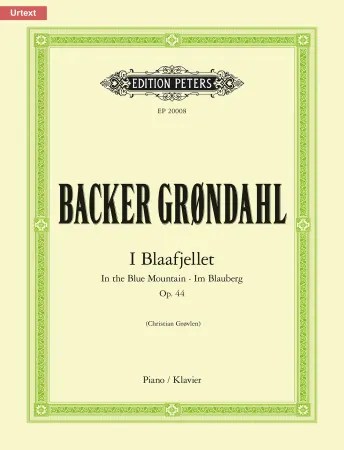
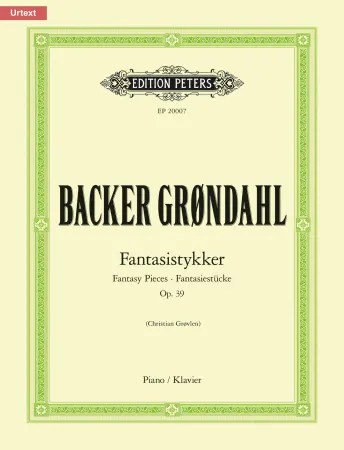
If patience is a virtue, then it could be coined a female trait. Hildegard von Bingen waited 900 years for a resurgence of interest in her music. Fortunately for Agathe Backer Grøndahl, it was only a century before she was honoured with a republica-tion and urtext edition of 2 of her piano cycles. The albums, Fantasistykker (Fantasy Pieces) Op. 39 and I Blaafjellet (In the Blue Mountains) Op. 44 have been re-issued, thanks to the work of pianist and editor Christian Grøvlen and Faber Music for Edition Peters.

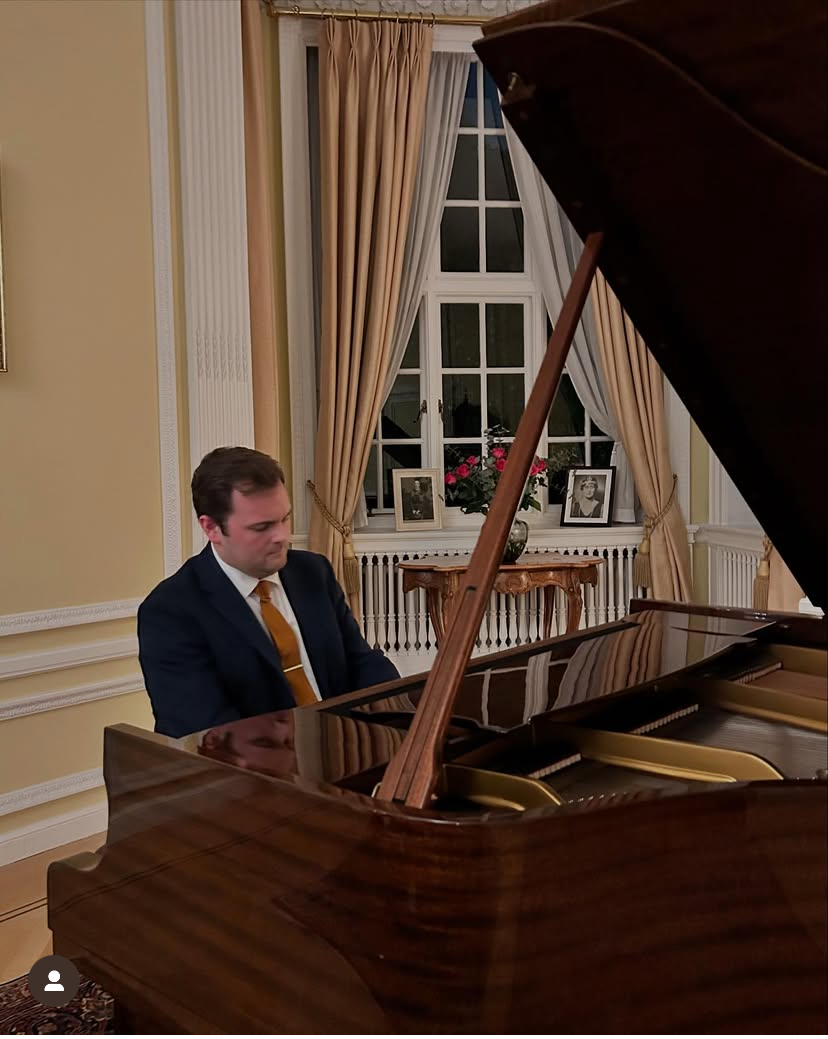
Grøvlen, Director of Music at the Composer’s Homes for Kode, has been promoting the works with a flurry of concerts showcasing these sparkling bright new albums whilst championing one of Norway’s greatest pianists and folklorist composers. So it was on a cold February night, that I was fortunate to attend an event at the beautiful home of the Norwegian Ambassador’s residence in Kensington, London. Outside the velvet winter sky contrasted with the pale luminosity glowing from drawing room windows, as musicians, publishers and journalists alike, were welcomed into the warmth.

The audience were transported to a world of Nordic magic in a setting that provided the perfect backdrop for the poetry of Norwegian landscapes encap-sulated by the visual reminder of paintings of fjords that hung on the walls. Grøvlen elicited both curiosity and laughter from the audience as he regaled with insightful anecdotes from the composer’s life and performed with a lyrical intensity.

Of special interest was his comparison of Grøndahl’s style to her colleague and passionate advocate and supporter, Edvard Grieg. Grøvlen deftly demonstrated similarities and differences between the two composers with musical cadences summarising their respective characters. Grøndahl’s music hinted at a subtler darker enigmatic underworld, more mysterious in harmonic complexity.

Grøvlen traced a link between Grøndhal, her envrironment and relations to her sis-ter Harriet Backer’s paintings which include many intimate scenes of music making often featuring Grøndahl at the piano. The exhibition last year at the Musee d’ Orsay of Harriet’s work was entitled “Music of Colour”. This evening could have been entitled an exhibition, “Sounds of Light and Shade” as tone painting and hints of impressionism within Grondahl’s music were displayed. Also explained was the influence of the poetry of Vilhelm Krag (1871-1933), noted for his symbolism, melancholy and connections to nature. This resonated with what I knew of Grøndahl’s own life. Krag explored the melancholic side of the human mind and within Grondahl’s music there is this Nordic melancholy – her music often filled with an inexplicable darkness, despite the light that shines from within. An artist who struggled with depression and ill health, music was her refuge. Music, she wrote, helped her forget slush and rain, encouraging her to daydream instead. “There are no feelings or passions which it cannot create, arouse to the highest degree of randomness, you can cry or rage, be gripped by the most excited enthusiasm and feel more wretched and humble than the felon in chains.”

Yet whilst I was filled with pride to see the music about which I had written and talked celebrated in brand new print, the beautiful cream pages bound by a cover surrounded by the distinctive spring green border of Edition Peters, I left feeling frustrated. Yes, it is time her music is made approachable with worthy inclusions of smart title pages, credits and contents, academic preface and full scale portaits of Grøndahl in modest flowing dress, and cap. Yet despite all this, I couldn’t stem the mild irritation that here again sympathy was portrayed for a woman and what more she might have achieved were she a man?
Here a woman was glimpsed through the 21st-century lens of expectations of what was missing, rather than seeing what was remarkably there burning bright in her own time. Presented by Grøvlen was an artist described as restrained, yet look deeper and a new picture emerges. Here after all is a woman who, as I wanted to yell from my seat, wrote a dawn chorus for the suffragette movement, who did indeed write and perform with and for orchestras and promoted herself despite the required modesty of the time. Why was that not mentioned? Here is a human who showed inconceivable will power pushing through boundaries to a life that was hard won for a woman of her era. Agathe Backer Grøndahl may have been “aggravatingly modest” as her era demanded, but she was also a woman whose bravery and courage took her to Europe as a young lady with a black jack truncheon in her pocket to protect herself from any angry or rowdy soldiers as pianist and recording artist of Grøndahl’s works, Sara Aimee Smiseth has pointed out. Look hard enough and what emerges is not the picture of a retiring wallflower chained unwillingly to a kitchen sink, but that of an exceptional artist fighting to follow her own creative path whilst fulfilling a role as mother and wife.

If you adjust the lens in the other direction another perspective emerges. Our gen-eration may be frustrated by the ideals of 19th-century decorum, but it was precisely the women’s salons of history where arts, celebrated in domestic settings, played an essential role in the flourishing of cultural traditions through the centuries. It was often in salon settings that the latest ideas were carried on chatter through windows out to the larger world. By virtue of Grøndahl’s career as a mother, musician and teacher firmly rooted to Nordic soil, she also had first hand access to her beloved folk music. Grøndahl more than Grieg transcribed these melodies, preserving them for future generations of male and female artists.

It is her work at home as a much-loved teacher and pianist that helped keep her name alive whilst raising standards of music in Norway.

Grøndahl may not have had the compositional career benefits of male gender, but in her own words to Bernard Shaw it is this “experience as a wife and mother that makes her an artist.”

Perhaps Grøndahl with all of her 400 songs and piano pieces wisely understood that it is by composing “salon miniatures” – the music of everyday inner details – and by experiencing the intricacies of life that her art will travel more feasibly than an epic sonata of grandiose ideas played by the few. Just as valuable as the giant sweeping brush strokes are the small yet miraculous details to be shared amongst generations of musicians at home as well as in the concert hall.

Whilst we celebrate the wonderful work of Edition Peters for replacing overcrowded print of antiquated editions and marching them into the clarity of the elegantly printed realm, let us also celebrate the achievements of a remarkable woman. Let us hope her story will not slip through the cracks of history.

Grøndahl brought to life the inner landscape of the soul. Perhaps this scattering of musical seeds will in the long run bear more fruit? I hope at least these informative editions will do much to contribute to hearing Grøndhal’s music, in the words of Vilhelm Krag, “grow beyond the frost of iron”.

Eva Maria Doroszkowska is an international pianist and teacher
evamaria.co.uk

Last week I attended a reception and recital hosted by H.E. Tore Hattrem, Ambassador of Norway, and Mrs Marit Gjelten, together with Faber Music and Kode Art Museums & Composers Homes to celebrate the first ever Urtext edition of Fantasistykker (Fantasy Pieces) Op. 39 and I Blaafjellet (In the Blue Mountain) Op. 44 by Norwegian composer Agathe Backer Grøndahl. The exclusive event for leading music professionals took place at the Ambassador’s residence in London, an elegant mansion close to Kensington Palace.

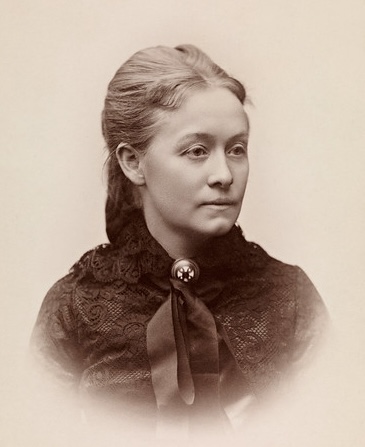
Agathe Backer Grøndahl (1847-1901) was a Norwegian pianist, composer and music teacher. She studied with Franz Liszt and Hans von Bulow, amongst others, and was a contemporary and close friend of Edvard Grieg. She wrote over 400 works, mainly for piano and voice, and, like Grieg’s, her music blends Norwegian folk elements with Romantic influences. The English writer and music critic George Bernard Shaw described her as one of the foremost pianists in Europe, and at the time of her death in 1907, she was hailed as one of the great names of Norway’s musical heritage. Yet, over the following years her music was overshadowed by her famous compatriot and has remained relatively unknown, until now.

The music was performed by Christian Grøvlen, who gave some fascinating insights into Backer Grøndahl’s life and her compositional output. Although these works can be defined as “salon pieces” , they display an intriguing range of styles, textures and musical colours – at times impressionistic or nodding towards Bartokian folk idioms and dance rhythms; at other times, energetic, virtuosic and sweepingly Romantic, with a depth of emotion that goes beyond far beyond the salon miniature.  

The Fantasy pieces resemble Grieg’s Lyric Pieces yet they can also be seen as tone paintings with their programmatic titles (Summer Night, In the Boat, Bird’s Winter Song, for example). And while beauty and charm may lie on the surface of these pieces with their elegance and decorativeness, there is smouldering darkness beneath – and this is the core of Agathe Backer Grøndahl’s music.

This darkness is more evident in the suite I Blaafjellet (In the Blue Mountain), one of Grøndahl’s major works, dedicated to her sister, the painter Harriet Backer. It owes something to the programmatic music of Liszt in that the suite takes the listener on a journey, not unlike the first year of Liszt’s Annees de Pelerinage. The ‘fairytale’ suite evokes the different moods of the magical mountains of Norway, replete with trolls and wood nymphs, and from the outset, despite the relatively calm opening piece ‘Night”, there is an unsettling sense that something is afoot…. The suite builds in intensity, as the troll emerges from the mountain, heralded by portentous, almost aggressive chords, and unnerving jazz-like rhythms.

This was a splendid introduction to Backer Grøndahl’s piano music, characterfully performed by Christian Grøvlen, whose affection for and appreciation of it shone through every note.

The first-ever Urtext editions of two of Backer Grøndahl’s greatest piano works are published by the distinguished music publisher Edition Peters. Edited by Christian Grøvlen, they are based on the original manuscript and the first edition of 1898, which was out of print for many years. Now, in these new critical editions, the beauty and inventiveness of Backer Grøndahl’s writing for piano can be brought to a wider audience and enjoyed by pianists professional and amateur alike.

“I hope these new editions will make more people play, explore, understand and love Backer Grøndahl’s music” – Christian Grøvlen, pianist

 Find out more


Support The Cross-Eyed Pianist

This site is free to access and ad-free, and takes many hours to research, write, and maintain. If you find joy and value in what I do, why not

BUY ME A COFFEE

Mindful

adjective

1. attentive, aware, or careful (usually followed by of): mindful of one’s responsibilities.

2. noting or relating to the psychological technique of mindfulness: mindful observation of one’s experiences.

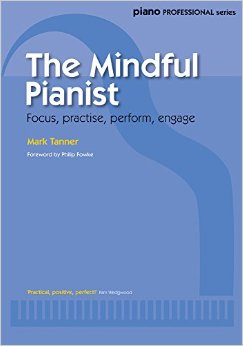
41czgktnuml-_sy344_bo1204203200_The Mindful Pianist by pianist, teacher composer and examiner, Mark Tanner is the latest volume in the Piano Professional series published by Faber Music in association with EPTA, UK (the European Piano Teachers’ Association). “Mindful” is the word du jour, and the practice of mindfulness – the therapeutic technique of focusing one’s awareness on the present moment, while calmly acknowledging and accepting one’s feelings, thoughts, and bodily sensations – has become increasingly popular in today’s stressful and busy world. This book, however, is not some groovy, new age, Zen guide to piano playing, but rather takes its inspiration and approach from the definitions of the word “Mindful”at the top of this article. With contributions from a number of leading pianists and piano pedagogues, including Philip Fowke, Murray McLachlan, Margaret Fingerhut, Penelope Roskell, Leslie Howard and Madeline Bruser, the book draws on the author’s and contributors’ own experiences of playing and teaching the piano, and explores ways in which pianists, amateur or professional, can be more attentive, careful, self-compassionate and mindful in their day-to-day engagement with the piano and its literature.



Written in an engaging and accessible style, yet clearly supported by many years of practical experience as a teacher and performer, and academic research, the book encourages the pianist to take a fresh perspective on playing and performing by applying the concept of mindfulness to the piano. Through 4 distinct parts, Mark Tanner explores the crucial connection between mind and body, and how an alert, focussed mind fosters playing that is more compelling, more refined and ultimately more rewarding. He begins with simple breathing exercises which enable one to focus while at the piano before a note has even been struck and includes practical advice on overcoming feelings of inadequacy when a practise session goes less well, or the self-esteem issues which accompany performing. He tackles the issues encountered by pianists when practising, performing, improvising and preparing for an exam with wisdom and gentleness – throughout the text, one has the sense of Mark encouraging us to be kind to ourselves and to show self-compassion. The section of exams (‘The View from the Examiner’s Chair’) is written from a wealth of personal experience and is particular helpful in offering perspective to those teachers, and  students, who may feel exams place undue pressure on aspiring young pianists. There is also a section on “mindful listening” (‘The Virtuoso Listener’) which encourages us to sharpen our listening abilities, both at the piano and when we hear music on the radio, in concert, on disc etc.

‘The Mindful Pianist’ is a long, detailed and highly satisfying read, and I will be extracting Mark’s wisdom to share with my own students as well as putting into practise some of his methods in my own playing and performing. Having recently had to deal with a setback in my playing career, I have found Mark’s intelligent, practical and gentle advice particularly helpful as I reflect and refocus on my own piano playing.

I am also grateful to Mark for citing this blog as a useful resource for independent learners.

Recommended

Interview with Mark Tanner

Further details and ordering

On Saturday 24th May I attended a workshop for piano teachers hosted by the Faber Music Academy/Faber Music, in association with Alfred Music and Edition Peters, as a guest of Edition Peters. The all-day event featured lectures by Pam Wedgwood, Andrew Higgins and Roy Howat, and concluded with a recital by pianist Daniel Grimwood. My friend and teaching colleague Rebecca Singerman-Knight accompanied me – and we met a number of other teaching friends and colleagues at the event. Rebecca has co-authored this review of the day with me (her comments are in italics).

The morning session offered opportunities for two publishers (Faber Music and Alfred Music) to showcase their method books. Pam Wedgwood from Faber used her slot to introduce her new 3-volume ‘Piano Basics’ Course (a 2-level course with accompanying ‘workout’ book offering technical exercises).  Pam is well known to UK piano teachers as the composer of many engaging and popular pieces in a variety of styles which are accessible to children and adult learners.  Her session included entertaining examples of games that can be played in lessons to reinforce rhythmic and pitch awareness away from the piano bench and I expect that all teachers present gained some fun ideas to take back to their studios.  She also played some of her own compositions which would certainly appeal to young learners.  However, ultimately I was left with the feeling that the session was little more than a marketing exercise for her own books, particularly towards the end as one book after another was presented.  Overall the overt marketing undermined what was otherwise a fun session. 

Andrew Higgins from Alfred Music followed, a refreshing change in that the Alfred books were used purely as examples to illustrate a truly inspirational session.   ndrew’s focus was the teaching of harmony – in particular chords and chord progressions – to allow students to fully explore musical concepts, develop improvisation and composition skills, and to gain a deeper understanding of repertoire. He demonstrated a wide variety of teaching ideas that would enable students to fully understand how harmony works across music of all genres – a highlight being how a popular Adele song used the same harmonic progressions as Beethoven’s ‘Waldstein’ Sonata!    

The contrast between the two morning sessions reflected the dilemmas faced by UK piano teachers today: I speak as one relatively new to the profession, having been teaching for just over a year, and as a current student of EPTA-UK’s Piano Teachers’ Course.  Although Andrew Higgins did not push the Alfred books to the participants, in response to a question he did state that Level 3 of the Premier course equated roughly to a Grade 1 standard. The first two levels of this course each contain two method books. Therefore, a teacher using this course (myself included) would go through five books before their students reached an approximate Grade 1 standard. In doing so, Andrew Higgins’ presentation made it clear that they would receive a good introduction to the use of chords, chord progressions and harmonic knowledge and be well on their way to being well-rounded musicians who could use this knowledge in improvisation and composition as well as being able to tackle the standard of repertoire needed at a Grade 1 level. In contrast Pam Wedgwood’s Basics book (in common with other UK methods) contains only two volumes and states that this will get a student to Grade 1 standard.  However, there is less in the way of work on chords and their progressions (a knowledge of which is not a prerequisite for passing early exams) and a scan through the books revealed that new concepts appeared to be introduced very quickly with little reinforcement before moving onto the next.  Whilst I have no doubt that in the hands of a good teacher this method would be successful in getting a student to Grade 1 standard I do feel that this can be rather a narrow objective for beginning piano students.  On the EPTA course we are told that it should take roughly three years from being a complete beginner to passing Grade 1 in order to develop really secure musical concepts.  This is roughly how long it would take to work through the Alfred method books and other, similar methods from the US (e.g. Piano Adventures).  However, in the UK many teachers feel pressure from parents to enter their children for exams earlier and it is common for grade 1 to be reached in 18-24 months or less.  Books such as Pam Wedgwood’s will appeal to teachers who aim to move their beginning students through the exam system quickly – which is a really valid approach for many students, particularly those for whom music is (or will become) a serious subject of study.  But it was refreshing to be reminded that there are other, very different, approaches available for teachers who want to take more time with their students in the early stages of their learning to explore many different musical ideas and concepts, not only those necessary for passing formal exams. 

The afternoon session began with a fascinating talk by renowned pianist and scholar Roy Howat, who has recently edited new Editions Peters editions of works by Debussy, Ravel and Faure. His highly erudite yet accessible talk focused on the piano music of these three great French composers, and highlighted the difficulties encountered by editors, and pianists, in trying to produce a ‘definitive’ urtext edition. By examining scores and earlier editions, Roy demonstrated how detailed analysis of source material and editorial notes can impact on the performance of these works, and how certain markings on the score have often been misunderstood or misinterpreted by performers. I found his comments on meter in Debussy’s music particularly interesting in which he showed how Debussy “wrote in” rubato, thus negating the need for exaggerated rubato or obvious adjustments to tempo by the performer. His talk was peppered with amusing anecdotes and pictures of the composers as well as demonstrations at the piano.

The event closed with a short recital by pianist Daniel Grimwood (who is an Edition Peters artist). His enjoyable, varied and engaging programme began with a work by Czerny, a composer more usually associated with piano studies and exercises, and included shorter pieces by Liszt, Blumenfeld and Henselt (also a composer of studies and exercises). He concluded with a crystalline and atmospheric encore of ‘Ondine’ from Ravel’s Gaspard de la Nuit.

This was a most enjoyable, stimulating and inspiring day, and an excellent opportunity to connect with other teachers and friends and colleagues in the profession.

impact of editorial and source research on performing the music of these great composers – See more at: http://www.fabermusic.com/news/faber-music-academy–piano-workshop-day-inspiration-for-inspirational-teachers15042014-1#sthash.0RQ8aTFv.dpuf