This post is inspired by Episode 2 of Season 3 of The Bear, a drama series about a young chef, Carmy Berzatto, trained in the fine dining world, who comes home to Chicago to run his family sandwich shop after a heartbreaking death in his family. By the third series, the noisy sandwich shop has been transformed into an elegant fine dining restaurant and Carmy is seeking a coveted Michelin star. In this episode, Carmy draws up a massive list of what he calls “non-negotiables”: the things that the restaurant must do on a consistent basis to achieve greatness.

Jeremy Allen White as Carmy Berzatto in The Bear

Looking through the list, while some of the non-negotiables are explicitly related to cheffing and kitchen/restaurant management, a number could apply equally to the musician in pursuit of consistency and excellence in their practice and performance of music.

It is a truth universally acknowledged that noticeable progress, at whatever level you play, comes from a well-organised, consistent, focussed and thoughtful approach to practicing. It’s not quantity (of hours spent practicing) but the quality of practicing that counts.

This, for me, is where Carmy’s non-negotiables come in.
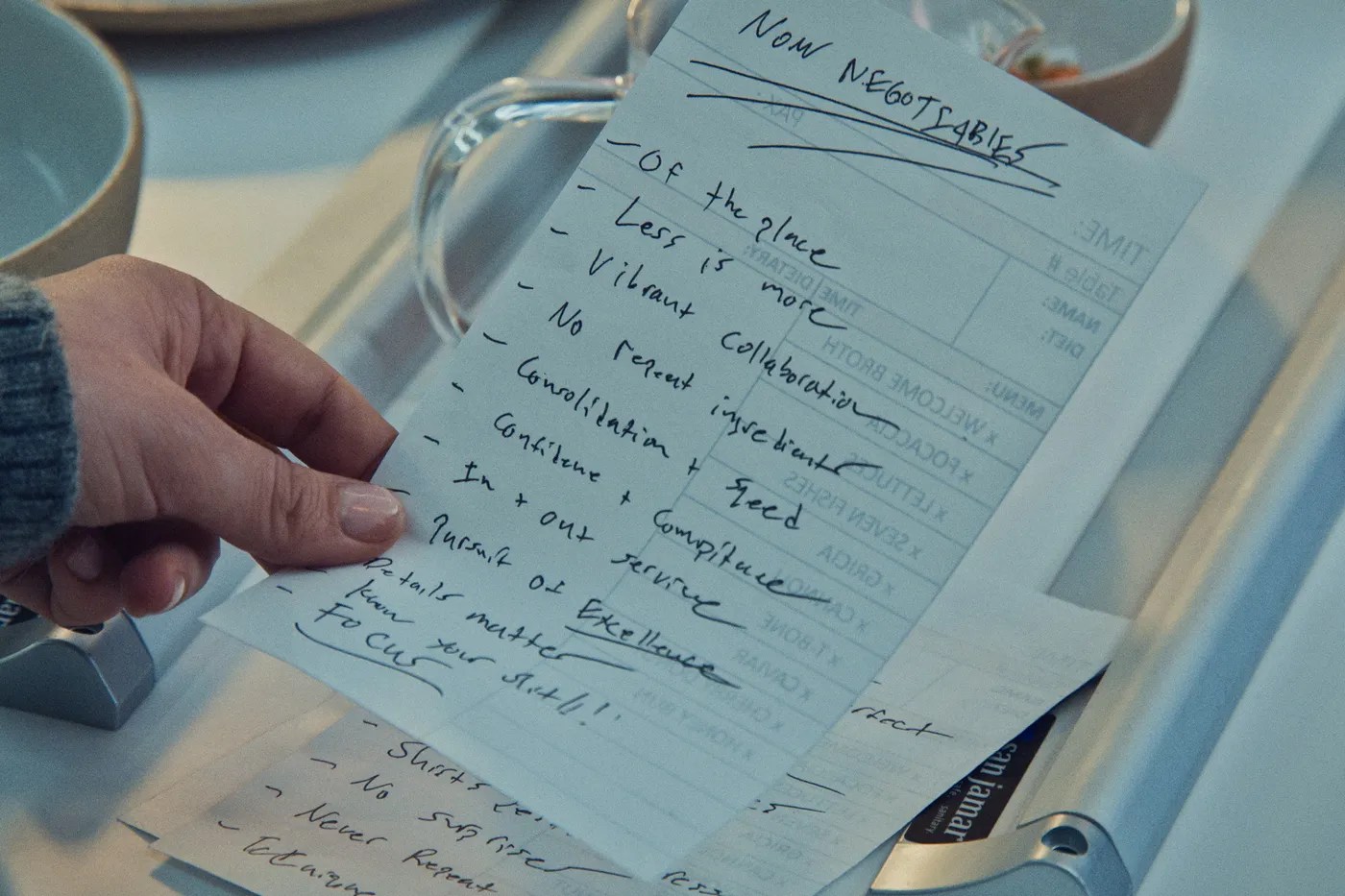
These principles, though originally used in contexts like culinary arts or other forms of craftsmanship, translate beautifully into music practice.

Change the Menu Every Day

Boredom is the enemy of progress, so incorporate variety into your daily practice routine. Instead of doing the same exercises daily or beginning with the same piece in the same place, try different approaches to challenge yourself in new ways.

No Repeat Ingredients

Avoid getting stuck in repetitive patterns. Constantly seek new skills, concepts, and exercises to enrich your practice. Challenge yourself with new materials rather than only practicing familiar ones. For example, if you’re used to playing pieces in a specific genre, try something completely different, like a jazz standard if you usually play classical repertoire.

Know Your Sh*t!

Fully understand the fundamentals of music, including theory, notation, and instrument mechanics. This knowledge helps you interpret music more intelligently and aids problem-solving

Respect Tradition

Appreciate and study the foundational pieces and techniques of your instrument. Understanding the work of past masters and traditional techniques gives you a solid framework of musical knowledge. BUT don’t let tradition or orthodoxy stand in the way of your approach to your music making or your personal interpretative choices. Remember, you can use the pedal in Bach!

Push Boundaries

Explore new techniques, unusual genres, or challenging pieces that lie just outside your comfort zone. This pushes your growth and helps you develop your own musical voice and autonomy as a musician.

Technique, Technique, Technique

Build a strong technical foundation. Mastering technique gives you control, precision, and freedom to express yourself without being limited by physical obstacles. But always remember that technique should serve the music, not the other way. Don’t let technique become the be all and end all of your music practice.

It’s Not About You

Remember that music serves a larger purpose – whether it’s storytelling, emotional expression, or creating a shared experience. Approach practice as a way to honour the music, not just to showcase your skills. If we become too emotionally attached to our music and instrument, it can cloud our objectivity: don’t let a bad practicing session translate into general negativity. Reflect and move on.

Additionally, be open-minded about taking advice from others – teachers, mentors, trusted colleagues and friends.

Less is More

Instead of overplaying or adding unnecessary elements, focus on clarity and purpose in each note. Embrace simplicity and avoid cluttering your performance or practice. For example, avoid false sentiment or the over-use of rubato to add more “expression” – it can sound contrived.

Details Matter

It goes without saying that we should pay attention to small details- dynamics, articulation, tempo changes, phrasing, pedal markings. These details bring music to life and distinguish good from great performances.

Confidence and Competence

Cultivate both confidence and competence through thorough preparation (“deep practicing”). Knowing you’ve practiced well allows you to play with conviction, which listeners can feel.

Constantly Evolve Through Passion and Creativity

Approach each practice session with curiosity, open-mindedness, and a willingness to improve. Use your passion to fuel your creativity and push yourself to develop.


Part 1 – Letting go of the music


Writers, artists and musicians all understand this dilemma – when do we “let go” of that article or book manuscript, painting or piece of music? Given half the chance, most of us would happily continue tinkering and refining ad infinitum, but there has to come a time when we must let go.

Amateur pianists are lucky, in many ways, because they can, if they so desire, continue to tinker with a piece or pieces of music for as long as they like. Professionals, on the other hand, know that there must come a point when the music is deemed “concert ready” – the time when it is put before an audience, or recording equipment, and held up for public scrutiny.

The processes involved in arriving at this point are not only the learning and upkeep of thousands of notes, but also a mixture of intelligent, highly focussed practicing and many hours of reflection and refinement. Many professionals (and serious amateurs too) use recording and video to self-critique, as well as working away from the piano using a variety of practices to really ‘get inside’ the music, know it intimately, and appreciate its myriad details and nuances.

Professionals and more experienced amateur pianists are able to judge when their music is “ready” – and I prefer to use the word “ready” rather than “finished”, for how can we ever say a piece is truly “finished”?

Art is never finished only abandoned. – Leonardo da Vinci

When we set aside music after a period of intense learning, returning to it at a later date can be like reacquainting oneself with an old friend, but it is also an opportunity to discover new things and reveal new details, if we approach that return with curiosity. We also bring experience, gained from learning other music – for every piece we learn and play will give us something which can be applied to another piece or pieces – listening, and from our life experiences too.

As a performer, I love the process of a piece always revealing something fresh if I’m open to it. – Eleonor Bindman, pianist

But before we have reached that moment of return, when do we know when to “let go” in the first place?

It would be easy – and facile – to say that you know when to let go when you feel you can play the piece confidently, that it is technically and artistically secure. But for less advanced pianists, recognising this point in their progress may not be so easy. A teacher or mentor can help by offering honest feedback.

Many of us have a goal in mind when we’re practising – be it a concert or other performance (perhaps at piano club), an exam, competition, or an audition. When I was working towards my performance diplomas, and especially the second and third diplomas when I had a much clearer understanding of the processes and timescales involved in bringing the repertoire up to performance-ready standard, I almost worked backwards from the performance date, knowing how long it would take to reach certain stages of refinement and readiness. This meant I could manage my practising efficiently, set and achieve realistic goals along the way, and, hopefully, prevent the music from “going stale” from too much practising, thus keeping something back for the day of the performance.

And this, for many amateur pianists in particular, is the real issue. At what point does your music reach the fine line between readiness and staleness, and how do you know this?

I think the danger points are when silly mistakes start to creep in during practice. Familiarity with the music can make us sloppy and complacent; we may overlook details, because we know the music too well, and we may be less assiduous about correcting errors, saying to ourselves during practice, “Oh it’s ok, I can fix that tomorrow!“. In fact, at this point, it is important to be super-vigilant in our practicing; it may also be a signal to set the music aside, if only for a few days, or perhaps weeks or even months.

Boredom is another sign that it might be time to let go. If each time you go to practice you inwardly sigh at having the same piece of music confront you on the music desk, and practicing it feels like a chore (even if it is music that you enjoy playing), it is time to let it go. Put the music away for awhile and turn your attention to other repertoire.

There is another aspect, which applies particularly to repertoire which is being made ready for performance, and that is the need to hold something back (or indeed let go of it!) for the concert.

I often repeat British pianist Stephen Hough’s assertion that one needs to be “a perfectionist in the practice room” in order to be “a bohemian on stage“. Disciplined, meticulous, deep practice gives us the technical and artistic security, and, importantly, the confidence to let go in performance. And it is in those moments of letting go that the real magic of performance happens – for audience and performer.

Don’t be afraid to let go of your music when you feel you have done all you can up to that point. The fingers and brain do not forget easily, and if you have done the right kind of practicing, returning to the music at a later date will not be too arduous. Remain open-minded and curious about your music and on each return to previously-learnt repertoire, you will discover different details and find pleasure and excitement anew.


In the second part of this essay, I will look at more extrinsic and psychological aspects including the problem with perfectionism, and learning to let go of criticism and self-critque, and how to release expectations, of ourselves as musicians, and of others.


This site is free to access and ad-free, and takes many hours to research, write, and maintain. If you find joy and value in what I do, please consider making a donation to support the continuance of this site

Make A Donation

