Playing Debussy on his Blüthner

Playing Debussy on his Blüthner was a ‘head-spinning experience’ – guest article by Michael Johnson

French pianist François Dumont has still not quite recovered from ‘the excitement, the anxiety’ of playing “Clair de Lune” on Debussy’s own Blüthner piano in a remote French museum.
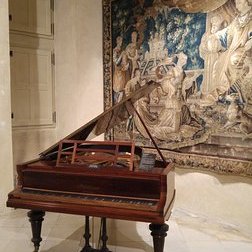
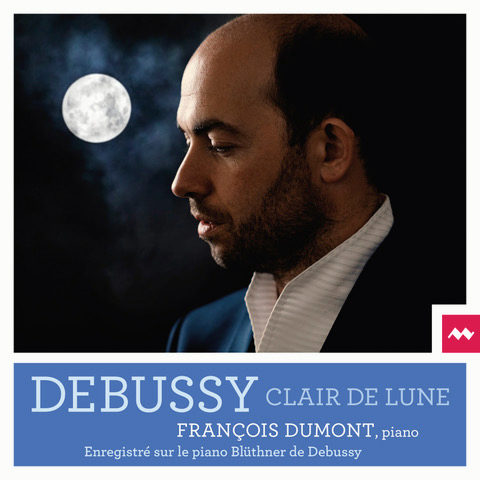
Dumont is one of the select few pianists ever allowed to touch the instrument, now fully restored and in mint condition. It was his credibility as a Debussy player that persuaded museum management to grant access.

Dumont has just released his new CD of Debussy piano music (Clair de Lune LaMusica LMU035) played on the vintage Blüthner at its resting place in the Labenche Museum in Brive-la-Gaillarde, not far from Bordeaux.

He recalled in our interview (below) how it felt to press a few keys the first time. ‘I sat down and timidly put my fingers on the keys… and it was just magical!’

The sound is indeed unique to the modern ear, a resonance intentionally soft and continuous, unlike the more glassy pedaled attacks of a Steinway grand. Dumont says changing to a nineteenth-century Blüthner is fascinating and deeply satisfying musically. Personally, I grew accustomed to his recording only after four or five hearings.

He puts the Blüthner to work on selected parts of Debussy’s Bergamasque Suite, Estampes, and Children’s Corner. His sensitive playing is as touching in the pianissimo as in forceful fortissimo. He recalled for me that he did several takes of “Clair de Lune” before he was satisfied. ‘I repeated it until I found the ethereal colours, the warmth of the melody I was looking for,’ he said.

Dumont thus joins a stellar group of established Debussy interpreters from the twentieth century and more recently performers such as Daniil Trifonov, Angela Hewitt and Steven Osborne. A busy recording artist, he has made about 45 CDs across a wide range of repertoire..

Dumont’s talent is in great demand in Europe where he maintains a punishing schedule of solo recitals and ensemble dates, as well as chamber orchestra works, in the United States, Latin America, China, Japan and South Korea.

Here are excerpts from our email exchanges about the new Debussy CD and the original Blüthner piano featured on it:

How long had this ancient Büuthner piano been idle? Shouldn’t it be falling apart?

Debussy bought the Blüthner in 1904 and kept it until his death in 1918. It was acquired by the Labenche Museum in Brive in 1989 and was fully restored, keeping the original strings and most of the original action

Are you the first pianist to be granted access to it?

There have been some others but very few. For me, it was an unbelievable privilege – a head-spinning experience – to have had access to it.

How were you chosen?

One needs to have real credibility and experience in playing Debussy to get the authorization. The museum generously offered me the use of the piano for the CD.

What is your memory of first sitting down and touching the keys? Were you nervous, excited, worried, afraid?

I will never forget that moment. I had travelled all the way from Lyon, over four hours by car, just to try the piano for an hour. I was very excited but also anxious. How would it sound, in what state would I find it? Would I feel comfortable creating my own sounds? I was afraid of being disappointed. I didn’t quite know what to expect.

It must have been a kind of electric feeling.

Yes, I sat down and timidly put my fingers on the keys… and it was just magical! I played my whole program without stopping. I was completely drawn to the originality and variety of colours.

Did you feel a spooky connection with Debussy, his ghostly presence hovering over you?

Yes, I suddenly felt I was transported to Debussy’s time, hearing the sounds as he was hearing them, playing the instrument he was playing. It is actually quite intimidating. Just imagine, some of the works on my CD, like “Children’s Corner”, were probably composed on this very instrument. A considerable amount of his music was seeing the first light of day on that Blüthner. It must have been like a laboratory for him.

How has the Blüthner design evolved since the 1850s?

The design and mechanics have indeed evolved, together with the sounds aesthetics, style and repertoire. Of course there is the question of parallel strings; now Blüthner uses crossed strings, like almost all modern manufacturers.

Why is the “fourth string” so important?

One of the specifics of the Blüthner piano is that string, called the Alicot. In the high register, instead of three strings, you find a fourth one that is not struck by the hammer. It resonates freely, by sympathy. creating a richness of color and vibration across all 88 keys.

How do you rate the Bluthner compared to the more dominant brands?

One has to remember that at Debussy’s time Blüthner was one of the most prominent brands, together with Bechstein, Erard and Pleyel. I find that Debussy’s Blüthner has a very beautiful range of colors, from bright to mellow to dark. It offers much more individuality than many modern instruments.

But isn’t it a smaller model, intended for the salon, not the concert stage?

True, when it comes to dynamic power you cannot compare it to today’s main brands. It is a chamber instrument, not even a half grand. It suits perfectly the room where it is now, surrounded by the museum’s beautiful tapestries.

What is the real value of the fourth string?

I am very seduced and intrigued by it, as it adds an element of resonance, a way of blurring the sounds, in the good sense. It is ideal for, let’s say, Romantic or Impressionistic music. I am not sure it would suit Baroque or Classical repertoire as well.

Does this fourth string alter other aspects of your playing, such as pedaling, control of dynamics or intense listening as you play?

Absolutely, many aspects are affected. Principally, you actually don’t need heavy pedaling, as you have a natural aura around the sounds. So you can keep precise pedaling, or sometimes experimentiation, to create really astonishing, impressionistic effects.

Don’t you have to work hard to control the sound you produce?

Yes, you have to listen very attentively, as the resonance is sometimes unpredictable. It is quite capricious, so you constantly need to adapt, which is artistically challenging but also very inspiring.

What musical qualities have you been able to draw from the Blüthner that you could not create with, say, a Steinway?

Well, the Steinway is so perfect, even, smooth and powerful at the same time, with absolute tone control. Debussy’s Blüthner is quite the opposite – capricious, uneven, with a very different character to each register. There is always a surprise with the Blüthner, which creates an element of risk which artistically pushes you to go further. For “Clair de Lune”, which we recorded at night, I had to do several takes till I found the ethereal colors, the warmth of the melody I was looking for. This piano has a unique vibration and warmth. You can really make it sing.

How did the piano affect your interpretations of the three Debussy cycles you chose for your CD?

I felt I was inspired to be freer, with more personal rubato and more creative with colors. On this piano you can really paint the tones.

But you cannot push it to produce, for example, the Russian School of “fast and loud”?

No, it cannot provide huge power but you can achieve many pianissimo dynamics, and subtle changes of sound and articulation. I also realised that some of colors were quite bright and contrasted, not just the pastel qualities usually associated with Debussy. This instrument taught me a different aesthetic, and pushed me toward greater flexibility and individuality.

Will other pianists be tempted to apply for access ?

Yes, I am sure that other pianists will be tempted by this wonderful adventure which brings us closer to Debussy and gives some insight into the interpretation of his works.
Debussy at the piano! One had to have seen it to appreciate its magic. No words could describe the mysterious enchantment of his playing…

– Jacques-Emile Blanche, 1932

25 March 2018 marks the centenary of the death of French composer Achille-Claude Debussy. While rightly noted for his orchestral, chamber music and songs, it is in his piano music that we find the finest examples of his distinctive compositional language. He revolutionised piano music in his use of timbre, unusual tonalities, parallel chords used for colour rather than a strict harmonic progression or structural bridges, the use of whole tone and pentatonic scales, idioms drawn from eastern music. He absorbed many influences, from the music of the Far and Middle East, Russia, Spain and America to that of his Baroque antecedents, the French clavecinistes Rameau and Couperin, yet he created music which was distinctly French and modern, providing inspiration for a diverse range of composers including Ralph Vaughan Williams, Arnold Bax, Charles Tomlinson Griffes, Béla Bartók, Pierre Boulez, Henri Dutilleux, Olivier Messiaen, Ned Rorem, Steve Reich, Philip Glass, Toru Takemitsu, George Gershwin, Bill Evans, Thelonious Monk, and Duke Ellington.

He is all too frequently described as an “impressionistic” composer, a term he is said to have disliked, but his attempts to create musical effects certainly bring to mind a visual scene, or ‘impression’, and his music’s lack of fully-realized ideas, dissonant chords and occasionally a seemingly almost complete lack of structure certainly gives listeners the feeling that they are not just listening to a piece of music but to a soundscape.

The Preludes for Piano, in two books, became – and remain – his most popular music for piano, arguably his finest works for the instrument in their variety – from exuberance to bleakness (Feux d’Artifice, Des pas sur la neige), eccentricity and mischief (Hommage à S. Pickwick Esq., La Danse de Puck), languor and drama (La Fille aux cheveux de lin, La Cathedrale Engloutie) – and replete with daring perfumed harmonies, sparkling figurations, and atmospheric textural layers. To encourage listeners, and performers, to respond intuitively to these beautiful piano miniatures, their titles were placed at the end of each piece so that listeners would not call to mind stereotyped images as they listened.

I’m not sure how old I was when I first heard Debussy’s music – the work in question was almost certainly La Mer, which my parents had on LP, and I remembering hearing at the Proms when I was a little girl. When I became reasonably proficient at the piano, his Preludes caught my imagination, captivating me with their curious colourful harmonies, sensuous fragmentary melodies and dramatic intensity in miniature form. I learnt La Cathedrale Engloutie when I was about 12 or 13. It was too advanced for me, and my small hands couldn’t really cope with the large chords and octaves, but the work has remained a favourite, along with perhaps his best-loved Prelude, La fille aux cheveux de lin. As an adult, returning to the piano after an absence of nearly 20 years, I veered towards the more “grown up” works in Debussy’s oeuvre – Hommage à Rameau, Voiles, the Images Inédites (the forerunner to his better known Images) and the erotically-charged La Plus que Lente. And from Debussy came my interest in the piano music of Olivier Messiaen.

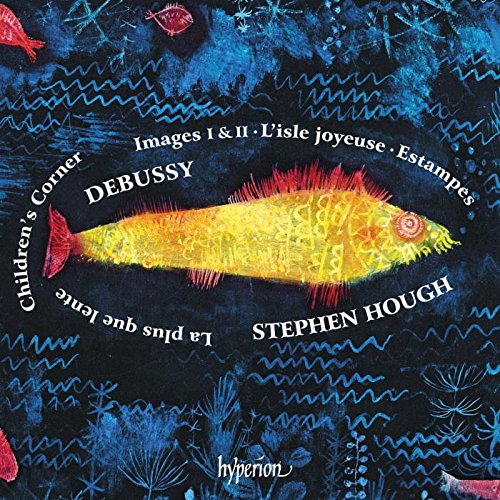
I adore Debussy’s piano music and I’ve been fortunate to hear some incredibly fine performances of it in concert in recent years – most memorably by Pavel Kolesnikov and Denis Kozhukin – and on disc (Stephen Hough’s new recording is a good starting point for anyone wishing to explore the variety and range of Debussy’s piano music).

His piano music is challenging to play, even the “easier” works. First, I think it is important to dismiss the notion that his music is “dreamy and ethereal” (the inaccurate and banal description given to it in a segment marking the composer’s centenary on Radio Four’s Today programme on 24 March). It is not a Monet painting in musical form. In fact, his music is tightly structured (for more detailed analysis on this see the writings of Roy Howat) and intellectually rigorous; paradoxically, it is this rigour which gives his music its uniquely delightful spontaneity and improvisatory qualities.

No other composer feels to me more improvised, more free-flowing. But then the player is conscious of a contradiction as the score is studied more closely: Music that sounds created in the moment is loaded with instructions on how to achieve this.

– Stephen Hough, pianist

Physically, much of his piano music demands that the pianist think in horizontal terms and forget that the piano is a machine of springs, wood and wires. Working on the Sarabande from Pour le Piano with my then teacher, in preparation for my first diploma, she urged me to forget that my arms had bones in them and to imagine instead two thick rubber bands of infinite freedom and softness.

While some works utilise sound washes akin to Monet’s brushstrokes – blurred lines and veiled textures – others have a clarity of expression with glittering virtuosic figurations, remarkable pianistic effects and distinct layers of musical colour (Pagodes, l’Isle Joyeuse, Jardins sous la pluie or Pour le Piano, which closes with a Baroque-inspired Toccata requiring extreme clarity of articulation on the part of the performer).

… the colour that only he could get from his piano. He played mostly in half-tint but, like Chopin, without any hardness of attack. […] His nuances ranged from a triple pianissimo to forte without ever becoming disordered in sonorities in which harmonic subtleties might be lost

– Marguerite Long, pianist


debussy-piano-music---stephen-hough-hyperion-1515405549…….make sure it’s Stephen Hough’s new disc of piano music by Debussy (Hyperion).

I read Stephen’s illuminating article about Claude Debussy (New York Times, 2 March 2018) and then listened to his new disc of Debussy’s piano music (Estampes, Images, Children’s Corner, La plus que lente and L’isle joyeuse). Here is Stephen writing on Pagodes, the first piece on his new disc:

[Debussy’s] use of its tonal color………is not so much a translation of a foreign text as it is a poem written in a newly learned, fully absorbed language

Stephen could be describing his own playing here (though he is far too modest to do so!). For those more used to hearing him play Liszt with cool yet colourful virtuosity, his Debussy playing is deliciously liquid, lucid, perfumed, sensuous and elegant. The phrasing and pacing is so natural and supple, fermatas and pauses so sensitively judged, touch, articulation and pedalling so clear and carefully nuanced, one has the sense that Stephen has also “fully absorbed” the composer’s language.

Take Pagodes, for example, the piece which opens this disc. Textures and lines emerge, blur and recede with all the ethereal delicacy of watercolour painting (and the suite Estampes is a reminder that Debussy loved art), but there is clarity too, so that every note sounds like a crystalline droplet. Reflets dans l’eau is similarly coloured, glistening and shimmering with subtlety and elegance. There’s nothing fussy or contrived in Stephen’s account of this music, and his assertion in the NYT article that Debussy was a “modern” composer is more than confirmed in his highlighting of the composer’s fondness for piquant or erotic harmonies, surprising melodic fragments (often using the pentatonic scale) and rhythmic quirks.

Children’s Corner proves as much a delight for adults as the young ones: snow dances with feathery delicacy, while The Little Shepherd a study in tender simplicity, tinged with poignancy. Strictly for adults, La plus que lente is wonderfully louche and languorous, with its late-night cocktail bar swagger. L’isle joyeuse closes this fine recording with a sparkling clarity, wit and sunlit joie de vivre

Highly recommended

Claude Debussy (1862-1918) / Piano Music / Stephen Hough (piano) / Hyperion CDA68139


Meet the Artist – Stephen Hough

© Wikipedia

2012 is the 150th anniversary of the birth of Claude-Achille Debussy (22 August 1862–25 March 1918), and, all being well, there will be plenty of performances of his fabulous music to celebrate the occasion.

2011 was of course Franz Liszt’s year, but despite many fine performances to mark the occasion (a couple of which I was fortunate enough to attend – reviews here and here), I suspect the case for Liszt still needs pleading (not something Debussy need worry about, given the perennial popularity of his music). Much of Liszt’s music remains obscure or impenetrable, or simply totally ‘over the top’ to many listeners and performers, and a common misconception remains that much of his music is unplayable, except by top flight virtuosi.

Not so the music of Debussy, which is accessible and generally easy on the ear, and which can be enjoyed by the proficient amateur as well as the professional musician. I can’t remember how old I was when I first heard Debussy’s music: I suspect it may have been a recording of La Mer, a richly evocative piece completed in 1905, after the composer enjoyed a stay at the English seaside resort of Eastbourne. The first piano piece by Debussy I learnt was a simplified version of the languorous Prélude ‘La fille aux cheveux de lin’ (‘the girl with the flaxen hair’); my father and I also played a clarinet and piano version of this, and later I learnt the original piano version. In my teens, I learnt another of the Préludes, ‘La cathédrale engloutie’ (‘the submerged cathedral’), in which the composer evokes the ancient Breton legend of the cathedral of Ys, which was said to rise from the waves, with its bells tolling, priests chanting, and the organ playing. Subsequently, I’ve dabbled with other Préludes, some of Children’s Corner, and the first two movements of the suite Pour le Piano. This year I’ll be learning more, probably the Hommage à Rameau, more Préludes, and the Valse Romantique.

Together with Maurice Ravel, Debussy is considered to be one of the most prominent figures in the “impressionistic” movement, though he himself disliked the term intensely when applied to his compositions. It is too sweeping a term, making a strong connection with Impressionist painters such as Claude Monet (the Dover editions of Debussy’s piano music have reproductions of paintings by Monet on their covers), and suggesting that Debussy’s music is all about blurred edges and misty harmonies. In a letter from 1908, Debussy described his music as being “an effect of reality”. His musical influences and style are far wider, and his early music demonstrates his interest in the Symbolist movement of art and literature with its dreamy, often morbid romanticism. Already, he was experimenting with harmonic colour, the use of whole-tone scales, and a move away from strictly classical forms of musical construction towards music with a single, continuous theme.

At times, he seems the natural heir to Chopin, with his sensitive approach to melody, filigree passagework and articulation, and fioriture, and his music bridges the gap between the Romantic period and the twentieth-century. In other works, he looks back to ancient music such as Gregorian chant, or East to Javanese gamelan music. In Pour le Piano, he makes direct reference to his French Baroque antecedents in both the organisation and style of the material. His two books of Préludes are related to Bach’s and Chopin’s, but they are impressionistic tone poems, their titles suggesting literary or artistic stimuli. Each is complete within its itself, but by including the title at the end of the piece, Debussy implied a “story” within the music. Meanwhile, his Prélude à l’après midi d’un faune is a revolutionary work, both in style and execution, perhaps the first piece of truly ‘modern’ music, and demonstrating the key features of his music: uncertain or parallel harmonies, unprepared modulations which lack a harmonic ‘bridge’, the use of harmony and chord progressions for colour and timbre, and the use of whole-tone and pentatonic scales.

Debussy is regarded as one of the most influential composers of the twentieth century. His use of harmony had a direct influence on composers such as Ravel, Stravinsky, Bartok, Messiaen, Boulez, as well as the minimalist composers Steve Reich, Philip Glass and Toru Takemitsu, and jazz musicians including George Gershwin, Bill Evans and George Shearing.

Today, in performance, his piano music in particular seems to “suffer” occasionally from too impressionistic a reading: there is a misconception that all his music is dreamy, fluid and gentle. It was, compared to the style prevailing at the time of its composition, but we have almost gone too far now. In any event, I am sure we can look forward to plenty of varied performances this year.

I expect everyone has their favourite works by Debussy. I list a handful of my own here:

La plus que Lente (literally “as slow as can be”). A decadent, tender and languorous cocktail waltz, full of subtle ambiguities and sly ironies.

Pascal Rogé – La Plus Que Lente

‘Voiles’ (from Préludes Book 1). More eroticism in a piece employing whole-tone and pentatonic scales to great effect, suggesting both veils and sails

Maurizio Pollini – Debussy: Préludes – Book 1 – 2. Voiles

‘La fille aux cheveux de lin’

Nelson Freire – Debussy: Préludes – Book 1 – 8. La fille aux cheveux de lin

‘La cathedréle engloutie’

Maurizio Pollini – Debussy: Préludes – Book 1 – 10. La cathédrale engloutie

Pour le Piano – there is a pleasing stridency and uprightness in Gilels’ performance, even in the ‘Sarabande’

Hommage à Rameau – another work which harks back to the Baroque, but which shares some of the decadent languor of La plus que lente

Pierre-Laurent Aimard – Debussy : Images Set 1 : II Hommage a Rameau

Syrinx

Emmanuel Pahud – Syrinx

Sonata for Violin and Piano in G minor

Janine Jansen – Debussy: Sonata for Violin and Piano in G minor – 1. Allegro vivo

Further reading/resources:

Images: the Piano Music of Claude Debussy – Paul Roberts (Amadeus Press)

The Piano Works of Claude Debussy – E. Robert Schmitz (Dover Publications)

Debussy at the Piano – interesting website with accounts describing Debussy as a pianist. Some useful insights into his playing style and how he wanted his piano music to be played.

Playing Debussy’s Piano Works – website by an amateur pianist with playing notes and analysis of many of Debussy’s piano music.

Notes from a Pianist – pianist and blogger Christine Stevenson will be writing about Debussy this year, following on from her journey through the music of Franz Liszt in 2011

Unveiling Debussy – an earlier blog post

