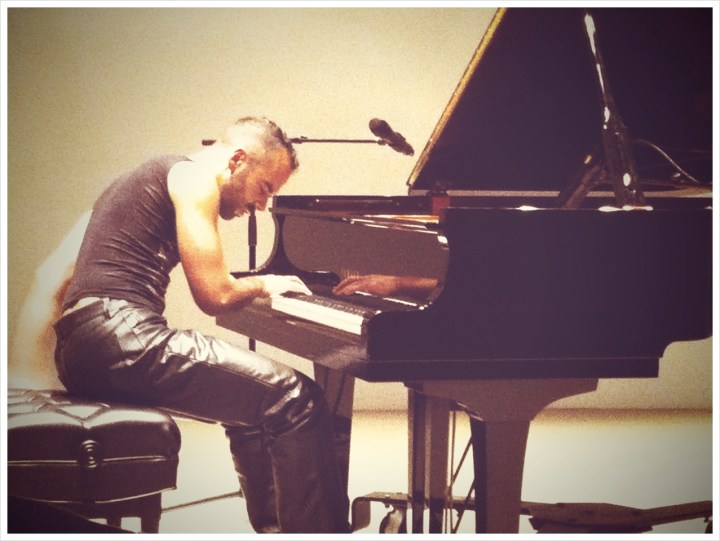
TendlerLeather—ScionFullana

Who or what inspired you to take up the piano and pursue a career in music?

It was a combination of things. In one regard, I took piano lessons since the age of six and, at least in my own memory, was rather unremarkable as a student. By middle school, however, I was playing certifiably classical music, though not well. By high school, when I hit the more advanced work of Chopin I started to see the creative possibilities of classical music—how I could really express through it—and then a kind of riptide dragged me from Chopin to Rachmaninov to Prokofiev to Copland to a whole world of modern and classical music. Totally obsessed, it was then that I started to practice, study, and really hustle to prepare for conservatory. On the flipside, I was bullied pretty relentlessly growing up, and the piano eventually served as a kind of escape. Not only could I retreat into my practice regime and not really have to navigate the hallways of my high school, but my talent itself—you know, this idea being special or exceptional at something—worked as a kind of shield or barrier from the harassment. And I guess it almost worked.

Who or what were the most important influences on your musical life and career?

The first pianist who really inspired me was William Kapell, an American virtuoso who died young, in a plane crash, in the 1950s. His playing had such personality and fire, and he had such strong convictions as an artist and such a complicated inner-world, almost debilitatingly nervous as a performer. I needed an idol who was both astonishing and complex, when in classical music everyone else seemed so perfect and unflappable. I should add that, while I’ve worked with dozens of teachers in my lifetime, all of them great artists, it was really my first teacher, a local piano instructor in Barre, Vermont, who let me truly explore music as I wished until I grew to love it on my own terms. He allowed me to play in the truest sense of the word, and as a musician I owe everything to him. He received my book’s dedication.

What have been the greatest challenges of your career so far?

I tend to wrestle with time, and always have. If I’m not practicing or reading or working on something, I’m apt to spiral into depression and guilt over what I didn’t get to and how that’s a reflection of my own deeply personal failure. This probably stems from a sense that I started late as a musician. I mean, I don’t even really know if I started late, and evidence probably shows that I actually didn’t start late, but it’s a perception I have and I battle it all the time. Even at Indiana University, I told myself that I had a tremendous amount of catching up to do, even though I really had an astonishingly accomplished number of years there. So I might also owe my life in music to this impulse to absorb and perform and push forward, but still, it’s a challenge and can feel kind of miserable in the day-to-day. I tend to believe that everyone else has it all figured out and that I’m the only one who can waste a whole morning drinking a cup of coffee.

Which performance/recordings are you most proud of?

I love the recording I did of my book, 88×50, which I don’t think a lot of people know about even though it’s on iTunes, streaming on Spotify, and is pretty much anywhere online. I spent months recording it at the DiMenna Center for Classical Music in New York, and the result is really fun and full of surprises. I also like the life that my live recording of Cage’s Sonatas and Interludes has taken since I released it for free on the web over five years ago, though I think I play the piece quite differently now. Also, Autumn Lines, is a very personal speaking-pianist piece that I released a few years back. Frankly, I’ve found that it’s too traumatizing to do live, so I’ve stopped performing it, nor will I really listen to it or watch live footage from concerts of it, but people seem to like it and I do like it, too. It’s just an intense composition from an intense period in my life. I’m proud of it, I just don’t like being around it. In terms of performance, most recently I performed a concert of music by Cage and Cowell at the open-air Maverick Theatre in Woodstock New York, where Cage’s 4’33” had its premiere in 1952. That was an incredible honor and a huge career highlight for me. Also, this week I organized a twenty-four pianist performance of Bach’s Well-Tempered Clavier, Book One, featuring mostly new music pianists, which was an epic and totally shattering experience in all the best ways.

Which particular works do you think you perform best?

I tend toward modern music by Americans, and love exploring the wide range of whatever that means. That said, I also like when a program pushes me out of my comfort zone, either backwards or forwards.

How do you make your repertoire choices from season to season?

It really depends on the series, the space, and sometimes the specific requests of my hosts. This season I learned a program of music by Luciano Berio, another by Henry Cowell, and for this festival coming up in London, I learned Morton Feldman’s Palais de Mari—all simply because my presenters asked. The great thing is, I’ll probably play this music for the rest of my life.

Do you have a favourite concert venue to perform in and why?

Probably the Rothko Chapel in Houston Texas. The space itself… the air… it has a kind of epsom salt effect on a person, just pulling stuff out that one doesn’t even know is there. I’ve played three concerts at Rothko Chapel, and would like to do a fourth! They consistently present inspiring and fearless programming for free to the public, so I’m proud to call it home.

Favourite pieces to perform? Listen to?

There are certain pieces I come back to, like the Cage Sonatas and Interludes. I’ve played that for eight years now—not constantly, but coming back to it once or twice a year—and each year it feels a little more settled and a little more internalized. It’s like seeing an old friend and jumping right back into a conversation, but then being like, “Hey, what’s different? Did you do something with your hair?” Something’s always a little different when I come back to it. I finally think I play that work with total assuredness—no traps or doubts or anything like that—which makes me think that perhaps it takes eight years for me to truly know a piece! Honestly, though, I find myself totally enrapt and obsessed with whatever I’m working on at a given time. In the days before a concert, I feel totally consumed with that music and its world, and after, I feel a little lost and desperate. In terms of listening, I only occasionally listen to classical or concert music. My brain buzzes too much with it on. I’d rather listen to bluegrass or artists outside of my field.

Who are your favourite musicians?

Nonspecifically, I’m taken with musicians who have a firm sense of their own creative identity, an unshakable passion for their craft, and the humility to understand that their journey is their own, and they have no obligation to mirror anyone else’s life or standards. I have countless examples of these kinds of people in my life, and aspire to their grace every day, people who seek to move their listeners rather than impress.

What is your most memorable concert experience?

Gosh, that’s really tough to answer. Every concert on my fifty-state tour from about ten years ago felt like a miracle. The good ones and the disastrous ones, they all still beat the odds in that I was creating a life in music when for all intents, people… experts…had told me that there were only certain ways to do it, certain avenues to take, and of course all were supposedly closed to me. So the experience of just getting out there and doing it and having people actually respond…well, yeah it was simply miraculous.

What do you consider to be the most important ideas and concepts to impart to aspiring musicians?

That there’s a place for anyone in music. Truly. Everyone has a seat at the table. One has to envision that place, though, be open to it shape-shifting over the years, which it will, and put in the work to build it, simply carving into that identity, that little niche, every day. Some days will feel super tough and other days effortless, but faith and tenacity and a great deal of devotion—those are the ingredients to a life in music. Not Hanon, I’m afraid.

What is your present state of mind?

Anxiety, worry, dread, fear, embarrassment, doubt, wonder, joy, gratitude… a regular morning.

Adam Tendler has been called “an exuberantly expressive pianist” who “vividly displayed his enthusiasm for every phrase” by The Los Angeles Times, an “intrepid…outstanding…maverick pianist” by The New Yorker, a “modern-music evangelist” by Time Out New York, and a pianist who “has managed to get behind and underneath the notes, living inside the music and making poetic sense of it all,” by The Baltimore Sun, who continued, “if they gave medals for musical bravery, dexterity and perseverance, Adam Tendler would earn them all.”

Tendler has performed solo recitals in all fifty United States, including engagements at Columbia University, Bard College, Princeton University, New York University, Kenyon College, Boston Conservatory, San Francisco Conservatory, Portland State University, University of Nebraska, University of Alaska and Rice University’s Shepherd School of Music, as well as artistic landmarks including Houston’s Rothko Chapel and James Turrell’s Skypace in Sarasota, where he was the space’s first musical performer. 

Tendler’s memorized performances of John Cage’s complete Sonatas and Interludes include a sold-out concert at The Rubin Museum in New York City and a featured solo recital in the “Cage100” festival at Symphony Space on what would have been Cage’s 100th birthday, listed by New York Magazine as one of the Top 10 Classical Music Events of 2012. In 2014, Tendler performed Cage’s 31’57.9864” in an appearance with the John Cage Trust at Bard College’s Fischer Center, presenting a realization of Cage’s 10,000 Things, and in 2015 he performed music by Cage and Henry Cowell, including Cage’s 4’33”, at the famed Maverick Theatre in Woodstock NY, where 4’33” had its premiere.

Tendler’s memoir, 88×50, about the year he performed solo recitals in all fifty states, was a 2014 Kirkus Indie Book of the Month and Lambda Literary Award Nominee. His premiere recording of Edward T. Cone’s 21 Little Preludes will appear in 2015, and he is developing an album of piano works by American composer, Robert Palmer. He also maintains the blog, The Dissonant States.

A graduate of Indiana University, Tendler presides over a private teaching studio in New York City, and in 2013 joined the piano faculty of Third Street Music School Settlement, the country’s first community music school.

adamtendler.com

Who or what inspired you to take up composing, and pursue a career in music?

I don’t recall a specific moment when I thought of becoming a composer. It’s something I have always done, as far as I can remember. Singing my own little tunes on long family walks was probably the way it emerged.

There was, however, a significant event when I was around nine years old. I had been playing the piano all day and searching for new harmonies (or new to me at any rate) on a rather gloomy day. At a particular point in the progression of chords the sun suddenly filled the room with golden light. I can’t remember what the notes were now and I wouldn’t have attributed this event to a supernatural cause but I do remember the jolt of pleasure at the coincidence and I have imagined music as a force of nature ever since.

Who or what were the most significant influences on your musical life and career as a composer?

Moods and emotional states affect me more than events, although they are naturally interlinked. Internally I have an almost constant flow of music which seems to shape itself to my environment. I don’t suppose this musical flow is of any great quality – that is the aim of the process of refining and reinforcing. Of course, I’m influenced by powerful creative encounters and it must be apparent in my music but I rarely experience this as direct emulation; it’s more like osmosis.

What have been the greatest challenges of your career so far? 

I don’t want to be too negative but sometimes the challenges of being a composer seem overwhelming. Leaving aside the difficulties of the creative process, which are usually absorbing, intriguing and rewarding, there are the difficulties of offering the results in a world which has less regard for the values I hold dear. The current cultural climate, at least in the West, seems to favour the extrovert and I often wonder whether someone like Schubert would have attained even the modest success he did if he were alive today.

What are the special challenges/pleasures of working on a commissioned piece? 

Ideally, perhaps, composers would write what they want or need to write when ready to do so. This is the old notion of ‘having something to say’ – and there is something to be said for that. There are innumerable practical reasons why this is rarely the case but, if one has a supple enough imagination, it is often possible to work under the illusion that the premise for the commission is entirely one’s own. For me it is essential to feel this way in order to generate confident ideas. I don’t think it’s just ‘not-invented-here’ syndrome. As for the pleasure, it’s always a fascinating sensation bringing something into existence – perhaps a feeling that it was waiting to appear like the sculpture in the marble block.

What are the special challenges/pleasures of working with particular musicians, singers, ensembles and orchestras? 

To my mind, nothing represents the internal state as revealingly as music. When people play my music with insight and sensitivity there is a strong feeling of transformation, even if it differs from my own way of thinking. It’s important to say that this is not fundamentally a matter of ego or self-importance; flaws are equally revealed. It’s a sense of joining with others.

Which works are you most proud of? 

As with many artists, I tend to think of my works as offspring; I have an affection for them all – even the less successful ones. The most recent piece is, probably naturally, the one I’m most interested in. I’m preparing my piano quartet for publication and I must admit to being quite pleased with it.

Who are your favourite musicians/composers?

Beethoven is evergreen for me. His music is nearly always open at the piano. Others who give me ‘nutrition’ as well as pleasure are Sibelius, Bartok, Britten and Tippett. Actually the list could go on and on and spans the centuries. As for living composers it’s more complex because you have to disentangle friendships, admiration of technique, bravery and determination from the mix, as they are different things. I’m more inclined to think of favourite works by contemporary composers than a list of favourite composers. Any composer with a feeling for the best qualities of tradition as well as a restless search for freshness is likely to appeal to me. A snapshot of what’s in my mind at the moment would feature the symphonies of David Matthews and Kalevi Aho

What is your most memorable concert experience?

Hearing Bernard Haitink conduct The Midsummer Marriage at ROH in the late nineties was unforgettable. The performance was wonderful and Tippett was there to receive some of the warmest applause I have ever witnessed. Many things came together for me, in that moment, which reaffirmed my own sense of purpose.

What do you consider to be the most important ideas and concepts to impart to aspiring musicians? 

It’s more important than ever to value the non-verbal intelligence of music and not to let material exigencies and social politics dominate this precious form of communication. It can be used as a prop for ideas but we shouldn’t forget that it’s a wonderful idea in itself.

What is your idea of perfect happiness? 

So many of the supposed satisfactions in life are illusory. Just as in music, there is the anticipation of an event and then the receding resonance of it but the event itself can be practically non-existent. I find I’m at my happiest when I’m in a state of effortless concentration and ideas and abilities seem to come almost without the sensation of thinking – alas all too rare. Oh – and then there’s throwing my seven-year-old daughter in the air and making monster noises. Now that’s fun!

James Francis Brown studied composition firstly with Hans Heimler (himself a pupil of Alban Berg) under the scholarship from the Surrey Scheme for Exceptionally Gifted Children and subsequently at the Royal Academy of Music. From 1994, James Francis Brown’s major works have been heard regularly at the South Bank and Wigmore Hall and have included a Piano Sonata (1994), a Viola Sonata (1995), and the String Trio (1996) for the Leopold String Trio which, following its première at the Deal Festival, has enjoyed numerous performances in London, Glasgow and as part of a British Council tour.

The English Chamber Orchestra with soloist Jack Liebeck gave the première of his Fantasy for Violin and Orchestra at the Barbican in February 2001. His Sinfonietta, commissioned by Faber Music, was performed at the Queen Elizabeth Hall in February 2002 by the London Chamber Orchestra. He has been a regular visitor to the Presteigne Festival and his song ‘Words’ is included on a CD of the collaborative song-cycle ‘A Garland for Presteigne’, on the Metronome label.

In March 2003, he was awarded a five-year NESTA fellowship. Recent works included a Piano Quartet for the Fidelio Piano Quartet and a piece for the Philharmonia Orchestra premièred at the 2004 Three Choirs Festival and subsequently broadcast on BBC Radio 3 by the BBC Scottish Symphony Orchestra conducted by Martyn Brabbins. In 2005 he scored a short film “The Clap” which has won several awards at major international film festivals and he was invited to be the first ever composer-in-residence at the International Musician’s Seminar, Prussia Cove.

2006 saw the première of the cello and piano version of Prospero’s Isle at the Hampstead and Highgate Festival as well as the Trio Concertante for the string trio and orchestra at the Presteigne Festival. Prospero’s Isle has subsequently been recast as a symphonic tone poem, which was performed by the State Academic Orchestra of St Petersburg in November 2007 as part of a major British music festival.

An accomplished arranger he recently reconstructed and orchestrated sketches for Wagner’s projected opera Männerlist großer als Frauenlist for the Royal Opera House, which was performed in October 2007. He has also arranged Wagner’s Siegfried Idyll for the 2008 City of London Festival. His Clarinet Concerto for Catriona Scott was performed at the 2008 Presteigne Festival.

In 2009, James was the composer-in-residence for the Ulverston International Music Festival, the composer-in-residence for the International Musicians’ Seminar in Prussia Cove (at the request of cellist Steven Isserlis). He also gave a talk with David Matthews on the inspiration of dreams in music in August that year.

In 2010, the Badke quartet premièred James’ String Quartet (which was commissioned by the London Chamber Music Society), and 2011 saw the release of his CD Prospero’s Isle.

2012 was a good year for the composer, there were world premières of the piano solo version of Dunwich Bells (performed by Clare Hammond), the Piano Trio (by the Barbican trio who later toured it), Fanfare and Chorale (at the Jersey International Music Festival, by Jersey Premier Brass), the song Ozymandias (by Simon Lepper on piano and soprano Gillian Keith). James became an associate of the Royal Academy of Music in July 2012, and – in 2013 – the world première of A Dream and A Dance (by the Nash ensemble) took place in honour of the composer David Matthew’s 70th birthday.

Successes in 2014 included a stunning performance of the string quartet at the London Chamber Music Society, and a new theatrical version of Prospero’s Isle performed by Matthew Sharp and Clare Hammond at Sharp’s RE:naissance festival. His new work Rigaudon, part of a collaborative anthology ‘Le Tombeau de Rachmaninov’, was premiered by pianist Noriko Ogawa at Bridgewater Hall in April 2015.


Pianist Clare Hammond (photo Julie Kim)

The piano study or ‘Étude’ has long engaged and challenged pianists, and the practice of writing etudes to provide practice material for perfecting a particular musical skill or technique developed in the early 19th century alongside the growing popularity of the piano. Many of us will remember working on studies by the likes of Clementi and Czerny as young piano students. But it was Fryderyk Chopin who elevated the student study into a work of great artistry and beauty, turning humble exercises into glittering concert pieces, and his Opp. 10 and 25 Études remain amongst the most popular works written for piano. Other notable composers of Études were Liszt, Alkan, Rachmaninoff, and Debussy, and the practice of writing piano etudes has continued into the modern area with composers such as Ligeti, Cage and Kapustin.

On her new disc for BIS, British pianist Clare Hammond explores the Étude in works by Lyapunov, Szymanowski, Kapustin and Chin, a truly international line up of composers (Russia, Poland and South Korea). The imaginative programme combines some of the most electrifying and adventurous piano works of the 20th and 21st centuries, ranging from the impassioned late-Romanticism of Sergei Lyapunov to the jazz-inspired rhythms of Nicolai Kapustin and the mercurial, post-Debussyan soundworld of Unsuk Chin. For Clare Hammond the choice of works on this disc represents some of the most innovative, invigorating and imaginative writing for piano and  the opportunity to explore what the piano is truly capable of. All the Études on the disc fulfil the traditional criteria of the Étude (in the Chopinesque sense) of a piece which combines the excitement of technical and virtuosic display with expression, colour and compositional inventiveness.

This disc is not only a showcase for the variety and ingenuity of these composers,  but also a fine vehicle for Clare Hammond to demonstrate a sparkling technical sure-footedness, clarity of touch and musical sensitivity (particularly in the Études by Chin, which are, by Clare’s own admission, extremely difficult). The works by Chin are more closely aligned to Clare’s particular interest in lesser-known and contemporary piano repertoire, for which she has received much praise, and these virtuosic and playful études skip and dance across the keyboard with wit, colour and vitality.

Clare brings a richness to the works by Lyapunov with which the disc begins. They recall the soundworld of Rachmaninoff in their scale and textures, and are modelled directly on Liszt’s set of the same title (Études d’exécution transcendante).

Karol Szymanowski’s Twelve Etudes, Op 33 share Chin’s interest in pianistic colour, and are more closely related the Études of Debussy rather than his fellow countryman Chopin. Fleet and mercurial, Clare deftly captures their transitory moods and luminous colours, dancing rhythms and haunting sonorities, while handling their technical demands with aplomb.

Finally, Five Études in Different Intervals complete this fascinating survey of the enduring appeal of the piano etude. Composed by Nikolai Kapustin, they are characteristic of his output, fusing formal classical structures with idioms drawn from jazz, which Kapustin studied from the age of 16. Clare pulls them off with precision and wit, and an evident relish for this kind of writing for the piano.

‘Étude’ by Clare Hammond is available on BIS Records label and is available from all major online retailers. 

Creating the Definitive Recording – an article by Clare Hammond on the process and experience of creating Étude

Who or what inspired you to take up the piano and composing, and pursue a career in music?

I grew up in a musical household as my mother was a piano teacher. She taught me piano and I also played viola and violin, and for as long as I can remember I knew wanted a career in music. I think I first started composing because improvising new melodies and harmonies made practising my scales more interesting!

Who or what were the most important influences on your musical life and career?

Many and varied. I was fortunate enough to have an excellent musical education with many good teachers, starting with my mother. My secondary school, Dame Alice Owen’s, had a very strong music department and I attended Trinity College of Music, Junior Department on Saturdays. I also played the viola in Hertfordshire County Youth Orchestra. I then went on to study music at Oxford and composition at King’s College, London.

More recently, I joined CoMA (Contemporary Music for All) in 2005, playing the piano in CoMA London Ensemble which is a contemporary music group open to all instruments and all abilities. Initially I thought that CoMA would be a good way to provide composing opportunities, but I enjoyed playing the piano in the ensemble so much that I started to realise that I had more of a passion for playing than composing, particularly the excitement of playing contemporary music. CoMA has taught me more about contemporary music than my master’s degree in composition and I have discovered many wonderful composers and explored their solo piano music, including Paul Burnell, Joanna Lee and Dave Smith whose works appear on my latest CD.

What have been the greatest challenges of your career so far?

The greatest challenge for me has been working out how to find my niche as a musician in the first place. I always knew I wanted a career in music and after graduating I worked for several years in music organisations alongside some composing and teaching. However I always felt that I wanted to spend more time making music myself. When I had the opportunity to switch to part time hours in my administrative work I was able to think seriously about what career I really wanted and how to get there, and that’s when I realised that I wanted to focus on piano.

While I had always taken piano seriously I knew that converting this into a full-time career would require a concentrated period of study and that’s when I got in touch with my teacher Thalia Myers. Under her guidance I threw myself into getting my playing up to a standard where I could forge a career as a pianist.

Embarking on a career as a professional pianist in ones thirties rather than twenties has its challenges, but I believe that a richness of musical and life experiences informs my playing, providing me with something a little different to offer audiences.

Which performance/recordings are you most proud of? 

My first CD, Dream Rotation, which I recorded in November 2013 and which has recently come out. Dream Rotation is a collection of six contemporary works by composers I know. Four of the works were in fact written for me to play, two of which are dedicated to me. Five are premiere recordings.

I had at the back of my mind that I would like to record some of the repertoire I had been working on. I decided to go for it in 2013 when I discovered I was expecting a baby in early 2014 and I knew that my practising time would be reduced afterwards. I recorded the six works in one day in November 2013 at the Jacqueline du Pré music building in Oxford with the excellent recording engineer Adaq Khan. In the run-up to the day I had to put a lot of work into learning the works to a standard I was happy with and I had three other concerts during that two-week period. All while being seven months pregnant! The recording day itself was enormous fun and went more smoothly than I could have hoped for, then all the editing and admin that goes into bringing a CD out was done during 2014 in bits of time snatched in between looking after my little boy.

Which particular works do you think you play best?

As I am always learning new things and developing as a player it tends to be whatever I’ve performed most recently. I love playing contemporary music and I actually find standard repertoire quite daunting because there are so many interpretations already out there. I also love playing in ensembles and orchestras and regard this aspect of my playing as just as important as my solo playing.

How do you make your repertoire choices from season to season?

In a variety of ways. Depending on what concerts are coming up I may look for a piece for a particular occasion or others might make a specific request. In addition, composers often send me their works, which I welcome although I also warn them that their pieces will go on to a large pile on my piano and there’s no guarantee of a performance! I have discovered that male composers are much less shy about sending pieces to performers than female composers. Women take note!

As a composer, who are the major influences on your work?

A tough question! Every piece is different and I have sometimes noticed that each piece has something of whatever I’ve been listening to and playing at the time. In recent years this means CoMA repertoire, particularly the use of aleotoric notation such as indefinite pitches and rhythms and generally thinking outside the box. Composers such as Howard Cheesman, Joanna Lee, Stephen Montague and Dave Smith all think creatively about what the performers are required to do and how to express that in a notation which will be understood.

Do you find your composing informs your performing and vice versa?

Absolutely! In terms of playing it is useful to think about what kind of sound the composer was aiming for in any particular texture and to imagine each passage as if it were written for voice, and as if it were written for orchestra, as well as how it is actually written for piano. Understanding the structure of a piece and how the material develops is essential in planning a performance.

It is imperative for composers to understand their music from the point of view of a performer because it is only the performer who can actually bring the music to life. Since I have been playing contemporary music I have thought much more carefully about writing music for the instruments playing it and notating from the performer’s point of view. I think the music I have written as a result of this has greater clarity and I have been much more careful about how things are notated.

You have a special interest in contemporary repertoire and new music. What are the special pleasures and challenges of working with this repertoire?

Bringing a piece to life for the very first time is a wonderful experience. I love the feeling of discovering a piece I didn’t know before and with a brand new piece there is the added feeling of being the first to discover it. Think of your favourite piece of music and imagine being the first person to hear it!

Performers who concentrate on mainstream repertoire rely on a filtering process by which the best works survived and the less successful ones didn’t, whereas performing contemporary music involves being part of this filtering process. I find this exciting and rewarding but it does require patience because one has to engage with the less successful pieces as well as the gems. Patience is also required when working on a piece for the first time because there are invariably teething problems requiring a dialogue with the composer. Again, I enjoy this but it does require patience.

Do you have a favourite concert venue to perform in and why?

I have given several recitals at the Schott recital room in central London. I like the intimacy of this venue which enables the performer to engage with the audience. So many concerts are in churches and other large venues where the audience can hide at the back. Having said that, I am very much looking forward to performing at St. Cuthbert’s Church NW6 on 27 September. It is a modern building with a wooden interior and is beautifully proportioned inside. The concert is to celebrate the arrival of a new piano and launch of their concert series and I think it is going to turn out to be a popular chamber music venue.

Favourite pieces to perform? Listen to?

I have a few pieces which I come back to regularly because they work so well in performance. Gabriel Jackson Angelorum is one I have performed many times as it is so satisfying to communicate to the audience, whether they are regular listeners of contemporary music or completely new to it. The pieces on my CD, particularly Joanna Lee Atta and Hopper and Paul Burnell 3 Plain Pieces fall in to the same category. Another piece I loved performing and hope to perform again is Patrick Nunn Music of the Spheres which includes electronic sounds taken from data from Voyager spacecraft as it flew past the planets. Great fun!

To listen to, I have several favourite composers including Bartok, Messiaen, Ravel and Schumann but really I love all classical music from Bach to Birtwistle.

Who are your favourite musicians?

Goodness, how long have we got? I think I’m just going to pick out a few musicians who have inspired me somehow for various reasons.

The pianist Mary Dullea is quite special. I have heard her and taken masterclasses with her at CoMA summer schools and her playing displays a really sensitive and intelligent musicianship as well as formidable technique. I am also a fan of the pianist Nicholas Hodges whose mastery of counterpoint makes sense of the most complex of Birtwistle’s piano works.

There are a number of living composers who I count amongst my favourites. Aside from the composers I have previously mentioned, I love the music of Phil Cashian. He has written a number of pieces for CoMA which work really well and he always uses fresh textures and has a wonderful ear for harmony. Julian Anderson and George Benjamin are also favourite composers of mine.

What is your most memorable concert experience?

My first recital at the Schott recital room in September 2011 was very special as it was my first recital after I started studying piano seriously again. I played a set of twelve waltzes by Schubert, a short piece by Phil Cashian called Slow Air, Gabriel Jackson’s Angelorum and Schumann Kinderszenen. Unfortunately the event was tinged with sadness because, having taught me to play the piano in the first place and provided so much support over the years, my mother was not there to hear it as she had died earlier that year.

What do you consider to be the most important ideas and concepts to impart to aspiring musicians?

General musicianship is so important. Develop a good sense of rhythm, pitch and harmony and everything else will be much easier. Taking part in a variety of musical activities, particular singing in a choir but also playing in an orchestra, accompanying, composing, arranging and improvising all helps to build a rounded musician.

Where would you like to be in 10 years’ time?

I would like to be able to play a scale in thirds with one hand and for it to sound beautifully smooth.

What is your idea of perfect happiness?

The things around me here at home: my lovely piano, wonderful husband, brilliant son and Maestro the cat. Not necessarily in that order!

What is your most treasured possession?

It would have to be the piano. What else? It is my first real piano. Until five years ago I only had a digital piano which is no replacement for the real thing. When I got married my in-laws gave us a proper piano as a wedding present. It was the best possible thing anyone could have given me. We chose a Boston upright UP132. When it arrived I realised that all I wanted to do was play the piano and I followed the course which has led me to where I am today.

What do you enjoy doing most?

Playing the piano, spending time with the people I love, eating and sleeping. Not necessarily in that order!

What is your present state of mind?

My mind is in many places at once nowadays as I try to get so much done in so little free time.
