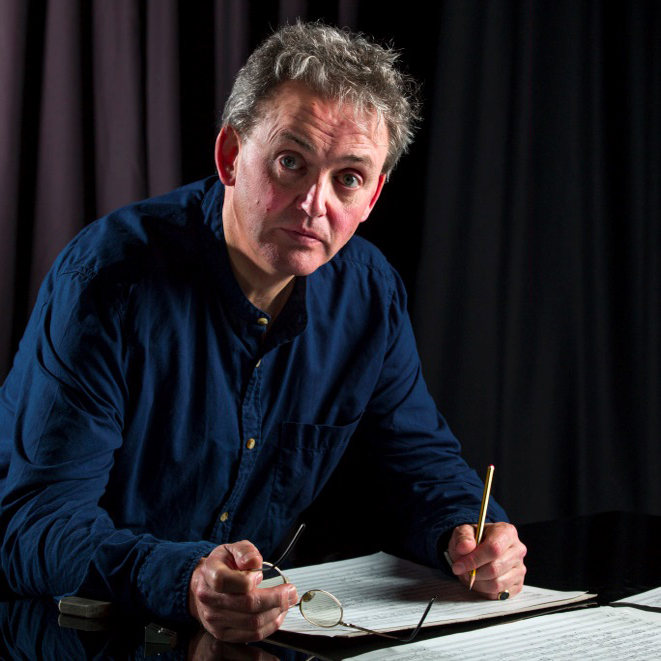
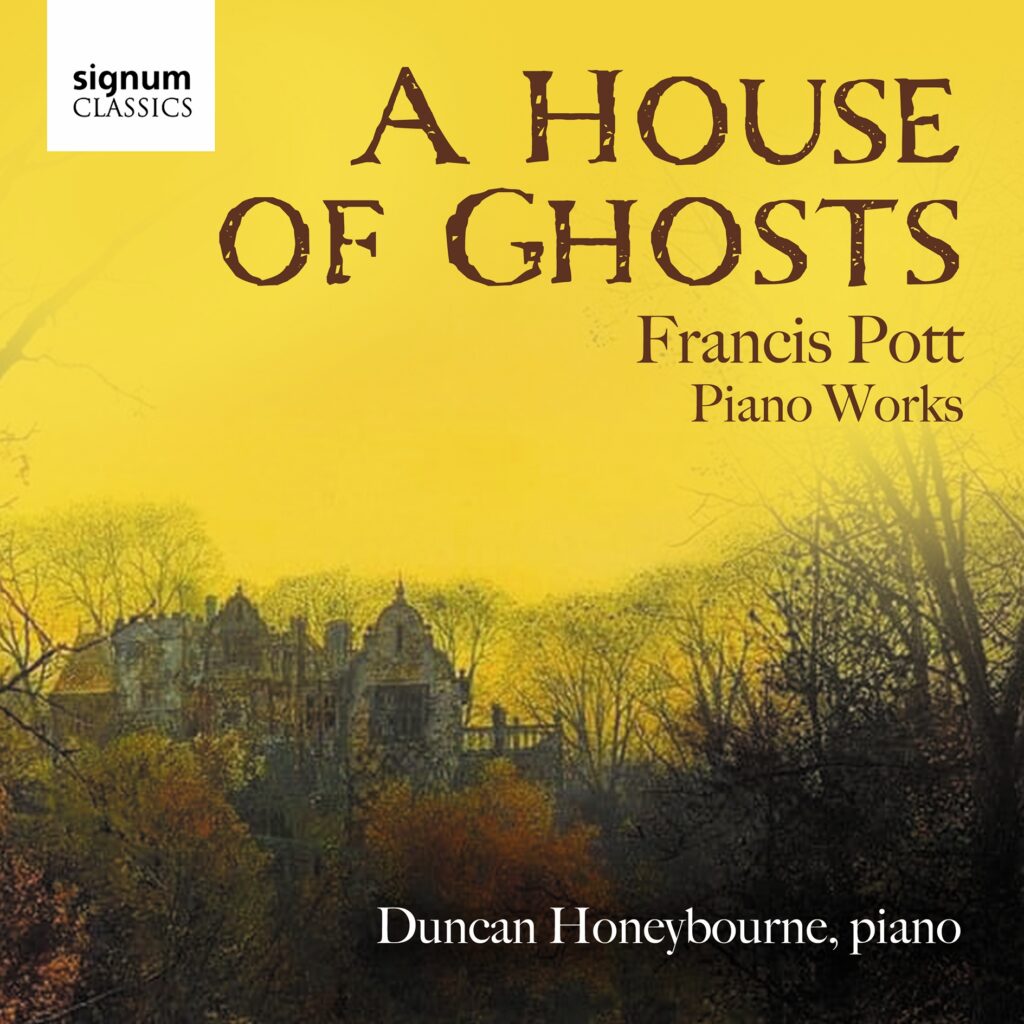
This new release of music by British composer Francis Pott, performed by Duncan Honeybourne, brings together piano works written between 1983 and 1997.

The title of the album, ‘A House of Ghosts’, reflects the character of the pieces: short works and miniatures which offer glimpses of places and voices that remain just out of reach, rather than an overall narrative. Pott’s music is elegant and restrained, reflecting on memory, landscape, and legend, occasional reference to medieval song (Minnelied, Blondel, Walsinghame), Chaucer (Pageant, with its distinctively ‘Medieval’ open fourth and fifth chords), T. S. Eliot (Revenant), and the abandoned community of St Kilda, a remote archipelago in Scotland (Farewell to Hirta). The mood of many of the pieces is wistful or nostalgic, with a timelessness which harks back to earlier times and musical styles: Pott’s influences include William Byrd, Gustav Mahler and Vaughan Williams, and one hears echoes of these composers, and others, in his harmonies, textures and long-spun melodies.

“A House of Ghosts is a sequence of a dozen short pieces concerned with the past, whether imagined, historical or (as in the case of the final piece) autobiographical. These movements are combined here with freestanding longer items, where sea music (Farewell to Hirta and Hunt’s Bay) is mixed with explorations of elusive memory (Le Temps qui n’est plus and Drowned Summer). Gently distinctive in its harmonic and tonal language, this music is the work of a professional pianist-composer with a refined and subtle insight into the physical and textural properties of the instrument.”

Duncan Honeybourne, pianist

I had the pleasure of page-turning for a performance by Duncan Honeybourne of several of the pieces featured on this album. This not only introduced me to Pott’s compelling soundworld but also offered a glimpse of his writing style. ‘A House of Ghosts’ is music written for the intimacy of the home, with the amateur pianist very much in mind. This is music that will appeal to the sophisticated amateur pianist who enjoys contemporary music that is melodic, structured and expressive, yet not overly-challenging. The music is highly pianistic (the composer is a pianist himself), approachable yet thought-provoking, consonant…. They may appear simple, but there is much scope for sensitivity in voicing, dynamics and pedalling to bring these finely-crafted pieces to life.

Duncan Honeybourne brings clarity, gracefulness and emotion to this elegant, atmospheric music, responding with much musical thought and sensitivity to its subtly-shifting colours and moods to create an album that is wholly enjoyable and deeply absorbing.

A House of Ghosts is released on digital streaming and download

Scores of Francis Pott’s music are available from Composers Edition

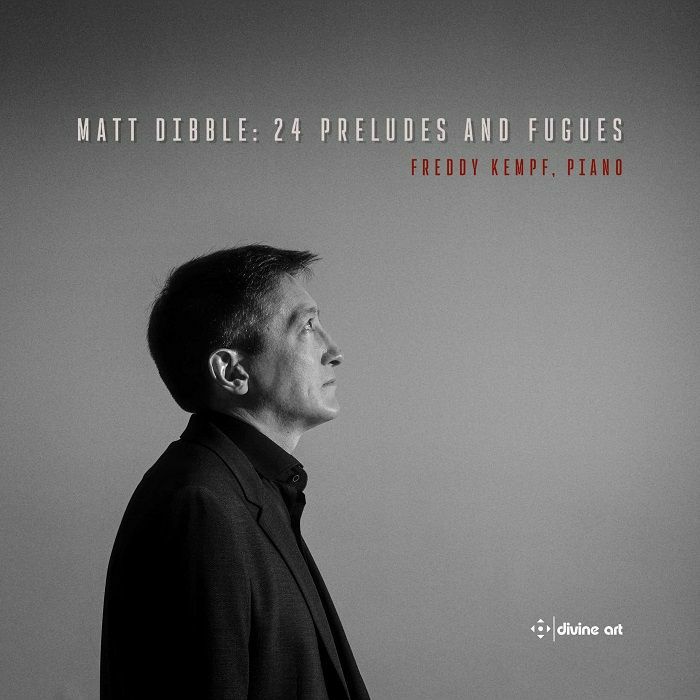
British composer and multi-faceted musician Matt Dibble died tragically in 2021 at the age of 40 from complications following the AstraZeneca covid vaccination. His untimely death left a void in the classical, jazz and pop worlds: he was a musician of great breadth, versatility, talent and innovation, and his 24 Preludes & Fugues, released posthumously, are a testament to this, blending neo-Baroque, jazz, easy listening pop, klezmer and folk music, and modernist influences into a deeply personal collection created over six years.

Only a handful of close friends knew of the ‘Preludes and Fugues’, which Matt began in 2015 and composed very privately, completing the set within mere weeks of his passing. Such was his devotion to this project that, when he first went to hospital, he told those with him where the compositions could be found, should anything happen to him. With the secrecy and longevity of the project, and the incredible timing of its completion, the story behind this music is akin to a romantic tragedy.

Read the full story on ArtMuseLondon.com


This site is free to access and ad-free, and takes many hours to research, write, and maintain. If you find joy and value in what I do, why not

BAGATELLES Piano Music by Bernard Hughes

Matthew Mills piano

Release date: 9th June 2023 | Divine Art Recordings (Divine Art DDX 21107)


This album presents the complete works of Bernard Hughes for solo piano, an eclectic collection covering a period of over 30 years. The oldest piece dates back to his teenage years and the most recent is a brand new suite, Partita Contrafacta, a quirky take on traditional Baroque dance forms. The rest of the music ranges from the large-scale Strettos and Striations to little occasional pieces written for the composer’s children. With such a varied range of music, there is something for everyone on this disc.

What makes this album truly special is the culmination of many years of collaboration between Hughes and Mills, who commissioned and premieres Partita Contrafacta on the disc. The two musicians have been working together for years, resulting in a deep understanding of each other’s artistic vision and an unparalleled ability to bring Hughes’ compositions to life on the piano.

Works

Song of the Walnut
Partita Contrafacta (suite in 7 movements)
Song of the Button
Bagatelles (12 movements)
Miniatures (11 movements)
Three Studies
O du Liebe meiner Liebe
Strettos and Striations
Cradle Song

Sample track:

Bernard Hughes says: “This album brings together pretty much all my music for solo piano written over the course of more than 30 years, the earliest from when I was still at school and the latest written just weeks before being recorded, in October 2022. The inspiration was my pianist and friend, Matthew Mills, who suggested the project and who has put untold hours into learning and animating the music, some of which is very straightforward, and lots of which is very much not.

And this variety is very much the point for me. As in all aspects of my compositional work, I don’t have a single piano ‘style’, but cut my cloth according to the occasion. Although there are several of techniques, textures and devices I return to over and again – as will be obvious to anyone listening straight through – there is also a huge range of approach, from music written for piano beginners up to the most virtuosic I could imagine, and from simple blink-and-you-miss-them melodies to ferocious, post-minimalist studies. In some cases, I don’t know what possessed me.”

Pianist Matthew Mills says: “I am very pleased to have done Bernard’s piano album. It’s a substantial milestone in a musical relationship that now goes back probably twenty years or so…. It really captures all facets of Bernard’s kaleidoscopic musical personality, and, having a close knowledge of the composer as well as the music, I think gives it a special resonance.

Pre-order BAGATELLES here

Bernard Hughes’ music has been performed by ensembles including the BBC Singers and the London Mozart Players at major British venues including the Royal Albert Hall and St Paul’s Cathedral. His music has won a number of awards both in the UK and internationally and is regularly broadcast on BBC Radio 3 in the UK. Bernard Hughes’s BBC commission Birdchant was premiered at the Proms festival in August 2021. This was the culmination of Bernard’s long relationship with the BBC Singers, which also included a major portrait concert in January 2020, leading to I Sing of Love being nominated for an Ivor Novello Composer Award. An album of Bernard Hughes’s choral music, I am the Song, performed by the BBC Singers, was released in 2016. His orchestral works for family concerts, Bernard & Isabel and The Knight Who Took All Day are frequently performed around Britain and were recorded by the Orchestra of the Swan on a release from February 2020. In 2015 he provided music for the comedy film Bill, a fantastical account of Shakespeare’s early years. A second album of choral music, Precious Things, sung by the Epiphoni Consort, was released in May 2022 and was described by Judith Weir as ‘choral music as we rarely hear it – generous, light-footed, surprising.’ Bernard lives in London where he is Composer-in-Residence at St Paul’s Girls’ School, a position he has held since 2015. He is a keen cricket fan, both as a watcher, a player and as chairman of Chiswick Cricket Club in London.

For almost three decades, Matthew Mills has enjoyed a busy and diverse freelance career as a pianist, composer, and conductor. With a repertoire encompassing music from five centuries, he has performed across the UK as a soloist, chamber musician, and accompanist, in addition to establishing a reputation as a sympathetic and creative dance accompanist.

A committed supporter of young composers and contemporary music, Matthew founded and directed a contemporary music ensemble at Royal Holloway, University of London, with whom, assisted by his own conducting students, he led workshops and performed works by student composers, as well as established twentieth-century names. He has enjoyed a long collaboration with the British composer Bernard Hughes, having given the first performance of his Bagatelles for piano and participated in the first performances of his chamber opera Dumbfounded! at the Riverside Studios, London.

Matthew studied at the Universities of Oxford and London, and at Trinity College of Music, London. His teachers have included Christopher Elton (piano), Daryl Runswick, Andrew Lovett, and Simon Holt (composition), and Gregory Rose (conducting). An award from Oxford University enabled a period of specialist study of contemporary piano repertoire with Rolf Hind, and he has appeared in masterclasses in composition with Michael Finnissy and George Benjamin, and in piano with John Lill and Rosalyn Tureck.


For further press information, interviews and review copies, please contact Frances Wilson

Guest post by Rhonda Rizzo

When did I begin my love affair with the music of living composers? The moment I found Yvar Mikhashoff’s ‘Incitation to Desire’ CD of tango music for the piano. The smoky cover, the provocative title track – I was caught before I listened to a single piece. Ah, and what a collection! Tangos from multiple eras and in multiple styles. Tangos that spoke of something illicit, a smoky world of furtive late-night romance, smoky dance halls, and sensuality. These tangos represented a freedom I craved – freedom from the performance practice expectations of standard repertoire, and freedom from the years of insecurities and assumptions I brought to the music I’d been playing my whole life. Tangos broke the rules. I’d never danced a tango in my life, but I knew I needed to make music with the freedom I heard in these pieces.

I’d never worked on music by a living composer before I found this CD, but my love of this music was such that I set about tracking down the scores of my favourite pieces. Many of the tangos were unpublished, which meant I wrote to the composer to purchase a copy. Scott Pender’s tango, ‘Ms Jackson Dances for the World’ was one of these. After I received it, Scott and I kept corresponding. We became friends and have remained so for over a decade. And I loved his music – so much so that I eventually played, performed, and taught most of what he’s written for the piano. Ironically, although Chester Biscardi’s ‘Incitation to Desire’ was easier to find (it was published), I never felt I got inside it well enough to perform it publicly. It sat in my music collection, its provocative title and gorgeous writing teasing me with the promise of something I couldn’t quite grasp.

It took me over a decade to put ‘Incitation to Desire’ on a concert programme. I think this was because I needed to live more before I truly understood it. I needed to go tango dancing and feel the freedom and sensuality of the Argentine tango in my bones. I needed to perform and record Piazzolla tangos with my duo partner Molly Wheeler. And, on a deeper level, I needed to break a whole lot of rules. I needed to experience the judgment that comes from choosing to leave a marriage that had been on life-support for years. I needed to experience being swept off my feet by an unexpected grown-up romance that changed my entire life. In other words, I needed to know freedom before I could play it on the piano.

Because ‘Incitation to Desire’ is about sensuality and freedom. Much like the Argentine dance, it relies on the pianist’s ability to instinctively feel their way through the score. This piece begs to be played almost as an improvisation – just the same way that the Argentine tango is danced. It’s the pianist and the piano and the interplay of notes – sensuous, slinky, unapologetic. Chester Biscardi asks for a flexible interpretation of dynamics and tempi. I take this to mean that that this piece is best played from the senses, not the brain; instinct, not reason. In other words, you can’t play this music until you let yourself be seduced by it.

It was my No Dead Guys post about (and YouTube recording of) ‘Incitation to Desire’ that prompted Chester Biscardi to email and tell me how much he enjoyed my performance of it. That correspondence led to me learning ‘In Time’s Unfolding’ and ‘Companion Piece (for Morton Feldman)’, two pieces that, ironically, I still feel I had more of an innate understanding of than the tango that introduced me to Chester’s music. Best of all, Chet and I kept corresponding, and that correspondence blossomed into another friendship that I cherish.

I’ve never coached a student on ‘Incitation to Desire’; I’m not sure it can be done without introducing topics to a lesson that can get an instructor arrested. Furthermore, because it’s so improvisatory, the key to playing this piece well lies within each pianist’s personal experience. If they’ve lived it, they can play it. If not, no amount of musicianship or technique will bring this piece to life. I can, however, offer some general guidelines on how to navigate the score:

1) Don’t be in a hurry. This is slowly unfolding, sensuous music that can’t be forced by the pianist. All forward momentum must come from the sense that the power of the moment itself is what propels the music forward.

2) Don’t dig in too deeply on the scale passages. These are flourishes, the twirl of a tango skirt, a spin. They’re caresses, not demands.

3) Don’t start your accelerando too quickly at m. 29; you’ve got a very long way to do before you hit the end of it. This – like everything else in the piece – should feel inevitable and effortless.

4) Pay very close attention to the pedalling; it makes or breaks the piece.

5) If you’ve never danced the Argentine tango, watch some videos of it. This will explain the start/stop, slow/fast, gesture-driven nature of the score.

6) When you play it, drop all expectations of the piece, surrender to the music, and let it take you where it wants to go.

Sometimes the best way to find ourselves is to break a bunch of rules. Incitation to Desire gave me the permission I needed to follow my instincts rather than others’ expectations. It seduced me into a lifelong passion for the music of living composers. And even today, it reminds me to let moments and situation unfold naturally; it reminds me that the richest life (and my best playing) lies in releasing rigidity and entering the messy, beautiful, passionate dance of earthy, real life with my hands and heart wide open.


Rhonda (Ringering) Rizzo is a writer and a former performing and recording pianist. Her novel, The Waco Variations, was released in the summer of 2018, and her numerous articles have appeared in national and international music magazines, including Pianist Magazine, American Music Teacher, Clavier, Piano & Keyboard, and Flute Talk. A specialist in music that borrows from both classical and jazz traditions, Rizzo released four CDs, Made in America, Oregon Impressions: the Piano Music of Dave Deason, 2 to Tango: Music for Piano Duet, and A Spin on It.

She holds a BA from Walla Walla University and a MM from Boston University and is a passionate advocate of new music and living composers.

Find out more

Chester Biscardi, composer


This site is free to access and ad-free, and takes many hours to research, write, and maintain. If you find joy and value in what I do, please consider making a donation to support the continuance of this site

Make A Donation