Unsuk Chin composer
Unsuk Chin, Berlin, den 12.05.2014

Korean-born composer Unsuk Chin is one of the featured artists at this year’s Aldeburgh Festival, which is celebrating its 75th anniversary. Find out more about Unsuk Chin’s influences, working methods, and thoughts about classical music in general in this insightful, thoughtful interview:

Who or what are the most significant influences on your musical life and career as a composer?

The most formative influences are probably those from childhood when the senses react to everything around them in a more ‘holistic’, immediate approach. Then, there was the time of my studies: immersing myself in European avant-garde music in the early 80s was vital, as I had before that known ‘Western’ musical history only until Stravinsky’s Violin Concerto. Conversely, the experience of studying with Ligeti, who denounced the avant-garde, requested utterly original music of excellent craftsmanship from himself and his students, asking me to throw away my prize-winning works, was a pivotal moment. Indeed, moments of crisis and subsequent attempts to find a way out are essential moments and threshold experiences.

The excellent Danish poet Inger Christensen wrote that the major influences on her work were creative stumbling blocks, irritations that, in the long term, made her question and develop her approach. For me, such a moment was when I worked, in the late 80s, and after a writer’s block of almost three years, for a couple of years at a studio for electroacoustic music. Through this, I could re-evaluate the essential elements of my compositional approach and expand the basis of my music. Another significant experience was, in the 90s, longer stays in Bali, where I studied Gamelan music – the acquaintance of a different tradition of great refinement and quality deeply rooted in the society was a discovery.

What have been the greatest challenges of your career so far?

That was to realise my childhood dream of becoming a professional musician and fighting my way out of difficult circumstances – in the 1960s and 1970s, South Korea was a poor post-war country on the periphery, and it was not easy to start as a female Asian composer in Germany.

What are the special challenges and pleasures of working on a commissioned piece?

Without a commission or deadline, I would never compose a work. One needs much pressure from the external world to get through this crazy process. I don’t have any works in my drawer. Writing a new piece is a very demanding process and can take years. I wouldn’t go for it without external pressure and the adrenaline rush. At the same time, I would never accept a commission with conditions that don’t fit into the musical thoughts and goals I am working with during a specific period.

What are the special challenges and pleasures of working with particular musicians, singers, ensembles or orchestras?

I always choose very carefully which commissions I accept. One has to prioritise. It almost needs to be a compulsion: if I don’t have an idea what to write for a certain instrument or concept, I won’t do it. For example, I wrote my First Violin Concerto in 2001 and was convinced I would never write another one. But then, when there was a possibility to write for Leonidas Kavakos, I reconsidered, and the work, 20 years later, is very different from the first one.

Of which works are you most proud?

I move on and try to do something new with every piece. I have removed several earlier works from my work list as I am not content with them. As for the remaining ones, I accept them, but there are also pieces to which I feel more emotional distance than others – which is unsurprising when one revisits works from several decades ago. But I can also name a counterexample – my Piano Concerto, which is from 1995 but which wasn’t much performed before the Deutsche Grammophon recording two decades later. This is a work into which I put all the energy and frenzy of my then 34-year-old self – I wouldn’t compose in this manner any more, but I feel emotionally close to it.

How would you characterise your compositional language?

I prefer not to, as it may make it more difficult for the listener to approach the work without prejudices. Besides, when I compose a new work, the most important thing for me is its unique shape. Of course, as a composer, you have a particular craft; you prefer certain materials and draw on compositional techniques acquired through the years. You cannot and perhaps shouldn’t avoid that. Nonetheless, it is important for me to attempt each work to be singular in character. Pablo Picasso once expressed it this way: style holds the painter captive in the same point of view, in a technique, in a formula, but he always wants to make something that is new and unknown to himself.

How do you work?

With pen and paper. Composing is, above all, waiting — days, sometimes weeks, before the empty staves. And then, suddenly, a door opens in the head. With age and experience, one develops trust that this door opens at some point if one tries hard enough. The music is in my head. I sometimes jot down ideas, plan harmonies, etc., but for me personally, it is an abstract process without piano or other devices. It can take several years for thoughts and concepts to mature. And when the pressure is great enough, it’s like giving birth: the thoughts have to come out, then you write.

As a musician, what is your definition of success?

That I am fortunate to be performed by several excellent musicians.

What advice would you give to young or aspiring composers?

To think carefully if one really wants to have a life as a professional composer. It is usually a back-breaking and lonely job, and the financial prospects are often non-existent. If one really wants to do it, one should, but one should be aware what price it takes.

What do you feel needs to be done to grow classical music’s audiences?

This is not easy since, nowadays, there is a tendency to think more and more in purely economic and functional categories, on top of which you have to add the quickness of modern mass media. Besides, there exists a mistaken notion that classical music would be something ‘elitist,’ which is why the notion that society should support artforms that only a small minority will engage with has lost traction. All of this does not mean that things were better during other times. However, it is concerning and a scandal that music is often no longer even considered a minor subject in schools due to very obscure claims of competitiveness and economic success – claims often made, for example, by numerous politicians. It is wrong to withhold from children the experience of art, which is one of the things that distinguishes human beings from AI, not to mention that art often provides indispensable solace and a utopia. Anyway, there are also ‘late bloomers’, audiences that can be won over with creative ideas and new approaches even if they won’t have had previous exposure to classical music; after all, the experience of great music can be a deeply emotional one. The methods and approaches used to try to develop classical music’s audiences depend on the place and context. But the main thing, I believe, is trust. Trust in quality, the hard work of serious performers and composers, the slow progress of building audiences and overcoming obstacles, an almost aggressive defence of artists’ quality and hard work, the audience’s right to hear this music, and the need for financial support of the whole musical ecosystem.

What is the one thing in the music industry we’re not talking about but you think we should be?

I doubt that such a thing exists as ‘the music industry’ – fortunately, we live in a diverse world. At the same time, of course, certain tendencies exist, but these are intertwined with societal developments. Our times are obsessed with the speed of information, packaging, and the surface, which can be problematic for developing sustainable quality standards. Also, the future of classical music institutions in many places is endangered. That leads often to market-think and occasionally to a winner-takes-it-all mentality. At the same time, fortunately, there are many niches and different initiatives. It was much more polarised in the 50 years after the Second World War: there was the established conservative music world, and then there were the rebellious circles of both the avant-garde and the early-music revival, who not infrequently fractured into warring factions. But every time has its challenges.

What do you enjoy doing most?

Playing the piano. If I need a break during an intense compositional process, I might play fugues by Bach for hours. This helps me clear my mind and persevere.

On Wednesday 12th June Tenebrae give the first UK performance of Unsuk Chin’s Nulla est finis – a prelude to ‘Spem in alium’ in Ely Cathedral as part of this year’s Aldburgh Festival. Find out more about Unsuk Chin’s music at Aldeburgh Festival here
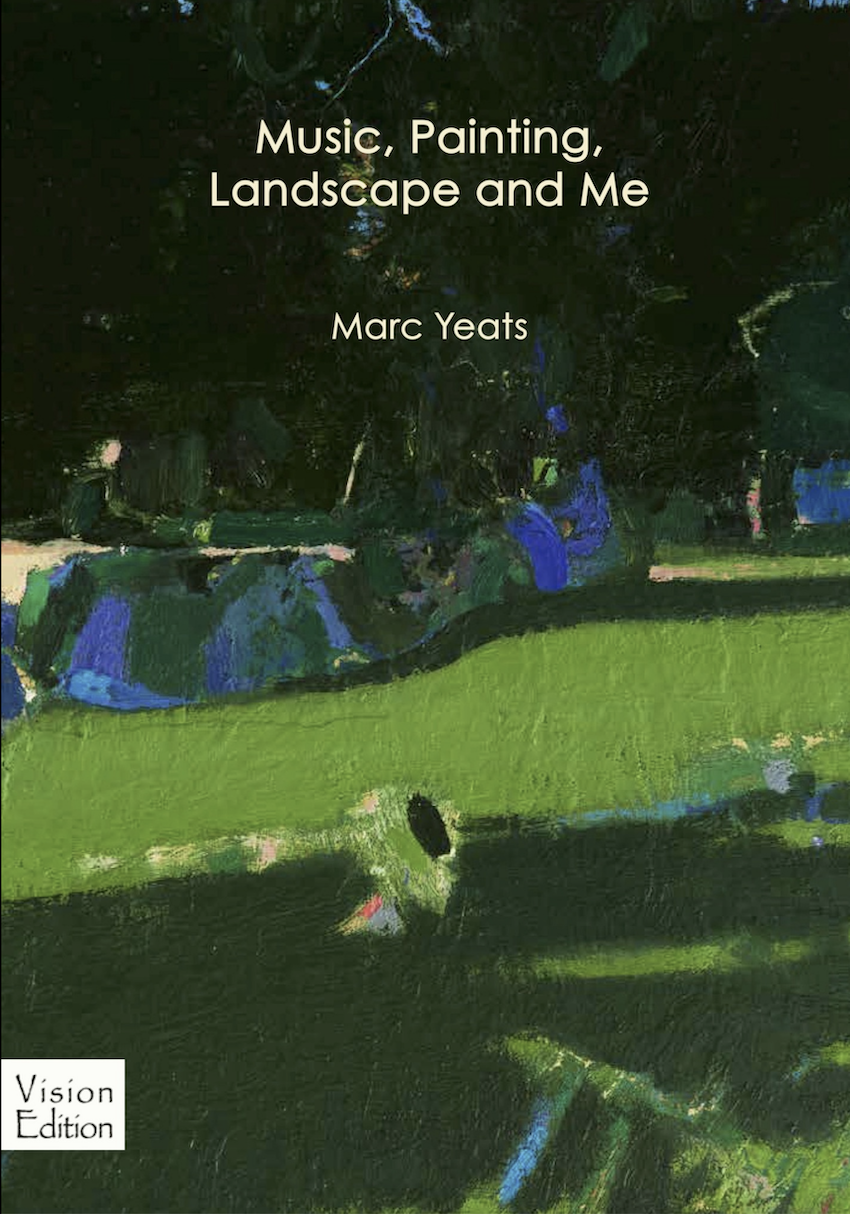
Music, Painting, Landscape, and Me’ by Marc Yeats

Publication date 1st April 2024

In this book, composer and landscape painter Marc Yeats embarks on an introspective journey, weaving together the symbolic realms of music and painting through the written word. This endeavour expands upon the immediacy of engagement with his compositions and paintings and what these artworks tell us, offering further understanding and dialogue concerning their interrelation. Yeats’s transformation of his inquiries and insights into text emerges from a conviction that the foundational questions—the ‘whys’ and ‘hows’ of being an artist and his creative exploration—resonate far beyond the confines of his personal experience, reaching out to a wider community of artists and those intrigued by the mechanisms of artistic expression.

I have known Marc Yeats for some years now. We met ‘virtually’, initially, as is often the way these days, via Facebook and TwitterX, and then in real life when I moved to Dorset in 2018. We have become good friends and enjoy many stimulating conversations about creativity – and so much more! (I also own one of Marc’s wonderful landscape paintings.) For a flavour of our conversations, do watch this video

I was very flattered when Marc asked me to endorse his book

Music, Painting, Landscape and Me is a fascinating, detailed and honest journey into the endlessly curious, questioning and polymathic mind of landscape artist and composer Marc Yeats. Drawing on a diverse range of subjects – including quantum mechanics, metaphysics, philosophy, fuzzy logic, neuroscience and hermeneutics – this book offers the reader an extraordinary personal insight into the complex mechanisms of making art and music, and Yeats’ own intent, impulse, imagination and inspiration. Furthermore, it shines an important light on the ‘how and why’, not only of Yeats’ artistic practice, but that of creative individuals in general, and is an invaluable contribution to the understanding of the creative impulse and ‘what artists do all day’.

Order the book direct from Vision Edition publishers

Cellist Clare O’Connell introduces her new kickstarter campaign

The creation of three new luminous contemporary works for cello by three outstanding female composers to be recorded on my next album.

This Kickstarter campaign is to raise money to pay for the commissions of three brand new works by outstanding female composers: Emily Hall, Emilie Levienaise Farrouch and Natalie Klouda, all to be recorded with the record label NMC on an album celebrating 21st century music for solo cello, and cello and electronics. On top of that, Natalie’s piece will receive its world premiere in the Wigmore Hall on International Women’s day, March 8th 2024.

It launches on 7 March and runs until 6 April 2023.

This will be the first solo cello album that NMC has supported, and we want it to be as uplifting and as experimental as possible, focussing on sharing the feeling of lightness, and lifting up with audiences, something very close to my heart and deeply relevant given the challenges of the past few years.

I am passionate about creating and sharing beautiful and moving musical experiences with people, both live and recorded, and I’m committed to raising up and collaborating with new artistic voices. So I’m thrilled to be collaborating with Emily, Natalie and Emilie, whose work will be represented alongside works by leading composers Edmund Finnis, Alex Mills and Nick Martin.

I also believe in paying performers and creators fairly for their work and the creativity that goes into it – it ensures greater equality, diversity, and freedom in art and thought.

This is where you come in! If you want to see experimental contemporary music created, if you want to see composers and musicians paid fairly for their work, if you want to hear new music for solo cello, if you want to support composers and performers exploring creative freedom and risk-taking, if you think music is one of the essential ways we connect with each other as fellow humans… then I would love to welcome you as a supporter.

To support please follow this link:

https://www.kickstarter.com/projects/oconnellcello/light-flowing

Every donation made is crucial in bringing this new music to life and I’m incredibly grateful for your support.

REWARDS

I am offering some really beautiful rewards for donations in this campaign, all linked with the music to be created.

They include printed scores of the new compositions, dedications crediting donors in the printed scores, exclusive downloads of music by the composers played by Clare, one to one cello lessons and even a live house concert!

I’m hugely grateful to my friends and colleagues David Le Page, Clara Sanabras, Susi Evans and Jack McNeill & Liam Byrne for offering to donate copies of their own CDs towards the campaign.

Also to wonderful artist Luke Hannam for his generosity in allowing me to make a limited edition print of a sketch he made of me as I was developing ideas behind this body of music, and to photographer Yvonne Catterson for her artistry and whose stunning imagery will be used in the final album artwork.

Who or what are the most significant influences on your musical life and career as a composer?

I didn’t begin to compose until I was sixteen. At that time I had given up piano lessons (I learned the piano between seven and thirteen) and attended a school where there was no music teacher, so composing was something I had to teach myself, or rather with the collaboration of my younger brother Colin, who also began to compose shortly after me. What made me start to compose was hearing Beethoven’s Ninth Symphony for the first time, and thinking that this was the most wonderful music I’d ever heard and that I must write a symphony of my own – so I did, and spent the next two years writing one, and when I’d finished, writing another. Beethoven is still my favourite composer, the ideal of everything I believe in. Meanwhile Mahler, all of whose works I’d got to know, became a huge influence, not just the music itself, but also what he stood for as a composer in Beethoven’s succession. Many other composers too were influential, Sibelius and Stravinsky pre-eminently, as I spent all my spare time listening to music and studying scores.

When I left university – where I read Classics as Music wasn’t possible as I hadn’t got music A level), I had the great good fortune to have got to know Deryck Cooke, who had made the performing version of Mahler’s Tenth Symphony and whom Colin and I later helped with a comprehensive revision. Deryck introduced me to a number of significant people in the musical world, among them Donald Mitchell, who had just founded Faber Music, mainly to publish Britten’s music. I began working freelance for Faber Music and quite soon Britten needed someone to help him with editorial work. Donald suggested me, and I then worked part time for Britten for four years. As the greatest living composer in this country, he was probably the most important influence in my life. He didn’t give composition lessons but I learned from him how to be a composer – see your later question, how do you work?

Other important influences were Michael Tippett, whom I also got to know and on whose music I wrote a short book – I liked his music even more than I liked Britten’s; Nicholas Maw, who became a friend and an unofficial teacher – I thought him the best of the younger composers; and the Australian composer Peter Sculthorpe, whom I met in England in 1974 and who became a close friend until his death in 2014. I visited many him many times in Australia and we collaborated on three film scores. Peter said that the music of the whole world was tonal, so why we should we pay attention to a few central European composers who said tonality was no longer possible? From Australia I saw music in a new light.

What have been the greatest challenges of your career so far?

The greatest challenge was getting my music played when I was young. As I hadn’t been to a music college I knew virtually no musicians. But I did send the score of a string quartet to the BBC when I was about 23 – they then had a reading panel – and it was played and broadcast; and when I was 26 I sent two orchestral songs to the Society for the Promotion of New Music (which sadly no longer exists) and they were performed at the Royal Festival Hall by Jane Manning with the London Philharmonic Orchestra conducted by Norman Del Mar (who became a friend and who commissioned my Symphony No.1 – I’d withdrawn my three earlier ones). That was a big step forward. However, I didn’t get a full publishing contract from Faber until 1982.

What are the special challenges/pleasures of working on a commissioned piece?

It’s easier, I find, to write a piece if you are given some limitations – i.e. how long it should be, the instrumentation, etc. I wouldn’t want too precise instructions, but that rarely happens.

What are the special challenges/pleasures of working with particular musicians, singers, ensembles or orchestras?

I much prefer writing for musicians I know (as Britten almost always did). I recently wrote an Oboe Sonata for Nicholas Daniel, someone I know well and for whom I wrote a Concerto. He has a very individual sound, a wonderful ability to play long sustained passages without taking breath, and extraordinary virtuosity. It was a real pleasure writing for him and hearing his special sound in my head.

The same with singers, of course, and with string players. I’ve written two CDs worth of solo violin music for my violinist friend Peter Sheppard Skaerved, and his Kreutzer Quartet are recording all fifteen (so far) of my string quartets, of which five were written especially for them. They know exactly what to do with my music as they’ve played so much of it. I’m not a string player but Peter has taught me so much about string technique. And with orchestras, I have a special relationship with the BBC Philharmonic, for whom I’ve written three of the last four of my ten symphonies. I can write for them knowing just how they will sound, and I’m also careful not to write anything that they won’t enjoy playing.

Of which works are you most proud?

I enjoy listening to my own music – well, if the composer doesn’t like his own music he shouldn’t expect anyone else to! There are quite a few pieces I’m proud of; for instance among my symphonies, No.8, several of my string quartets; also my Cello Concerto, Concerto in Azzurro, written for Steven Isserlis and recorded on CD by Guy Johnston. The piece I’m most proud of is my choral and orchestral piece Vespers, of which there is a splendid recording by the Bach Choir and the Bournemouth Symphony Orchestra conducted by David Hill. And in the last two years I’ve composed my first opera, which hasn’t yet had a stage performance, only a run-through with piano, but I hope I’ll be proud of it if and when I hear it with orchestra.

How would you characterise your compositional language?

It’s tonal, though usually not in a traditional way. I use very wide-ranging harmony. I use counterpoint modelled on the way the great masters of the past used it, and above all I try to write memorable melodies. I think the loss of memorable melody in most contemporary music is very sad.

How do you work?

When I’m composing, I like to work every day from after breakfast until lunch. I may go back for a while in the late afternoon. I learned regular hours from Britten. But I’m always thinking about the piece I’m writing, and I quite often wake up at night with ideas.

I try to start a piece well in advance of the deadline (another thing I learned from Britten: always meet deadlines). I think a lot about what character the piece will have, and its shape, and then I have the first musical idea, generally a melodic idea, and after that I may leave the piece to grow inside my head for some while before I start it properly. Once I’ve started, I don’t often get stuck – just for a day or two perhaps. I revise a lot while I’m writing, and don’t usually write more than ten to twenty bars a day, though sometimes more when I’ve almost reached the end.

As a musician, what is your definition of success?

My music is concerned with my feelings about life, expressed to the best of my ability in melody, harmony and counterpoint, and in a form that I hope conveys what I intended. I’m happy if I think I’ve done my best with these aims. I also hope that the musicians, who work so hard to bring my pieces to life, will enjoy playing what I have written.

What advice would you give to young/aspiring composers?

Don’t write pieces that present impossible difficulties to players. Also, be patient, it may take a long time before you can get your pieces played regularly. And find your own voice, don’t get led astray by fashion.

What do you feel needs to be done to grow classical music’s audiences?

Of course it worries me that a lot of people who are brought up on a constant diet of pop music find classical music difficult, and especially modern classical music. Because of this, audiences for contemporary music are almost always small. It’s this that worries me most: I feel that a lot of new music today supplies very little to move audiences, if it’s written in a virtually incomprehensible language, and often a very aggressive, off-putting one. And then, except (rightly) for the Kanneh-Mason family, none of the brilliant young musicians around now are being praised by the mass media, which now largely ignores classical music. Their extraordinary talent should be widely celebrated.

What’s the one thing in the music industry we’re not talking about but you really think we should be?

I’m worried that decisions about what new music to programme, by the BBC for instance, are no longer based purely on quality, which I think they should, but on other criteria. I’m very happy to hear music by women composers, but it must be good music. To play it just because it’s by a woman is in fact insulting.

What next – where would you like to be in 10 years?

Still alive – as long as I can keep my current good health, and still composing reasonably well, if I’m still able to.

What is your idea of perfect happiness?

Sharing a meal at home with my wife.

What do you enjoy doing most?

Apart from composing: reading, drinking good wine, walking in the countryside, and watching and listening to birds.


With a singular body of work spanning almost 60 years, David Matthews has established an international reputation as one of the leading symphonists of our time. Born in London in 1943, he began composing at the age of sixteen. He read Classics at the University of Nottingham – where he has more recently been made an Honorary Doctor of Music – and afterwards studied composition privately with Anthony Milner. He was also helped by the advice and encouragement of Nicholas Maw and spent three years as an assistant to Benjamin Britten in the late 1960s. In the 1970s a friendship with the Australian composer Peter Sculthorpe (leading to collaboration and numerous trips to Sydney) helped Matthews find his own distinctive voice.

Read more

David Matthews’ website


