Bridget Cunningham

Who or what inspired you to take up conducting and playing the harpsichord, and make it your career?

Being around other musicians and performing live music from childhood at home, in the church, at music schools and with good teachers inspired me to be a musician. Performing music has always been where I feel most comfortable, and the actual process of communicating with others through music lifts the spirits. When conducting from the harpsichord, the sound of the other instruments in the orchestra and singers around hits the soundboard of the harpsichord which becomes a melting pot where all these sounds go in and magic is made.

Who or what were the most important influences on your playing and conducting?

The most important influence is the music itself from the emotional and dramatic works of Handel, the energy of Vivaldi, the complexity of Bach and Palestrina, the freshness of Mozart, the complex rhythms of Messiaen, the richness of Wagner and much more, have always inspired and influenced me to learn more.

What have been the greatest challenges of your career so far?

The biggest challenge has always been to get funding to put on undiscovered early operas, pasticcios, masses, and other works and material I have researched and to record this material which really deserves a hearing. It is also a learning curve to get the means to make documentaries and films about this music, the history of it and the whole process of music making, which are all fascinating aspect

Which performances/compositions/recordings are you most proud of?

I have just recently conducted a recording for a CD of stunning music, some unrecorded material too which I am pleased about, from the 18th century Vauxhall Pleasure Gardens with London Early Opera, and fabulous producer Chris Alder, which I am eagerly waiting to hear. It was a wonderful process finding the music and putting it all together to recreate a magical night at the gardens.

Do you have a favourite concert venue to perform in?

I have many and love the variety I have performed in from large to the more intimate, including Southwark Cathedral, the Wigmore Hall, Handel House Museum, St George’s Basillica in Gozo, St Cecilia’s Hall, Edinburgh, the Pieta in Venice and Schloss Ambras in Innsbruck.

Favourite pieces to perform? Listen to?

I have always loved conducting Handel operas, Purcell masques, Vivaldi and Mozart operas.. they are all colourful with amazing text, word painting and harmonies. Conducting from the harpsichord centres me with the music in the very heart of the orchestra and the actual score of the work being performed. Again, I enjoy all the later repertoire I conduct from George Butterworth to Bernstein as it is all fabulous repertoire which I enjoy listening to as well.

Who are your favourite musicians?

Barenboim, McKerras, Brabbins, Hogwood, Alsop, Davies, Edwards, many conductors; also the historic Bernstein, and several baroque musicians… Catherine Mackintosh, Robert Woolley… where do we stop…the list goes on…

What is your most memorable concert experience?

Performing Vivaldi in the Pieta in Venice… an amazing place and also listening to Jordi Savall playing French divisions in his viol concert at St Nicholas Church in Galway by candlelight was extremely inspiring

What do you consider to be the most important ideas and concepts to impart to aspiring musicians?

Every new day there is something new to learn and we are always students and must always be open to gaining new knowledge and to aspire to new things. Keep on focusing on where you are going and work hard and practice, practice….

What are you working on at the moment?

I am collating music, parts and scores and taking sectional rehearsals for the next recording project that I am conducting with London Early Opera and following concert tour next year.

What is your most treasured possession?

My glorious harpsichords: one is a double manual Franco Flemish Blanchet copy of a Ruckers – perfect for all kinds of repertoire with a lovely resonance in the bass – and the other is a single manual Italian harpsichord with a real brightness of sound and touch.


Bridget Cunningham is a prizewinning harpsichordist, conductor and early music specialist. Bridget is in demand to conduct choirs, orchestras, festivals and recordings throughout Europe and her performing experience includes conducting London Early Opera and Schola Pietatis Antonio Vivaldi and she conducts regularlyfrom the harpsichord at venues such as St Martin-in-the Fields, Grosvenor Chapel, St James’s Piccadilly and Southwark Cathedral. She has recently recorded a harpsichord album ‘Handel in Ireland’ and performed as a solo harpsichordist to Prince Charles at Buckingham Palace. She also regularly gives lecture recitals and broadcasts at Art Galleries and last year she opened the Watteau exhibition at the Royal Academy of Arts and gave a lecture recital on Handel and Watteau in 18thCentury London. She has recorded and presented BBC documentaries with the Orchestra of the Age of Enlightment and Vivaldi’s Women and the virginal and harpsichord music for the BBC 1 series ‘Elizabeth, the Virgin Queen’, How London Was Built and BBC’s ‘Messiah’. Radio broadcasts include Radio 3 and 4 King James’s Bible. Bridget has also just conducted London Early Opera’s CD Handel in Vauxhall Pleasure Gardens with producer Chris Alder.

www.bridgetcunningham.org.uk

Scott Inglis-Kidger (photograph: Clive Boursnell)

Who or what inspired you to take up conducting and make it your career?

My first inspiration was my music teacher, Matthew Grehan-Bradley. He had a meticulous attention to detail which inspired me in my own pursuit of perfection. He took a small group of us to Prague to sing Palestrina masses; this was when I decided to become a countertenor. The second and most influential musician in my life is Stephen Cleobury, Director of Music for the Choir of King’s College, Cambridge. It was a privilege to sing in this marvellous choir in my final year at Cambridge. I was enthralled by Stephen’s conducting during a performance of Handel’s Messiah, and from then on I knew I wanted to be a conductor.

Who or what were the most important influences on your conducting?

I have always admired the work of Harry Christophers’ The Sixteen and John Eliot Gardiner’s Monteverdi Choir. These immensely successful ensembles were founded during university days by conductors who had a vision, not only for the performance of renaissance and baroque music, but also for the growth of the ensembles. It was this which encouraged me to form Platinum Consort, which I co-founded with Claire Jaggers. I am now beginning to realise my dream with a professional ensemble of singers, a boys’ choir and thriving diary of choral workshops.

What have been the greatest challenges of your career so far?

The greatest challenge so far has been leaving the security of my post as a school Director of Music. Teaching was such a valuable experience in terms of mastering the art of positive reinforcement, essential for children and adults alike. I also learnt a lot about management. I like to think of myself as being quite entrepreneurial, and the experience of managing a busy team of music teachers was crucial in building the ‘business’ side of Platinum. I knew I would miss the children and my staffroom colleagues but now that I am a fully freelance conductor I realise it was the right thing to do.

Which performances/compositions/recordings are you most proud of?

I will never forget conducting my very first Platinum Consort concert in 2005. I had little experience in programming and managed to cram 15 of the most difficult pieces of choral music (Gesualdo featuring heavily) and a new mass setting by my friend Richard Bates into 90 minutes. It was a learning curve, to say the least, but I still listen to the recording and I am very proud of the amazing sounds we created. In terms of my latest activities, I am immensely proud of Platinum’s debut album In The Dark which will be released later this year. It represents the journey of Platinum over the last seven years. In many ways, it really doesn’t feel like a debut!

Do you have a favourite concert venue to perform in?

One of my most treasured places to perform is the chapel of Jesus College, Cambridge. It is one of the oldest chapels in the university and has the most sublime acoustic, perfectly suited to the early and early-inspired choral repertoire. Having said that, I am very excited to be performing in the newest concert hall in London. The interior of Hall One at Kings Place was created with wood from a single oak tree. This makes for a pretty awesome atmosphere! I will conduct Platinum Consort there later in 2012 and also in 2013 as part of their series of concerts.

Favourite pieces to perform? Listen to?

At the moment they are James MacMillan’s Miserere and Gesualdo’s Tristis est anima mea. The MacMillan is ecstatically beautiful and the Gesualdo wonderfully perverse. In fact I am listening to Tristis now against a backdrop of thunder and lightening. Both will feature on our debut album In The Dark.

Who are your favourite musicians?

In the early music field I have a massive soft spot for soprano Dame Emma Kirkby and baroque violinist Rachel Podger. Their performances are spirited and free from constraint, something every musician strives for. My favourite choir at the moment is the young British ensemble, Stile Antico.

What is your most memorable concert experience?

I conducted my first Handel Messiah in November 2011. I had the combined forces of Thomas’s Choral Society, Saraband Consort and a stunning line up of soloists, all housed in a precariously packed Holy Trinity, Sloane Square. We have all heard a hundred renditions of the ‘Hallelujah’ chorus but this one was different – it was ‘Scott’s Way’. I will never forget it.

What do you consider to be the most important ideas and concepts to impart to aspiring musicians?

As a singer myself – and someone who was politely told at primary school he was tone deaf – I encourage everyone to realise the potential in their own voice, whether they are children, amateurs or professionals. The crucial thing I realised from a very early stage in my career is that there should be no distinction between these three types of musician. Imparting good vocal technique and unbounded passion and enthusiasm is crucial across the board. Something I impart to the young choristers of Platinum Boys’ Choir is the importance of them carrying on a deeply rooted tradition. Choral singing is alive and well, but could disappear as easily as it was invented. The only constant is the walls in which we sing.

What are you working on at the moment?

I have just completed a very busy two months, including Platinum’s first commercial recording project and a Boys’ Choir tour to Venice. I have a number of workshops to look forward to in London as well as our very first workshop – Vivat – in Durham on 2nd June, celebrating the Queen’s Diamond Jubilee. I am conducting a very special concert in May to launch Platinum Choral Foundation and later this year I am looking forward to the release of our album and appearing at Kings Place.

Where would you like to be in 10 years’ time?

In 10 years’ time I would like to be recording a new album several times per year, performing in festivals in the UK and abroad, and for Platinum Consort to have recognition as being amongst the top choral groups in world. I would also like to have thriving Boys’ and Girls’ Choirs along with a young singers’ scheme, creating a path for talented young singers to realise their potential.

What is your most treasured possession?

Apart from my Apple Mac, which I couldn’t function without, my most treasured possession is a signet ring passed down to me by my grandmother. I wear it for good luck when I’m conducting.

Scott Inglis-Kidger is a conductor and vocal coach based in London. He is Founder and Director of Platinum Consort and Director of Music for Thomas’s Choral Society. He read Music at the University of Cambridge, where he sang as a countertenor in the world famous King’s College Choir. In addition to conducting, Scott directs many workshops around the country and is much in demand as a vocal coach for individuals and groups, and as an early music specialist. He was previously Director of Music at Willington Independent Preparatory School and Thomas’s Preparatory School, Battersea, establishing highly regarded liturgical choirs in both schools.

Platinum Consort was founded by Scott Inglis-Kidger and Claire Jaggers in 2005. The consort specialises in bringing vibrancy to early music, as well as breathing life into newly commissioned pieces. Originating at the University of Cambridge, the consort attracted singers from the renowned choirs of St John’s, Jesus, Trinity and King’s Colleges. Now a professional vocal octet, Platinum Consort boasts some of the best young singers in London. The group has an affinity with the music of composer Richard Bates and recently premiered his Tenebrae Responsories. Platinum also comprises a Boys’ Choir which aims to be one of the best of its kind in the UK. In addition to this our Choral Workshops provide a wealth of opportunities for singers who wish to explore glorious repertoire in smaller groups. You can find out more at:

www.platinumconsort.com.

www.twitter.com/SInglisKidger

www.twitter.com/PlatinumConsort

www.facebook.com/PlatinumConsort

www.youtube.com/PlatinumConsort

www.vimeo.com/PlatinumConsort

www.soundcloud.com/PlatinumConsort

Who or what inspired you to take up composing, and make it your career?

My grandfather was a coal miner who loved music. He encouraged me to get involved. He and my mum talked music a lot, and I gradually began to find out about composers. From the first day I picked up an instrument I knew I wanted to be a composer, although at that stage I did not know what that would mean.

Who or what are the most important influences on your composing?

As a young boy it was Beethoven and Wagner. Later it was the great contrapuntalists like Palestrina and Bach who taught me about complexity. In the 20th century it was my fellow Catholic Messiaen.

What have been the greatest challenges of your career so far?

I have never thought of it as a career. I have a wide range of interests, including politics, which sometime impinge directly on my work. Being a ‘public figure’ in Scotland can bring unwelcome aggression, and while it may have nothing to do with music, it can’t help interfere with my life and work sometimes.

Which compositions/recordings are you most proud of?

I am pleased with all the recordings I have made but I only regard them as a secondary activity to composing. I am usually most absorbed in the most recent works, which are a new orchestral work for Marin Alsop, a setting of the Credo for this year’s BBC Proms and a new work for the Edinburgh Festival.

Do you have a favourite concert venue?

The Concertgebouw, Amsterdam.

Who are your favourite musicians?

I have a special admiration for choirs, and especially those choirs which have children on the top line, producing music of the highest quality and complexity. Therefore some of the British ‘church’ choirs like Westminster Cathedral and King’s College Cambridge, who have sung my music recently, are near the top of my list.

What is your most memorable concert experience?

Conducting my St John Passion in Copenhagen, Brussels and Liverpool.

What do you consider to be the most important ideas and concepts to impart to aspiring musicians/composers?

They should learn how to handle complexity – study Palestrina and Bach!

What are you working on at the moment?

I have just finished a brass band piece for Black Dyke Mills, and I have now embarked on a setting of the St Luke Passion.

What is your most treasured possession?

An actual relic of Blessed John Henry Newman.

What is your present state of mind?

Fulfilled and chilled!


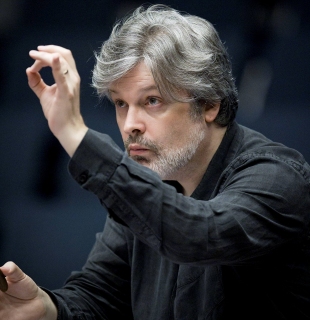
James MacMillan is one of today’s most successful living composers and is also internationally active as a conductor. His musical language is flooded with influences from his Scottish heritage, Catholic faith, social conscience and close connection with Celtic folk music, blended with influences from Far Eastern, Scandinavian and Eastern European music. His major works include percussion concerto Veni, Veni, Emmanuel, which has received more than 400 performances, a cello concerto for Mstislav Rostropovich, large scale choral-orchestral work Quickening, and three symphonies. Recent major works include his St John Passion, co-commissioned by the London Symphony Orchestra, Concertgebouw Orchestra, Boston Symphony and Rundfunkchor Berlin, and his Violin Concerto, co-commissioned by the London Symphony Orchestra, Philadelphia Orchestra, Concertgebouw Zaterdag Matinee and the Ensemble Orchestral de Paris.

James MacMillan at Boosey & Hawkes


