Guest post by pianist Christopher Guild
There’s quite a bit of repertoire for a live performer with a fixed audio track of some kind, where the player of the acoustic instrument needs to keep in synchronisation with in performance. Jonathan Harvey’s Tombeau de Messiaen is the most obvious example I can think of, and a work that I’ve performed on two occasions now. It’s written for piano and pre-recorded piano – actually, the track is an electronic keyboard with a piano sound (and a very 1994 keyboard piano sound at that – the work dates from that year). The prerecorded piano is a quarter tone out from the standard A440Hz tuning of the live piano, and there are fluctuations in pitch throughout. But there is no fluctuation in tempo: it is fixed, and even if there is some rubato, it’s obvious that it’s going to be the same with each performance.
This is challenging for the classical musician; brought up to listen to, and react to, the other performers we are playing with. We can’t do this with an audio track. My impulsive reaction to considering the idea of playing a piece the same way, time after time, with no scope for spontanaiety, used to be, ‘well why include a live performer at all? Why not write it as a piece of recorded music?’. There are many reasons why, and they will differ depending on which piece one considers.
Tombeau de Messiaen could, I suppose, be arranged for two live performers, so that we gain the flexibility and indeed human magic of performing with another pianist (and sound diffuser); we have the technology now to play with a second live piano, or perhaps keyboard, linked to a laptop from which the pitch and the other synthesiser effects could be manipulated. That sounds like a fun idea to me and one I’m thinking of trying to realise when I have the time!
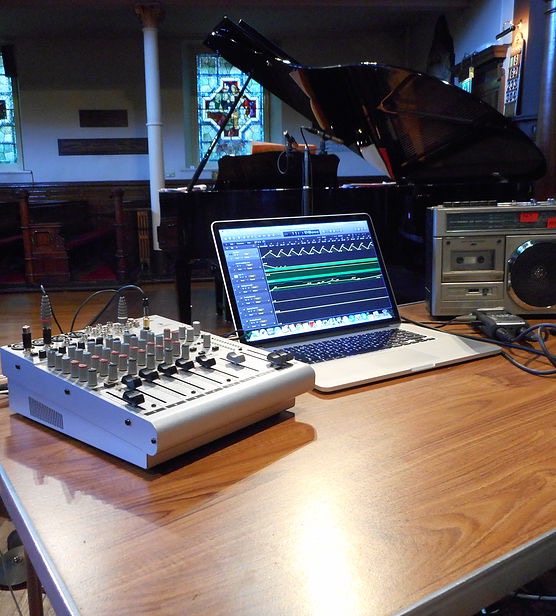
Piers Tattersall’s I Work With Care To Open My Heart, which I’ll be playing for the fourth time in public on Saturday 20th February at the Schott Recital Room in London, is a work for live piano, analogue radio, and electronics. The electronics part is predetermined and fixed. The piano part is too, and the ‘script’ or instructions for the radio operator is too, though part of the point of the piece is that no two performances will ever be the same because different programmes will be on the radio when we play them! The volume of the radio signal is controlled using automation. This means that the radio has predetermined instructions inputted to Logic and runs exactly in synchronisation with the electronics part played by the midi sequencer.
Early on we found it necessary to add a click track for me, along with low-level signal from the radio and midi sequencer, via an earpiece.
This brings me to my main point, which is to describe the experience of performing a piece of (extremely hard) classical music with a clicktrack. One practises with a metronome, but isn’t in the performance mindset in the practice room, so I can’t count that as an experience to draw upon really.
Something I found with Tombeau de Messiaen is that I had to carefully work out how long I had during the stiller moments, when the resonance of the piano was left to decay and nothing was happening in the audio track. This is because quite often the live pianist has to come in exactly with the track without any warning, or, often, very little: there are moments in the score where Harvey has indicated the piano should play very quickly after the audio track enters. One needs to be ready, but to minimise the surprise one has to learn where it comes in. This is fine if the moment of stillness is measured in beats – one counts – but it never is in Tombeau de Messiaen, so the entry of the electronics is harder to anticipate. Sometimes the performer is given ‘c.6”‘, for example. So it’s important to build up what initially only feels like a sense of when to play, and with that, exactly how fast to play the rapid, unmeasured and extensive acciaccatura flourishes in order to finish at about the right time in order to begin the next musical event in synchronisation with the audio track. Such practice might be called building up procedural memory. I was able to do this through a huge amount of repetition, so that it all became habit.
I Work With Care To Open My Heart is similar, but presents additional challenges.
When I come to a particularly technically difficult passage, usually where I’ve got to tackle a tricky dart across the keyboard or where I need to negotiate semiquavers with uneven distribution between the hands, I slow down. I do this musically, not in the sense of bad practise whereby I might immediately stop playing so quickly simply because I can’t play this bit: that isn’t effective and holds back progress. I prepare for it by means of a rallentando in to the tricky section. Then, I accelerando once I’ve got out of the bad patch, and carry on. Essentially, I’m making my own music out of a problem, but I lessen the application of this practice method with each repetition. Then – somehow! – it begins to hang together better, and before too long I can rattle through the passage in question unhindered. It’s a big paradox of my experience of piano playing, but it really does work. Additionally, in order to make myself feel more comfortable when playing any big piece where the technical demands are great, I push myself to use extreme (and silly) rubato in practice – it’s a good test of how comfortable and in control one is, and it means if I can do it with total assurance, then I’m in control.
Whilst the element of risk in a performance is exciting for the performer and the audience, it should never be so great so as to really worry everybody! Letting the music almost play itself is a great feeling. I remember one teacher of mine (Andrew Ball) say to me once that the best concerts he ever gave were the ones where he felt like he was sailing a boat: the weather was such (metaphorically) that the boat was able to sail happily without much effort from the skipper, but only a nudge on the rudder now and again according to (musical) will or fancy was required to keep the journey interesting. Otherwise, the skipper/performer could sit back and let it happen. Feeling in control applies very much to I Work Carefully.
Importantly, the reason I can’t practise I work carefully… with the metronome is because there is a metric modulation almost every bar. ‘Irrational’ time signatures play an important role in this piece, and there are often passages going from 3/4 to 4/5, leading in to 4/4 leading in to 5/10, etc. The principle beat of each bar changes too often to make practice with the metronome worthwhile. (It’s worth just pointing out that this is obviously what the clicktrack is programmed to do!). After several rehearsals with the click, the piece does begin to play itself, and I can begin to sit back as described above.
It wouldn’t be fair to leave the idea of suppressing one’s own artistry, though. There is scope for playing the plentiful rapid passagework in I work carefully… with a wide variety of touches, articulation, and dynamics. One can interpret it as capricious in places, martellato (I believe, even when the composer hasn’t explicitly called for it), and staccatissimo. But it just all has to take place within the very fixed temporal framework dictated by the electronics.
The Edison Ensemble (Christopher Guild and Piers Tattersall) will be performing at Schott Music, 49 Great Marlborough Street, London W1, on Saturday, 20th February at 19:00. Tickets £7 in advance, or £12 on the night.
Meet the Artist……Christopher Guild
Meet the Artist……Piers Tattersall

 Conway Hall, in London’s Red Lion Square, just a stone’s throw from Holborn and the British Museum, was purpose-built in 1929 to host concerts and lectures, which continue here today, and is a landmark of London’s independent intellectual, political and cultural life. The hall is owned by the Conway Hall Ethical Society, an organisation which advocates secular humanism.





 The Cross-Eyed Pianist