My local music society based at the National Physical Laboratory in Teddington is proving a rich and varied source of fine music this autumn. Last month I attended excellent concerts by Helen Burford, in an eclectic programme of mostly contemporary music, and Joseph Tong who played works by McCabe, Sibelius and Ravel, and ended with a rollicking ‘Wanderer Fantasy’ by Schubert. For the first concert of November, pianist Madelaine Jones returned to the NPL to give a lunchtime recital of works by Bach, Beethoven, Stravinsky, and little-known female composer Louise Farrenc.
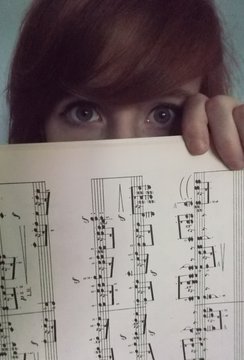 Now in her final year at Trinity Laban Conservatoire of Music and Dance in Greenwich, south-east London, Madelaine studies with my piano teacher, Penelope Roskell (I first met Maddie at one of my teacher’s weekend courses, some three years ago). A busy performing musician, Madelaine is now looking beyond next summer to where her musical studies might take her next: this recital was an opportunity for her to perform her programme for forthcoming auditions at the Royal Academy and Royal College of Music, Trinity, and Yale, amongst others.
Madelaine introduced her programme, explaining that Bach’s ‘Well-Tempered Clavier’ is considered to be the Old Testament of music, while Beethoven’s 32 Piano Sonatas are the New Testament. As it happened, her programme contained works from both, and the opening Prelude from the Prelude & Fugue in D minor BWV 875 from Book 2 of the WTC was played with vigour, colour, and crisp articulation (Madelaine also plays the harpsichord, evident in her lightness of touch in the Prelude). The Fugue was more thoughtful, with sensitive attention to the strands of counterpoint (in her introduction, Madelaine described a fugue rather charmingly as “voices chasing each other”). This was an authoritative account, and a splendid opener for the concert.
Beethoven’s Opus 10 Piano Sonatas were published in 1798. The first and the third of the Opus are serious and tempestuous (the Op 10, no. 1 prefigures the Pathétique Sonata), but the middle sonata of the triptych, Op 10 no. 2 in F major, is more light-hearted, a “cheeky” first movement which amply displays Beethoven’s characteristic wit and musical humour. Madelaine was alert to the rapid shifts of mood, dynamics, and orchestration in Beethoven’s writing: a sprightly first movement gave way to an elegant minuet and trio, followed by a fugal finale, nimbly played by Madelaine. Sparing use of the pedal, precise articulation and musical intelligence resulted in a very colourful and enjoyable account of this early period sonata.
In a change to the printed programme, Stravinsky’s second Piano Sonata (1924) came next, again engagingly introduced by Madelaine. Composed while Stravinsky was resident in Paris in the 1920s, this Sonata harks back to Baroque and Classical models, and it was an inspired piece of programming to place it straight after the Beethoven, which helped illuminate the classical elements inherent in Stravinsky’s writing (a first movement in Sonata form – exposition, development, recapitulation – followed by a slow movement). Indeed, the slow movement, as Madelaine put it, was written as if Stravinsky had taken a typical Beethoven slow movement and simply “allowed the hands the wander around the keyboard”. Madelaine’s precise attention to detail, tonal clarity, energy of attack, and musical understanding made for a most interesting performance.
To finish Madelaine played the Air russe varié, op. 17 by Louise Dumont Farrenc, a French composer who, according to Schumann, writing in his Die neue Zeitschrift für Musik showed great promise, but who has fallen into obscurity. And indeed the work Madelaine performed was redolent of Schumann’s own music with its contrasting and varied movements and musical volte-faces. This work was proof that Madelaine is equally comfortable in Romantic repertoire, delivering a performance that caught the full emotional sweep and virtuosity of this music: a committed, bravura performance founded on solid technique and undeniable musicality.
Details of Madelaine’s forthcoming concerts can be found on her website:
madelainejones.co.uk
My Meet the Artist interview with Madelaine
Forthcoming concerts at the National Physical Laboratory Musical Society:
6th November – Corrine Morris, cello and Kathron Sturrock, piano
11th November – Alice Pinto, piano
18th November – Nadav Hertzka, piano
22nd November – Kathron Sturrock, piano
26th November – Frances Wilson (AKA The Cross-Eyed Pianist), piano in works by Bach, Cage, Debussy, Liszt, Elgar, and Messiaen
Concerts take place in the Scientific Music, Bushy House, National Physical Laboratory, Teddington TW11 0LW, and start at 12.45pm. Tickets £3 on the door.






 The Cross-Eyed Pianist