Guest interview by Michael Johnson

A legend in contemporary piano music, Ursula Oppens has just turned 80 and shows no sign of trimming back her busy life of recording, performing, teaching and commissioning new works from American composers. She fights the aging process with tremendous vitality and mostly wins.

But as she told The New York Times recently, “The eyesight goes, the fingers, the retention”.

A few weeks later in my telephone interview with her, she was more optimistic. “My mind is still functioning the way I would like it to function. I am lucky to be very active at this time and I plan to continue.”

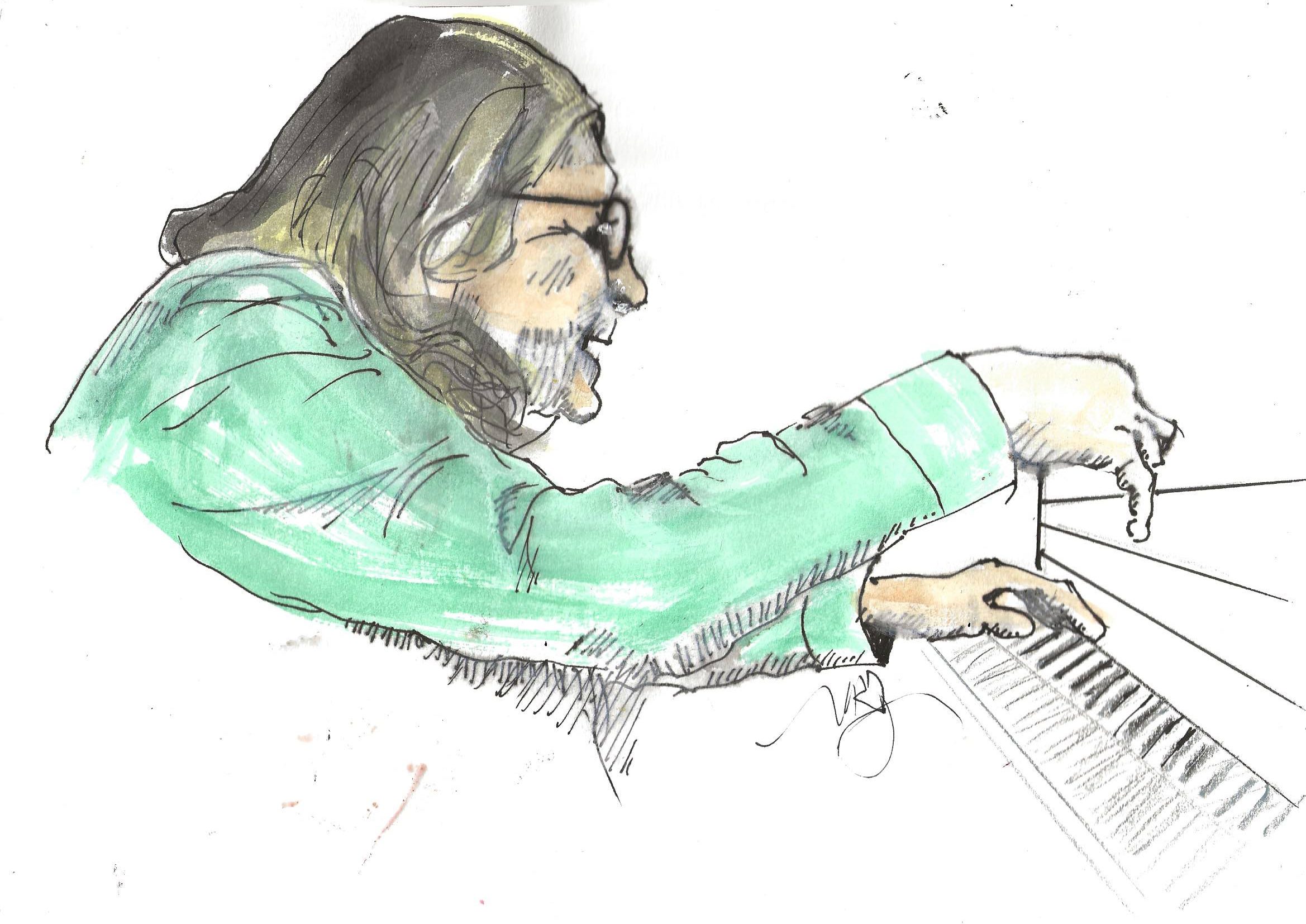
The Times rather bluntly described her as “a little fragile, tiny and stooped”. I tried to capture some of that in my portrait of her.

But she is also recognized as a powerful performer who tackles the thorniest of new pieces. As she said in our interview, she remembers hearing the difficult works of Julian Hemphill for the first time and thinking “This is for me!”.

Composers who have been commissioned by her or who have written works for her include such leading lights as Frederic Rzewski, William Bolcom, and Charles Wuorinen.

Perhaps her best known collaboration was with expatriate American Rzewski with whom she became “very, very, very close friends” and produced the now standard “People United will Never be Defeated”, a magnificent set of 39 variations. Some critics have classed it alongside Bach’s Goldberg Variations and Beethoven’s Diabelli Variations.

She worked together at a distance with Rzewski during the pandemic, ending with his musical tribute “Friendship”. As Oppens told me, we could not meet in person for two years but “he could write and I could play”.

In this clip she plays Rzewski’s “Friendship” on a Fazioli grand.

Her attraction to modernity took shape when she attended lectures and a concert at Radcliffe College with the young French composer Pierre Boulez. She was musically smitten and never looked back.

Edited excerpts from our recent conversation, recorded while she was at a music festival in North Carolina:

You have helped shape contemporary American music through your commissioning of new works. How did you become so interested in modernity?

My parents were refugees from Europe and they felt they had left a great culture behind. I found out much later in life that my mother had taken a course with Anton Webern. And my father joined the ISCM (International Society for Contemporary Music). So they had been interested in new music all along. I didn’t know that as I was growing up but it might have been an influence in ways I didn’t understand.

You are perhaps best known for your commissioning. Are there other people out there also looking for new works? Or are you alone?`

Oh no. There are people like that all over the place.

Where has the commissioning money come from? Family funds?

No, some has come from foundation grants. For example, I received a big grant from the Washington Performing Arts Society. But funding commissions can come from all kinds of sources.

When did you start commissioning?

I didn’t really commission until after college. The first composers I approached to write pieces for me were Tobias Picker and Peter Lieberson. I recorded both their pieces. One composer who had a great influence on me was composer John Harbison. I also played with this wife, the violinist Rosemary Harbison.

I believe the late Fredric Rzewski was among your friends. You knew him, didn’t you?

Oh yes, he was a very, very very close friend. I commissioned his “People United Will Never be Defeated”. The most recent piece I commissioned from him was “Friendship”. It was very much a pandemic piece. For two years we couldn’t see each other but he could write and I could play. He died at 83 in Italy during the pandemic.

You have a new CD coming out soon?

Yes, it’s the music of Charles Wourinen. Mostly solo piano but there’s also a ballet for two pianos that we still have to record. I knew Charles well and worked with him from 1966 to his death in 2020, maybe the longest relationship I’ve had.

What was your relationship with Julian Hemphill?

I lived with Julian for almost twelve years. He is a fine composer and a wonderful man. When I heard his difficult music I thought, “This is for me!”

In your CD “Winging It”, you featured the John Corigliano music that you had commissioned. Does that happen often? You commission something, the composer writes it and you record it. Is that how it works?

That’s what it’s all about. Yes, when you commission a piece it’s a little bit like having a child. You let the child go out into the world, make his own friends, and live his own life. What’s exciting is that after a while other people start playing it.

You seem to be focused on the American composers.

Basically yes, because American composers are people I can work with, people I can bump into. You want this personal contact and you become their friends, like Thomas Picker — I am very honored to be a friend of his, you know. Working with him has made my life very exciting.

Your fans worry about your health. Should they?

Not really. I work more slowly. I don’t run any more. But I’m perfectly healthy as far as I can tell. Of course as one gets older things get a little creakier. My mind is still functioning the way I would like it to function. I am lucky to be very active at this time and I plan to continue. I have had a wonderful share of happiness in my life.
What has aging done to your piano technique?

Luckily I don’t have any serious problems but I cannot say I play as well as I did when I was fifty. I am careful about expanding my repertory. I don’t take on impossible pieces, like Prokofiev’s eighth Sonata.

Are you slower, are you careful about your repertory?

Yes, recently I was teaching the Prokofiev. It was very sad that I had never played it. It’s too difficult a piece for me to learn at this point. I could practice but I probably would not be able to perform it.

But you could still teach it?

Oh yeah.

It is like a master class, I suppose? You play a few bars to show the way?

Not necessarily. You can point out the phrasing, and this and that. You’ve got to hear this note to make sense of the next one — and stuff like that.

Most of the musicians I talk to avoid contemporary music because it requires a lot of learning and they are not sure it’s worth the trouble. Is it really that difficult to master?

It can be difficult, yes, but often it is absolutely wonderful. There is no limit to how exciting it can be. It’s very, very thrilling. You bring to life something that has not existed before.

What about the limited reception by people who are not tuned into contemporary sound worlds? They say well, it’s not Mozart. Doesn’t that drive you up the wall?

No. Live music in a small hall with an audience of sixty people can be so wonderful. Sometimes I tell the audience to listen for certain passages. It makes it an exciting experience for them.

Do you have any fear of being slightly crowded out by the Asians who have suddenly discovered us?

No. If immigration were not part of America I would not exist. I am the daughter of immigrants. We are a mixture, and that is fantastic. I know some of the great young pianists are Chinese. There are people everywhere who can run better, who can jump better, and there are people who can play the piano better.

Do you have a swan song in mind? Are you even thinking of your legacy after the inevitable end?

I will keep making music as long as I can. I know that one day I won’t be able to, and that’s a normal part of life. But I don’t wish to be playing the harp for eternity.

(Ursula Oppens, portrait by Michael Johnson)


MICHAEL JOHNSON is a music critic and writer with a particular interest in piano. He has worked as a reporter and editor in New York, Moscow, Paris and London over his journalism career. He covered European technology for Business Week for five years, and served nine years as chief editor of International Management magazine and was chief editor of the French technology weekly 01 Informatique. He also spent four years as Moscow correspondent of The Associated Press. He is a regular contributor to International Piano magazine, and is the author of five books. Michael Johnson is based in Bordeaux, France. Besides English and French he is also fluent in Russian.

Michael Johnson, in collaboration with The Cross-Eyed Pianist (Frances Wilson), has published ‘Lifting the Lid’, a book of interviews with concert pianists. Find out more / order a copy
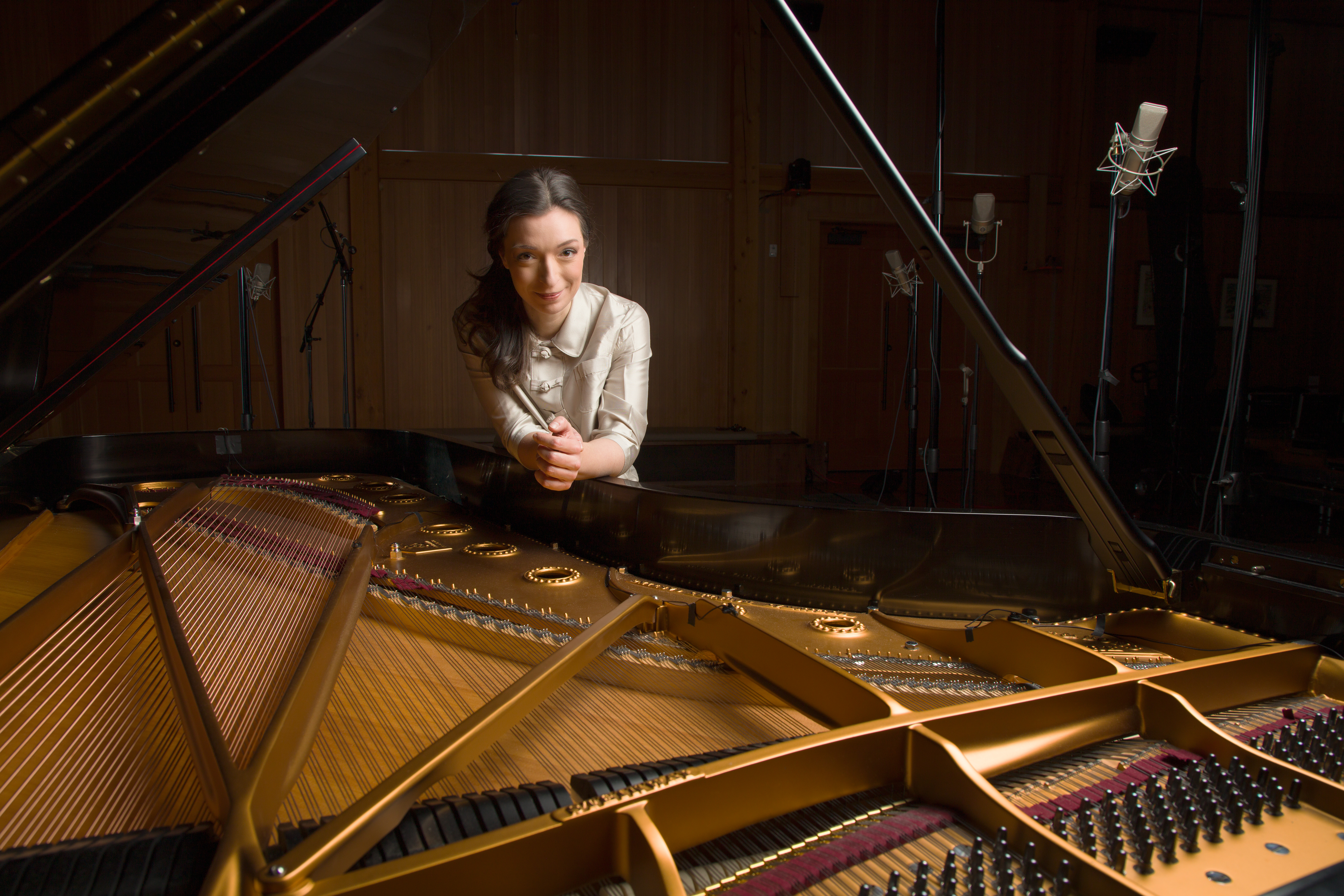
To coincide with the release of her new album ‘Chopin: Voyage’, Russian pianist Yulianna Avdeeva talks about her life in music, balancing one’s artistic needs with the external pressures of a professional career, and how inspiration “can be found anywhere”.….


Who or what inspired you to pursue a career in music and who or what have been the most important influences on your musical life and career?

In my childhood I was surrounded by music. Although my parents are not professional musicians, they were great music lovers and had an upright piano at home, as well as a solid LP collection. At some point they realized that I was trying to play a melody that I had just heard with one finger on the piano, and took me to the Gnessin Special Music School. When I was 5 years old I entered the piano class of Elena Ivanova, with whom I studied for 13 years, until my graduation, and who became a family member for me. Thanks to her amazing admiration and approach to music, I was able to discover this magical world for me as well. However, the moment I remember so well, which was crucial to me, was my first public performance, when I was 6. I was supposed to play 2 Tchaikowsky pieces from his Children‘s album, and my parents and teacher were explaining that I shouldn‘t be scared by the light and people and the audience and should be concentrating on the music I’d play for them. I was not scared at all; on the contrary, I enjoyed very much communicating with the audience through the language of music! And I wished to perform again. So the solution for how to stay motivated for practice was found! I keep that feeling until today and am so grateful to be able to speak this universal language with people all over the world.  

What have been the greatest challenges of your career so far?

I think the greatest challenge is to find out what your mental and physical needs are in order to achieve the most satisfying artistic result. This result depends on many factors, which I had to recognize and acknowledge in my preparation work as well as in my stage performance. Time management is one of the most essential elements; it means that I must know how I should organize my practice, so that I give each piece I perform enough space not only in my daily practice but also in my soul, since I need to “live” with a piece for a while so that it becomes, in a way, my co-creation. On the other hand, I have to know my limits — for instance, if I have a very tight schedule, how many programmes can I really handle? And does it make sense, artistically? My personal goal is to be in the best shape when I walk onstage, and it is probably a never-ending process to understand myself.

Which performances/recordings are you most proud of? 

It is always very difficult for me to listen to my own recordings or the recordings of my own concerts. I almost always think, “Oh, now I would play that completely differently!”. This is the charm and challenge of music — it exists only in the moment when it is being performed, and it is not easy to capture this moment on any recording. So I very rarely listen to my own performances — with some exceptions, of course. For example, it is an amazing inspiration and joy to work with Bernhard Guettler, the sound producer I have worked with for my latest two recordings — Resilience, and Voyage, my new Chopin album, on the Pentatone label, featuring his late works, which has just been released. This particular recording experience was absolutely unique for me for two essential reasons: the location and the instrument. I was so lucky to make this recording at the one and only Tippet Rise Arts Center, in Fishtail, Montana, surrounded by nature and a wonderful team. And on top of that, I played the music on Vladimir Horowitz’s personal piano, which has an exceptionally long and warm sound that opens up like a flower.

When I first touched this piano in September 2022 at the TIppet Rise Arts Center, my first thought was, “This piano is my dream partner for Chopin’s music!”. So I am very thankful to Peter and Cathy Halstead and the entire team at Tippet Rise Arts Center for their most kind support; Mike Toya for his amazing care of the piano; Bernhard Guettler for his patience and his unlimited desire to explore the sound worlds; and the Pentatone team for bringing this recording to life.

Which particular works/composers do you think you perform best?

The moment I decide to play any piece, it becomes “the best and dearest piece” for me, otherwise I will not be able to find an authentic approach to it. Nevertheless, of course there are composers I admire so much, since they have an enormous emotional impact on me, such as Bach, Beethoven, Schubert, Schumann, Chopin, Liszt, Rachmaninoff, Mahler, Prokofiev, Shostakovich, and Bartok, to name just a few. A great discovery for me was Bernstein’s Second Symphony, “Age of anxiety,” in which the piano has a very important solo-like part. It was an exciting process to prepare this unique work, based on Auden’s poem, and I am so lucky to have performed it a couple of times in Spain and Italy and finally to play it in the United States with the Minnesota Orchestra and Robert Trevino on October 18th and 19th, 2024!

How do you make your repertoire choices from season to season?

The piano repertoire is just limitless, which is the pianist’s curse and blessing! My personal list of pieces I would love to play is getting longer every year, so I have to make decisions about what I would like to play next. Sometimes it takes a long while to decide on a recital programme; for me it is important that there is a certain concept, or at least a connecting idea between the pieces. The programme I am performing at Carnegie Hall on October 22, 2024 is a Chopin and Liszt recital. They were the two giants of the Romantic era, both unique performers, and both were trying out the most extreme ways of expression on the piano, even if they were moving on very different paths.

Next year I will be performing Shostakovich’s 24 Preludes and Fugues, op 87, which for me is one the greatest cycles for piano of all time. It was inspired by Bach’s The Well-Tempered Clavier, which I will be playing in 2027. These cycles require my entire concentration in the preparation. At the same time, for next year I also prepared a programme that connects two composers you wouldn’t expect to see together — Chopin and Shostakovich. But Shostakovich was a participant at the first Chopin Competition, in 1927, in Warsaw, and he played Chopin a lot in his younger years. So it is always kind of a work of investigation to create a recital programme.

Do you have a favourite concert venue to perform in and why?

There are many; I could not pick only one. Some of the halls are very inspiring because of their history and the musicians who have performed there — like Carnegie Hall, or the Musikverein in Vienna, but also some modern halls are amazing because of their acoustics and atmosphere — for example, Disney Hall in Los Angeles, or Elbphilharmonie in Hamburg. 

What do you do off stage that provides inspiration on stage?

I am convinced that inspiration can be found anywhere — it can be a color from the sky or of the leaves on a tree; it can be a conversation, or a great book, or even a smell — like the smell of the air in the autumn, or the aroma of a fantastic meal. I just have to be very open to be able to absorb it.

What is your most memorable concert experience?

It is difficult to say. In every concert I share a part of my soul, and my soul in turn keeps the memories of each single concert. And, as I mentioned, the music exists only in a moment when it is being performed and cannot be repeated — that is why each concert experience, even with the same repertoire, is always different.

As a musician, what is your definition of success?

Artistic success for me is probably when I am able to present an interpretation of a piece which on the one hand comes as close as possible to the composer’s will — though this criteria is very subjective — so, on the other hand, it is about my personal feelings about the music, which should be very strong and authentic. And the message of the music I perform should be acceptable for the audience, otherwise I have failed to translate the music score into human feelings. 

What do you feel needs to be done to grow classical music’s audiences?

It is essential to give access to music to the youngest. That can be through playing an instrument, singing, dancing, or any other kind of musical activity, because music also helps children to feel and articulate the emotions they experience. This is what makes human beings unique and irreplaceable. Later on, children who have been exposed to these experiences will decide whether they want to play or sing for their family, or go to concerts, or become a professional musician. Maybe they will not have any interest in it at all. But our goal should be to give them a chance to explore this magical world of music.

What advice would you give to young or aspiring musicians?

I would like to encourage young musicians to think, before they go on stage, about how lucky we are to be able to speak the language of music and share our passion with the audience. And it does not matter if their audience is big or small, or if it is a concert, an exam, or a competition — it is only music, which matters for the performer, and we should only focus on it. I am wishing you a long, happy life, full of wonderful sounds! 

Yulianna Avdeeva performs music by Chopin and Liszt at Carnegie Hall, New York, on 22nd October. Find out more here

Yulianna Avdeeva’s new recording ‘Chopin: Voyage’ is available now on the Pentatone label.


Who or what inspired you to pursue a career in music and who or what have been the most important influences on your musical life and career?

There was no musical influence until I saw and wanted a little toy piano at the age of 5, which my parents bought for me. Having shown interest in pressing keys that make sound, my parents proceeded to find me a teacher. In fact one of my several childhood teachers still follows my career to this day. She introduced me to the wonders of music through reading me all sorts of stories, literature and relating it to the music that we would listen to. I especially remember being inspired by the legendary recording of 12-year-old Evgeny Kissin playing both Chopin Concerti.

What have been the greatest challenges of your career so far?

It has definitely been a learning curve since winning the Leeds Piano Competition. You have to be very disciplined with your time, carefully estimate and learn about what you can or can’t manage, preferably not the hard way! Planning programmes has been especially challenging as you have to take into account many factors, e.g. my development, audiences, and of course what I want to say artistically.

Which performances/recordings are you most proud of? 

I am pretty happy with the Transcendental Etudes for the time being. I really enjoyed the process of creating something in a church in Hampstead for three days straight. It was quite an intimate experience as opposed to being on stage. That music has such a vast variety of ideas, so I felt fortunate to be able to explore it and try to convey this variety.

Which particular works/composers do you think you perform best?

At this point, I don’t think there are any I could say I perform best. I’m constantly learning about the styles of each composer and sometimes I relate with one more than the other at certain times. I can only say that I could never stop playing Beethoven or Chopin.

What do you do off stage that provides inspiration on stage?

Everything in life contributes, from eating, visiting places, to spending time with interesting people. A more direct way of being inspired for me is listening to others.

Do you have a favourite concert venue to perform in and why?

Besides Wigmore Hall, I very much enjoy playing in the Philharmonic Hall of my home town in Almaty, Kazakhstan. I enjoy sharing with the audience of such different culture what I’ve learnt over here.

What do you feel needs to be done to grow classical music’saudiences?

Making classical music accessible to everyone so everybody has the opportunity to discover potential affinity for it. Of course, the earlier the better.

What is your most memorable concert experience?

Definitely Rachmaninov Second Piano Concerto at the Proms [in 2023] with 2 days notice!

As a musician, what is your definition of success?

Success suggests an end goal for a certain task. As there is no end to perfection in music, I’d say making sure of consistent growth however small, is a success.

What advice would you give to young/aspiring musicians?

Discover yourself, your strengths and weaknesses. Play to your strengths while working on your weaknesses. I was fortunate to have a teacher who assisted me with this.

Pianist Alim Beisembayev hails from Kazakhstan and has already made a name for himself, having won the world-renowned Leeds Piano Competition in 2021 aged just 23. He appears at this year’s Cheltenham Music Festival on Thursday 11 July playing music by Schubert, Chopin and Clara Schumann. More information


alimbeisembayev.co.uk


This site is free to access and ad-free, and takes many hours to research, write, and maintain. If you find joy and value in what I do, why not

Long read guest post by Dr Michael Low, in part in response to this article by Zach Manzi


For as long as I can remember, Classical music has touched me in a way no other musical genre was able to. This, coupled with my love for playing the piano, made it inevitable that I would dedicate my life to these two overlapping fields.

‘Musicians must be the luckiest people alive!’ I recall saying to my father as a wide-eyed teenager, ‘They travel the world and play beautiful music. Imagine the joy of sharing something that is so personal to you with thousands and thousands of people; I want to be a musician one day.’ My father was an amateur French horn player who went into finance and business to support his family, but, despite his career change, he never lost his love for music, and was supportive of my decision to dedicate my life to music.

Unfortunately, the same could not be said of everyone to whom I pitched my dream career, though hindsight shows that rejection and setbacks are just part of the journey in all walks of life. One extended family member was dismissive of my career choice and told me that I would end up ‘cleaning tables in restaurants for money’ (a derogatory statement itself aimed at those in the hospitality industry). Needless to say, I have not seen or been in touch with this particular person since I left England for South Africa.

My piano teacher at the time, Richard Frostick, also expressed his reservations about my choice of career. Richard told me that the views expressed by this particular member of my extended family were done out of care rather than cruelty, and that a reality check was needed on my part. However, it was the words of Graham Fitch, my teacher during my studies at London’s Centre for Young Musicians, that gave me the greatest hope: ‘If this is your dream, then I would like to believe that anything is possible.’ Graham warned that the competitive nature of Classical music grows in inverse relation to the ever-decreasing career opportunities, but added, ‘there will always be a place for someone who is talented and works hard.’

Because I was a late starter, a lot of catching up was needed on a technical and musical level. And I was willing to forsake my academic subjects for the purpose of pianistic and musical developments. Unfortunately, in my desire to be ‘on par’ with my pianistic contemporaries, many short cuts were taken and numerous corners slashed. I hadn’t taken time to learn the true value of rhythmic discipline and develop my sense of internal rhythm, which meant that everything was very approximate (in other words, I would play what I thought the music should be, as opposed to what is actually written). But I got away with it (at least for the time being) thanks to my musical temperament, as well as the uncanny Chinese ability to (more or less) replicate my favourite recordings. It was not until a few years later when I read Artur Rubenstein’s biography that I understood the following quote: ‘To Hell with the Germans and their exact fingers! TEMPERAMENT!!!’).

Failed auditions and disappointing performances mark every musician’s journey, but I kept my eyes firmly on the prize. The summer of 1996 was to be a watershed moment. I met an eminent piano professor at a summer school who expressed an interest in my playing. He openly told everyone during a masterclass that I had ‘a marvellous musical temperament, but very little else.’ At the same time he assured me that when all the aspects of my playing had developed, that I will be ‘some’ player. I was encouraged by these words and further lessons were arranged. Sadly, our last meeting was not a positive one. He reduced me to tears by laughing and ridiculing my playing. A few years ago I found out that the same professor has passed on. I sometimes wondered what he would make of my playing if he were to hear me now.

My university years proved to be some of the most productive in my life. I threw myself into learning some of the most challenging piano repertoire and listening to many of the 20th century’s greatest pianists. What is so special about their playing? What is their ‘X factor’? These were some of the questions that I often asked myself when I was in the listening library. Unfortunately, many of my contemporaries didn’t understand my obsession. One of them called me ‘a sad f**k’ when we crossed paths for the second day in a row. A final year student asked me, ‘Why do you insist on learning all these difficult pieces when you will never get the opportunity to perform them?’ I responded with just a smile, as I didn’t want to come across as rude, always reminding myself that I could spend the rest of my musical life ‘polishing,’ but the structural labour on the musical sculptures had to be done right now.

I was proud that all my efforts were not in vain, and there was validation amongst my lecturers and peers in regards to my hard work. One of the highlights of my student years was making my concerto debut performing Tchaikovsky’s First Piano Concerto. But all of this came at a cost: one of my closest friends wrote me a letter when she was going through a particular difficult period during her final year, asking, ‘Where were you when I most needed you, Michael?’ I replied with, ‘I am sad to say that I was nowhere’. I was willing to sacrifice everything for an ideal while neglecting the more important aspects of life, such as the relationship between friends. I consoled myself with the excuse that some of the most creative personalities have never been ‘people’s people’, and how wrong was I? It was only years later that I came to the realisation that piano playing has always been a reflection of life, whereas life has never been just about playing the piano.

In spite of my enormous desire to make huge musical and pianistic strides, my playing was riddled with idiosyncrasies and plagued with physical tension. In hindsight, I can only thank my lucky stars that I didn’t pick up some form of physical injury, especially when I was practising up to six hours daily. I was told that I had ‘massive technical problems,’ but the reality was that my lack of rhythmic discipline and internal pulse finally caught up with me. The big musical structures of works such as Liszt’s ballades and Beethoven’s sonatas fragmented into intimate miniatures, and there was little awareness of the longer melodic line especially in the musical direction of the composition. ‘Moments of brilliance are often followed by moments of incompetence,’ was one lecturer’s assessment of my playing. I was also a ‘nightmare’ student to mark, according to the hierarchy, because I was so inconsistent. Though my lecturers may have had a point, one part of me didn’t take their criticism too seriously as another part of me strongly felt that their words had more to do with my inability to negotiate departmental politics. I reassured myself with the thought that the musicians who made the greatest impression on me were often some of the most controversial. Who on earth wants to play a mediocre 75 per cent in a performance anyway? At least I could hit the 90s, even though at times I was wide of the mark. ‘Just keep going and one day everything will fall into place,’ I told myself.

VIDEO (Michael Low plays Beethoven/Alkan)

South Africa gave me a chance to press the reset button, but the stakes were too high. I told myself that being an international scholarship student meant that I had to be close to ‘perfect’ every time I performed, when this was far from the truth. I yielded to my musical neurosis by spending hours on end polishing my repertoire when I should have taken advantage of the considerable performing opportunities available. And because I raised the performance bar to near impossibility, it only meant that I had that much further to fall when things didn’t go as planned. Every time I walked off stage, I was haunted by wrong notes, memory lapses as well as other interpretive discrepancies. That is not to say that there weren’t moments where I made an impression, but the consistency that I so desperately craved never materialised, and it often felt like the harder I worked, the further away I was straying from my musical goal. ‘If it doesn’t happen for you now, maybe you have to accept the fact that it will never happen,’ was one professor’s assessment of my progress. Another told me that while he found my playing ‘very sensitive and very musical,’  he also wondered if I had what it takes to ‘stomach my nerves.’ The same person also assured me that, ‘There is no shame in this, I know a lot of wonderful musicians who cannot quite make things happen on stage.’ These words may sound harsh, but they were nothing like the brutal assessment given by a visiting professor, who told me, ‘Sort out your rhythm, or stop playing the piano entirely.’ I was desolate because I knew that was the truth. I looked on as my musical peers gained scholarships to study with some of the industry’s most prolific performers in Europe and America. Although I feel a sense of happiness and pride for them, I now knew the inevitable: I would never have a career as a concert pianist.

When I started teaching in my late twenties, I was determined that none of my students would be as rhythmically undisciplined as I was. Hence, I started formulating my own teaching method and in doing so found some form of closure with regard to my inability to become a performer. The fabled stories of Adele Marcus and some of the 20th century’s greatest pedagogues gave me hope: ‘The greatest performers don’t necessarily make the greatest teachers,’ I said to myself. I was determined to be the best educator I could be. Even though I still perform in the occasional soirees and private functions, the fire within me that longs for the stage no longer burns with the same intensity. I then found Christianity, which affirmed my ability as a mere mortal. ‘There are those who are chosen by God to be performers,’ I recall saying to a colleague, ‘and then there are people like myself who chose to do music as a career, and that is the difference.’ The elders in my congregation praised me for my insightfulness, while my Christian friends commended me for entrusting my life in the hands of the Almighty. ‘Everything seems to make sense now’, I said to myself. Little was I to know that in the years to come, the one person who would challenge both my spiritual and musical beliefs turned out to become the most important person of my life.

Piano and Classical music took a further ‘back seat’ when I fell in love with the game of golf. I saw a lot of parallels between this strange yet beautiful game and playing the piano. I traded the practice room for the driving range, and I signed up to become a member of one of South Africa’s top golf clubs. For the next three years I learned only one piece of piano music – Scott Joplin’s Bethena Waltz – which haunted me for weeks after I watch David Fincher’s movie adaptation of The Curious Case of Benjamin Button. Any spare time I had was spent forging a repeatable golf swing or inputting musical scores into Sibelius as I looked to finish my PhD in Music. Playing the piano was now a distant memory, and the truth is that I had not given myself a timeline as to when I would reconnect with my black and white friend again.

In Part 2, Michael Low describes how he reconnected with the piano.


As a teenager, Michael Low studied piano under the guidance of Richard Frostick before enrolling in London’s prestigious Centre for Young Musicians, where he studied composition with the English composer Julian Grant, and piano with the internationally acclaimed pedagogue Graham Fitch. During his studies at Surrey University in England, Michael made his debut playing Tchaikovsky’s First Piano Concerto in the 1999 Guildford International Music Festival, before graduating with Honours under the tutelage of Clive Williamson. In 2000, Michael obtained his Masters in Music (also from Surrey University), specialising in music criticism, studio production and solo performance under Nils Franke.



An international scholarship brought Michael to the University of Cape Town, where he resumed his studies with Graham Fitch. During this time, Michael was invited to perform Tchaikovsky’s First Piano Concerto for The Penang Governer’s Birthday Celebration Gala Concert. In 2009, Michael obtained his Doctorate in Music from the University of Cape Town under the supervision of South Africa greatest living composer, Hendrik Hofmeyr. His thesis set out to explore the Influence of Romanticism on the Evolution of Liszt’s Transcendental Etudes.

In 2013, Michael started a project in Singapore collaborating with The Kawai School Elite in a series of masterclasses and workshops for teachers and students. Having grown up in the East and lived his life in the West, Michael believes that both cultures has much to offer and envisage an exchange between Singapore and Cape Town in the future.

Michael is also the co-founder of the Elvira Ensemble – a Classical Chamber Orchestra specialising in the Piano Concertos of Mozart and Beethoven as well as Soundtracks from Blockbuster Hollywood Movies. The Ensemble have given performances at several high-profile events such as the wedding of Justin Snaith, South Africa’s leading race-horse trainer. In January 2020, the ensemble was engaged to perform at the wedding of the former Miss Universe and Miss South Africa, Miss Demi-Leigh Nel Peters.

Michael has also worked with numerous eminent teachers and pianists, including Nina Svetlanova, Niel Immelman, Frank Heneghan, James Gibb, Phillip Fowke, Renna Kellaway, Carolina Oltsmann, Florian Uhlig, Gordon Fergus Thompson, Francois du Toit and Helena van Heerden.

Michael currently holds teaching positions in two of Cape Town’s exclusive education centres: Western Province Preparatory School and Herschel School for Girls. He is very much sought after as a passionate educator of young children.

Michael has also served as a jury member in the 2nd WPTA Singapore International Piano Competition in 2020. He has been engaged for a series of talks and masterclasses with the WPTA Indonesia in September of 2021.

Michael Low’s website

Video credits:

Director: Bill Chen https://vimeo.com/billagechen

Sound Engineer: Liam Pitcher https//www.liampitcher.com