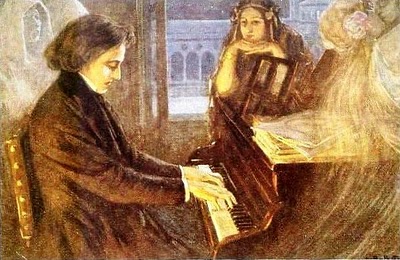
The story of composer Fryderyk Chopin and writer George Sand is one of the most compelling, romantic and passionate, a nine-year love affair which continues to fascinate and grip the imagination. It is a story of creative union and artistic inspiration, of a relationship severed by ugly jealousy and recrimination, and one which ended tragically with the untimely death of Chopin in October 1839.

For many, the relationship between Chopin and Sand is an attraction of opposites: she with her fiery, mercurial, outspoken personality, her penchant for men’s clothes and cigars contrasted with Chopin’s fastidiousness, his delicacy and shyness (particularly in performing in public). Yet during the nine years of their relationship, Chopin produced some of his finest piano music, including the 24 Preludes Op 28 and the B minor Piano Sonata. Despite her reputation for taking up with and then discarding lovers with the casualness one might discard a dirty chemise, Sand gave Chopin love and affection, and a settled home life, divided between Paris and her house at Nohant, that enabled him to compose. She nursed him when he was ill and offered solace and support when he felt his muse had deserted him. Added to this, their circle of friends comprising artists (the painter Eugene Delacroix, amongst others), musicians (Pauline Viardot, Auguste Franchomme), writers and composers (Franz Liszt) provided Chopin and Sand with a supportive and inspirational background against which they could create music and words.

‘Divine fire’ was Sand’s own description of the intensity of her attraction to Chopin, suggesting a love that transcended the purely physical to a more spiritual plane, a meeting of bodies and minds. It is also the title of a words and music presentation conceived and written by actress Susan Porrett with music performed by pianist Viv McLean.

The narrative runs chronologically, picking up the story of Chopin and Sand from their first meeting in Paris (at which Chopin initially found Sand “repulsive”) through their ill-starred winter in Majorca, contentment at Nohant, Chopin’s acclaimed recital at Salle Pleyel to their stormy parting and Chopin’s tragic death. The narrative is interspersed with music, selected by Viv to complement the text, and comprising some of Chopin’s loveliest works. The opening piece, the fleeting Prelude in A, Op 28 No. 7, set the tone for the evening – played with an ethereal delicacy, the last note was no more than a whisper.

The great strength of this format is the subtle interweaving of words and music. Susan’s text brings to life the personalities of Chopin and Sand through letters between them and their friends, and contemporary accounts. The readings set the tone, and the music reflects it, each piece sensitively rendered by Viv with expression and commitment, from the tenderest, most intimate Nocturnes (Op 9, No. 2, Op post. In C sharp minor) to an intensely poignant Mazurka (Op 17 No 4). Two Ballades (A major and G minor) illustrate Chopin’s contrasting textures and moods, while the Scherzo in C sharp minor is a heroic declamation, shot through with a contrasting motif combining a chorale-like figure with sound showers high in the treble register. Viv’s understated, modest delivery always allows the music to speak for itself, while Susan’s words lend greater focus, encouraging us to listen to the music even more attentively.

Viv expressed some concerns about the piano (an Estonia) to me afterwards, but I and several other audience members assured him that the range of sound was absolutely appropriate for the size of the venue (Bridport Arts Centre is a converted chapel, with cinema-style seating for c200), from the sweetest, most lyrical cantabile (in the Nocturnes, Prelude and Mazurka) to the thunderous, dramatic Presto con fuoco coda of the G minor Ballade. At times the music was accompanied by the faint, plaintive wailing of seagulls (Bridport is close to Dorset’s Jurassic coast), which lent even greater pathos to the music and narrative.

The concert closed with a poignant account of Chopin’s death, and an intense and emotional performance of the Polonaise Fantasie in A flat, Op 61, bringing to an end an absorbing, moving and beautifully presented evening of words and music.

www.vivmclean.com

More about 7 Star Arts

Further reading:

Chopin’s Funeral – Benita Eisler

Chopin: Prince of the Romantics – Adam Zamoyski

Chopin in Paris – Tad Szulc

Chopin’s Letters (Dover)

A Winter in Mallorca – George Sand

This week I had the very interesting and unique experience of meeting and playing some rather special pianos which reside at Hatchlands Park, near Guildford, home of the Cobbe Collection of keyboard instruments. The collection includes not just pianos (including a number with very famous and unusual connections, autographs and provenance), but also harpsichords, spinets and organs.

The collection was assembled over forty years by Alec Cobbe with the intention of bringing together instruments by makers who were highly regarded or patronised by composers, and eighteen of the instruments were actually owned or played by some of the greatest classical composers, including Purcell, J C Bach, Haydn, Mozart, Beethoven, Chopin, Liszt, Bizet, Mahler and Elgar. In 2007 it was revealed that the 1846 Pleyel in the collection was a piano which Chopin had had shipped to England for his concerts here in 1848 (more on this remarkable story here). The piano had been in Alec Cobbe’s collection for twenty years before this discovery about its history and use was made.

Chopin is said to have favoured the French-made Pleyel, praising it for its sound and describing the piano as “the last word in perfection”. I heard the famous Pleyel being played in a recital of music by Chopin at Hatchlands in July 2007, not long after its back story was revealed, (Nocturnes Op 55 and Piano Sonata in B minor) and talking to the pianist afterwards piqued my interest in the instrument, in particular the pianist’s comments about controlling the dynamic range of the instrument.

While I’m not, in general, a big fan of “period instruments”, there are good reasons for experiencing Chopin’s music on the make and era of piano he would have favoured, and for both listener and pianist it highlights several interesting aspects of his piano music which are sometimes overlooked when playing it on a modern piano. In particular, he is said to have favoured the softer, more mellow sound of the Pleyel (over the other great French piano maker, Erard). As the late Charles Rosen observed: “what interested him were subtle gradations of color, inflections of phrasing, and it was what he expected from performers.” (source: The Chopin Touch by Charles Rosen, New York Review of Books). Chopin observed that each finger had a particular characteristic and quality of touch and, therefore, sound: for example, delicate passages were played with the weakest fingers (fourth and fifth), while passages requiring a cantabile melodic line employed the strongest fingers, often one finger alone. This runs counter to the received piano pedagogy of the day – that all the fingers were equal.

In my study of a handful of the Études, Nocturnes, Waltzes and Mazurkas, and the first Ballade with my current teacher we have often discussed the issue of touch and sound quality. Also, the assertion from many of Chopin’s contemporaries and students who heard him play that his dynamic range never rose above mezzo forte, even in passages marked forte. This led me to develop a sense of “warming up the sound” rather than deliberately increasing the volume of sound: this also enables one to retain a beautiful sound, even when playing more loudly. Obviously, one cannot hope to replicate exactly the sounds and textures Chopin himself achieved, but it is possible to employ the techniques he used and taught (absolute suppleness and flexibility of hand and arm, for example, a sense of “ease” at all times).

When we hear Chopin’s music performed on a modern, concert grand piano, we sometimes forget about the subtle shadings, nuances and colours that are possible in his music – and which he probably insisted from his students (and himself when he played). And because, more often than not, we hear Chopin’s music performed in quite large venues, we may also forget that much of his output was of “miniatures” – intimate, interior pieces to be enjoyed at home or in the salon, rather than the concert hall.

The 1846 Pleyel in the Cobbe Collection is not a big piano. It is the kind of instrument one might have at home, a “parlour piano” rather than a concert instrument. Its touch, action and sound were akin to my teacher’s Blüthner (early 20th century). There was a fractional delay between depressing the keys and hearing sound, which was slightly disconcerting at first (as is evidenced in the rather hesitant opening measures in my recording of the Nocturne Op 62 No. 2), but overall this was an “easy” piano to play. It felt quite effortless, in comparison to the Erard (autographed by Thalberg) which was really quite hard work, in particular in trying to achieve a very smooth, singing legato in Liszt’s Sonetto di Petrarca 47.

Since Chopin was said to revere Bach, I felt it was appropriate to play some Bach on the Pleyel (the ‘Adagio’ from the Concerto in D minor after Marcello). In this piece, I really enjoyed the delicate tone of the instrument. Minimal pedal was used throughout and the light action of the piano enabled me to keep the ornaments soft and floating.

The Liszt Sonetto is very much work in progress, but it was nonetheless interesting to attempt to play this, and the Sonetto 104 (from my LTCL programme) on a piano contemporary with their composer. I found the Erard really quite “effortful” (particularly compared to the Pleyel): it seemed one had to work for every single note.

I am very grateful to Alec Cobbe for granting me special access to these interesting pianos (normally reserved for scholars and performers rehearsing for concerts). Visitors to the house, which is managed by the National Trust, can view the collection of keyboard instruments, and also hear some of them in concert. Please see the links at the end of this article for further information.

The Cobbe Collection

Hatchlands Park

Further reading:

Charles Rosen on Chopin (New York Review of Books)

Chopin’s Pedagogy: A Practical Approach (transcript of a presentation given by David Korevaar, University of Colorado)

(photo credit: Julien Faugère)

Canadian pianist Janina Fialkowska has Polish blood in her veins (her father is Polish), and she was described by her pianistic idol, Arthur Rubinstein, as “a natural born Chopin interpreter”. This assertion was more than confirmed by a carefully executed and beautifully nuanced lunchtime concert of music by Fryderyk Chopin at London’s Wigmore Hall. Read my full review here

Janina Fialkowska has won “Best Instrumen​tal CD Award” in the 2013 BBC Music Magazine Awards for her ‘Chopin Recital’

Pianist Janina Fialkowska wins “Best Instrumen​tal CD Award” in the 2013 BBC Music Magazine Awards for Chopin Recital 2 disc

Pianist Janina Fialkowska, who was left temporarily paralysed in her arm, has won the “Best Instrumental CD of 2012” award in the 2013 BBC Music Magazine Awards for her critically-acclaimed disc “Chopin Recital 2”, released on the ATMA Classique label. Arthur Rubinstein described Fialkowska as “a born Chopin interpreter” and Gramophone Magazine concluded that “she has done her one time mentor, Arthur Rubinstein proud.” The prestigious award comes 10 years after a cancerous tumour left Fialkowska paralysed in her left arm for two years.

BBC Music Magazine commented:

How does she do it? By some mysterious alchemy, Fialkowska only has to perform a note of Chopin and instantly it’s inimitable, indelible.”

Following groundbreaking treatment on her arm in 2003, the highly-respected pianist Janina Fialkowska has determinedly rebuilt her career as a leading international concert pianist. Now 10 years after successful treatment, Canadian-Polish Fialkowska has firmly re-established herself as one of the foremost Chopin interpreters in the world.

The award comes after a remarkably successful year for Fialkowska which included her being awarded the ‘2012 Governor General’s Performing Arts Award’ for Lifetime Artistic Achievement in Classical Music at a ceremony in May. The award is Canada’s most prestigious honour in the performing arts, equivalent to the ‘Kennedy Center Awards’ in the United States.

Fialkowska’s “Chopin Recital 2” CD is the second recording of her critically acclaimed Chopin Recital series given in May 2012. The disc includes Chopin’s Ballade No. 2. Scherzo No. 2 and a selection of Nocturnes, Mazurkas, and Waltzes including Le Grande Valse Brillante. Fialkowska is firmly established as one of the world’s foremost interpreters of Chopin and Liszt and has released five celebrated CDs in three years.

Her most recent recording features Mozart’s Piano Concertos No. 13 & 14 (K. 415 & 449) in arrangement for piano quintet, which was released on 29 January 2013 to exceptional reviews. The Financial Times commented “Fialkowska’s crystalline, unsentimentalised treatment of Mozart’s piano writing lends the music a spontaneous fluency that is invigorating.”

Fialkowska’s award follows an all-Chopin lunchtime recital in the Wigmore Hall which was broadcast live on BBC Radio 3’s Lunchtime Concert Series (click the link below to listen again). On Thursday 11th April, Fialkowska performs a programme of Chopin Grieg and Schubert at the Sage, Gateshead in aid of the British Red Cross.

[Source: Nicky Thomas Media Consultancy]

My review of Janina Fialkowska’s recent Wigmore Hall lunchtime concert

Read my Meet the Artist interview with Janina Fialkowska


