
 Piano Sonata No. 6 in A, Op. 82 (1940)
Piano Sonata No. 7 in B flat, Op. 83 (1942)
Piano Sonata No. 8 in B flat, Op. 84 (1944)
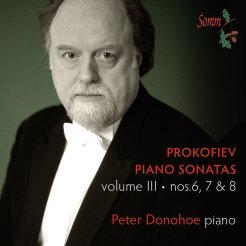
Peter Donohoe, piano
Peter Donohoe’s third volume of Piano Sonatas by Sergei Prokofiev completes the cycle with Nos. 6, 7 and 8. Peter has a long association with the piano music of Prokofiev – the Sonata No 6 was part of his silver medal-winning programme at the 1982 Tchaikovsky Competition – and indeed the composer’s homeland, as a regular visitor to Russia throughout his career (his diary from his stay in then Soviet Moscow during the 1982 Tchaikovsky Competition is a fascinating read).
Prokofiev composed piano sonatas throughout his life and the final three belong together in the same way as the final three piano sonatas of Beethoven and Schubert. Though the works were not intended to be performed consecutively, they do exhibit “familiar” attributes which connect them. For Peter Donohoe, these sonatas form one of the great cycles in piano literature, written by a composer who was also a magnificent pianist (surviving recordings of Prokofiev playing his own works are testament to this). This final instalment of Donohoe’s recording for Somm includes what are called the “war trilogy” piano sonatas, written during World War II, and reflecting on and reacting to the horrors of Soviet Russia’s titanic struggle against Hitler.
The sixth sonata opens with a clangorous motif which rings out before the music retreats into darker passage work and a second subject with folksong qualities. Donohoe’s pacing, acute rhythmic vitality and colourful dynamic palette combined with a glorious sound (evident throughout the recording) allows the music to build gradually to a climactic reprise of the open motif. Donohoe brings a wry humour to the second movement, a rather jaunty march, interrupted by a tense and sinuous middle section, but the ominous tread is never far away. The third movement is an elegant and rather poignant waltz, and like the preceding movement the middle section contains more unsettling material. There is a lovely clarity of line here which brings an expansive romantic sweep to the movement. The finale, all frenetic scurryings and mocking themes, is a fine example of Donohoe’s effortless fluency and technical control.
The Sonata No. 7 is the most popular of the three, and its menacing, militaristic tread is evident from the opening. Donohoe’s restraint in the quieter, middle section hints at impending drama as the frenetic energy builds. Although scored in a major key, there is nothing joyous about this music. The middle movement, marked Andante caloroso, contains a consoling cantabile melody as beautiful as any nineteenth-century salon piece, but once again the mood is disturbed by plangent bass chords and an overriding sense of melancholy. There is power here, in Donohoe’s rich fortes, but his sense of restraint creates an extraordinary tension despite the hushed conclusion. The perpetuum mobile finale crackles with energy, subtly phrased and crisply articulated, it is both triumphant and unsettling.
Like the previous sonata, No. 8 is also scored in B flat. Composed in 1944, it is the longest of Prokofiev’s nine piano sonatas and is a work of great breadth and emotional tension. Again, it is Donohoe’s ability to hold back rather than push the dynamics which creates a greater sense of drama, tension and impending tragedy. The middle movement opens with a lyrical Schubertian melody over an accompaniment which grows more florid. This feels like the calm before the final tempest and Donohoe’s sensitive line and delicate touch creates passages of great charm and beauty. The finale begins with a hectic motif which is both playful and heroic.
There is a wonderful immediacy to Donohoe’s playing combined with vibrant pianistic colour, sprightly articulation, technical assuredness and musical authority which runs through every note. An impressive conclusion to the cycle.
Available on the Somm label
 The latest release from pianist
 The curious, often sensual and hypnotic soundworld of Alexander Scriabin is viewed through the lens of a three-piece jazz ensemble in the David Gordon Trio’s new album Alexander Scriabin’s Ragtime Band. Released at the close of the year marking the centenary of Russian composer Alexander Scriabin’s death, the album is a witty and imaginative take on Scriabin’s music, part reinterpretation, part hommage to the many elements and influences which make up this composer’s unusual oeuvre.
 The Scottish composer Ronald Stevenson died in March 2015. He was one of the most important composers of our time, a composer-pianist in the grand tradition of Beethoven, Chopin and Rachmaninov, probably best remembered for his monumental Passcaglia on DSCH. Pianist Christopher Guild’s first volume of Stevenson’s piano music was released on the Toccata Classics label in early March 2015, though I suspect Guild did not realise at the time that his recording would become a kind of memorial for Stevenson. The CD celebrates Stevenson’s shorter works for piano with a special focus on one of his major preoccupations: his love of Scottish and Celtic culture. The album contains three suites of pieces based on Scottish folk songs or songs for children, together with the more substantial A Scottish Triptych, three pieces each written some time apart, and A Rosary of Variations on Sean O’Riada’s Irish Folk Mass (1980).
 The piano is the ideal instrument for miniatures, and Christopher Guild brings warmth, intimacy and wistfulness to the pieces based on Scottish folk tunes with his assured lightness of touch, sensitive voicing, clean articulation, rhythmic vitality and a keen sense of the fleeting moods and characters of each piece, and Stevenson’s penchant for complex harmonies and unexpectedly vivid dissonances. Meanwhile, A Scottish Triptych explores more plangent piano sonorities in its opening movement, and even utilises the piano’s interior (strummed and plucked strings) to produce unexpected colours and resonances in the final movement.



 The Cross-Eyed Pianist