Who or what inspired you to pursue a career in music and who or what have been the most important influences on your musical life and career?

When I was 7 years old, my parents told me that I was enrolled in a guitar group at my school.  Back then I didn’t even know what a guitar was, or that you could have a career as a guitarist !  At around 10 years of age, I took part in some guitar events in China where I saw some professional foreign guitarists play concerts and I was told I had the ability to do the same as them.

This is what first put the idea of pursuing a career in music into my head, without really knowing what it entailed.  My youthful enthusiasm took me to the Central Conservatory of Music in Beijing, against the wishes of my family, where I became the very first guitar student in the whole country.  During my ten years there I constantly felt that my instrument was under appreciated and underestimated.  This enhanced my own determination to have a musical career and show everyone what the guitar can do.  I was also so inspired by the great musical environment at the conservatory, and this too strengthened my resolve to become a musician.

What have been the greatest challenges of your career so far?

There have been many challenges on my musical journey.  When I started playing in China, no one in China had taken this path before, so there were no local role models.  The country had no classical guitar tradition.  Looking back, I had to battle against the odds to make my own path. Over the years this took me to the Central Conservatory of Music in Beijing, and later abroad to study at the Royal Academy of Music in London.  It’s not easy for an Eastern person to come to the West and make a career with no familiarity with the environment here.  Especially so when that career is playing a niche Western instrument. Therefore, I am extremely grateful for all the support I have received to come this far.

Which performances/recordings are you most proud of

My recordings are like my children. I like them all, but I am particularly proud of two,  Bach Concertos and Sketches of China. These both contain new repertoire for guitar, so I put a great deal of effort and time to make these happen.  Not only the recording, but sourcing the repertoire, and making the guitar arrangements.

There are also many concerts that I am proud of, but my most recent is actually a highlight. It was called ‘Once Upon a Time in Brazil’ and I played for two consecutive nights at the NCPA in Beijing.  The concert presents a wide selection of Brazilian music from classical to popular style. The program highlighted the central role that guitar has in all this music .  I pushed my own boundaries as a classically trained player.  I felt a revelation performing new musical styles in collaboration with different combinations of chamber musicians.  For example, we had one set with guitar, percussion, and double bass, rather like a jazz trio which worked really well.  The enthusiastic response from the audience on both nights gave me great encouragement and was a welcome reward for the project.

Which particular works/composers do you think you perform best?

I feel particularly at home with lyrical, romantic works.  I consider lyricism as one of my hallmarks.  I am always singing in my head as I play.  Several string players have told me that I phrase as if I have a bow in my hand. That’s a complement I really like and can associate with.

What do you do off stage that provides inspiration on stage?

Travel!  I like travelling to see how people live in different places around the world, and to learn about their culture.  That’s a great source of inspiration when interpreting music from these cultures.  It’s not only an inspiration on stage, but it opens my mind and helps me understand myself and my own cultural background in a broader and deeper way and understand other people more.

How do you make your repertoire choices from season to season?

It’s based on a combination of factors, my own personal tastes and desires, the concert schedule and promoter’s requests, and my recording plans. In general, I try to balance a program to have something for everyone. I also try to feature something familiar and something new, whilst at the same time broadening my own repertoire.

Do you have a favourite concert venue to perform in and why?

I think my overall favourite is Wigmore Hall in London. It has a perfect acoustic for guitar.

What do you feel needs to be done to grow classical music’s audiences?

I think a few factors need to be addressed.  I don’t know if classical music is losing audiences as such, but nowadays people have more choices about how to use their time, so we must compete for their attention.  We need to make the music relevant to them. I also feel there are still elements of elitism in classical music, that make many feel excluded from the circle.  Musical education plays a huge role in this.  For example, in China a vast number of children are learning instruments, and their parents will take them to hear concerts.

What is your most memorable concert experience?

I have many!  Two come to mind.  My first is meeting the composer Rodrigo who came to my Spanish debut concert in Madrid when I was 14!  More recently it was amazing to play on Bastille Day sitting under the Eiffel Tower with the French National Orchestra, performing to a huge live audience on the Champ de Mars, and an even bigger audience via the broadcast on French national television.

As a musician, what is your definition of success?

I think I would consider myself as a success if I could be recognised and remembered for my professional legacy.

What advice would you give to young/aspiring musicians?

There are easier ways to make a living.  It’s often a tough, competitive, and unforgiving profession, even for those who truly have talent.  It’s very easy to be distracted or disillusioned, so I think it’s useful to keep reminding yourself why you are following this path, and never lose the love and enjoyment of the music.

What’s the one thing in the music industry we’re not talking about which you think we should be?

Finding the right business model that allows promoters to balance artistic innovation versus commercial risk.  In economically hard times, there is great pressure on promoters to take commercially safe options in choices of artists, repertoire, and programs.  However, in the long run this is a danger to the health of innovation in the arts. Exciting things happen at the edge of the comfort zone. I hope the industry will regain sufficient financial independence to strike a good balance.

What’s next?

Merry Christmas Mr. Lawrence, the first single from my upcoming digital album X-Culture (released 19th May 2023), was released on Friday 7th April from  It was rather poignant to learn today that the composer of the piece, Ryuichi Sakamoto died earlier this month. I knew he was unwell at the time I was recording his piece; I was actually thinking of his feelings at that time. Reading about his suffering gave me a sense of nostalgia as I recorded the piece.

What is your idea of perfect happiness?

Good health, great loving relationship, and being able to do what I enjoy doing.

What is your most treasured possession?

My guitars.

Xuefei Yang performs in the Image China concert at London’s Cadogan Hall on Thursday 13th April. The programme features celebrated and ground-breaking works by acclaimed Chinese composers Chen Qigang, Tan Dun, Wang Xilin, Zhou Tian, and Fu Renchang alongside Western composers Edward Elgar and John Brunning.

More info/tickets


Xuefei Yang is acclaimed as one of the world’s finest classical guitarists. Hailed as a musical pioneer – her fascinating journey began after the Cultural Revolution, a period where Western musical instruments & music were banned. Xuefei was the first-ever guitarist in China to enter a music school, & became the first internationally recognised Chinese guitarist on the world stage. Her first public appearance was at the age of ten and received such acclaim that the Spanish Ambassador in China presented her with a concert guitar. Her debut in Madrid at the age of 14 was attended by the composer Joaquín Rodrigo and, when John Williams heard her play, he gave two of his own instruments to Beijing’s Central Conservatoire especially for her and other advanced students.
Read more

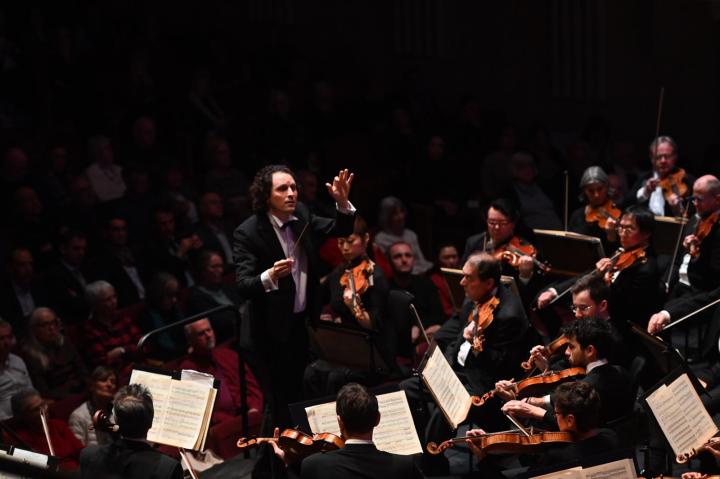
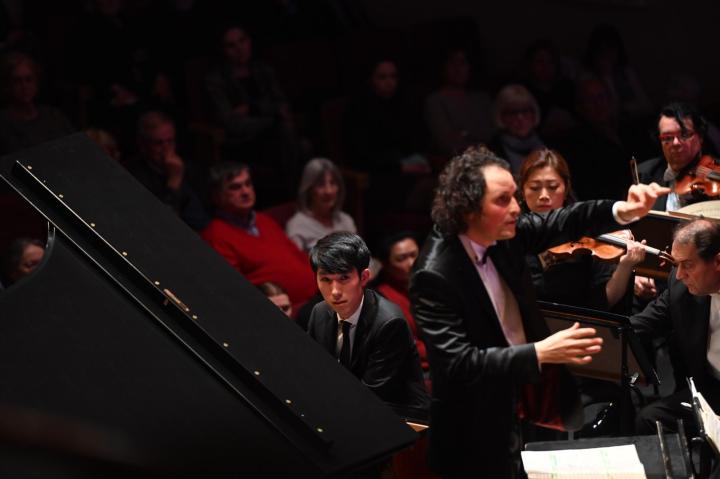
Two days before the UK exited the EU, the Orchestre National de Lille (ONL) performed a programme of European music at London’s Cadogan Hall. They were joined by Chinese-American prize-winning pianist Eric Lu for Beethoven’s Piano Concerto No. 4, the piece with which Lu secured his first prize at the Leeds International Piano Competition in 2018.

The foyer and concert hall reverberated with bi-lingual conversations; unsurprisingly, there were many French people in the audience. In 2020, the ONL is the only French symphony orchestra touring the UK, and its presence here is part of a wider cultural and economic delegation to foster ongoing links with the UK and the Hauts-de-France region, and to further strengthen Anglo-French relations post-Brexit.

The charismatic Alexandre Bloch conducted without the score for the works by Ravel and Debussy, perhaps a sign of how intuitive this music is for him. Opening with Ravel’s Ma Mère l’Oye, a perennial favourite and a gentle opener for this colourful programme, Bloch drew characterful watercolour washes of sound and textures from the orchestra, whose silky transparent strings, haunting woodwind and sparkling percussion elevated these children’s pieces to something far more subtle and sophisticated.

image3

Debussy’s La mer was illustrated in more vivid strokes and colour in an evocative and dramatic portrayal of the mercurial, capricious nature of the sea, from gently lapping waves on a summertime beach to a swelling, storm-tossed ocean. It’s a cliché to say that French musicians truly understand French music, but here one felt a profound appreciation by orchestra and conductor of Debussy’s kaleidoscopic, atmospheric soundworld – those shimmering agitated strings, bright brass and luminous woodwind which brought the music to life in myriad detail and brooding intensity, culminating in a thrilling climax.

Unusually, the concerto opened the second half. This was perhaps for practical reasons, given the amount of rearranging of the stage which was required. Beethoven began sketching his Fourth Piano Concerto in 1804, and unlike many other pieces from his middle period which have become associated with heroic struggle and his personal demons, this work is imbued with serenity and joy, though not without poignancy: this was the last of the composer’s five concertos which he was able to perform himself, due to his increasingly debilitating deafness.

I have been wanting to hear Eric Lu live since enjoying his Leeds competition performance, and I missed his Wigmore Hall solo debut last December due to illness. There are two things which immediately strike you about this young (he’s only just 22) pianist: his modest stage presence and elegant, poetic sound, most obviously demonstrated in his pianissimo touch and Mozartian clarity, especially in the upper register of the piano. There was an intimacy too, in his interactions with the orchestra, and when not playing he turned towards them and conductor, awaiting his next cue.

His quiet presence brought a very palpable tranquility to the second movement, the piano’s tender, hymn-like entries contrasting with the bold, pestering strings. In the finale there was a quiet strength and bravura from Lu in gleaming passages and crisply articulated rhythms, the orchestra matching him with energy and élan.

image2

Unfortunately, I had to leave after the Beethoven, and only heard Lu’s encore (Chopin’s Prelude in B-flat) via the live link the foyer, before dashing for my train. I also missed the final piece in the programme, Ravel’s La Valse, which I don’t doubt was played with the requisite passion and sensuality by the ONL.


Photos ©Ugo Ponte/ONL

Who or what inspired you to take up the piano and pursue a career in music?

I actually never dreamed of becoming a classical musician, and I feel very privileged to have had such a natural and in many ways unexpected career path. The piano choice was purely practical – it was an instrument that was offered to us by a friend so I could start lessons. Of course, now I can say that I was very lucky because I love my instrument for the endless colours and possibilities it offers, for the many sounds – big and small – and the vast repertoire.

Who or what have been the most important influences on your musical life and career?

Influence on my musical life and career can be linked directly to the influence on my life, and that has been mainly by my parents, who have instilled morals, discipline, and enjoyment upon my life. I gather inspiration from everything that surrounds me, the experiences I have, and those I encounter both on and off stage.

What have been the greatest challenges of your career so far?

I cannot, with certainty, separate challenges from successes, as these are inextricably linked in my mind. On the one hand, I do not come from a musical family, but I have learned everything from scratch. When I persevere through the most challenging segments of my calendar, they make me stronger, and enable me to know what I am capable of and what I wish (not) to do.

Which performances/recordings are you most proud of?

I hope to be proud of every performance, and especially of every recording. The way I judge past performances includes elements such as the piano, the hall, and the audience, and these are intertwined with the memories I kept of that particular week – a very large cauldron. I have especially fond memories of some performances, such as the first time I performed in Warsaw, where all my grandparents heard me perform in a concert environment for the first time ever, or my BBC Proms debut in sweltering London summer weather.

Which particular works do you think you play best?

I would not programme works I do not think myself capable of performing, and I hope to add something unique with my interpretation.

How do you make your repertoire choices from season to season?

As a pianist I am in the position of having seemingly endless repertoire to choose from. I have certain pieces on the horizon that I would like to perform, and when there’s the opportunity to do so, I will add them to my repertoire. Recordings dictate the choices of repertoire somewhat, in that I need to prepare it beforehand and perform it after. Large multi-concert tours likewise; these decisions are mutual, made years in advance.

Do you have a favourite concert venue to perform in and why?

I’m terrible at picking favourites (favourite colour, country, person, city, etc.) and this extends to all walks of life. I enjoy the variety of concert halls, and believe it is a skill to adjust appropriately to each environment, from the ultra-accurate 21st-century “high-definition” halls, to some beautiful 19th-century acoustically warm ones, to the Italian opera houses which make you feel suffocated (acoustically, of course), not to mention everything in between. Every hall presents a challenge – and an opportunity – and overcoming the challenges while exploiting the opportunities is part of what makes a performance successful.

Who are your favourite musicians?

I have too many to name – from those I’ve worked with and admire, to those I am friends with, to others who may inspire me in performance.

What is your most memorable concert experience?

I flew to a remote community in Saskatchewan, Canada; an outreach concert from my performance with the Saskatoon Symphony. In La Ronge, most people had never heard a piano before – it was also sent for the recital. The concert was packed, the excitement was palpable, and the genuine appreciation was unlike anything I’ve felt before or since. Falling snow, children in “Sunday’s best” sitting on the floor of the school gymnasium in complete silence. A concert I will gather strength from for years to come.

As a musician, what is your definition of success?

Success is deeply individual, and I consider myself very fortunate to be where I am today.

What do you consider to be the most important ideas and concepts to impart to aspiring musicians?

Make sure you stay true to yourself, practice only just enough, and learn about other things beyond music.

Where would you like to be in 10 years’ time?

Walking on planet Earth.

What is your idea of perfect happiness?

Enjoying the small things that make life magical.

What is your most treasured possession?

My memories.

What is your present state of mind?

Always the same – happy.


Canadian pianist Jan Lisiecki has won acclaim for his extraordinary interpretive maturity, distinctive sound, and poetic sensibility. The New York Times has called him “a pianist who makes every note count”. Lisiecki’s insightful interpretations, refined technique, and natural affinity for art give him a musical voice that belies his age.

Jan Lisiecki was born to Polish parents in Canada in 1995. He began piano lessons at the age of five and made his concerto debut four years later, while always rebuffing the label of “child prodigy”. His approach to music is a refreshing combination of dedication, skill, enthusiasm and a realistic perspective on the career of a musician.

Read more


(Artist photo: JL Holger-Hage)

Guest post by Ben Goldscheider

The Serenade for Tenor, Horn and Strings by Benjamin Britten is one of the many works written for the great horn player of the twentieth century, Dennis Brain. It had its first performance on the 15th October 1943 at the Wigmore Hall with Brain playing and Peter Pears singing.

What, to me, is so remarkable in this piece is how Britten uses the horn as an unspoken commentator on the text sung by the Tenor. This is introduced in the Prologue which is a short movement for solo horn, setting a rather haunting atmosphere that sets up the reflective mood of the following movement, the Pastoral. Britten was seemingly trying very hard to push the limits of a seemingly invincible Dennis Brain, indicating that the Prologue be played on the natural partials of the horn; a recipe for disaster for many other horn players! He makes particular use of the 7th, 11th and 14th partials which, on the horns natural configuration, are “out of tune” to our modern tempered ears. I like to think that Britten was both pushing forward in terms of technical challenges and musical idiom but also looking back, using the natural harmonics of an instrument very much connected to nature, a theme that is central to the Serenade.

Britten’s style of “word painting”, that is, to match the music with the literal meaning of the text, is masterful throughout the Serenade. The opening verse of the Pastoral,  “The Day’s grown old; the fainting sun/ Has but a little way to run”  evokes a very reflective or even sombre feeling which is perfectly encapsulated by the descending triadic melody in D-flat Major that dominates the movement. Sharing this melody between horn and voice, Britten manages to create a musical language in which, after a period of time, merges the dialogue between horn and voice into one expressive gesture.

Again in the following movement, the Nocturne, Britten’s use of the horn to accentuate the power of the text is central to the musical message. He uses the phrase “Blow, bugle blow” from Tennyson’s The Princess which is then punctuated by the horn playing rapid fanfare figures, starting further away in a very quiet dynamic before coming to the fore at the height of the horn’s range and dynamic powers. In the third movement, the phrase, “O rose, thou art Sick” by William Blake is expressed by a mournful descending semitone figure over a pulsating string ostinato that pushes the music in a very uneasy way.

In the Hymn, a movement based on text by Ben Jonson, Britten continues in the tradition of the Mozart and Strauss Horn Concertos by writing a rondo-like figure in 6/8 time. Britten chose words from Cynthia’s Revels which is a play that depicts Queen Elizabeth I as the virgin huntress Cynthia. This allowed Britten the freedom to deploy the horn in its typical hunting style in an extremely lively movement that finishes with the horn player walking off stage to prepare for the Epilogue. Whilst the piece is by no means humorous, I can’t help but find connotations with the humour written into the horn part of the Mozart Horn Concertos by the composer himself, often making fun of, and insulting, the horn player. It cannot be a coincidence, or at least Britten himself must have had it in his conscience, that following a 6/8 movement (all of Mozart’s Horn Concertos finish with a lively 6/8 Rondo), Britten writes one of the lowest notes available on the horn (perhaps he liked the idea that one may miss this note and then have to walk off stage embarrassed) before the horn player has to leave in an almost comedic effect. I have never played this piece without hearing at least one snigger from the audience…

As a piece, Britten’s Serenade is written extremely well for the horn. It is very idiomatic, despite its challenging aspects of endurance and sheer technical capability. What is rather rare to the piece is that Britten writes the expressive phrases in sonorities that sit very well on the instrument: he writes the explosive figures at a range in which the horn player will be able to fully express the meaning of the music and he writes with a full understanding of the instrument’s capacity to be a perfect partner to the sensitivity of the voice. I personally find it hugely rewarding to play and it is an absolute joy to be able to play such a masterpiece with the human voice, an instrument which is to me, the epitome of expression.


d68502_b03c86f3f58d41b592ad96ad328dbb7dmv2_d_3477_5150_s_4_2_srz_970_903_85_22_0-50_1-20_0At the age of eighteen, Ben Goldscheider reached the Final of the 2016 BBC Young Musician Competition, where he performed at London’s Barbican Hall with the BBC Symphony Orchestra. Since then, he has performed at venues including the Berlin Philharmonie, Lucerne Culture and Congress Centre and London’s Royal Albert Hall, where he made his BBC Proms Debut in 2018. He has also appeared as soloist with the Lucerne Symphony Orchestra, Aurora Orchestra and City of London Sinfonia. In 2018, Ben released his debut album with Willowhayne Records to critical acclaim, and was selected both as BBC Music Magazine’s “Rising Star” and Gramophone Magazine’s “One to Watch”.



This season, Ben makes concerto debuts with the English Chamber Orchestra, Manchester Camerata and the Prague Philharmonia.  In February he returns to the Berlin Philarmonie to perform the Gliere Horn Concerto with das Sinfonie Orchester Berlin conducted by Radek Baborák. A committed chamber musician, Ben has performed at London’s Wigmore Hall with tenor Julian Prégardien and pianist Christoph Schnackertz, the Pierre Boulez Saal alongside Daniel Barenboim and Michael Barenboim and the Verbier Festival with Sergei Babayan. Future highlights include the Jerusalem Chamber Music Festival and Trio concerts with Callum Smart (violin) and Richard Uttley (piano) across the UK, featuring the premiere of a new work by Geoffrey Gordon in London. Sought-after as an orchestral player, he has performed as guest with the Staatskapelle Berlin, Philharmonia, English Chamber, West-Eastern Divan Orchestras and in 2018, played the solo horn call from Wagner’s Siegfried in a semi-staged production with The Hallé and Sir Mark Elder.

Read more

Meet the Artist interview with Ben Goldscheider