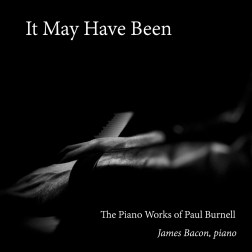
it20may20have20been20album20front20cover201500This new album celebrates the piano music of British composer Paul Burnell, spanning 30 years. Paul had recorded and produced previous albums himself, but in this instance he decided it was time to work with another musician, the pianist, composer and recording engineer James Bacon who runs the Piano Recording Studio. The music was recorded on a Bosendorfer Phoenix Imperial 290, fitted with the Phoenix agraffe system pioneered by Richard Dain at Hurstwood Farm Pianos, which gives the piano greater sustain and clarity of sound, especially in the high registers. This makes it ideal for Burnell’s piano music, much of which explores the timbre and sonic possibilities of the piano rather than melody per se.

“Unembellished, unfussy, unsophisticated…..and short” – Burnell’s own programme note for his Plain Pieces, a triptych dedicated to pianist Natalie Bleicher, could be applied to all the music on this album, though I would hesitate to use the word “unsophisticated”. Short, unfussy these pieces might be, but there is sophistication in the careful placing of notes to create subtle shadings, unexpected harmonies and suspended sounds. “Minimalist” is a description which immediately springs to mind on first hearing Burnell’s music, but this is not the frenetic (sometimes irritatingly so) repetitious minimalism of Philip Glass or Michael Nyman, but rather the more contemplative and spare minimalism of composers such as Lawrence Crane, whom Burnell cites as important influence (It May Have Been, Just Before Dawn). The more up-tempo pieces here (Pacer Nos, 1, 2 and 3) owe more to Howard Skempton (another significant influence) in the use of changing chords and sequences to create energy and climactic episodes. There are also echoes of that other great American minimalist, Steve Reich, in Standing in the Rain. Composed in the mid-1980s, the piece features a persistent rhythmic figure redolent of Reich’s Clapping Music and similar compositions.

Paul was kind enough to send me copies of the scores of the pieces featured on this album and it has been a pleasure to explore the music both through listening and playing. The music is accessible (roughly Grade 3-7) and attractive, but not simplistic (see my earlier comments about sophistication) and it takes a skilled and thoughtful pianist to create the considered sounds which Burnell’s music requires. This music also offers the piano student a good introduction to minimalism and provides a jumping off point for further exploration of this genre.

James Bacon brings the works to life on this recording with clarity, sensitivity and creativity – adding a drone to 2 Ping – combined with his technical expertise in the field of recording and sound engineering, and superb state-of-the-art equipment.

Recommended.

‘It May Have Been’ is available from iTunes, Amazon and other retailers as a download or CD, and can also be streamed on Spotify.

Paul Burnell’s Meet the Artist interview will be published shortly.


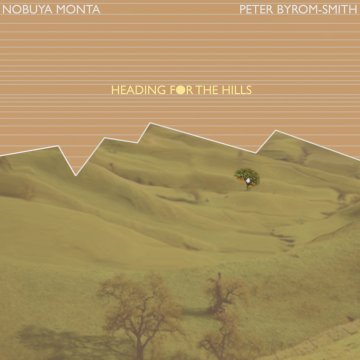
‘Heading for the Hills’ by Nobuya Monta and Peter Byrom-Smith
a1757970457_10
Performed by Strata String Quartet
Violin 1: Oliver Morris
Violin 2: Alexandra Dunn
Viola: Laurie Dempsey / Alice Billen
Cello: Roderick Skipp

Recorded at Blueprint Studios, Salford
Mixed and Mastered by Gaz Hadfield
Cover design by Louis Barabbas

Debt Records, released July 15, 2016

This first classical release by Debt Records celebrates a groundbreaking East-West collaborative partnership between Japanese composer Nobuya Monta and British composer Peter Byrom-Smith. ‘Heading for the Hills’, a suite in 10 movements for string quartet, is the main work on the album, bookended by Sonata Lamentosa and Sinfonia by Monta. Peter Byrom-Smith’s work, which lends its title to the album, is a tribute to the landscape of the Peak District close to where Peter and his wife Gillian, a poet, have made their home in Glossop in Derbyshire.

“The title of the album was taken from a poem written by my wife Gillian Byrom-Smith. The poem was inspired by the frequent rail journeys we have taken across the flat Vale of York towards the beauty of the Pennines.”

The main six movements of the work are musical images of real journeys between the east and west of England, depicting things the composer observed, or thought he had observed during the course of these journeys (Galleons, Swallows, Raindrops, Heading for the Hills Lanterns, Buds). A Prelude and Postlude were added to complete the work – and the journey – so that the suite works as an entire narrative when performed in concert. No. 7, Buds, was composed by Nobuya Monta and Peter Byrom-Smith.

This haunting, expressive and evocative music contains hints of British minimalist composer Michael Nyman, but without the (sometimes tiresome) insistent repetitions. Byrom-Smith seems more intent on using melody, harmony and dialogue between the instruments to create interesting textures and musical interactions. Motifs are stated, restated and developed, for example the dancing figure which opens over a drone in ‘Raindrops’  develops into a playful, twirling dance between the instruments. Here there are more than a few hints of English folksong and dance before the middle section unfolds in a more contemplative manner. Later, the folksy motif returns and an insistent little fanfare is heard in all instruments. 

‘Swallows’ creates a feeling of space, of birds wheeling and circling in the sky, with its contoured melodic lines and delicate fioriture, redolent of the solo violin line in ‘The Lark Ascending’ by Vaughan-Williams. ‘Buds’ unfolds slowly, just as a flower or plant opens to reveal itself. The final work in the suite, Postlude, recalls themes heard previously in the Prelude and introduces new material to bring the narrative and imagery to its conclusion.

Nobuya Monta’s ‘Sonata Lamentosa’ is an emotional response to the tragedies that have occurred all over the world. The textures here are more florid, the mood more urgent with an almost Schubertian melancholy (cf String Quartet No. 14, ‘Death and the Maiden’), though, as in Schubert, there is also a sense of hope. 

The closing work on the album, ‘Sinfonia’, is also by Monta, and once again seems infused with the moods and motifs of late Schubert and the harmonic and rhythmic piquancy of the early twentieth century (Ravel, Debussy). It utilises contrapuntal textures and the second movement is a thrilling fugue.

‘Heading for the Hills’ – CD or download

Composer Peter Byrom-Smith will featured in forthcoming Meet the Artist interview


Jimmy-Lee-Guitar-Runaway-WildKat

Who or what inspired you to take up composing, and pursue a career in music?

I discovered my ability to compose almost by accident. I had always been active and in love with the performing arts, school plays, school and church choir’s amateur dramatics etc…. It all started for me when I began to write poetry, mostly autobiographical of childhood memories, life experiences and so on. Without any formal training, I found that I could create melodies by turning my poems into song; I seem to have a natural gift as a songwriter. The four pieces on the album ‘The Empty Room’ were written on guitar some time ago and although I was not able to transcribe them for symphony orchestra myself at that time, When I was eventually able to hear the music played by the ensemble I founded, I was more than delighted and promised myself that one day I would record and perform all of my music albeit ballads, folk, Americana but most importantly, orchestral.  That time came a few years ago. Since that time I have produced four albums, written over thirty songs poems and produced two musical stage productions from albums.. All have been well received and proven very popular with a variety of audiences. I am ‘at one’ when I am performing!

Who or what were the most significant influences on your musical life and career as a composer?

In my childhood and at school I became emotional, reflective and very thoughtful when I heard pleasing melodies and songs. I remember at school performing Schubert’s ‘Trout’, so beautiful and meaningful; also the songs of Stephen C Foster. I was captivated by their meaning and how simple it seemed to be able to tell a story and express emotion and events good or bad. In the early 60’s I was fortunate enough to share a flat in London with very talented musicians, with a wide range of musical interests from folk to orchestral and I attended many performances throughout London and yearned to play my part. I practised hard on guitar/vocals and played my first few gigs at the Troubadour and the Half Moon in Putney.. From then on I was hooked.

What have been the greatest challenges of your career so far?

To keep my desire to perform in check. I have dipped in and out of the music scene from the late 70s, performing in the UK, Europe and the USA but my sense of responsibilities’ to provide security for my young family always overruled my personal ambition. I have no regrets in pursuing a career in the commercial world, which was thankfully both enjoyable and successful.

What are the special challenges/pleasures of working on a commissioned piece?

The challenge is to understand what is required and to create something that will last, stand the test of time and be meaningful and pleasing not just to the audience but to yourself. I have no respect for transient music.

What are the special challenges/pleasures of working with particular musicians, singers, ensembles and orchestras?

I am not the greatest musician in the world and I am always in awe of the standard talent and ability of trained or gifted musicians. Sometimes I feel intimidated and inadequate but I am usually put at ease and enjoy that company enormously.

Which works are you most proud of?

Apart from my orchestral works, which I am enormously proud of, there is a ballad on my ‘Runaway’ album called Hard Man. It was a difficult song to write and sometimes too difficult to sing but the lyrics say it all. It is a song about my Father who suffered terribly in Burma during the WWI and carried the scars for life. It is both a criticism and a tribute to a man who was never able to be the Father that I know he could have been and wanted to be.

Who are your favourite musicians/composers?

There are many from Chopin, Mozart, Schubert, John Williams, Paul Simon, John Lennon, Adele, Leonard Cohen, Kris Kristofferson and many more!

What is your most memorable concert experience?

Hearing my orchestral works performed by a full symphony orchestra at the Guards Chapel in Wellington Barracks, London in November 2015

What do you consider to be the most important ideas and concepts to impart to aspiring musicians?

For me, all music must tell a story that would be both interesting and in some way moving. The story line/lyrics will often suggest music and the music will often suggest a story line or lyrics. The two are inseparable do not be swayed by what is in vogue follow your instincts your gifts are specific to you… create and never give up!

Where would you like to be in 10 years’ time?…….

Still alive and well.

What is your idea of perfect happiness?….

Contentment.

What is your most treasured possession?…

My health and my guitar.

What do you enjoy doing most?…

Snowboarding, wind-surfing, and performing but not at the same time !!!!

What is your present state of mind?…

Excited, apprehensive, confident and pleased that at this time in my life I still have a lot to look forward to.

From classical music to folk and country, Jimmy Lee has an exotic and diverse compositional style. Disregarding all barriers that stand between genres, Jimmy has pursued his love of music regardless of any rules. His career has taken him across the globe from bars and beer joints in America’s Mid West to London’s Wembley Arena. After taking a break from the music scene, Jimmy Lee founded the Blue Coconut Music Club and decided to take up his calling once again.

Jimmy Lee released his debut classical album for symphony orchestra in Spring 2016. Having caught the attention of the Director Music at The Army Corps of Musicians (CAMUS), Kneller Hall with the power and beauty of his music, Jimmy Lee begun a collaboration with the Military for his next project. The album was recorded by Abbey Road Studios at The Guards Chapel, Wellington Barracks and Birdcage Walk with combined military and civilian musicians.

Read more about Jimmy Lee here


jackwhite1

Who or what inspired you to take up composing, and pursue a career in music?

My parents and especially my granddad have always been very supportive and encouraging. My granddad always wanted to be able to play the piano and compose, but he wasn’t offered any opportunities to learn when he was younger. I think that’s what drove him to encourage me: he saw that I enjoyed it, and made sure I took all the opportunities I could.

Who or what were the most significant influences on your musical life and career as a composer?

It may sound obvious, but my parents. I couldn’t have been offered the opportunities I have been today without their help and support.

What have been the greatest challenges/frustrations of your career so far?

I think it’s important to learn how to fail ‘productively’. As a freelance composer you are never going to get every single opportunity you put yourself forward for. It’s important to try and remain positive. Take criticism on board where you think it’s fair, but remember that your music should ultimately be defined by you. There have been times when I have felt it was right to reject criticism. Knowing when to do this can be tricky to navigate when you’re starting out.

With every performance you get better at communicating the music in your mind’s ear to an audience. This process is a very personal one. It operates on many levels between transcription and translation. No-one can tell you whether it has been successful other than yourself. Do not be too self-critical when you make a mistake, because that’s how you learn.

What are the special challenges/pleasures of working on a commissioned piece?

It’s great when you can shape a piece around a specific group. I always try to feed off the energy and enthusiasm of an ensemble when I write.

What have been your favourite aspects of working with London Music Masters as part of your award over the last year?

I think the performance of my piece “Flutter” in Festival Hall was very exciting.  I loved seeing the faces of the children after they had performed the piece, they looked like they had enjoyed performing it, and that was very satisfying for me.

Can you tell me a little bit more about how the piece came about?

I had the idea of using pieces of foil on the strings, to make the piece a bit more fun for the very young performers.  This came from the idea of music’s transformative power which has the possibility to effect change in people’s lives. The piece was written for beginner string players and a choir, so this idea became part of the chorus: “Music is a butterfly, filling the air with something you can’t buy, because
it makes my heart-beat flutter”.

What feedback did you receive from the piece?

Well it was lovely to hear that the piece had been well received by the LMM teachers who said that it was aimed at just the right level without being too simplistic.  I also had a few parents come up to me to thank me after the concert. One mother said that her child had been singing it all the time, so I apologised as you may expect!   When I was writing it I structured the whole piece around the simplest part (just using open strings) and built it up from there. I think this approach worked well rather than taking the hardest part and working back.

You’ve also been writing for a YCAT artist as part of the award, can you tell us who it is yet?

Yes, it’s the trombonist Peter Moore.  I was very excited to have the opportunity to write for such a talented performer.

What have you written for him?

The piece is called ‘Three After-Dinner Pieces’.  It’s in three movement and each is based on a different type of cheese.

Cheese? Tell us more about this….

I am a big fan of cheese in all it’s different variety.  I work part time in a cheese shop in Cardiff called “Madame Fromage” and I thought it would be a unique way of structuring a piece. My ideas have come both from the physical form and taste of the cheese, and its country of origin. For example, in the first movement (Stilton) the mouldy striation reminded me of unsynchronised fanfares, which have become part of the texture of the work. Similarly the viscosity of Epoisses has allowed an exploration of glissandi effects in the trombone part.

Which cheeses did you select for your piece?

Stilton, Caerphilly and Epoisses, the last of these being my favourite.

Are you pleased with the piece?

Yes, I haven’t written for the trombone as a solo instrument before, and Peter is such an excellent performer with an amazing expressive range that I wanted to write something to show this off.  I will be looking forward to the premiere very much.

When is the premiere and where will it be performed after that?

27th September in Colston Hall, Bristol, with the first London performance on October 3rd, in Wigmore Hall. I am also lucky to be able to conduct some workshops around this performance in association with LMM. We will be visiting schools to talk about the writing of the piece.

What are you working on at the moment?

I have been commissioned to arrange a recording of Satie’s “Parade” for National Dance Wales, in a performance about the Russian revolution.  BBC NOW are recording the piece in early September so I will have my work cut out for me to get everything ready in time for the performances on 25th Oct in Wales Millennium Centre, Cardiff and the 29th in Pontio, Bangor.


Of which works are you most proud?

I love the recording of my BBCSO orchestral piece ‘Digital Dust’. Also, the multi-part choral piece ‘Islands (Ynysoedd)’ I wrote for what became a celebration of Sir John Tavener’s life in Southwark Cathedral, following his death. More recently I wrote a piece for Côr Aduniad called ‘We Have No Right To The Stars’. This is a translation of a poem by Hedd Wyn, and I think it’s one of my favourite choral settings to date.

How would you characterise your compositional language?

I like to describe my style as emotional and accessible. When I was first getting inspired by music I used to get the ‘tingle factor’ (when the hairs on the back of your neck used to stand up) when I listened to music I loved. I have tried to find a compositional language which allows others to feel a strong emotional attachment to my work.

How do you work?

I like to write straight into the computer if I am working on a piece. I usually work at a piano to sketch ideas, and when I am happy with them, notate them straight away.

Who are your favourite musicians/composers?

Kaija Saariaho, Jonathan Harvey, Michael Tippett, John Tavener, Benjamin Britten, Tori Amos, Björk.

What is your most memorable concert experience?

I can’t remember the exact details but I watched Vaughan Williams’ ‘Fantasia on a Theme by Thomas Tallis’ when I was very young. I can remember the music having a profound impact upon me.

What do you consider to be the most important ideas and concepts to impart to aspiring musicians?

Learning how to listen is probably the most important part of becoming a musician. It takes time to develop and is fundamental to your success in all areas of the business.

Where would you like to be in 10 years’ time?

In a studio which would make Hans Zimmer jealous!

What is your idea of perfect happiness?

Being truly grateful for everything you have.

What is your most treasured possession?

My piano.

What do you enjoy doing most?

Laughing.

What is your present state of mind?

Upbeat.


Jack White studied music at Somerville College, Oxford.  His postgraduate studies have been undertaken solely at Cardiff University where he has recently finished his PhD in composition.  His research interests are in electroacoustic composition and the combination of this media with traditional ensembles in ‘live’ performance.  He is also interested in the scoring methods used by electroacoustic composers and the relationship between such methods and a work’s identity.

Jack White is the recent recipient of a London Music Masters award

Jack White’s website