guest post by Michael Johnson

It has been a long journey I enjoy re-living as I take note this year of the great Ludwig van Beethoven’s 250th birthday. As a practicing music critic and journalist from American corn country, I call myself a hick hack but I experience meltdown at almost everything the great man wrote. How can one not love Beethoven?

Well, at first he might seem an unlikely idol for me, growing up in a small town in the flat, agricultural Midwest, too far from everything. My ears rang with Tennessee Ernie Ford’s recording of “Cry of the Wild Goose”, a mindless vehicle for the late crooner, but I ate it up. My five brothers and sisters and I played it over and over on our new 45-rpm console. It was one of the records that came free with the player.  There was also “Whoopie Ti-Yi-Yo” by the Sons of the Pioneers.

Only after I escaped from Indiana and moved to California for university education did I open myself to new worlds of music. I first discovered Baroque, an instantly accessible form that had me humming along and tapping both feet. Friends observed my head bobbing uncontrollably as Vivaldi, Scarlatti, Purcell, Corelli, Lully, Campra and others excited me.

Finally a colleague on the San Jose State University school newspaper took me aside and promised much better thrills – more satisfying than cannabis and completely legal. He had just come from a performance of Beethoven’s Ninth and was still marveling at the experience. “You gotta hear this,” he gushed. “It will knock your socks off.” He was almost right.

I never lost my socks but over the next year I built up a complete library of Beethoven symphonies on vinyl LPs, moving backward from Nine to One. The scope and variety left me spinning, and I have never stopped exploring the rich oeuvre of symphonic, choral, solo piano and chamber music Ludwig left us.

In my early piano studies at university I played what every schoolgirl plays –  the Bagatelle “Für Elise”, moving on to his “Moonlight Sonata”. And by shameless cherry-picking, I plunged into parts of the “Diabelli Variations” and a few of his 32 piano sonatas, guided by tempo markings such as “Largo”, “Andante” and, my favorite, “Grave e maestoso”. The slower the better.

I gave up piano lessons when I grew tired of wandering around on the famous plateau students hit after the easy stuff is done. I have spent the rest of my life picking out passages of Schubert, Chopin, Schumann, and Liszt I catch on radio as I tell myself, “Hey, I could play that.” Sometimes I get the sheet music off the internet and start to work.

Now my CD collection is particularly rich in Beethoven. I am listening to the late string quartets as I write this, and his piano trios are among my favorites. Of course nothing beats the Ninth, or even the Fifth. I also relate to the emotional Seventh.

I gradually became a music writer and critic, keeping myself busy attending concerts and writing my reaction to the players’ efforts. The idea of a pianist alone on a spacious stage playing for an hour and a half from memory, no safety net, still strikes me as one of the great feats of human courage and accomplishment.

By chance, I have done interviews recently with two pianists who have performed the five Beethoven piano concertos from memory, conducted from the keyboard, in one day – François-Frédéric Guy and Rudolf Buchbinder. François also plays all the sonatas from memory over three weekends.

I liked Rudi’s dismissal of my praise for his “marathon” performances. “Ach,” he said, “it’s nothing special.” François said he is not running a marathon here, he is showing the audience how Beethoven’s creativity evolved.

Beethoven has a way of remaining ubiquitous. His work is eternal and musicians love performing it. New recordings appear like clockwork. In this crowded field, no one, in my opinion, has surpassed Wilhelm Kempf’s heart-stopping sonatas.

In many other ways Beethoven keeps entering my life. When I was based in Paris as an economic journalist I received news that my father was failing fast with lung cancer after a lifetime of smoking two packs a day of Lucky Strikes. We were never close, but I picked up the phone and asked my mother to put him on. Silence for a few minutes. She came back and said, “He is lying on the hardwood floor, the only place he can find comfort. He is listening to Beethoven’s Ninth.” He never made it to the phone. He died two days later.


Michael Johnson is a music critic with particular interest in piano. He worked as a reporter and editor in New York, Moscow, Paris and London over his writing career. He is the author of five books and divides his time between Boston and Bordeaux. He is a regular contributor to The Cross-Eyed Pianist.

Illustration by Michael Johnson
Guest post by Nick Hely-Hutchinson

The first in a series of guest articles exploring people’s personal responses to or relationship with Beethoven and his music.


Beethoven and me go back a long time. I recall precisely the first occasion I heard his music.

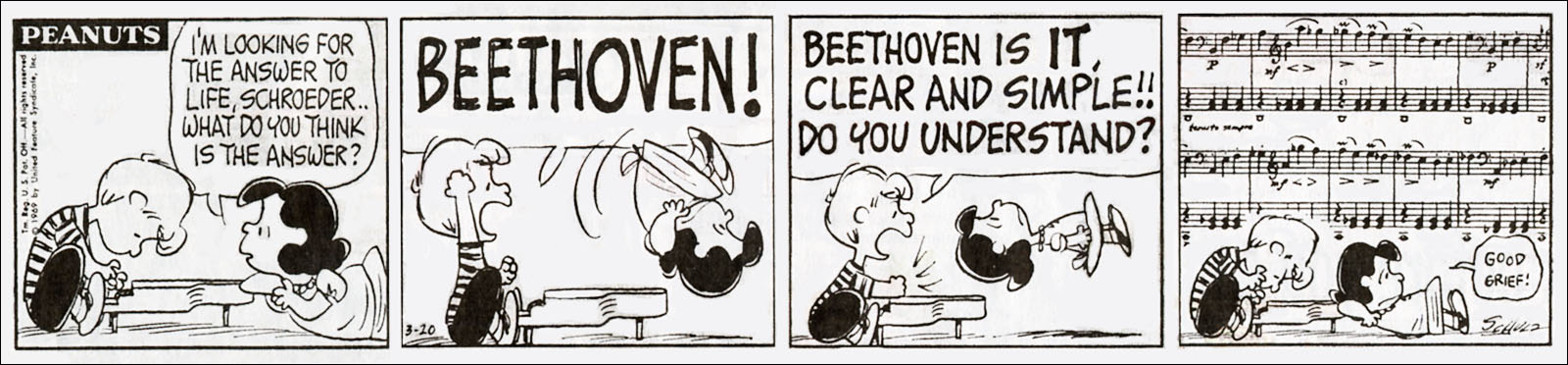
I was taken as a young child to one of the early Charlie Brown films. Along with Linus and Snoopy the dog, Schroeder is Charlie Brown’s closest friend. But the other passion in Schroeder’s life is Beethoven. He is, you might say, nuts about him.

beethoven1600x372

During the film, Schroeder plays the slow movement from the Pathétique sonata, and I went home resolved to learn the piece. (Battling the two outer movements came some years later. This became something of a pattern for me – “Oh, I could play that!”, only to discover that Beethoven rarely composed simple stand-alone works.)

You are going to read a great deal about this complex man during 2020, this being the 250th anniversary of his birth. I am no expert, no musicologist, just an amateur enthusiast, but Ludwig van Beethoven gets my vote as being one of the most influential people ever to grace the planet. The simple truth is that he threw away all the rules, and nothing in music, perhaps even the wider arts, was the same after him.

Readers of my blog, manuscriptnotes.com, will know that Schubert is my favourite composer. But if I had to single out the one composer who had, has, the greatest impact on me in so many ways, it would have to be Beethoven. In the context of classical music, I am minded to replace the word ‘music’ in John Miles’s famous lyric to read ‘”Beethoven was my first love and he will be my last.”

Why so?

It may sound hokey, but in Beethoven’s music you have everything of what it means to be human. Schulz’s cartoon above says it all. His irascibility, temper, scruffiness, woeful love-life, manifold dwellings, poor personal hygiene are all well known; as is his near thirty-year struggle with deafness, a particularly cruel infliction for a composer. All of these traits and frustrations are writ large in his music: never before has the personality, the humanity, of a composer been so glaringly revealed in his output, whether symphony, concerto, sonata, choral work, or chamber. All his music speaks to us of life itself.

Lest you charge me with spewing out sentimental nonsense, let me try and demonstrate it with a piece of music with which you may not be familiar.

Beethoven wrote sixteen string quartets, a form first used by Haydn, then developed by Mozart. Conveniently, these fall into three periods in his life, early, middle, and late, and it is the slow movement of one of the late ones, no.13, which sums up this humanity more than any other piece I know.

Writing about music is notoriously difficult, and nothing demonstrates that better than this. The 5th movement, the Cavatina, does not have a tune per se that will leave you humming it later. Marked molto espressivo, you may not ‘get’ it at first. I didn’t. But after a few listens you will want to submit to its profound and indescribable beauty, yearning for it to go on when it comes to a sudden halt. At its heart is a searing violin, the music soon enfolds you in this heart-wrenching blanket of tenderness. Half way through, there is a brief ‘choke’, a change of tempo, and it is widely believed that a blotch on the original score is a tear from the eyes of its composer.

Beethoven could only hear these notes in his head – he couldn’t test anything out on a keyboard. Composed less than two years before his death, you can feel the aching sorrow at his condition, but also a sense that after all the bang, crash, wallop we associate with Beethoven, this, more than anything else, (and he wrote some truly gorgeous slow movements) is the purest summation of the man, his music, his life – and, by extension, humanity itself.

If that consigns me to Pseud’s Corner, I go willingly.


Nick Hely-Hutchinson worked in the City of London for nearly 40 years, but his great love has always been classical music. The purpose of his blog, Manuscript Notes, is to introduce classical music in an unintimidating way to people who might not obviously be disposed towards it, following a surprise reaction to an opera by his son, “Hey, dad, this is really good!“. He is married with three adult children and is a regular contributor to The Cross-Eyed Pianist.

Guest post by Nick Hely-Hutchinson

If Beethoven were alive today, there has to be a decent chance – likelihood, even – that he would have been cured of the deafness which beset him for the last fifteen years of his life.

Of the various remedies which were suggested to him, and there were plenty, amongst them was the suggestion to use olive oil.

In Cornwall last year, I managed to collect some water in my left ear which refused to come out, with the result that by April this year I could barely hear a thing if I blocked my right one. Nearly two hundred years after the great man, I was also recommended the use of olive oil, but as a precursor to having the ear syringed, as the oil softens the wax and thereby reduces the risk of damage to the drum during the procedure.

Beethoven is unlikely to have collected too much water in his ear, for his personal hygiene was almost nonexistent. I am equally sure that it would have taken more than syringing to deal with his problem. But my own experience has given me the teensiest sense of what it is like not to hear properly.

Summing up the work of any composer in just one piece is not just difficult, it is verging on the daft. Beethoven’s enormous output in his miserable life had many landmarks, many ‘firsts’. His third symphony, the Eroica, changed symphonic writing for good. His ninth was the first to include a choir. I could go on…

But if I had to single out just one piece which summed up the core frustration in his life, it would be his 23rd (of 32) piano sonata, now known as the Appassionata.

Writing about music is notoriously hard, and, some would say, a little futile, because it is the hearing of it and the experience which is personal to each of us. Beethoven, however, who once quipped that he would rather write 10,000 notes than a single letter of the alphabet, speaks to us so directly in his music, and this piece in particular, that it is not at all difficult to understand its message.

Beethoven has something of a reputation for tumultuous, even ballsy music. Because of this, it is easy to forget that the man wrote some of the most exquisite and sensitive slow movements in the entire repertoire. It’s like a lion stopping in his tracks and scooping up a lesser mortal to tend and nurture, rather than trample or devour.

So today I’m giving you the last two movements of the Appassionata, played with appropriate passion and wonderful clarity by Valentina Lisitsa.  It starts with a simple theme, followed by three distinct variations, before returning to the original. At first it may seem a little pedestrian, but as it unfolds, Beethoven’s mastery of counterpoint, the ability to have two or more tunes singing at the same time, comes to the fore. It becomes five minutes of pure tenderness, which grow on you each time you hear it. As it comes to its close, Beethoven launches straight into the final movement without a pause.

This is Beethoven ranting at the world at the loss of his hearing. Listen to that circular motif after the first few seconds, which remains a theme throughout: it is the cry of an anguished man, pacing up and down in his room. Anger; frustration; desperation; turmoil. In the unlikely event that he has not made his point, the final minute will leave you in no doubt. And yet,  in the midst of it all this, a pleading beautiful melody, begging for a cure.

(I was once advised by a piano teacher to concentrate on the left hand and the right will take care of itself. Not a chance that works here.)

This is Beethoven laid bare in the sound. Of all composers, few reach us on such a human level: he goes directly to our souls like no other. Some of Beethoven’s greatest works were written when he was completely deaf. Imagine that for a moment: to know how it’s going to sound without the experience of actually hearing it. What a genius.

I have deterred you too long. Listen to this and be glad you can. And if you haven’t had your ears syringed, you might like to consider it. I’m now turning the volume down, not up.

Just need to stop saying ‘what?’, which has become something of an irritating habit.


This article originally appeared on Nick Hely-Hutchinson’s Manuscript Notes site.


Nick Hely-Hutchinson worked in the City of London for nearly 40 years, but his great love has always been classical music. The purpose of his blog, Manuscript Notes, is to introduce classical music in an unintimidating way to people who might not obviously be disposed towards it, following a surprise reaction to an opera by his son, “Hey, dad, this is really good!“. He is married with three adult children and is a regular contributor to The Cross-Eyed Pianist.

The crescendo to the final of the 2018 Leeds International Piano Competition has been abuzz with activity, commentary and interviews, concerts and masterclasses, and has created a wonderful sense of a shared celebration of all things piano. Many of these activities are the initiative of the new Artistic Directors of the Leeds competition (Adam Gatehouse and Paul Lewis) in a bid to give the competition a wider reach beyond the confines of the concert hall, and even experiencing them at arm’s length, via social media and the broadcasts on MediciTV, I’ve sensed the excitement surrounding the revamped Leeds competition. The addition of a chamber music element to the competition is a very welcome one too, in my opinion, and I agree fully with Adam Gatehouse’s assertion that if one is able to play, connect and communicate with other musicians in a chamber music setting, one is also able to connect and communicate with an orchestra – as the finalists must do in their concerto performances.

MediciTV’s live stream of all the performances has brought an immediacy to those of us who didn’t make it to Leeds in person – the broadcasts are no longer consigned to a discreet evening slot on BBCFour – and also makes the competition feel truly international: anyone can tune in from around the world.

Performances by Aljoša Jurinić (Croatia, aged 29), Anna Geniushene (Russia, aged 27) and Mario Häring (Germany, aged 28) comprised the first evening’s finals concert, and here I offer my brief thoughts (from notes made while watching the live stream broadcast) on the three competitors:

007-Aljosa-Jurinic-SQUARE
Aljoša Jurinić

Aljoša Jurinić – Mozart Piano Concerto in C minor, K491

It’s really cheering to see a Mozart concerto in a piano competition final. And this year there are, unusually, no concertos by Rachmaninov or Tchaikovsky. A shot of Aljoša Jurinić backstage, chatting to conductor Edward Gardner, showed a young man who looked incredibly chilled and relaxed ahead of one of the most significant performances of his career. This easefulness was translated into his playing which was natural and poised. The first movement had a lovely clarity of articulation and shading, with a good sense of synergy between soloist and orchestra. Jurinić seemed sensitive to the drama and muscularity of this opening movement, creating a sense of spontaneity and improvisation, particularly in the cadenza. The second movement was elegant and good-natured, but the finale felt a little too polite/safe for me. Given that this concerto was completed just before the premiere of The Marriage of Figaro, I felt more operatic drama was needed. But overall, this was a very mature, confident and engaging performance.

Anna Geniushene – Prokofiev Piano Concerto No.3 in C major, Op.26 

025Anna-Geniushene-SQUARE
Anna Geniushene

This for me was a really fine performance – assured, confident, with soul and personality, and a wonderful sense of freedom. My husband, who was half watching in between following la Vuelta (tour of Spain cycling race on his laptop), remarked, without any prompting from me, that he playing was “singing and colourful”. I last heard this concerto performed by Martha Argerich at the Festival Hall in 2016, and I felt Anna brought some of the same excitement, colour and spontaneity to the work, as well as a clear sense of ownership. Her communication with conductor and orchestra was excellent, and the passages where the piano part seems to take flight into its own world were very convincing.

Noriko Ogawa deemed it “a dream concerto!” after the performance – and I agree with her: it was!

063-Mario-Haring-SQUARE
Mario Häring

Mario Häring – Beethoven Piano Concerto No. 1 in C major, Op. 15

A warm, generous and joyous performance by Mario Häring, with excellent communication with conductor and orchestra. I felt the conductor in particular was really enjoying this work and the pleasure came through, with Mario responding equally in a performance that was lively, precise, colourful and engaging with great clarity and musical sense.

Tonight’s concert features performances by the other two finalists, Eric Lu and Xinyuan Wang.

Follow the Leeds Competition on MediciTV and on Twitter via #LeedsPiano2018


More on the Leeds on this blog:

Leeds preview – in conversation with Jon Jacob

Podcast with Adam Gatehouse