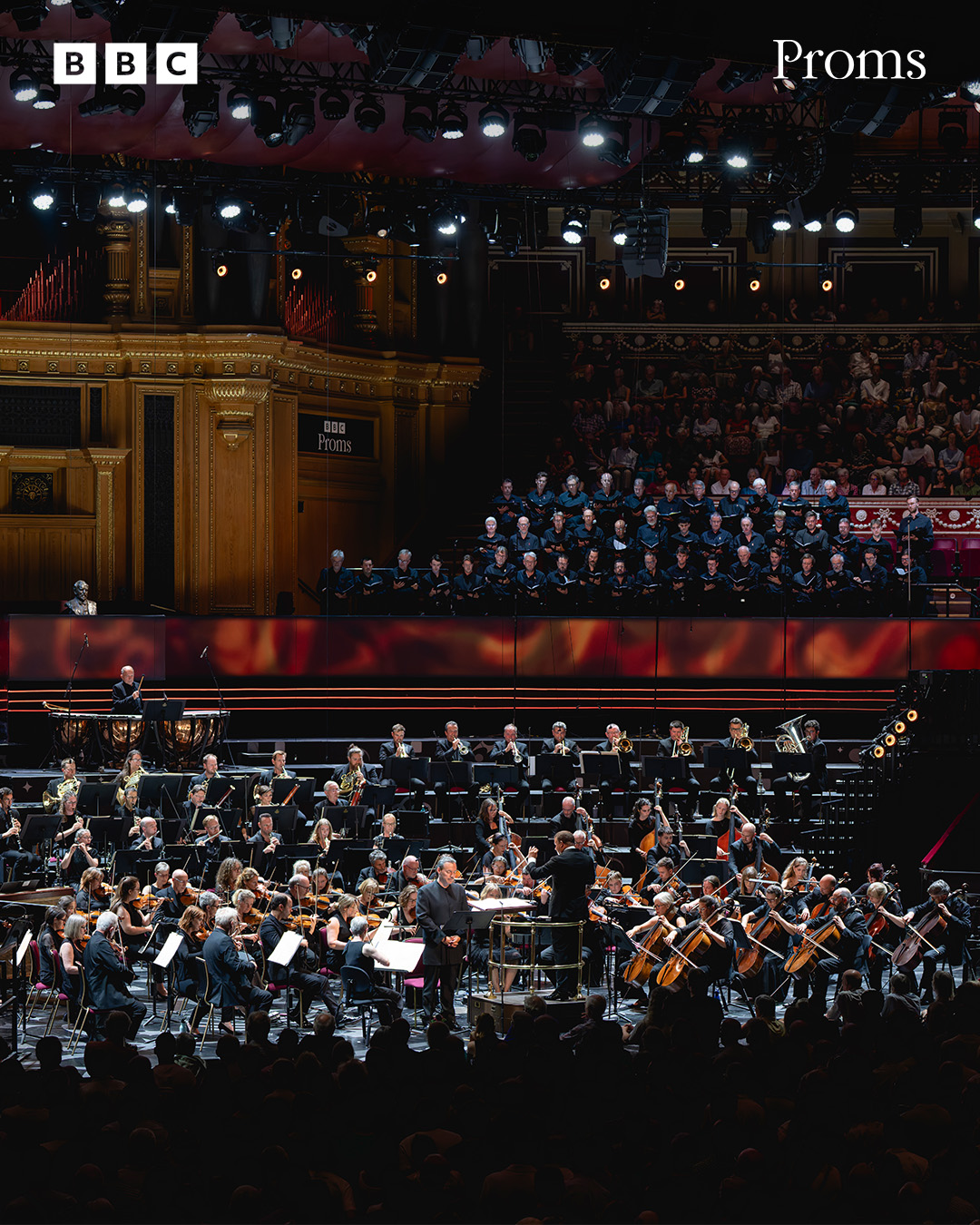
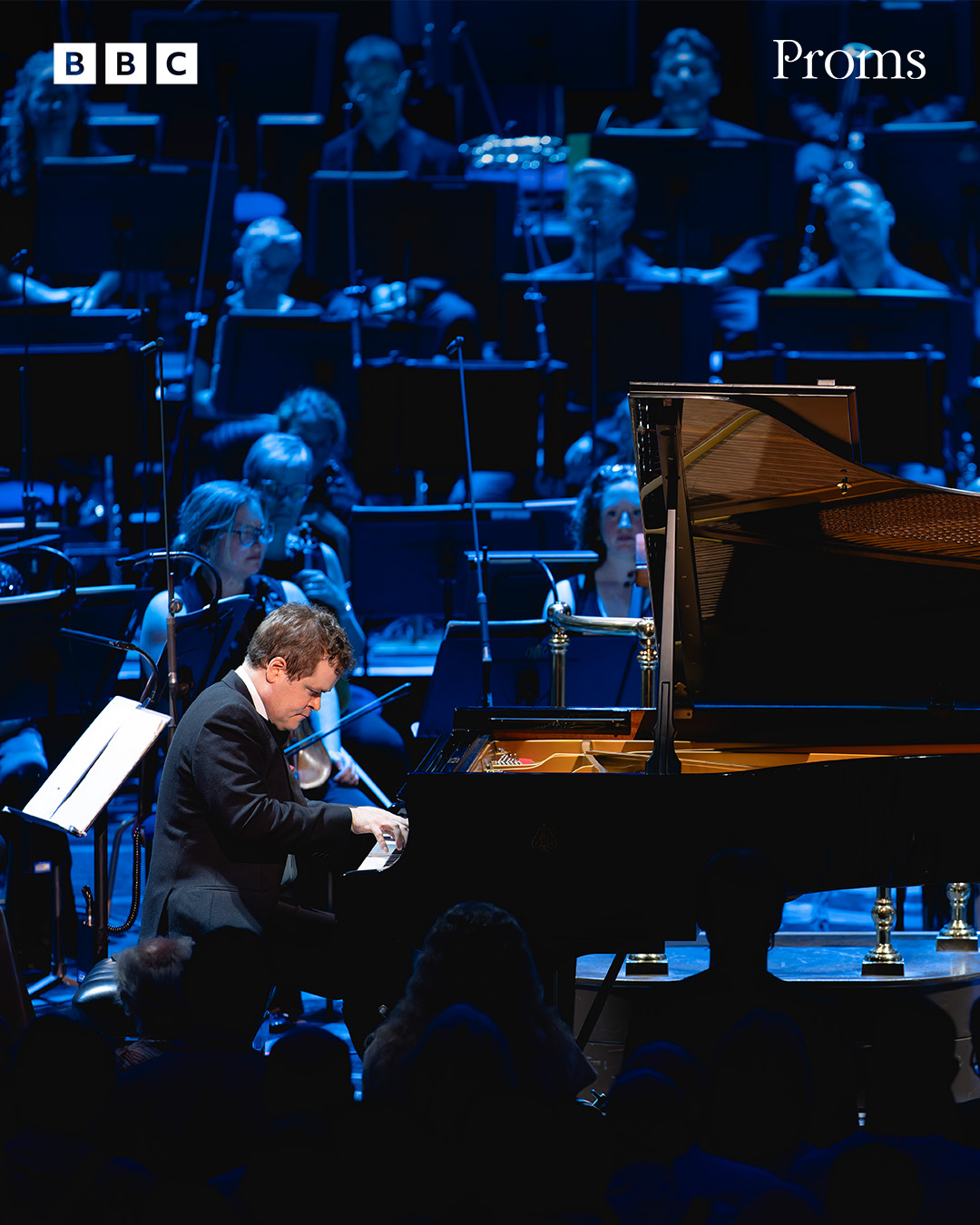
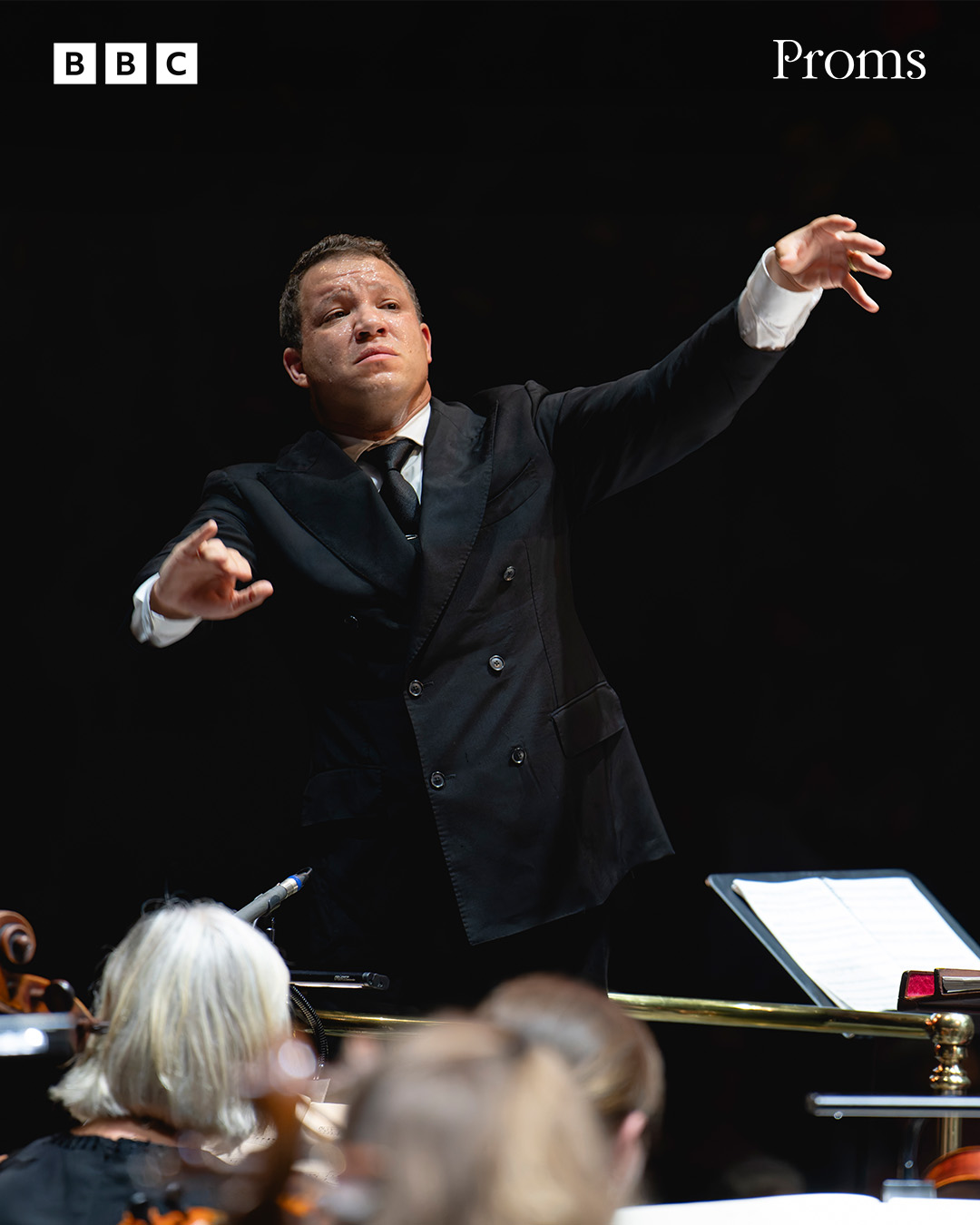
Social media, for all its faults, is also a force for good and can throw up unexpected encounters and delights. One such gem is Andy Lewis’s Proms blog, which I discovered via the music critic of The Spectator, Richard Bratby.
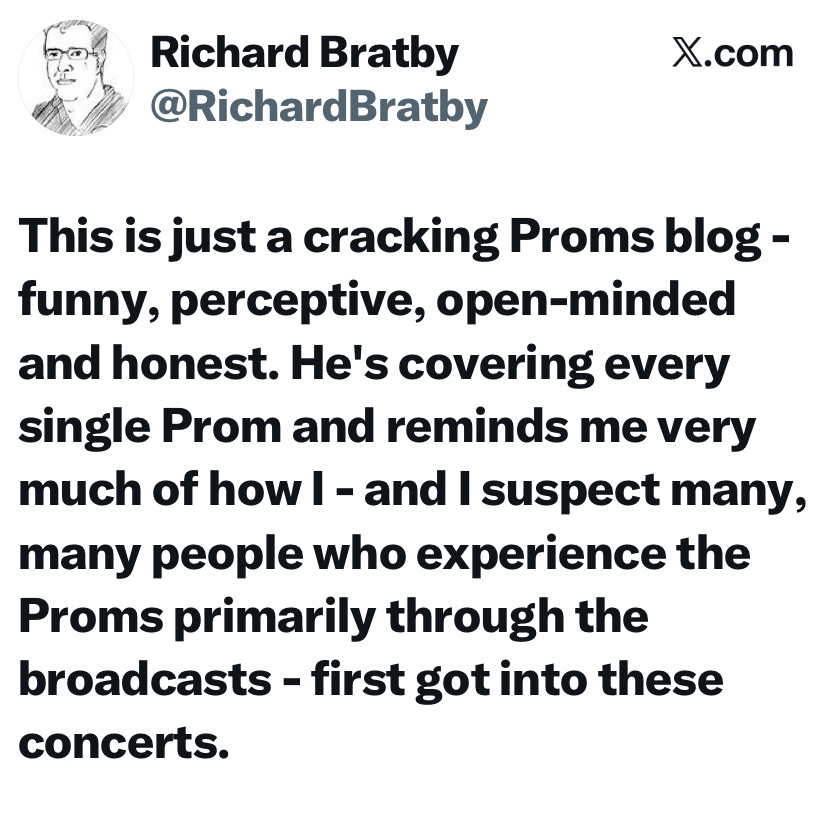
Andy Lewis is blogging about every single Prom of this year’s season, mostly via the broadcasts on BBC Radio 3. He hasn’t missed a single one and is now in the home straight, as it were – the final week, and the close of this year’s at the Last Night of the Proms.

What is so wonderful about Andy’s blog is that it’s not trying to be a serious critique or dry academic appraisal of each concert, but rather a personal reaction to and reflection on the music. He publishes his posts soon after each concert has taken place and as a consequence, his writing is fresh and spontaneous, entertaining, engaging and intelligent (and it reminds me of how and why I started blogging, back in 2010).

I caught up with Andy to find about more about his motivation for writing about the Proms and what he’s enjoyed in this season’s programme….

What made you decide to blog about every single Prom of the 2025 season?

It came about for a few different reasons. I was taken with the premise of the Proms; the fact that it is still possible to buy a ticket on the day for just a few pounds. I used to think to myself, ‘I’d be at the box office every morning if I lived around here.’ This triggered an ambition of one day attending every Prom at the Albert Hall, and this idea has laid dormant in my mind for years. I like to keep myself occupied, and this year my diary was nearly empty for the eight or so weeks when the Proms were happening. To fill my free time, I decided I would ‘attend’ every Prom, whether it be watching it on TV, listening on the radio, or actually getting down to the Royal Albert Hall in person. To make it more meaningful, I decided to create a record of it – hence the idea of the blog. As the weeks have progressed, the blog has also evolved into including little diary snippets from my daily life. If I’m still alive and well in thirty years, it will hopefully be interesting (for me) to read it back. Maybe my opinions on things will have changed by that time. Maybe I’ll be living a completely different life.

Have you attended/followed the Proms before this year?

I had only ever attended one Prom before, and I can tell you exactly which one it was!

It was Prom 48, Sunday 21st August 2016. The programme was Reflections on Narcissus by Matthias Pintscher to start, and then the second half was Mendelssohn’s theme to A Midsummer Night’s Dream. As I remember it, the music was blended with pop-up dramatic performances in different areas of the hall. Going to this Prom was what initiated my desire to see all the acts in one given year, but I had not gotten round to it until now.

What have been the challenges and pleasures of this project? 

The pleasure has been discovering new composers, and getting a deeper understanding of composers I only half-knew before. Additionally, looking up the history and origins of the Promenade concerts themselves has been fascinating. In terms of challenges, it has often been exhausting to keep up with the schedule on a daily basis. Early in the run, I was having doubts as to whether I would be able to keep up with it all. If I miss a Prom one day, the momentum will very quickly snowball against me, so I need to make sure I am on top of blogging every day; trying to keep my writing fresh, avoiding repetition where possible, and keeping my grammar in reasonable check against a tight schedule.

And what have been the stand-out moments/performances for you?

It has honestly all been great and varied, but if you really tortured me I think I would say that the best Proms, for me, have been the ones that took me by surprise – those Proms that I thought were going to be boring and difficult to document, but turned out to be the exact opposite. Who would have thought that ‘100 Years of the Shipping Forecast’ would turn out to be so contemporary and engaging? There were packets of surprises hidden in the ‘Bruce Liu plays Tchaikovsky’ Prom – I was gleeful at the inclusion of Maple Leaf Rag amongst others. And Joe Hisaishi’s Proms debut introduced me to music I already knew. Music in the Studio Ghibli productions such as My Neighbour Totoro offer something gorgeously meditative.

Why do you think the Proms is “the world’s greatest classical music festival”?

I think it’s a combination of accessibility, variety, diversity, and longevity. The fundamental idea of the festival is that it opens up classical music to your ‘average Joe’ like me. I can grab a ticket for £8 (in 2025) and enjoy an evening of world-class entertainment. The variety of the performances across the summer weeks makes sure there is something for everyone. The diversity on the stage has ensured the Proms have kept up-to-date with the world around us, and this in turn has kept the Proms running for as long, and successfully, as they have been.

What would you say to people who are unsure about classical music or who have never attended a Prom before?

I would say, ‘don’t be afraid of getting classical music wrong’. If you enjoy what you hear, go and see it played live, just like you would a pop or rock act. Even pass comment on it if you dare to do so. There may well be a bunch of Oxbridge academics looking back at you like that Leonardo DiCaprio meme, but the truth is that music is subjective and – when offering an opinion on it – they are as clueless as the rest of us.

Would you do it all again in the same way for next year’s Proms? 

Right at this moment I would say absolutely not! However, I do think I have opened a new relationship with the Proms, and in future years I will be more liable to be looking through the catalogue, choosing which Proms I would like to watch, listen to, or attend.

With regard to my writing, this is likely to be a one-off. But I would never say never. It would be nice to do something with a similar twist. For example, another one of my cultural challenges has been to watch every Shakespeare play, performed live. At time of writing I am on thirty-one plays, seen at different venues around the country. Given the number of operas based on Shakespeare and his characters, it could be an idea to review them with an amusing twist, comparing a production at the Royal Opera House to, say, the time I saw the same play at Gordale Garden Centre.


My name is Andy Lewis, I am thirty six years old. From the Wirral but living and working in Runcorn. I work in Medical Information for a multinational healthcare company, and in my spare time I like to attend rock concerts and theatre. I also play guitar, piano and harmonica. I am a music lover with my main genre being blues-rock, but I do also love classical and orchestral music.

Follow Andy on X

Read Andy’s BBC Proms Marathon 2025 blog
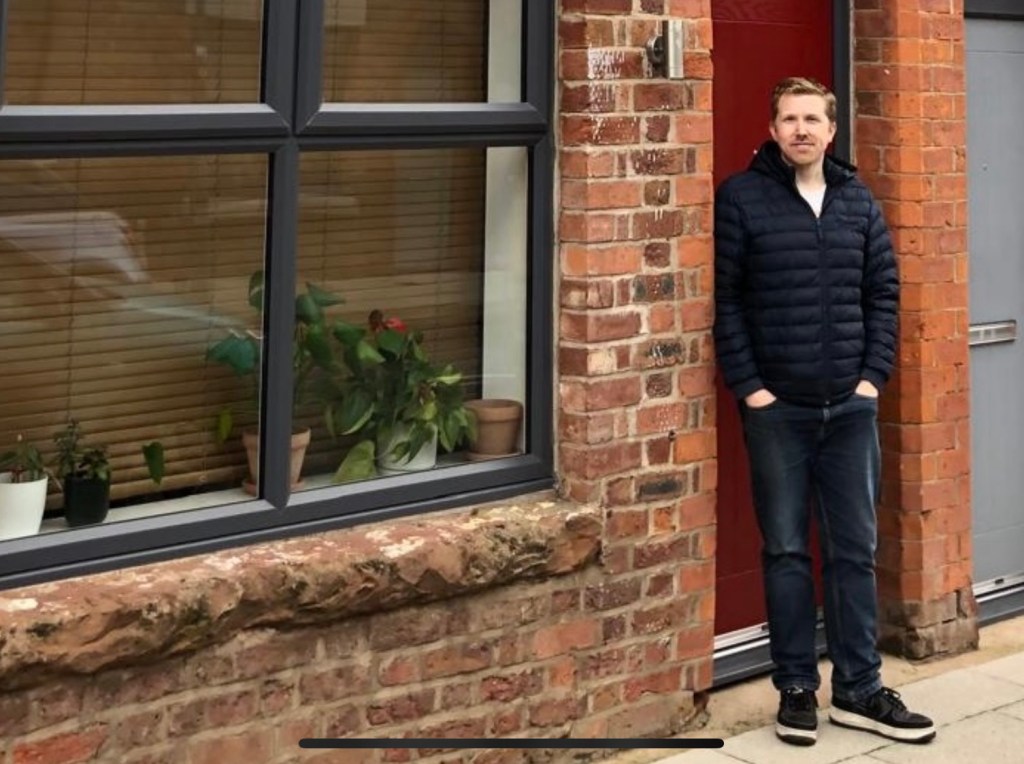
Andy Lewis

Sofia Gubaidulina Revue Music for Symphony Orchestra and Jazz Band
UK premiere

Ravel Piano Concerto in G major

Shostakovich Symphony No. 13 in B flat minor, ‘Babi Yar’

Benjamin Grosvenor piano
Kostas Smoriginas bass-baritone

Synergy Vocals
BBC National Chorus of Wales (lower voices)
BBC National Orchestra of Wales
Ryan Bancroft conductor


It’s eight years since I was last at the Proms in person. In that time, there is better air-conditioning in the Royal Albert Hall, and the queues for the ladies’ loos are not quite as long. People grumble about the deficiencies of the RAH, but it remains an impressive space and one can’t help feeling excited on entering the vast arena and sensing that pre-concert anticipation building amongst the audience.

We escaped the teeming crowds around South Kensington station and had a very civilised pre-concert supper just off High Street Kensington and then strolled back to the RAH through elegant streets lined with Porsches and other luxury vehicles. At the hall, there was the usual confusion about which door (“is it door 6 or door J??”) and then we were in our seats, behind the Prommers, with a direct sightline to where the piano would be for the Ravel (concert companion and I are piano nerds – and he chose the seats!).

The opening piece, Sofia Gubaidulina’s Revue Music for Symphony Orchestra and Jazz Band, receiving its UK premiere, was, frankly, utterly bonkers. A crazy mash up of groovy 60s psychedelics, 70s funk, movie soundtracks and big band jazz collided with lush orchestration and silky strings redolent of Korngold, with some spoken word and vocals thrown into the mix for good measure. It was foot-tappingly lively, unexpected, witty and fun: an uplifting and entertaining opener for this concert.

And it provided the perfect link to Ravel’s glittering G major concerto, a work of syncopated jazz brilliance, composed at the height of the Jazz Age in Paris, replete with nods to Spanish Basque music and the “blue notes” of Gershwin. Benjamin Grosvenor gave a stand out performance, playing what is perhaps his “signature piece” (in 2004 he won the Keyboard final of BBC Young Musician with this concerto, when he was just 11). And here, as in any piece he touches, he created the most beautiful sound, even in the fortissimo range. This was matched by remarkable versatility, switching from sparkling, playful runs across the keyboard to gorgeous passages of luminous lyricism, especially in the second movement, a sublime meditation set between the heady Spanish exoticism and jazz idioms of the outer movements. For an encore he gave a remarkable performance of the ‘Precipitato’ finale from Prokofiev’s Sonata No. 7, with its repeating “rock and roll” left hand idiom and angular, relentless drive.

The first half was a brilliant example of thoughtful programming, where the works connected and reflected upon one another. And then that encore, from a sonata composed in the depths of wartime, provided a bridge to the second half, and a complete change of mood.

Where previously conductor Ryan Bancroft bounded onto the stage with all the exuberance of a puppy, now he was serious, quietly escorting bass-baritone Kostas Smoriginas for the performance of Shostakovich’s Symphony No. 13. Here, the composer set words by the Russian poet Yevgeny Yevtushenko , to commemorate and mourns a heinous act of mass murder, when in 1941 and 1943, during the Nazi occupation of Soviet Ukraine, more than 100,000 people, most of them Jews, were shot by Nazi soldiers, with the help of members of the local population, in a ravine called Babi Yar in Kyiv. The symphony is also a condemnation of anti-semitism, its five movements scored for bass-baritone, male chorus, and large orchestra with an expanded percussion section.

A tolling bell opens this work of immense power, bleakness and strange, granitic beauty. The music snarls and bites, soars and whispers, sardonic humour contrasts with moments of tenderness and profound poignancy. You don’t need the text to understand the narrative – the music does it all. In the final movement there is a sense of hope, with sweet string writing, a haunting solo on bass clarinet, a distant tolling bell and the gentle tinkling of the celesta to bring this monumental work to a quiet climax. Silence enveloped the hall for perhaps two minutes: how else could one respond to such a masterful performance of this compelling, profound and thought-provoking music.

Listen on BBC iPlayer

(Images BBC Proms, header image by Marco Borggreve)

Who or what inspired you to pursue a career in music and who or what have been the most important influences on your musical life and career?

There was no musical influence until I saw and wanted a little toy piano at the age of 5, which my parents bought for me. Having shown interest in pressing keys that make sound, my parents proceeded to find me a teacher. In fact one of my several childhood teachers still follows my career to this day. She introduced me to the wonders of music through reading me all sorts of stories, literature and relating it to the music that we would listen to. I especially remember being inspired by the legendary recording of 12-year-old Evgeny Kissin playing both Chopin Concerti.

What have been the greatest challenges of your career so far?

It has definitely been a learning curve since winning the Leeds Piano Competition. You have to be very disciplined with your time, carefully estimate and learn about what you can or can’t manage, preferably not the hard way! Planning programmes has been especially challenging as you have to take into account many factors, e.g. my development, audiences, and of course what I want to say artistically.

Which performances/recordings are you most proud of? 

I am pretty happy with the Transcendental Etudes for the time being. I really enjoyed the process of creating something in a church in Hampstead for three days straight. It was quite an intimate experience as opposed to being on stage. That music has such a vast variety of ideas, so I felt fortunate to be able to explore it and try to convey this variety.

Which particular works/composers do you think you perform best?

At this point, I don’t think there are any I could say I perform best. I’m constantly learning about the styles of each composer and sometimes I relate with one more than the other at certain times. I can only say that I could never stop playing Beethoven or Chopin.

What do you do off stage that provides inspiration on stage?

Everything in life contributes, from eating, visiting places, to spending time with interesting people. A more direct way of being inspired for me is listening to others.

Do you have a favourite concert venue to perform in and why?

Besides Wigmore Hall, I very much enjoy playing in the Philharmonic Hall of my home town in Almaty, Kazakhstan. I enjoy sharing with the audience of such different culture what I’ve learnt over here.

What do you feel needs to be done to grow classical music’saudiences?

Making classical music accessible to everyone so everybody has the opportunity to discover potential affinity for it. Of course, the earlier the better.

What is your most memorable concert experience?

Definitely Rachmaninov Second Piano Concerto at the Proms [in 2023] with 2 days notice!

As a musician, what is your definition of success?

Success suggests an end goal for a certain task. As there is no end to perfection in music, I’d say making sure of consistent growth however small, is a success.

What advice would you give to young/aspiring musicians?

Discover yourself, your strengths and weaknesses. Play to your strengths while working on your weaknesses. I was fortunate to have a teacher who assisted me with this.

Pianist Alim Beisembayev hails from Kazakhstan and has already made a name for himself, having won the world-renowned Leeds Piano Competition in 2021 aged just 23. He appears at this year’s Cheltenham Music Festival on Thursday 11 July playing music by Schubert, Chopin and Clara Schumann. More information


alimbeisembayev.co.uk


This site is free to access and ad-free, and takes many hours to research, write, and maintain. If you find joy and value in what I do, why not

Guest post by Adrian Ainsworth

It’s not often I take up my pen in literal anger, writing to purge myself somehow of an irritation that has been eating away at me for a day or two now. I speak – as you have no doubt guessed – of the latest BBC Proms recruitment ad, seeking candidates for roles in ‘Live Events and Communications’.

“Here’s a short video,” the BBC Proms Twitter account chirped, “to give you a taster of what it’s like working at the Proms.”

With a cute ‘technical-glitch’ shimmy, we’re immediately introduced to a freshly-minted young BBC publicist. Against a percussive, rhythmic soundtrack, she says: “One thing about the Proms that people don’t know is that it’s not all just about classical music like Mozart and Beethoven.” Cue frantic burst of definitely-not-classical music. She continues, over montages of Proms passim: “The Proms showcases so many different music genres and styles from House, Ibiza music, to Sci Fi film music, to breakdancing music. So there really is something for everyone, and you don’t necessarily have to have a background in classical music to work at the Proms.”

Then we switch to a colleague, whose ‘stand-out moment’ when working for the Proms was dressing up as an astronaut and jumping about on stage during a performance by the band Public Service Broadcasting.

Perhaps anxious to avoid the tone becoming any more ‘space cadet’, the video returns to our first correspondent, who says that “Working at the BBC Proms helped me to build up so many skills. This allowed me to get another job at the BBC working in publicity for TV programmes instead.”

We finish with the Spaceman warmly recalling the various teams within the overall Proms department feeling like a large, happy community, with further images from concerts in which, thankfully, some classical musicians are included.

It may be a feature of lockdown, and the slightly dislocated mental state it can produce, that the oddest and most unexpected things can really push your buttons. THIS really pushed my buttons. I checked to see if it was 1 April. On a second viewing, I felt like gnawing my own arm off, and by a blinking, disbelieving third, I wanted to cry. I assure you, my flippancy is disguising – perhaps not very well – a deep-seated hatred of this advert and the thinking that went into it.

When the ad first appeared, some people reacted with distaste, sadness or horror – similar responses to mine, in other words. Others played its impact down, more or less saying that it’s only aimed at getting a certain type of dynamic, can-do employee through the door and that the ‘audience’, in this case, is not the audience. And yet – it’s out there for all of us to see, isn’t it, as circulated by the BBC Proms team? They endorse this ‘message’.

And what a message. Taking it from the top, what have we got?

  • Luckily, the whole thing isn’t just classical music ‘like’ Mozart and Beethoven. Boooo-ring!
  • The Proms offer a wide range of musical genres, but I don’t know what any of them are. I thought they had quite broad, well-known names like jazz and soul, but someone handed me a piece of paper with ‘Ibiza music’ and ‘breakdancing music’ on it.
  • For those of you who aren’t really interested in the music aspect at all, there’s the jumping astronaut element.
  • After all, you’ll only be using the skills you learn at the Proms to get another job doing what you really want to do.

Forgive me: it turns out I am still angry.

This ad was put together by people who are, unaccountably, embarrassed by classical music – to the point where they feel the need to sideline it, to apologise for its irksome presence. They couldn’t be bothered to give their poor participants some kind of script or direction to sound at least vaguely interested – let alone well-versed – in music of any shape or form. Why bother, I suppose, if they’re only going to hang around for a minimum length of time before moving on?

The Proms is the world’s ‘largest’ classical music festival. I believe this claim is undisputed. Normally, I’d be the first to say size doesn’t matter, quality over quantity, and so on. But I think the sheer scale of the Proms says something positive. It would be pointless, unseemly and of course, wrong to say we have all the ‘best’ venues, singers, players, and so on: this is the arts, not sport. But the ambition shown simply to mount the Proms year in, year out – notwithstanding the virus wrecking the 2020 season – sends a signal about how much we care about classical music. Under the BBC’s stewardship, some 80 concerts take place each year, which reach well beyond the capital: every minute of Proms music goes out on BBC Radio 3, and a handsome amount makes it to TV on BBC4. Programming is deliberately wide, and at its inventive heights it seasons the classical music line-up (which, let’s get this straight, is the absolute backbone of the repertoire) with forays into other genres which complement the whole. The diversity can be itself diverse: macro – full concerts foregrounding musicians from all corners of the globe – or micro – lining up premieres from living composers alongside the old ‘warhorse’ pieces to ensure new music is heard. And as everyone involved knows, there’s still a lot more the festival can do, and a lot further it can go.

I try to get across in all my writing (and occasional speaking) that classical music is approachable and accessible as long as you treat it as such; as vital, vibrant and valid as any other style of music. As a result, the Proms recruitment ad felt like a kick in the teeth. It could have placed classical music proudly alongside the genres it inspires, supports, complements and interacts with… and accordingly, win over some applicants who would want to work in a classical music environment and stay there.

Instead, everything good the Proms sets out to achieve, this unthinking dumbshow throws into reverse. I hope they accidentally recruit some excellent communicators.

(This article first appeared on the ArtMuseLondon site)


Adrian Ainsworth is, by day, a copywriter specialising in plain language communications about finance and benefits. However, he spends the rest of the time consuming as much music, live or recorded, as possible – then writing about it, often on Specs, his slightly erratic ‘cultural diary’ containing thought pieces, performance and exhibition write-ups, playlists, and even a spot of light photography. He has a particular interest in art song and opera… and a general interest in everything else. He is a regular guest writer for The Cross-Eyed Pianist and a reviewer for its sister site ArtMuseLondon.

Twitter @Adrian_Specs