
Who was the busiest conductor in 2011? Who was the most performer composer? How is opera faring, despite the high price of tickets? What were the most performed works in 2011? Find out the answers to these questions – and lots more – on Bachtrack’s Concert and Opera League Tables
And is there honey still for tea? The Last Night of the Proms
As English as Earl Grey tea, wasps at a picnic, warm beer, wet summers, Rupert Brooke, and Andy Murray not getting past the semis at Wimbledon, the Last Night of the Proms is a fine tradition and a much-loved national treasure.
Music snobs and cynics may criticise the Last Night (and indeed other programmes in the Proms season) for “dumbing down” classical music. Others may regard all the flag-waving and singing of Rule Britannia! as rampant jingoism verging on unpleasant nationalism – and if the Prommers were skinheads and card-carrying BNP members, maybe that would be true. But in fact, watching the Last Night on television on Saturday night, the overriding sense is of a wonderful shared experience and a real celebration of music and music making. And not all the flags were Union Jacks, not by any means…..

The Proms has grown, from its relatively humble origins at the Queen’s Hall in London at the end of the nineteenth century, to an internationally renowned music festival. When the Proms were first conceived, the motivation was to bring classical music to a wider public and to encourage those who might not normally go to classical music concerts to attend. This is still the Proms’ USP, and something it is clearly doing right, given the record attendance figures this year. Latterly, the Proms has become more populist: this year we’ve had a Horrible Histories Prom, a Comedy Prom and a Spaghetti Western Prom, but alongside these more popular programmes we’ve also had many premiers of new works, fine orchestras and soloists from all around the world, and night after night of fantastic music. I have been to four Proms, reviewing for Bachtrack, and have enjoyed every single one of them. After the stuffy, hidebound, reverential atmosphere of the Wigmore Hall, with its (mostly) snooty, superannuated audience, the Royal Albert Hall is a breath of fresh air. At each Prom I attended, there was a wonderful sense of people coming together to enjoy and celebrate music.
It’s hard to get a ticket to the Last Night: like Wimbledon, tickets are allocated by ballot and you have to submit your request months in advance. Thus, the sense of occasion is even greater, if you are one of the lucky ones to be there. Even if you are not, the tv and radio coverage is so good these days that you can join in the festivities from your living room, as I did last night. Or attend a Prom in the Park, a relatively new innovation which aims to bring music to an even wider audience.
The programme started seriously enough with a new work by Sir Peter Maxwell Davies, followed by some lively, spiky Bartok, before the first Main Event of the evening, Susan Bullock singing Brunhilde’s self-immolation scene from Wagner’s Ring cycle. I can live without Wagner, though certain friends insist that I can’t, and while I admired Susan Bullock’s performance – and her striking scarlet dress – I found the extreme vibrato in her voice obscured the music. She’s clearly a popular performer, and interviewed afterwards by Katie Derham, she admitted that the atmosphere in the hall was remarkable.
Next up was Chinese posterboy rockstar pianist Lang Lang. He’d dashed from the Prom in the Park across the road in Hyde Park, where he’d played the most ridiculously flashy account of Liszt’s ‘La Campanella’ I have ever heard, to perform more Liszt, the First Piano Concerto, in the main hall. I admit I have very little patience with performers like Lang Lang. Sure, he’s a fine technician, but there’s no real substance nor depth to his playing – and this was more than evident in the Liszt Concerto, which he reduced to another display of unnecessary piano pyrotechnics. Added to that, his gurning and grinning, his affected gestures, and his Liberace-like smiles at the camera…. He’s a big crowd-pleaser and received rousing and sustained applause. He returned after the interval to wreck Chopin’s ‘Grande Polonaise Brillante’, more schmaltz and sugar plums, before offering the most sycophantic, sentimental Liszt (the ‘Consolation’ No. 3) as an encore.
Next, Britten’s ‘Young Person’s Guide to the Orchestra’, a welcome relief after Lang Lang’s extreme attention-seeking, with Jenny Agutter reading a rather toe-curling new version of the text written by poet Wendy Cope. The rest of the programme is, traditionally, devoted to the massed singalong, beginning this year with ‘Climb Ev’ry Mountain’ (from The Sound of Music) and ‘You’ll Never Walk Alone’, Susan Bullock returning to the stage in a vivid electric blue gown, to lead the singing. Then it was Elgar, twice, the audience urged by conductor Edward Gardner (the youngest conductor to conduct at the Last Night) to sing up and drown the piccolo. And finally, Rule Britannia!, sung by Susan Bullock, wearing a hilarious parody of Britannia’s costume, complete with flashing daffodils on her breastplate, and Jerusalem. All good wholesome fun, and entirely uplifting.
So, the Proms is over for another year, yet predictions are already being made about next year’s programme. I’ve heard rumours that Barenboim will conduct all nine of Beethoven’s Symphonies, and, being the Olympic year, the 2012 season is likely to be really special. I’m looking forward to it already!
Meanwhile, the autumn season at the Wigmore Hall has just begun, and I have a full diary of concerts to look forward to, beginning tomorrow lunchtime with young French ‘piano babe’ Lise de la Salle. Other highlights include Robert Levin playing Mozart with the OAE, Garrick Ohlsson, Louis Lortie, Peter Donohoe and Mitsuko Uchida. You can find links to all my reviews for Bachtrack on this blog, as well as plenty of other piano-musings. And don’t forget to check out Bachtrack’s listings for concerts, opera and ballet around the world (click on the graphic on the left).
The Old Vicarage, Grantchester by Rupert Brooke (spot the quote which inspired this post!!)
Review: Prom 54 – Jaw-dropping virtuosity

Canadian pianist Marc-André Hamelin celebrated the 200th birthday of Franz Liszt in a late-night Prom of coruscating virtuosity and extreme pianism. Read my review for Bachtrack here.
Of Proms and Promming
This time last year I wrote a piece for this blog arguing for a change of venue for the Proms, London’s two-month summer classical music festival. We’re a fortnight into the current season, and I have already attended two Prom concerts, courtesy of Bachtrack. One was at Cadogan Hall, a lovely venue just off Sloane Square, with comfy seats, a great view of the stage wherever you sit, a fine acoustic (it’s a converted church), and a champagne bar. Here I heard the young harpsichordist Mahan Esfahani give an exquisite and at times idiosyncratic performance of Bach’s iconic Goldberg Variations (read my review for Bachtrack here). And then, last Friday, I attended the Proms ‘proper’, if you will, for a lively evening of Franco-Hispanic music by Debussy, Ravel and de Falla: from Bach’s Baroque world in microcosm to a sweeping panorama of Spain evoked in lively and atmospheric orchestral music.
As a child and teenager, I used to go to the Proms every year with my parents, who would pour over the programme as soon as it was published (this, of course, many years pre-internet, and the Proms booklet would be for sale in WH Smith). There wasn’t such competition for tickets then, although tickets for the First and Last nights were allocated by ballot. I heard a wide variety of music, and sometimes we would sit in the choir stalls behind the stage, affording one a wonderful view of the orchestra at work. About 10 years ago, I heard Lang Lang, playing Tchaikovsky, before he shot to superstar status, and before that Evgeny Kissin. The last time I was at the Proms, before last Friday, we sat high up in the vertiginous upper circle, where we sweltered, and from where Stephen Hough, the soloist, was but a speck on the stage, and Rach Three was rather lost in the vastness of the Albert Hall. In the interval we drank warm white wine out of plastic glasses and had to sit on the stairs near the ladies’ loo. Not especially enjoyable. The whole experience was rather tiring, fraught and effortful. After that, I decided I would avoid the Proms.
The Proms have not always been resident at the Royal Albert Hall. The concert series was pioneered by a Mr Robert Newman, and its first home was the Queen’s Hall. In those early days, the programmes were far more varied, and somewhat eccentric or lacking in coherence (a trawl through the BBC Proms Archive site reveals some interesting programmes, cram full with a huge variety of music in one single concert), and often included unscheduled musical offerings. For example, the violinist Fritz Kreisler liked to warm up both himself and the audience with an unprogrammed “appetiser” such as his own ‘Praeludium’. Robert Newman conceived the Proms to encourage an audience who would not normally attend classical music concerts, enticing them with the low ticket prices and more informal atmosphere. From the earliest days, promenading was permitted, as was eating and drinking. Smoking was also allowed, though patrons were requested “not to strike matches between movements or during quiet passages”. After Newman’s sudden death in 1926, Henry Wood took over the directorship of the concert series. The Proms took up residence at the Royal Albert Hall in 1942 after the destruction of Queen’s Hall, though they moved again during the war to Bedford Corn Exchange, home of the BBC Symphony Orchestra since 1941, and remained at this venue until the end of the war.
What is so wonderful about the Proms is that the original spirit in which they were conceived continues today. Even as we approached the hall last Friday (I went with a friend who had never been to a Prom before), there was a buzz of excited expectancy amongst the people milling around the hall, queuing to “promenade” (pay a fiver and stand in the arena, or up in the gods), or for returns at the box office. It was a fine summer evening, the Albert Memorial gleamed in the setting sun, the park was still full of people enjoying the last warmth of the day, lovers strolling hand in hand, children running across the grass, a patient queue at the bus stop.
After picking up the tickets at the Press Office, we had a drink in the bar near door 9 and at the appointed hour drifted into the hall where we had excellent seats in the circle. Inside, the hall vibrated with the hum of 5000 people in that special state of eager expectation a few minutes ahead of the start of a concert. The orchestra were taking their places, the ‘prommers’ claiming their ‘pitch’ in the arena. Above the stage, a plush red and gold velvet swag proclaimed that these were the ‘BBC Proms’. Then the formalities began, first with the arrival of the assistant leader of the orchestra, then the leader, and finally the ‘master of ceremonies’, conductor Juanjo Mena (who takes over as principal conductor of the BBC Philharmonic Orchestra in September). With the raise of his baton, the evening’s entertainment was underway.
I am well aware of the limitations of the Albert Hall as a music venue: small scale, chamber and solo recitals are often lost in its vast space, and its dodgy acoustic can give the sense that the music is being heard from a next door room. Even the full-size orchestra last Friday struggled at times to be heard, especially in the quieter passages of the opening piece (Debussy’s ‘Gigues’ from his Images for orchestra), but at other times, the woodwind and brass sections (who were particularly fine throughout the concert) sang through perfectly, clear, bright, melodious and mellow, while the strings were silky and translucent.
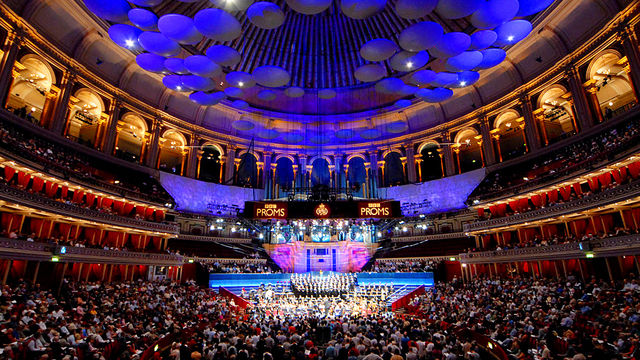
“Where are they off to?” my friend asked after the applause for Ravel’s wonderful Rhapsodie Espagnole and the orchestra started to drift off the stage. I pointed out it was the interval and therefore time for another glass of perfectly chilled rosé in the bar. Nick expressed his delight at being there, spoke intelligently about what he had heard and what we would hear in the second half. He seemed intrigued by the idea that I could have come to any Prom I care to, courtesy of Bachtrack. Around us people chatted and laughed; the atmosphere was friendly and relaxed. Afterwards, walking back to the tube station along the tunnel at South Ken, we overhead other people’s responses to what they had heard (always useful grist to the reviewer’s mill!). We talked all the way home on the train and agreed that we’d had a great night out.
And this, to me, is what the Proms is all about. Too often people are put off attending classical music because they perceive it as stuffy, elitist and populated by (largely) snooty octogenarians who demand hushed reverence. The Wigmore audience is perhaps the very worst example of this, although it doesn’t bother me any more, and without those people the Wigmore probably wouldn’t exist. But at the Proms, everyone is welcome. In recent years, the programmes have definitely become more “populist”, with themed concerts such as a Dr Who Prom, and, this year, a Human Planet prom and forthcoming Horrible Histories and Spaghetti Western proms. Music snobs and critics may throw their hands up at this, but I think these concerts are a great way of introducing classical music to people who may have no previous knowledge or experience of it. The atmosphere inside the Albert Hall is very friendly and good-natured, with its special Prom traditions: the Prommers always yell “heave-ho!” as the piano lid is raised, for example. And if people applaud during movements, so what? To me, it’s a spontaneous, instant response to something they have enjoyed, and should not be sneered at as ignorance of “concert etiquette”. (The habit of not applauding between movements had not existed before the twentieth century.) So, hip hip hooray for the Proms and all they stand for, and long may they continue. You can be guaranteed a huge variety of music, from new commissions to old favourites, works on a vast scale (Havergal Brian’s monumental Gothic Symphony), to intimate chamber music and solo miniatures.
I am back at the Proms towards the end of August for a late-night recital of Liszt, including the beautiful Benediction de Dieu dans la Solitude, performed by Marc-André Hamelin. I am not sure how Liszt’s solo piano works will fare in the vastness of the Royal Albert Hall, but I have little doubt that this is the kind of venue, and concert experience, of which Liszt himself would have thoroughly approved.
For more information about the Proms click here
Bachtrack.com – international concert listings site




 The Cross-Eyed Pianist