Photo credit: Marco Borggreve

It would be foolish of me to attempt to review harpsichordist Mahan Esfahani’s magical Wigmore Hall recital in detail, as I have neither the knowledge of the mechanics of the instrument nor familiarity with the repertoire to do justice his performance. I “dabbled” with the harpsichord while at school, playing continuo in a Baroque group, and now I occasionally play a friend’s instrument, more to attempt to understand some of Bach’s writing in pieces I am learning on the piano, than any serious commitment to the instrument. For years, I felt it was best left to early music and Baroque specialists.

I grew up listening to my parents’ LPs of Glenn Gould’s recordings of the Goldberg Variations, and believed these were the benchmark against which all other interpretations of this mighty work should be set. However, in 2011, after reading about the young Iranian harpsichordist Mahan Esfahani on Norman Lebrecht’s blog, I decided to take the plunge and review a harpsichord recital. In July 2011, at London’s elegant Cadogan Hall, a double debut took place: Mahan’s Proms debut and the first time ever a solo harpsichord recital was presented at the Proms. I called my review “Spellbound by Bach” because for the full hour of the concert that is the state in which Mahan’s playing put us. Credited with bringing the harpsichord “out of the closet”, Mahan’s approach captivated and enthralled. He made the instrument – and the music – appear modern, newly-wrought.

So, when I and the friend who owns the harpsichord rocked up at the Wigmore on Friday night I knew we were in for an exceptional evening of music.

The pieces by Byrd drew inspiration from dances and songs, some toe-tapping and rousing, others stately and elegant, and religious texts, written by a composer living in a country poised on the cusp of change, as England sloughed off the Middle Ages and stepped confidently into the Renaissance. Some of the works were delicate, fleeting, poignant, others proud and courtly. All were beautifully presented, Mahan highlighting the subtleties of sound and touch possible on the instrument. During a pause in the performance, Mahan talked engagingly about Byrd’s importance in the canon of English music, and the forward-pull of his compositional vision. I was struck, not for the first time on hearing Mahan, at the range of tone, colours and moods he was able to achieve with the instrument.

After the interval, a selection works by Bach from the ‘Musical Offering’, a collection of canons and fugues and musical “riddles” which Bach composed in response to a challenge from Frederick the Great (and to whom they are dedicated). A three-part fugue and a six-part fugure (Ricercars) and a “Canon in tones” showed Bach at his most esoteric, teasing and “modern”, which set the scene nicely for, what was, for me, the highlight of the evening – the complete harpsichord music of Gyorgi Ligeti, which recalls Renaissance and Baroque models (the Passacaglia and Chaconne).

Again, Mahan introduced the works, explaining that in the Soviet Eastern Bloc, the harpsichord and early music were considered dangerously reactionary and composers and musicians were not permitted to write for or play the harpsichord. (Interestingly, a number of key modern composers and champions of the harpsichord are from former Eastern Bloc countries.) Mahan then explained that the second harpsichord on the stage was a rather special instrument, a modern harpsichord with nine pedals, a kind of “prepared piano” of the harpsichord world, capable of some extraordinary, other-worldly, sounds – amply demonstrated by Mahan in his performance of the works by Ligeti.

The Passacaglia Ungherese was redolent of the falling figures and ground basses of the music of Bach and his contemporaries; by contrast, Continuum was a fleeting sonic flurry, its strange sound-world recalling an alarm, breaking glass, an angry mosquito. (Ligeti used the harpsichord for this piece because the rapid speed would be almost impossible to achieve on the heavier action of piano.) To close, Mahan played Ligeti’s Hungarian Rock, a tour de force of rhythm and sonic textures suggesting the plucked sound of a modern guitar. The basis of the work is a Chaconne, a set of variations over a pounding, repeating chord pattern (the basis for much jazz and rock music). It was an energetic – and energising – close to a stunning and unusual programme.

For an encore, a short work by Purcell: simple, elegant, perfect. Afterwards, we queued up the stairs to the green room of the Wigmore to congratulate Mahan on a truly miraculous evening of music making.

Mahan argues the case for a modern appreciation of the harpischord and its repertoire far better than I can. Read his guest blog for Gramophone here

My Meet the Artist interview with Mahan Esfahani (from 2012)

Review of Mahan Esfahani’s Prom’s debut

Just five minutes from Waterloo Station is the splendid 1901 Arts Club, an elegant venue that seeks to recreate the “salon culture” of 19th-century Europe. The building, a former schoolmaster’s house built in 1901, retains its late Victorian exterior, while inside the richly-decorated rooms suggest a private home. There is a comfortable upstairs sitting room and bar, and an intimate recital area downstairs, with a medium-sized Steinway piano set against a backdrop of gold swags and tails. The staff are welcoming and friendly, and the whole ambience is that of a private concert in your own home. It made for a very unique experience of the first book of J S Bach’s Well-Tempered Clavier, performed by Japanese pianist Kimiko Ishizaka.

Ms Ishizaka is on a mission to bring Bach to the people and to make his wonderful music accessible to everyone. Her Open Goldberg Variations, a crowd-funded (via Kickstarter), non-profit project that created a high-quality recording, typeset score and iPad app all free to download, is a fine example of her democratic approach.

Bach composed his Well-Tempered Clavier “for the profit and use of musical youth desirous of learning, and especially for the pastime of those already skilled in this study”, in effect the forty-eight Preludes and Fugues are technical studies or Etudes, and were probably never intended to be performed as concert pieces. But in the years since their publication, the “48” as they are also called, have come to be regarded as some of the finest writing for keyboard. The works offer great variety of styles, structure, textures, colours, and moods, all of which Ms Ishizaka demonstrated in her performance.

In a concert lasting nearly two hours (with an interval), we experienced a committed and intense performance in which Ms Ishizaka highlighted the shifting moods and soundscapes of Bach’s writing. A serene opening Prelude in C Major (the most famous of the entire 48) launched us on a journey of discovery through dances and chorales (D minor and B-flat minor Preludes), joy and yearning (C-sharp major and F minor Preludes), sunshine and sadness (D major and C-sharp minor Preludes), seriousness and serenity (E mjaor and C minor Preludes). Ms Ishizaka eschewed the pedal throughout, though not through any wish to present a historically authentic performance. Rather, she did not need it: her superior legato technique created some exquisite cantabile playing, especially in the slow movements, while sprightly passagework and lively tempi gave the suggestion of the harpsichord in the rapid movements. Her sense of counterpoint was well-defined in the Fugues, with clear lines and distinct voices.

Ms Ishizaka is not afraid of robust fortes, perhaps sometimes too robust for the size of the venue, but overall her dynamic range was varied and colourful. There was judicious use of rubato in the Preludes, and some rather fine highlighting of dissonances and unusual harmonies, showing the forward pull of Bach’s musicial vision. Although a rather long evening of music, it was a fine lesson in Bach’s compositional thought, presented in an elegant and powerful performance.

Kimiko Ishizaka’s Meet the Artist interview

Open Goldberg Variations project

1901 Arts Club

When I was learning the piano as a child, it wasn’t obvious to me why my teacher insisted that I learnt certain repertoire, for example, by Bach, Beethoven or Chopin (my Grade 8 programme featured works by all three). Unfortunately, I wasn’t taught technique as a specific area of piano study, and my teacher never really explained why certain composers and works were useful for both technical and artistic development. Meanwhile, my grounding in music history, styles and genres came from O- and A-level music, going to concerts and opera with my family, and listening to music at home.

Now, as I survey the vast repertoire available to the pianist (far bigger than for any other instrumentalist), I realise that there is much to be gained from studying works by specific composers, for they can each teach us something special which informs the way we approach, interpret and play music.

So, what exactly can the great composers teach us? I have tried to highlight one or two key areas for each composer (these are my own suggestions, based on my experience of their repertoire):

Bach – “counterpoint”

  • how to approach separate voices and textures within a work. Useful not just for playing Baroque repertoire, but for any music where one is required to highlight different voices and layers of sound.

Mozart – “clarity”, “elegance”

  • to play Mozart well, one needs precise articulation, finger independence, control, and lightness
  • an ability to utilise the full range of dynamics and phrasing, with minimal/sensitive use of pedal

Beethoven – “strength”, “structure”

  • an understanding of the building blocks and architecture of music, and the ability to highlight this
  • strength, projection, scrupulous attention to rhythm

Schubert – “melody”, “emotion”

  • Beautifully shaped melodies, rapid shifts in emotion, musical chiaroscuro
  • the ability to move seamlessly between many emotions, from joy to despair, sometimes within the space of a handful of bars, or even a single bar

Chopin – “sensitivity”, “songlines”

  • ultra-smooth legato, controlled shading, dynamics, voicing, pedalling
  • an understanding of the essential melodic line

Liszt – “virtuosity”

  • Play Liszt and you learn how to be a real performer, with the confidence, communication skills and strength to tackle the big warhorses of the repertoire (Russian concertos, Etudes etc) with true bravura
  • Fantastic technical grounding: double-octaves, chunky chords, projection, physical stamina, legatissimo and leggiero playing

Debussy – “colour”, “control”, “detail”

  • Debussy often asks the pianist to forget how the piano works and instead demands touch-sensitive control, subtle shadings, fine articulation, absolute rhythmic accuracy and superb attention to detail. Observe each and every marking in Debussy’s score – they are there for a reason!

Twentieth-century composers – “percussion”, “rhythm”, “articulation”, “colour”

  • Bartok offers even the most junior pianist the chance to learn about percussion and rhythmic vitality, while Prokofiev combines these elements with references back to classical antecedents
  • Messiaen for rhythm, brilliance, emotion, meditation
Maurice Sand, ‘Chopin giving a piano lesson to Pauline Viardot’, drawing (1844)

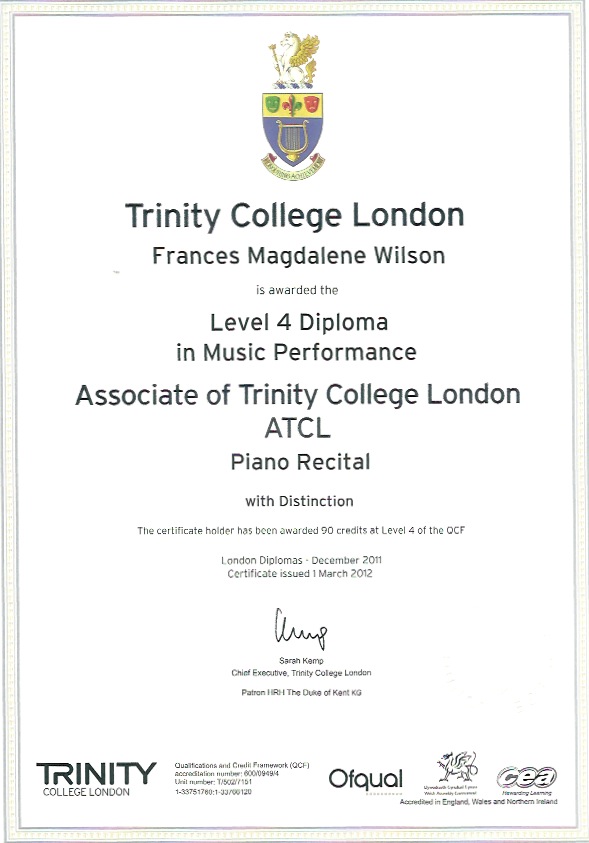
Going back over old territory here, but by chance I found a film I made when I was rehearsing for my ATCL Diploma recital last winter with my page turner (who also happens to be a very good friend of mine, and one of my piano students). I’ve edited it into a more watchable programme. The pieces are played in the order in which I performed them in the exam recital on 14th December 2011

http://vimeo.com/38985321