by Michael Johnson

Latvian-American pianist Eleonor Bindman has often surprised pianophiles with her unique transcriptions, dating from Bach onward. The great cello suites, reworked for the modern piano, found new audiences in Europe, Asia and the United States. And her four-hand arrangements of all six Brandenburg concertos broke CD sales records.

She is achieving her ambitious aims – to widen the appeal of past keyboard and orchestral works, mainly the music of Bach, through her fresh and adventurous transcriptions.

And she is still doing it. Her new CD, which she cleverly titled AbsOlute, brings a flowing sense of joy to the Bach lute suites. They have never been heard like this.

“I don’t want to bore the listener,” she tells me in an extended interview. “I try to make my intentions clear about what I am doing.

Traditionally, transcribers and arrangers have felt constrained by Bach’s already “perfect” compositions. But she is not about improving Bach, she says. “Not being a composer myself, I find that transcribing still gives me a feeling of creating something new.

An imported New Yorker, Ms. Bindman speaks in an accent she brought with her from her native Riga, Latvia’s capital. Her American career has flourished as a performer, a transcriber and teacher. For several years she taught private students in her New York home, playing her beloved “mellow” Bosendorfer, perfectly chosen to enrich her lute scores. In recent years she has taught less frequently, being overwhelmed with massive transcription projects such as the four-hand piano version of the Brandenburgs and the larger Bach orchestral suites.

Is she Russian-trained? Not quite. She never studied in Moscow but her first teacher came from the great Heinrich Neuhaus line. Her professor Theodore Gutman was a Neuhaus student and her second teacher was Lev Natocherny, a product of the Moscow Conservatory, so the Russian tradition found its way into her sensibilities.

She cites the Russian pianist and conductor Vladimir Feltsman as a major influence. We have “similar temperaments” she says, so his teaching was easy to assimilate.

It is now time to focus on getting a fresh perspective, she says, a new look at Bach’s music. “In the past year or so, I’ve become a little less hesitant, a little less inhibited, even adding ornamentation that does not agree with any particular convention.”

Ms. Bindman has relied on lute recordings to help her find the piano voice she wanted. She cites the CDs of Italian Evangelina Maccardi as an influence and probably the best of the lutenists playing today.

Critical acclaim seems to have come easily to her. Some reviewers praise her transcriptions and Bach originals without holding back. One fell in love with her Partitas, calling her a “marvellous Bach performer”. “The prelude from Partita 1, he wrote “is deliciously slow and expressive, with unexpected marking of inner voices, beautiful ornamentation, shimmering tone.… There’s not a bad movement in the bunch.

In this YouTube clip, Lute Suite in C minor, BWV997, her easy mastery of the transcription can he seen, heard and felt:

Ms. Bindman balances her note-perfect clarity with rubato touches that bring out the emotion that some Bach interpreters eschew. Her strong feelings emerged when I raised the subject of respecting the score to a fault. Bach should be very emotional, she insisted. “It’s not about playing the right notes at the right time. He wanted to leave room turn it into your Bach”.

Among her collection of videos posted on YouTube and on her own internet site are glimpses of her impish wit. In one version of the suites BVW 996-998 she dressed in 17th-century attire, including a voluminous wig and custom-made shoes. In this clip, note the swaying body language and confident, if silent, foot-tapping (both feet simultaneously). Her joy is uninhibited.

Edited excerpts from our Q&A interview:

You were obviously enjoying this. Smiling and rocking on the bench, you are conveying the joy Bach intended. Is there an actor in you trying to get out?

No, I don’t think so, but I’m glad I wasn’t the only one who had fun.

You cannot sit still while playing Bach. You almost dance to his music, don’t you? How do you reconcile your changes with the “perfect” scores you started with?

Well, not being a composer, I find that transcribing still gives me a feeling of creating something new. Some musicians feel constrained from doing very much with it. Not I!

Aren’t you also a jazz fan?

Yes, I also love jazz and the freedom it gives you, and I always try to bring a fresh, improvisatory element to my playing.

Bach predated the modern piano by more than 200 years so how does one try to recreate what his compositions would have sounded like in his day?

His lute suites were originally composed for the lautenwerk or lautenwerck (lute-harpsichord), one of Bach’s favourite instruments, similar to the harpsichord.

The 17th-century lute came to his attention through his son CPE Bach who was personally acquainted with a prominent lutenist of the day. Inevitably the lute became part of the Bach family.

You have remained independent-minded in your development as a musician but perhaps you could name principal teachers who have guided you?

Of course there were various teachers along the way, with pianist and conductor Vladimir Feltsman being the most important one.

You mix the Bach clarity with your own emotions, to make us love the music you are playing. How do you dare?

I am concerned about the listening experience. I don’t want to bore the public. I try to make my intentions clear about what I am doing. Bach can and should be very emotional. Playing him is not about hitting the right notes at the right time. He leaves room turn it into your Bach. Now that I have done my cello suites and the lute suites I feel I have a lot more data. I studied the scores so I could decide what I could do with them.

Haven’t you helped bring some international attention to these delicate lute suites?

Yes, many pianists do not know this music until they try the transcriptions.

Your reputation rests on your personal treatments of Bach. What other composers attract you?

Bach’s music is an endless source of wonder. But I also love Liszt, especially his poetic and mystical side, and have had some transformative experiences while playing his music. I feel a special affinity for the musical personalities of Schumann and Brahms, and the Russians, of course – Mussorgsky, Rachmaninov – since they permeated my upbringing. I absolutely revel in Spanish music, particularly Albeniz.

In an interview with The Cross-Eyed Pianist, you were asked what your definition of success is.

Being able to hold people’s attention and transport them into a different time and place.

AbsOlute is available on CD and streaming on the Orchid Classics label
eleonorbindman.com

ABSOLUTE

J.S. Bach: Lute Suites BWV 996-998Transcribed for piano and performed by Eleonor Bindman

All my transcriptions are motivated by the desire to play my favourite music on the piano. – Eleonor Bindman

A lifelong love of J S Bach has led pianist Eleonor Bindman to produce a number of important transcriptions for solo piano and piano duo of his music for other instruments, including the evergreen Cello Suites and the Brandenberg Concertos.

In addition to recordings demonstrating ‘Bach playing of the highest order’ (Pianodao), Eleonor has also produced sheet music and anthologies of her transcriptions, primarily aimed at amateur pianists and piano teachers. Her two-volume ‘Stepping Stones to Bach’ features intermediate piano arrangements of the Baroque master’s most famous tunes, including the Gavotte from the Violin Partita, No.3, and the Badinerie from the Orchestral Suite, No. 2. In making these transcriptions, she is following in the footsteps of the master himself: Bach regularly transcribed his own and other composers’ music and created different instrumental versions of the same piece.

The resulting musical statement may be a faithful reproduction …, a transformation beyond recognition or something in between. Regardless of the outcome, the original source is of such exceptional depth and appeal that for the past three centuries it attracted a steady stream of pilgrims, ready to sacrifice their time and energy for the joy of communion.

Eleonor Bindman

In her latest project, she has turned her attention to works originally composed for the lautenwerk or lautenwerck (lute-harpsichord), one of Bach’s favourite instruments, similar to the harpsichord, but with gut (or nylon today) rather than metal strings, which results in a more mellow tone. Generally performed on harpsichord, lute, and guitar, Eleonor’s new recording of the Lute Suites brings a fresh perspective on these rarely-explored masterpieces, showcasing their intricate structures, rich textures, and emotive character on the modern piano.

Eleonor Bindman’s Bach pianism is all about clarity and order. Her strong and assertive fingerwork complements her firmly centred rhythm

Gramophone magazine

Highlights include BWV 997 and 998, featuring stunning fugues with ornate middle sections unlike typical keyboard fugues, and a heartfelt arrangement of “Betrachte, meine Seele” from St. John’s Passion, which serves as a moving conclusion to the album.

Fans of Eleonor Bindman’s previous transcriptions – such as The Brandenburg Duets and The Cello Suites – will appreciate this latest addition to the pianist’s catalogue, recorded on a Bösendorfer piano which truly captures the remarkable richness of Bach’s writing.

Eleonor Bindman writes, ‘Transcriptions can revive interest in original compositions, and I am hoping that a piano version of Bach’s Suites BWV 996, 997, and 998 will increase their popularity. Just like Bach’s other solo collections, these suites present a technical and musical tour de force for their performers and deserve their rightful place alongside Bach’s suites for keyboard, violin, and cello.’

Eleonor Bindman celebrates J S Bach’s 340th birthday and launches her new CD with a special concert at the 1901 Arts Club, London’s most stylish small venue, on Sunday 23 March at 3pm. Tickets/info here

ABSOLUTE is released on Friday 7th March on the Orchid Classics label. Available on CD and via streaming. Pre-order here

eleonorbindman.com

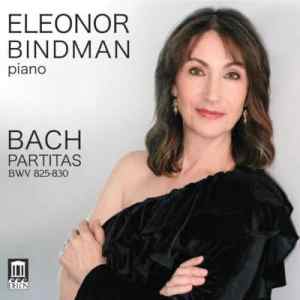
J S BACH – PARTITAS BWV 825-830, 2 CDs

Release date: 6 May 2022 on the Delos label

Eleonor Bindman, piano

‘Bach playing of the highest order – Andrew Eales/Pianodao.com

Bach’s six keyboard Partitas have long been regarded as one of the most important milestones of the Baroque keyboard repertoire and remain amongst Bach’s most popular works for pianists and listeners alike, with their wealth of invention, drama, intimacy, wit and emotion.

Praised for her musical sense and appreciation of the majesty in Bach’s music, Latvian-American pianist Eleonor Bindman follows her critically-acclaimed recordings of her own transcriptions of Bach’s Brandenburg Concertos for piano-four-hands and the Cello Suites for solo piano, with her latest release of the complete keyboard Partitas.

Bach published the six keyboard Partitas himself in 1731 as his “Opus 1,” clearly indicating that he was satisfied with his work. The keyboard Partitas follow a similar template to his English and French Suites, with a succession of popular Baroque dance movements which also appear in all six Partitas. But unlike the French Suites, each begins with a form of Prelude with a different title for each of the six (for example, Sinfonia, Fantasia, Praeambulum and Toccata), demonstrating Bach’s flexibility and personality. With the inclusion of a diverse selection of dance movements, the Partitas are the most varied and cosmopolitan of Bach’s keyboard suites.

Eleonor Bindman’s experience of working with the complex counterpoint of the Brandenburg Concertos, which she transcribed for piano-four-hands, as well as with the expressive possibilities of a single melodic line of the Cello Suites (her most recent transcription for solo piano), results in some fresh interpretive insights in the Partitas – for example, in the choice of pace and tempi to allow listeners the opportunity to enjoy the emotional connotations of rhythm, harmony, counterpoint and ornamentation, and in the creative treatment of repeats.

Eleonor explains:

‘I find the variety of keys and the character (largely implied by the opening movements of course) of each suite gratifying. I also believe that the Partitas, as an oeuvre, include some of Bach’s most diverse, ingenious and intimate writing for the keyboard (aside from the Well-Tempered Clavier to an extent, of course). They deserve a lot more attention than the Goldbergs, in my humble opinion.  Rather than a series of exercises in canons, they are in fact a kaleidoscopic representation of Bach’s genius.  The incredible sincerity and communicative warmth of the Allemandes from Suites 4 and 6, the jazzy Courante from No. 6, the comical Aria and Burlesca from Partitas 4 and 3, respectively, the scintillating Praeambulum of Partita 5 and the challenging fugues or Capriccio of Partita 2 as endings – these are unique emanations of Bach’s personality. In the Partitas there isn’t a single even semi-boring page.  The aforementioned Allemandes are my favourite keyboard playing experiences.  Bach doesn’t even try to disguise them into dance form, save for the titles.  Playing the Allemande from Partita No. 4 in D major brings me into a state which I can only – inadequately and clumsily – describe as “participating in a revelation of truth.”’ 

Produced, engineered and edited by Sam Ward Recorded Dececember 20-21, 2020, and January 9-10, 2021 at President Street Studios, Brooklyn, NY

Instrument: Bösendorfer #48862


About Eleonor Bindman

Praised for her “lively, clear-textured and urbane” Bach performances and her ”impressive clarity of purpose and a full grasp of the music’s spirit,” New York-based pianist, chamber musician, arranger and teacher Eleonor Bindman was born in Riga, Latvia, and began studying the piano at the E. Darzins Special Music School at the age of five. After her family emigrated to the United States, she attended the High School of Performing Arts in New York City while studying piano as a full scholarship student at the Elaine Kaufman Cultural Center. She received a BA in music from New York University and completed her MA in piano pedagogy at the State University of New York, New Paltz, under the guidance of Vladimir Feltsman.

Ms. Bindman’s recital appearances have included Carnegie Hall, The 92nd Street Y, Merkin Hall and Alice Tully Hall; concerto appearances have included engagements with the National Music Week Orchestra, the Staten Island Symphony, the Hudson Valley Philharmonic, the New York Youth Symphony, and the Moscow Radio and Television Symphony Orchestra. Classical Archives declared: “Prepare to be surprised” when encountering Ms. Bindman’s vast range of activity.

In the past few years, she has been focusing on the music of J.S. Bach. Her Brandenburg Duets, a new arrangement of the six Brandenburg Concertos for Piano-four-hands, with pianist Jenny Lin, was declared 7 “breathtaking in its sheer precision and vitality” by Pianist Magazine, while the Cello Suites for Piano, an accurate transcription of Bach’s iconic set, made its debut at #7 on the Billboard® Traditional Classical Charts. Both recordings were best-selling releases for Grand Piano Records in 2018 and 2020. A recording of Ms. Bindman’s arrangement of the Orchestral Suites, also for Piano-four-hands, is forthcoming.

eleonorbindman.com


For further press information, review copies and interviews, please contact Frances Wilson frances_wilson66@live.com