I hate to say it, but classical music still suffers from an image problem; an image crisis in fact. Despite the best efforts of performers, promoters, venues and music lovers, the artform is perceived by many as elitist and only accessible to the few, not the many. It wasn’t always like this: when I was growing up in the UK in the 1960s and 70s, there seemed to be classical music everywhere – on the radio and tv (including live broadcasts of orchestral concerts and wonderful programmes presented by André Previn), in tv adverts and in shops.

Now if you mention you are a fan of classical music, people may look at you slightly askance. Or, as has happened to me on several occasions, ask, “did you come to like classical music as you got older?” – because, yes, the demographic for classical music is generally in the over 50 bracket. (I’ve always liked classical music, ever since I was a little girl.)

Yet venues and promoters obsess about capturing that elusive (and often not especially interested) “younger/youth audience”, at the risk of alienating their core audience/demographic. One particularly depressing current example of this is London’s Southbank Centre, which is “leaning more heavily on describing classical music with a different language. Well-meant pieces to camera demystify the genre for this untapped, cynical and supposedly disinterested audience, the word ‘bangers’ used to describe popular works and sundry other nerve-jangling scores.” (Thoroughly Good blog). Alongside this, the venue has launched a classical music podcast for which “you don’t need a PhD to listen to”.

It has never been necessary to hold a PhD to enjoy classical music – or indeed any genre of music (though I might make an exception for jazz, which I find far more esoteric,  exclusive and mystifying than classical music – but that’s just me!). Which is why I am drawn to this phrase “audience needed – no experience necessary” (borrowed from this image):
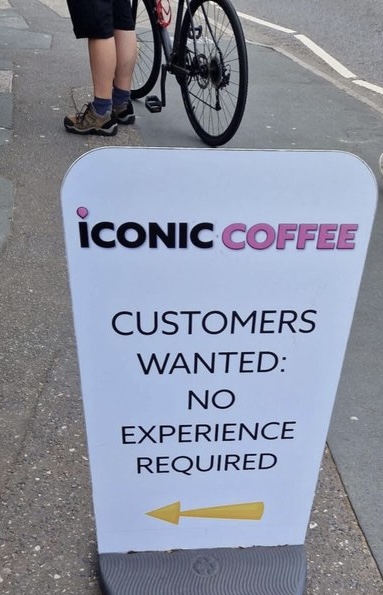
The phrase “audience needed – no experience required” reframes classical music from something exclusive and intimidating into something open, welcoming, and participatory. It signals that listeners don’t need prior knowledge, training, or cultural “credentials” to belong – only curiosity and willingness to listen. Added to that, it doesn’t patronise or use “trendy” language. It tells newcomers that their lack of expertise isn’t a disadvantage but rather an asset, a starting point for discovery.

Musicians can use the message to bridge the gap between performer and audience. It frames them not as distant experts, but as fellow explorers eager to share something beautiful and immediate.

And instead of focusing on technicalities (composers, historical context, musical analysis), this kind of marketing can tap into the emotional and sensory appeal of live performance – the sound, the atmosphere, the shared moment. The phrase evokes a sense of adventure and discovery.

It also connects with modern cultural values. Today’s audiences respond to inclusivity, authenticity, and accessibility. “No experience required” aligns with those values, suggesting classical music is for everyone – not a rarefied art form, but a living, breathing experience.

This site is free to access and advert-free, and takes many hours each month to compile and edit. If you find value and joy in this site, please consider making a donation to support its continuance:

The Hertfordshire Festival of Music (HFoM) is a community-based arts charity (registration number 1175716), founded in 2016 by conductor Tom Hammond and composer James Francis Brown. HFoM aims to bring world-class professional artists to perform alongside local musicians in community locations, giving the widest possible audiences opportunities to learn more about, and experience classical music.

Having run successful programmes over the last 7 years, HFoM wants to remain relevant and be able to continue to effectively contribute to the cultural life of the county of Hertfordshire. This survey aims to ascertain the interests and preferences of those who already know about and may have attended Festival events, alongside those who have not yet engaged with HFoM but may do so in the future.

This survey is anonymous. No identifying data will be linked to your survey responses when they are analysed. Personal data will only be retained (for the sole purpose of future communication with you about the Hertfordshire Festival of Music) if you have given your explicit permission to do that. There is the option to share your details, should you wish, at end. (Privacy Policy)

HFoM would be most grateful if you could spare the time to complete the survey – estimated 12 minutes. (You can submit the survey at any point – partial information would still be useful.) And please feel free to share the survey with your friends and contacts to maximise participant numbers.

Thank you.

Hertfordshire Festival of Music

In response to my article Where Have All The Audiences Gone, a reader, and a keen concert-goer, makes this response:

First, we need a functioning transport system at a price that normal people can afford.  We need trains outside London running 24/7 as tube and bus has inside London for years.

Second, we need to radically reduce the “cost of experience”. I have no issue with venues making a profit but a sandwich in Waitrose is about £3 so a 10% uplift would seem reasonable – say £3.50.  Drinks likewise.  And have everything open!  Covid is being used as excuse for poor customer service – plain-as.

Tickets – bring the cost down and fill all the seats. The Proms was a case in point – much better to have ALL the seats filled for £10 each rather than the 50% empty I witnessed. I found £44 stalls seats for the Labeque Sisters on StubHub for £11, a sure sign that the market has collapsed. Have transport-included/subsidised offers – buy two tickets for concert X and get the associated rail fare for 50%.

And start giving out tickets for students and children for free via schools and heavily reduced for their responsible adults – get young, really young people back just as the Schools Opera and Robert Meyer concerts did for my generation.

And. Stop Talking about COVID! My view is that our reaction to it was totally overblown, likely to kill more people through a depressed economy than the illness itself. My generation (50s) has always been the cultural backbone audience and so many that I know have taken Covid as an excuse to curl-up into early retirement. I rage against the dying of that light.


Comments are open if you would like to join in this discussion, or respond via Twitter

Last week I went up to Stratford to attend a concert given by the Orchestra of the Swan, conducted by Tom Hammond, a friend and colleague for whom I have been doing some publicity work.

There’s a nice symmetry in all of this because Tom and I first met online through a blog article he wrote, bemoaning the fact that critics and concert reviewers rarely seem to make the effort to travel outside of the M25, or indeed Zone 6 on the Underground, to cover the excellent and varied music-making which goes on outside the capital. The issue came up for discussion at the Music Into Words event I co-organised back in 2016, where an arts editor from a leading broadsheet newspaper basically admitted that they tend only to cover the “premier division” of concerts, and that these are by and large in London. It’s a great pity because there is so much fantastic music-making going on outside of the capital: since moving to Dorset I have attended three excellent music festivals, which, by the way, attract international artists, and Tom is co-artistic director of an excellent music festival based in Hertfordshire – easily accessible by road and rail from London, but largely overlooked by mainstream critics because, despite also attracting international artists, it takes place in what is sneeringly call “the provinces”.

There is nothing provincial about the Orchestra of the Swan (OOTS), nor the programme at Tuesday night’s concert. Led by David Le Page, one of the most self-contained and sincere musicians I have ever met, OOTS can match any London chamber ensemble in its creative programming and outreach and educational projects. Tom had been invited by David Le Page, who is AD of the orchestra, to create a programme and he chose to focus on Jean Sibelius, whose music first attracted him to classical music when he was a child. Some may regard a programme focusing on a single composer as “a list”, but this imaginative programme combined well-known works, such as The Swan of Tuonela and the layered complexity of the Seventh Syphony, with the rarely-performed Humoresques for Violin & Orchestra and excerpts from the Tempest suite. Entitled Intimate Voices, it gave the audience the opportunity not only to experience some of Sibelius’ lesser-known music but to also appreciate the breadth of his musical imagination and artistic development for the programmed spanned the outer limits of his compositional life. It made for a fascinating and absorbing evening, and the orchestra rose to the challenge of this complex, multi-faceted music with great aplomb. They were joined for the Humoresques by violinist Tamsin Waley-Cohen and there was a very palpable sense of mutual cooperation and enjoyment between soloist and orchestra.

But there was more, beyond the music itself, which made this a particularly enjoyable and uplifting evening, and that was the audience, who filled the Stratford Playhouse auditorium with the kind of warm enthusiasm that many promoters can only dream of. It was quite evident that this audience was as committed as the orchestra, and this created a wonderful sense of a shared experience – which is what music making is all about, after all.

82590819_10157549399048935_9045941483248549888_o
Tom Hammond conducting Orchestra of the Swan, 21 January 2020


