Who or what inspired you to pursue a career in music?

I come from a very musical family of parents who are professional musicians, two sisters who are professional musicians, and one brother who used to play the violin. As you can imagine, growing up surrounded by music was incredibly inspiring and stimulating! I started playing violin at age 3 and piano at 5, and I remember making the decision around 11 years of age to become a professional pianist. At that time, I had attended an international summer institute for young pianists, and something just “clicked” with being surrounded by so many wonderful musicians. I thought something to the effect of “I have to do this!” and I’ve been devoted to the profession ever since.

Who or what have been the most important influences on your musical life and career?

I have been blessed with fantastic teachers throughout my life, teachers who not only gave me a foundation of musicianship and technique at the piano, but who also supported me as a person (and continue to do so). In this business, I think it is so important to have teachers who care about students in their development as musicians AND human beings. One person in particular who has had an extraordinary influence in my life is a Brazilian pianist named Luiz de Moura Castro. He also taught my eldest sister, and from the time I was ten, he has had a great impact on my approach to music. In addition, I come from a lineage of Russian teachers including a wonderful woman by the name of Zena Ilyashov (whom I studied with as a young pianist) and the well-known pianist and pedagogue Boris Berman (while at Yale School of Music). Both teachers gave me imperative tools for approaching the keyboard, perhaps most specifically in how I create “sound.”

As for performers who influenced me, I remember being spellbound at a young age by violinist Jascha Heifetz. There was something about the electricity of his playing which enamored me, and he’s one of the performers who still gives me goosebumps every time I hear one of his recordings. Likewise, Vladimir Horowitz has always been close to my musical heart; there’s a similar electricity and emotional impact when listening to him. I always try to tap into this kind of excitement/fire when performing.

What have been the greatest challenges of your career so far?

I’ve done quite a lot of competitions, and that can be a brutal part of the learning process for any young pianist. As so many people know, there are variables quite often out of one’s control (politics, personal preferences, etc.), which can be disheartening. I did very well in some and less well in others, but at the end of the day, I learned about myself in the process: not just about playing at a consistent, high level, but what it means to believe in one’s self as a musician.

As with any profession, people can be dismissive, and especially when something is as personal as art. Therefore, it is imperative one believes in one’s worth and what one has have to offer as a musician. As clichéd as it may sound, I do what I do because I believe music needs to be shared with people; to me, being a performer is not about my ego or another person’s ego, but rather being a conduit for great music. This gives me the confidence to believe in what I am doing.

Which performances/recordings are you most proud of?

I absolutely love performing with orchestras, and my first performance of Brahms’ D minor concerto will always stand out in my memory. There’s something about that piece that requires extreme vulnerability and strength, and performing it was powerful beyond what I expected. The way Brahms conceived of the orchestral writing is stunning, and it truly feels chamber music when performing it.

It seems my most memorable performances are with orchestra, but another one was performing Prokofiev’s Second Piano Concerto a few years back. Of course it is a powerhouse of a piece, but there was a particular performance which felt like the highest energy I’ve ever had onstage, both in how I felt with the piano part as well as the interaction with orchestra. Both the Brahms and Prokofiev are extraordinarily powerful pieces, but the Prokofiev is powerful in a way that’s primal.

Which particular works do you think you perform best?

That’s a great question, as I think I’ve “evolved” over the years in both my tastes and what I’ve excelled at. I used to gravitate primarily toward Russian repertoire, but in the past few years, I’ve come to adore J.S. Bach (even more than I used to) and much of the Spanish repertoire. Perhaps that’s an odd combination, but I would like to explore more of Bach in performance (although it can feel scary/exposed!) as well as the Spanish repertoire (would like to finally perform Granados’ Goyescas in its entirety).

I would be remiss not to mention the works of Australian composer Carl Vine, as I have recently released an album of his solo piano music including the world premiere recording of his Piano Sonata No. 4, a work written for me this past year. I adore his music, and much of the last year has been devoted to performing and recording Vine. In particular, the sound-world he creates is fascinating to explore, and there’s also an aspect of virtuosity that makes performing his music incredibly exciting (his writing is challenging yet idiomatic to the instrument).

How do you make your repertoire choices from season to season?

Well as I mentioned, the past year has been greatly focused on Carl Vine, in particular because I commissioned a piece from him and knew I would be giving several premieres internationally. Usually, I make repertoire choices based on particular pieces I would like to play or composers I would like to explore more of. There are also times where presenters will request a particular piece(s), so it can be a combination of reasons.

Do you have a favourite concert venue to perform in and why?

I recently gave a solo recital at Carnegie Hall’s Weill Recital Hall, and it was a pure delight. The acoustics are fantastic, and there’s an intimacy to the hall that I much prefer in a solo piano recital rather than a hall which seats 4,000. I had a similar impression performing at the Salzburg Mozarteum, having a beautiful intimacy to the hall. That said, I performed with the Montreal Orchestre de Metropolitain in Montreal’s Place des Arts, and that was a fantastic hall and huge space. So, it also depends on the context of what and with whom I’m performing!

As a musician, what is your definition of success?

On a superficial level, one could say success is defined by how many prestigious halls one plays in, how many recordings one sells, how many successful musicians one performs with. While those are all wonderful and important things to use as professional goals, I think they are also things which can be distracting to leading a fulfilled life as a musician. There are so many times when a musician will come to a crossroads in their career, asking themselves why they do what they do. I’ve come to realize that success as a musician can only truly be measured by how much one is enjoying what one does and how genuinely one is connecting with the audience, no matter the size or prestige. If I give a performance where even just one person has found inspiration or comfort through the music, or I’ve managed to inspire a young musician to get excited about classical music, that to me is true success as a musician.

What do you consider to be the most important ideas and concepts to impart to aspiring musicians?

Follow this career path because you love it and will do it no matter what difficulties come your way! It’s a very difficult career to choose, but one that can bring incredible good and beauty to the world.

What is your most treasured possession?

If I can count my cats as possessions, then I’ll say my cats!

What is your present state of mind?

Honestly, I’m grateful to be a musician. Without it, life would make a lot less sense!

Aphorisms: The Piano Music of Carl Vine is available now


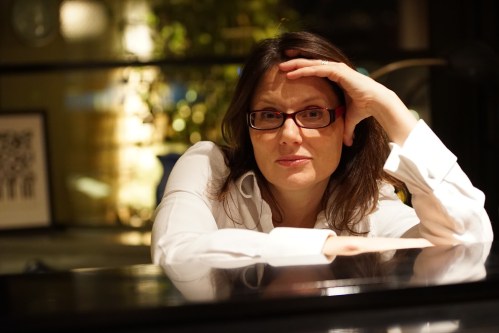
Pianist Lindsay Garritson has performed throughout the United States and abroad since the age of four. She has appeared on stages such as Carnegie Hall, the Kennedy Center, and Place des Arts (Montreal), and has been featured as soloist with the Phoenix Symphony Orchestra, Charleston Symphony Orchestra, Eastern Connecticut Symphony Orchestra, Las Colinas Symphony Orchestra (Texas), Orchestre Métropolitain (Montreal), Atlantic Classical Orchestra, Orquestra Sinfônica Barra Mansa (Brazil), the Yale Philharmonic Orchestra, and the European Philharmonic Orchestra, among others.
Read more

On April 20, 1993, sixteen-year-old Cassie watches her world burn to the ground. A week later—far from Waco, TX and the Branch Davidean fire that claimed her family, friends, savior, and the only life she had ever known—Cassie enters a new life—a strange new ‘normal’ life after being ripped from a cult and forced to function in routine society with little knowledge of how to navigate reality.

Cassie has just two goals: to play the piano and to learn how to be normal. Her love of music, especially the music of J.S Bach, is her only thread to a past she buries under her “normal” façade, the thread that holds her together where therapy and religion fail. But Cassie’s habit of using music to hide from her emotions fails her and she must grieve the truth about losing her family and her world in the Waco fire and begin to let time, and Bach, heal her. And only through Bach’s music can she dare to feel the loss of her parents.

When US authorities raided cult-leader David Khoresh’s compound in February 1993, it led to 10 deaths and a 51-day standoff that ended when a fire killed more than 70 men, women, and children. Those who survived Waco were forced to confront the dark things Khoresh did: narcissistic and abusive, he was deeply controlling yet charismatic and personable.

This well-crafted and sensitively-written novel by American pianist Rhonda Rizzo does not shy away from presenting Khoresh and his cult in unsentimental terms, but rather than offer long descriptions, small disturbing details are slipped into the narrative in the form of flashbacks by Cassie, the protagonist, as she tries to come to terms what has happened to her and her family, and comprehend her parents’ life choices. The complex story of Cassie’s struggle to process the trauma of Waco and resulting PTSD, and the extraordinarily closed world of a religious cult, is told in unsentimental, vividly realistic terms, and Rhonda Rizzo’s own musical background brings an authenticity and authority to the descriptions of the music, including the experience of studying and performing music, the hot house, competitive atmosphere of music college, and the special pleasures (and difficulties) of playing with other musicians.

This is as much a coming-of-age novel as a book about recovery and renewal, and Cassie’s naive, tentative entry into a normal teenage girl’s life of fashion, boys and alcohol is presented in bold, believable terms: her relationships are not always straightforward and her attempts to fit in, despite her unusual background, are familiar to anyone who has felt like an outsider.

In one of those serendipitous encounters which sometimes happen via my blog, the author contacted me out of the blue to ask if I would review her book. I’m so glad I agreed, as I found The Waco Variations a real page-turner, and, ultimately, a wonderful celebration of the restorative powers of music. The novel offers a universal message – that music has the power to touch our souls, to heal and calm, and so much more…..

Recommended

The Waco Variations

Meet the Artist interview with Rhonda Rizzo

rhonda2bheadshot2bpiano
Rhonda Rizzo


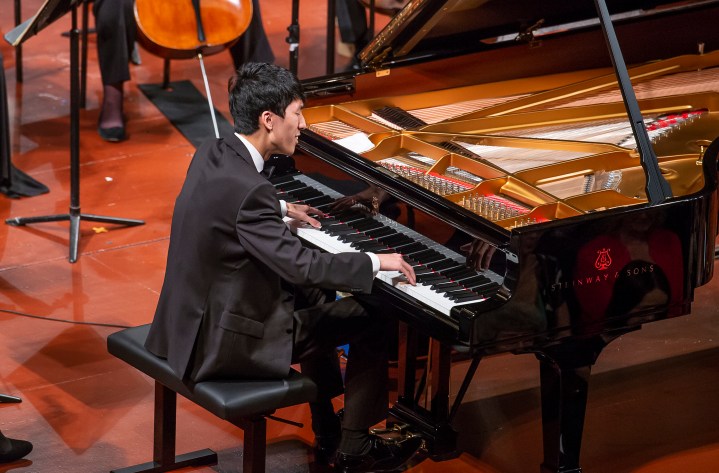
20-year old American pianist, Eric Lu, has been awarded first place and the Dame Fanny Waterman Gold Medal at the prestigious Leeds International Piano Competition 2018, a triennial event which is widely regarded as among the most coveted prizes in the musical world. He also won the Terence Judd Hallé Orchestra Prize.

International star pianist Lang Lang, Global Ambassador of the Competition, presented the prizes following the last Concerto Final with the Hallé, conducted by Edward Gardner in Leeds Town Hall.

In addition to the £25,000 cash prize, Lu receives a ground-breaking portfolio prize designed with long-term career development in mind. It includes worldwide management with Askonas Holt – one of the world’s leading arts management agencies; an international album release on Warner Classics – one of the foremost global classical music recording companies, and a range of performance and recording opportunities with BBC Radio 3. The prize also includes a host of performance engagements with high profile promoters, including with some of the world’s premier venues and orchestras, such as London’s Wigmore Hall and Southbank Centre, the Hallé and Oslo Philharmonic Orchestras.

Leeds International Piano Competition
Eric Lu playing Beethoven’s Piano Concerto No. 4 in the Final of Leeds Piano Competition

On Thursday [20 September], Lu opens Royal Liverpool Philharmonic Orchestra’s new season under the baton of Vasily Petrenko, performing Beethoven’s Piano Concerto No. 4 in G major, Op. 58. On Friday [21 September], Warner Classics releases a digital single of a highlight from his Competition performances, and, on 2 November, a full album, including Lu’s live Concerto performance from the Final with the Hallé conducted by Edward Gardner, as well as a selection of recital repertoire from the earlier Rounds.

Second place, £15,000 and the Yaltah Menuhin Award for the greatest collaborative chamber performance, was awarded to 28-year old German pianist, Mario Häring.

Xinyuan Wang, 23 from China, was third and received £10,000. The Audience Award, which was, for the first time this year, opened up to a global audience through online streaming by medici.tv, also went to Wang, who will have a concert broadcast on medici.tv.

Both Häring and Wang will give major recitals in St George’s Hall, Liverpool, on 17 and 18 September 2018 as part of their prize, and will each – like Lu – have an opportunity to give a solo recital at London’s Wigmore Hall in 2019. A full list of concert engagements for the prize winners is available here.

All the prize winners will have long-term mentoring from Patron Murray Perahia, Co-Artistic Director Paul Lewis – who also chaired the jury, and other members of the performer-led jury which included Sa Chen, Imogen Cooper, Adam Gatehouse, Henning Kraggerud, Thomas Larcher, Gillian Moore, Lars Vogt and Shai Wosner.

The prize presentations followed the conferment of an honorary degree on Lang Lang from the University of Leeds, the Competition’s Principal Partner.

Lang Lang said:

“The Finals of The Leeds will stay in my memory for a long time. It has been a privilege to witness so much extraordinary talent on stage and an honour to receive a Doctorate from the University of Leeds. I’m extremely proud of my association with the city of Leeds, with the piano competition – which is doing so much to unite excellence and accessibility – and with the University. It is truly is the city of the piano and I look forward to returning.” 

Paul Lewis, Chair of the Jury and Co-Artistic Director of The Leeds, said:

“All the pianists  have shown extraordinary  talent, passion and  dedication throughout the Competition, and it goes without saying that the standard of playing has been remarkable. Many of the world’s greatest pianists have started out at The Leeds and I’m certain all the 2018 Finalists  have bright futures, and we look forward to supporting what we believe will be successful and fulfilling careers.“

The Leeds hugely expanded its programme for 2018, going beyond a single competition to become a city-wide celebration of the piano. With a new programme of talks, masterclasses, exhibitions, free family events, schools projects, and concerts – as well as The Leeds Piano Trail, which invited the public to play on 12 beautifully decorated public pianos in the city centre – The Leeds had the opportunity to share its passion for the piano with more people than ever before. The majority of the public pianos will remain in place for the foreseeable future, continuing the Competition’s legacy for new and wider audiences.

medici.tv’s extensive coverage, supported by the University of Leeds, which began in August and ran throughout the Competition, reached audiences in more than 3,700 cities in 140 countries. It was particularly popular in the UK, USA, China, Japan and Germany. Millions more enjoyed the Finals on BBC Radio 3, which broadcast live from Leeds Town Hall and also covered all the Semi-Finals.

All rounds of The Leeds remain available to watch at leedspiano2018.medici.tv for three years, and BBC Radio 3’s extensive coverage of the Semi-Finals and Finals is available via BBC i Player Radio. The Finals are broadcast on BBC FOUR television on Sunday 23 September.

The next Competition will take place in 2021.

For more information about the Competition visit www.leedspiano.com.

@leedspiano


[source: Victoria Bevan PR]

Who or what inspired you to take up piano and pursue a career in music?

When I was very young, my grandmother made up a game of tapping a rhythm and having me name the song the rhythm was from. She seemed to think I was good at this game so one day, as a 4-year old,  I was taken to an admission test for a “special music school for gifted children” in Riga, Latvia (the former USSR).  After tapping out some more rhythms, singing and matching pitches, I remember being asked whether I wanted to play the violin because my 4th (ring) fingers were relatively long.  I said that I couldn’t play the violin “because we didn’t have one at home but we already had a piano” and so it was decided.  I spent 9 years at that school and received an excellent musical foundation.  It was always assumed by my family that I would become a musician.  There was also a personal experience of catching the music-making “bug” which remains a vivid memory. I was once practicing a piece by Khachaturian called “Ivan’s Song” and suddenly I heard myself play and appreciated the beauty of the music; there also seemed to be a meaning to that haunting melody which couldn’t be put into words.  I guess a part of me understood the importance of this experience and I realized that I have a skill which, in turn, gave me a sense of identity.

Who or what have been the most important influences on your musical life and career?

I was always fascinated by the piano’s orchestral potential and studied many transcriptions, primarily by Liszt and Busoni. That led me to making my own piano versions of music I was dying to play on the piano, like “A Night on Bald Mountain by Mussorgsky.”  Not being a composer, transcribing still gives me a feeling of creating something new.   I also love jazz and the freedom it gives and try to bring an fresh, improvisatory element to my playing.  And of course there were various teachers along the way, Vladimir Feltsman being the most important one.

What have been the greatest challenges of your career so far?

Unquestionably, the need to propel one’s career is a challenge to many musicians and it has been a source of many soul-searching hours for me. Motherhood was also a show-stopper, literally. That existential struggle between just wanting to play the piano for my personal growth as a musician and serving the larger purpose of bringing art and beauty to people because of my training and calling is always present.

Which performance/recordings are you most proud of? 

My most recent recording, the newly transcribed set of “Brandenburg Duets” is a result of several painstaking years arranging all 6 Brandenburg Concertos by Bach for piano-4-hands.  Embarking on a project of such magnitude taught me an important lesson on perseverance. I am very happy with the way the recording came out and grateful to my piano partner Jenny Lin and the Grand Piano label of Naxos Records for making the CD set a reality.  The feedback has been tremendous so far as I am constantly being told by listeners that they just love how the music makes them feel and how the piano conveys the material somewhat more clearly than an orchestra in this case and brings the concertos into a new perspective.  It feels great to have been able to pull this off and I can’t wait to get the arrangements published.

Which particular works do you think you play best?

I have always found playing Bach gratifying, especially the Partitas, since it’s a challenge and a thrill to memorize long sequences of such superior material and to have to focus on precision and conveying intentional meaning to such a degree.  His music is an endless source of wonder.  I love Liszt, especially his poetic and mystical side, and have had some transformative experiences while playing his music.  I feel a special affinity for the musical personalities of Schumann and Brahms and the Russians, of course, since they permeated my upbringing.  I also absolutely revel in Spanish music, particularly Albeniz.

How do you make your repertoire choices from season to season?

There is usually a mental queue of repertoire in my head and possible combinations which evolve over time.  I try to play the music I enjoy most.

Who are your favourite musicians?

I have heard some amazing recitals by Radu Lupu where one’s attention was held from the very first note until he walked off stage.  I love Martha Argerich, Richter, the recordings of Gyorgy Cziffra and Rachmaninov.

Do you have a favorite concert venue to perform in and why? What is your most memorable concert experience?

I had an epiphany a long time ago while waiting to perform a harpsichord recital at a small venue on City Island, in the Bronx.  In the middle of the usual, mild pre-concert anxiety, it occurred to me that the audience members were gathering to hear Bach at noon on a Sunday because it was important to them.  They made the trip instead of taking a nap or watching TV.  My nervousness and ego didn’t matter, what mattered was transmitting the music they wanted to hear in a manner worthy of the task.  Since then the venues and other details became secondary to the privilege of being the medium for this singular venture.

As a musician, what is your definition of success?

Being able to hold people’s attention and transport them into a different time and place.

What do you consider to be the most important ideas and concepts to impart to aspiring musicians?

As much as I venerate iconic pianists, I think that one shouldn’t listen to recordings before learning a particular piece well enough to have found one’s own interpretation, however initially tentative it may be.   Other than hours of practice and years at schools and conservatories, It’s important to have cultural and artistic references to gain a deeper understanding of music we perform.  Traveling, reading, looking at art and investigating historical details will help you find a unique voice and interpretation.  In turn, that unique voice will help a musician find success in today’s musical market.

What is your idea of perfect happiness? 

Being alone in a (pleasant) place I’ve never been before.

What is your most treasured possession?

Without a doubt, my Bosendorfer piano.


Eleonor Bindman’s Brandenburg Duets were completed and recorded in 2017 and released by Naxos Records on their Grand Piano label in March 2018


Praised for “lively, clear textured and urbane” performances and “impressive clarity of purpose and a full grasp of the music’s spirit” (The New York Times), New York-based pianist, chamber musician, arranger, and teacher, Eleonor Bindman has appeared at Carnegie Hall, The 92 Street Y, Merkin Hall, Alice Tully Hall, and on solo concerto engagements with the National Music Week Orchestra, the Staten Island Symphony, the Hudson Valley Philharmonic, the New York Youth Symphony, and The Radio and Television Symphony Orchestra of Moscow, Russia. Ms. Bindman is a prizewinner of the New Orleans, F. Busoni and Jose Iturbi international piano competitions and a recipient of a National Foundation for the Advancement of the Arts award.

Born in Riga, Latvia, Ms. Bindman began studying the piano at the E. Darzins Special Music School at the age of five. Her first piano teacher, Rita Kroner, hailed from the studio of Heinrich Neuhaus, the venerable Russian piano pedagogue. After her family immigrated to the United States, she attended the High School of Performing Arts while studying piano as a full scholarship student at the Elaine Kaufmann Cultural Center. She received a B.A. in music from NYU and completed her M.A. in piano pedagogy at SUNY, New Paltz under the guidance of Vladimir Feltsman. The Poughkeepsie Journal describers Ms. Bindman as a strong pianist who attacks her work with great vitality and emotion…and mesmerizes her audiences with her flair and technique” (Barbara Hauptman).


More about Eleonor Bindman


