
Guest review by Tara Yonder
Sky’s Amadeus miniseries sets out to revive one of the most deliciously operatic stories ever told about artistic genius – the supposed rivalry between Wolfgang Amadeus Mozart and Antonio Salieri – for 21st-century viewers. This latest portrayal of the feud that never was, and the persistent myth that Salieri attempted to poison Mozart, comes from Peter Shaffer’s 1979 play ‘Amadeus’ (which itself was inspired by Pushkin’s 1830 play ‘Mozart and Salieri’), and subsequent acclaimed 1984 film of the same name, adapted from the stage play (Shaffer wrote the screenplay) and directed by Milos Forman.
I’m old enough to remember the debut of both the play and the film, and the hoo-har surrounding the film in particular, especially the casting of Tom Hulce as a punky, pink haired, potty-mouthed Mozart with an irritating high, cackling giggle. Critics were largely won over by the inspired casting, its rich emotional landscape and of course Mozart’s magnificent music. Music historians still criticse the film’s historical inaccuracies, but Shaffer never claimed it was intended as an authentic biography of Mozart, describing his play as a “fantasia on [a real-life] theme”.
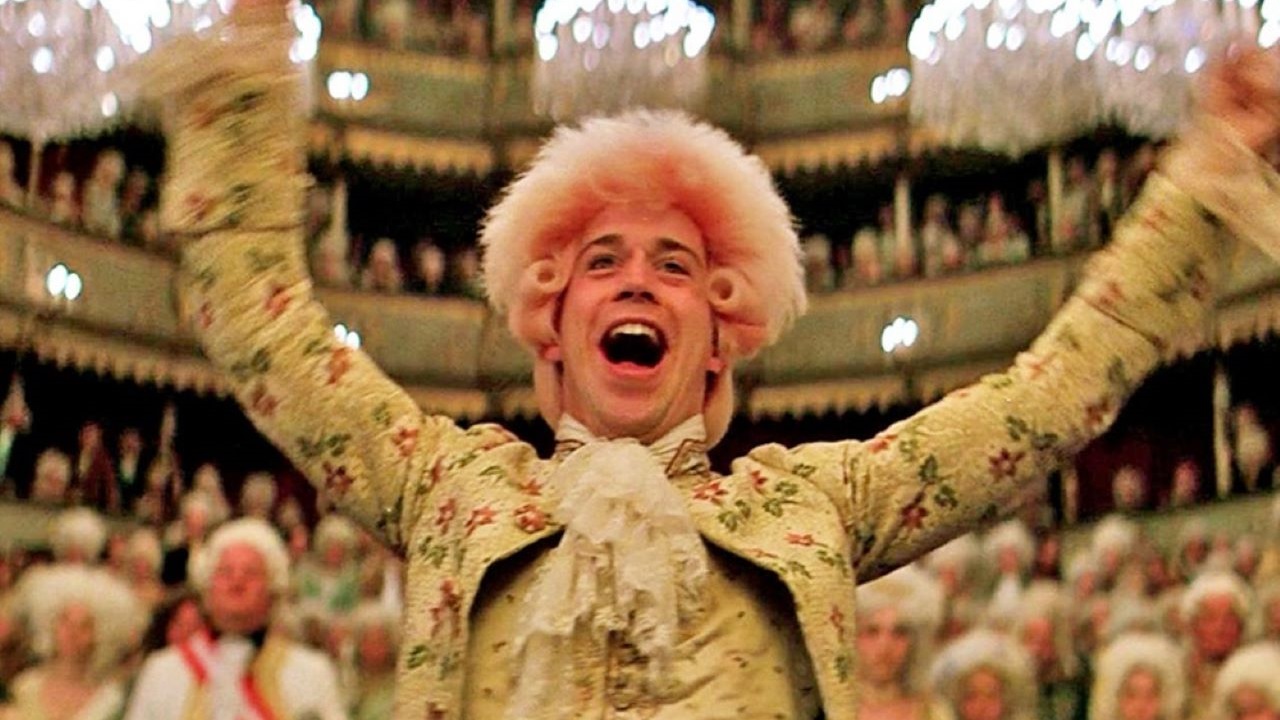
I loved the film ‘Amadeus’, and repeated viewings reveal greater depths. It’s a brilliant, beautifully-crafted film. Visually and aurally arresting, it combines humour and wit, absurdity and poignancy, tenderness and tragedy, and celebrates both Mozart’s genius and the exigencies of his life in late 18th-century Vienna.
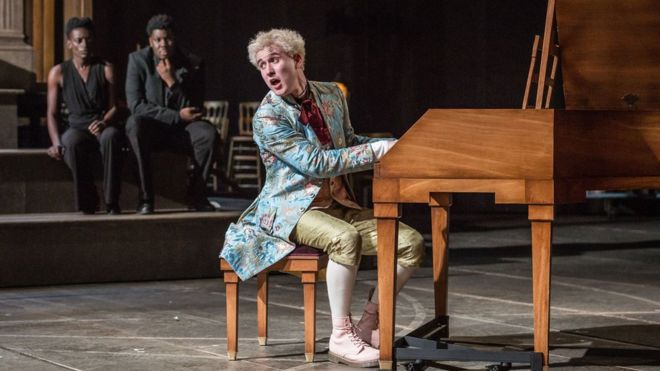
The play was revived by the National Theatre in 2016 (to mark the death of Peter Shaffer that year). I saw it twice, and loved it, in particular the way the music and musicians came to the fore in a thrilling piece of complete ‘music-theatre’.
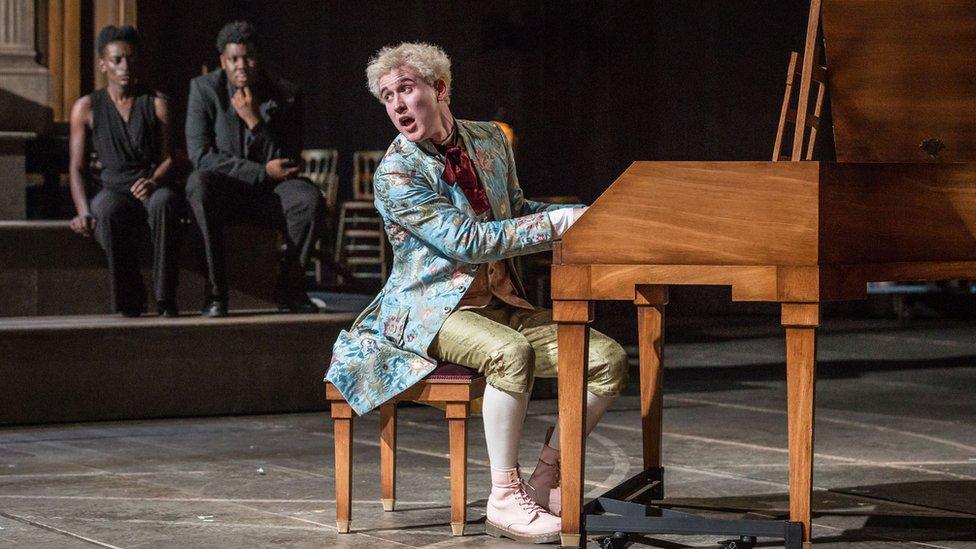
London, 2016)
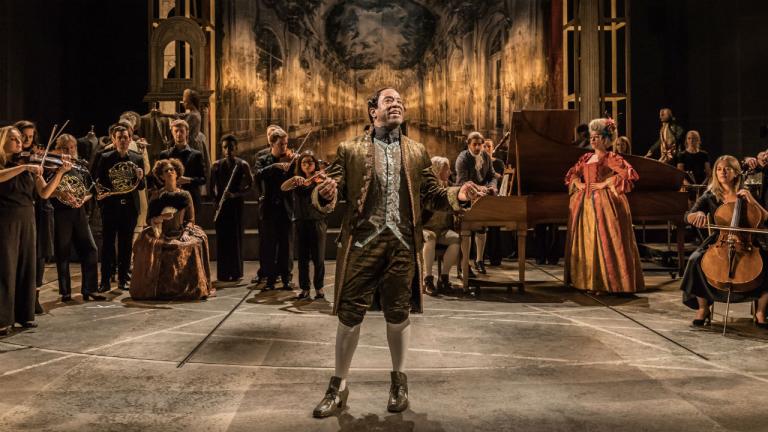
Sky’s five-part miniseries ‘Amadeus’, which dropped on 21 December, mostly proves that some legends are perhaps better left echoing in memory. The creators of this latest incarnation of the Mozart-Salieri myth clearly adore Shaffer’s play and Forman’s film, but admiration is perhaps not the same thing as inspiration. It doesn’t feel like the tribute it might have intended to be.
The problem isn’t that ‘Amadeus’ takes liberties with history; that controversy was there from the start – Shaffer was openly unapologetic about turning Salieri into a mediocrity driven mad by his proximity to genius, and Forman doubled down on this with visual extravagance and black humour. It’s rather than Sky’s version, stretching the narrative into 5 hour-long episodes, somehow finds less to say, padding out familiar scenes with ‘prestige-TV’ glamour and gloom, interlaced with dreary banality, especially in the script, rather than genuine dramatic tension.
True, it’s lavish and visually stunning – the costumes, the wigs, the grand settings (it was filmed in Hungary) – with that uber-high-res, hyper-real format which is now the norm in film and tv drama (see also ‘Black Doves and Giri/Haji’ – both directed by Joe Barton, co-creator of Sky’s ‘Amadeus’, – and ‘Rivals’).
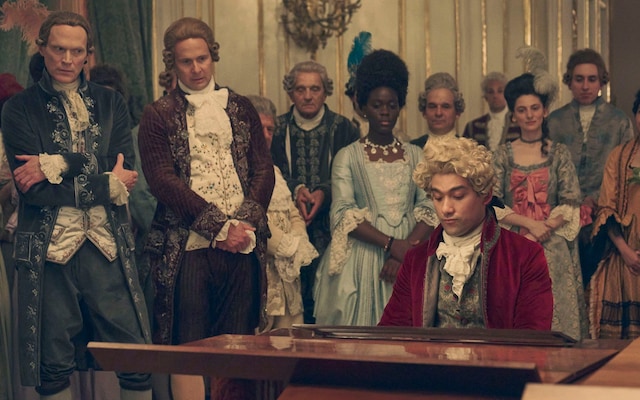
Mozart’s genius is repeatedly asserted but hardly truly felt: we are told he is transcendent, but rarely allowed to actually experience that transcendence because there are so few examples (instead we have music by, amongst others, Jonny Greenwood, and Max Richter). What was shocking in the original play and film – the gleeful vulgarity, the blasphemous rage at God, the audacity of portraying divine talent as a cruel joke – here feels pedestrian, superficial or simply contrived. There are the obligatory gratuitously lewd scenes, and plenty of zeitgeisty swearing (though far less scatological than in the original play or Mozart’s own letters), but this adds little to the overall narrative. If it’s intended to shock, it never really lands.
Paul Bettany is well cast as Salieri, emotions simmering beneath an austere, thin-lipped surface, while Will Sharpe plays Mozart as childish and brilliant. The scenes between the two do have a crackle of real tension, and overall the series is confidently acted and staged, and undeniably ‘modern’.
But other aspects of the casting simply grate. There’s the ‘diverse casting’ we’ve come to expect from 21st-century tv/film drama, and while that may not matter in fiction, it feels clunky and inaccurate in the portrayal of real historical figures at a particular period in history (for example, women did not play in orchestras in the 18th century). And overall, it’s hard to feel empathy or connection with any of the characters (except perhaps Mozart’s long-suffering wife Constanze) so one never truly cares about their fortunes.
But the greatest heresy is against the music, which is strangely absent when it should be centre stage. Sure, there are excerpts, but while the music was omnipresent in the original play and film, providing a powerful narrative and character all of its own (in particular, the quotes from Mozart’s Requiem), there is simply not enough in this series. It becomes footnote to the main characters, and their egos and jealousy; thus, Mozart’s sublime pieces serve as background, rather than argument. ‘Amadeus’ is, first and foremost, about the music – music which should overwhelm the narrative, interrupt and challenge it, and impel the audience into the same state of awe that overwhelms Salieri.
Sky’s ‘Amadeus’ is technically accomplished, visually stunning, and intermittently entertaining. Watch it as one might ‘Rivals’ and it’s fun and unserious, the ideal drama for our narcissistic, unserious times, but in no way does this feel like a worthy tribute to the original play and film. And that’s a shame because it could have been a great opportunity to create fine drama on an obviously very large budget.
This remake is not that bad. It’s clearly well-intentioned, often intelligent, and occasionally arresting. But it forgets the crucial thing that made the story immortal and universally compelling: Mozart was not great because others envied him. He was great – and others envied him – because he made contact with something eternal and gave it voice.
Tara Yonder is a music lover, amateur pianist, and unashamed dilettante
Header image credit: Sky




 The Cross-Eyed Pianist