Guest post by Alexandra Westcott

This article about learning the piano, the skills and the memories was lovely, and jogged my own memories of myself both as student and teacher.

I was about 6 when I used my sister’s books to learn the piano – they had photos for hand positions and finger numbers and that seemed all I needed (I’ve no idea to this day how I learned the rhythm and counting; I don’t remember reading about it but I must have!). I raced through the books and started fiddling with any music floating around, which was a fair amount as my Mum was a singer and also played the piano. I remember having the C major Mozart sonata at home and learning two pages during each holiday when home from boarding school at around 8 or 9. At this point Mum asked me if I wanted lessons, and because all my friends hated it (they hated the
practice); I said no because I loved playing, but she obviously ignored me and I ended up with a teacher I adored with whom I became very close.

I played the piano in all my spare time to the extent my reports used to say ‘she spends a lot of time at the piano’ and during prep, having done my homework as fast as possible, would skip off to the music rooms. I was fussy even then about the piano I played, and only the teachers’ or the grand in the assembly hall would do! None of the awful practice pianos for me!
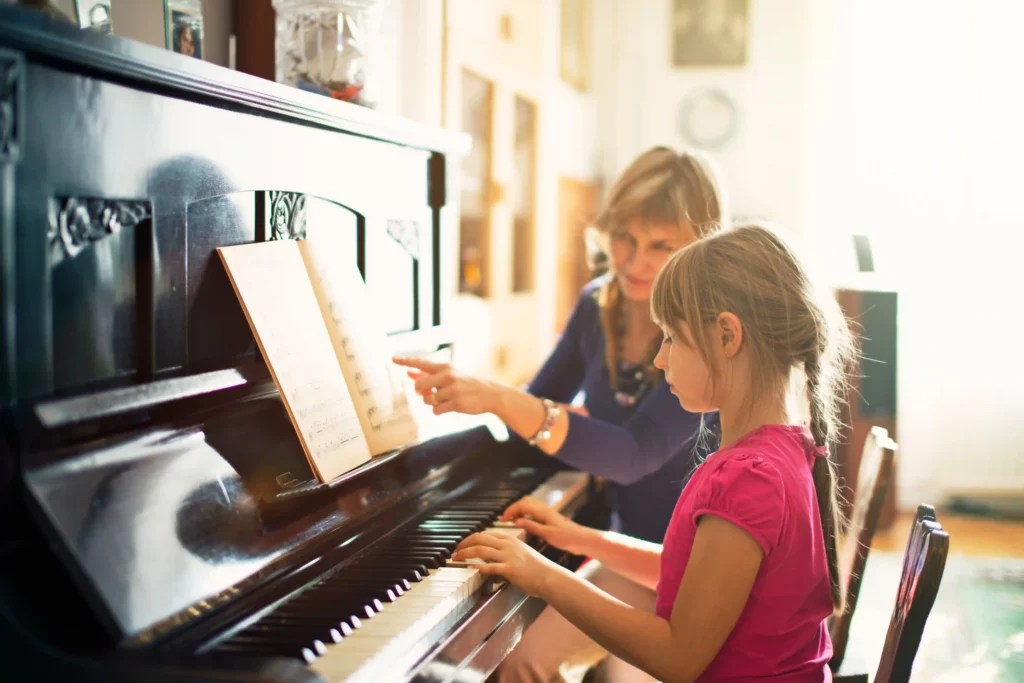
During my time at school with this wonderful teacher, me and a group of friends would be taken away for a weekend each term to him and his wife at his amazing ancient cottage. He was the church organist and ran the church choir so we ate well on local Devon produce that he was given by local friends and members of the church. At times we also had breakfast in bed (often sugar on toast!), It was all very idyllic and I stayed in touch with him and his wife until they died.

For the 6th form I left there and went to a college local to my home, so I changed teacher and went to a local music school during my A levels. A completely different teacher and one the parents were scared of but the pupils loved. We did Sunday concerts at her house, always with cake, and a large concert once a year at the 6th form college at which she got her advanced students to do a movement of a concerto with her school orchestra. I did the first movement of the Schumann. I never wanted to be a concert pianist but this was good experience and I later had the chance to play on a few occasions with another orchestra, and for one of the concerts performed the whole of the Schumann. It brought back many memories.

I had another teacher for my degree, and then had a break in formal lessons before returning to a commitment to my own playing in my 20s. I had a local teacher for a year but then met Nelly Ben Or and knew I had to learn with her.
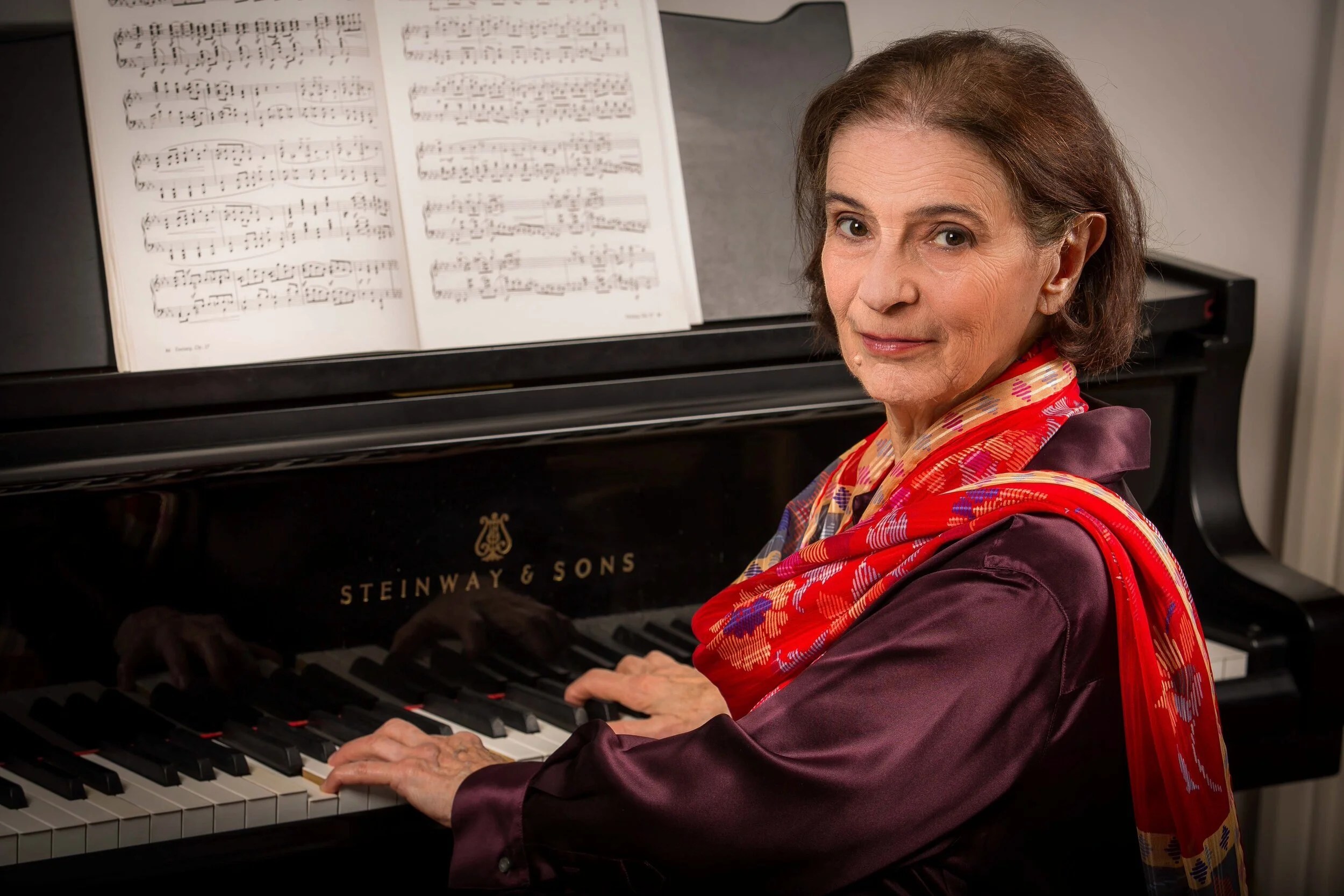
Nelly Ben Or

I studied with Nelly for many many years undoing my bad habits in order to acquire new and better ones and becoming a much better pianist, and a better teacher for that. I would often have lunch along with my lessons, and, again, house concerts and other performances enhanced the lessons. And, yes, you guessed it, always with accompanying food and drink.

As a teacher myself I became the sort of teacher I had grown up with; I had close bonds with my students, always had house concerts and local concerts both with tea parties afterwards, usually some chocolate for after lessons, and often would become close friends and either take them out for tea when young, or stay in touch later on.

Piano teachers, or any instrument teacher, hold a particular place in the life of a child. Such a close bond is formed and often many confidentialities shared. There needs to be trust for something that is hard to learn and something that needs self expression in execution. It is maybe not surprising that the bond becomes a firm friendship (and, often, one that needs physical as well as sustenance)!

I often wonder about my students’ memories of their time with me and whether they have similar memories as I do about my own mentors. I hope they hold the same  happy and cherished memories in their hearts for all the hours we spent and fun we had together as I do for my own teachers.

Alexandra Westcott is a piano teacher based in north London who specialises in understanding the piano in the light of the Alexander Technique, as studied with Nelly Ben Or, and encourages all areas of learning in a creative way. Find out more here

If you would like to share your piano memories, whether you are a teacher or pianist, or bothm, please get in touch


This site is free to access and advert-free. If you find joy and value in the content of this site, please consider making a donation to support its continuance, and to ensure it remains free to read.


Guest post by Alexandra Westcott


An article in response to Andrew Eales’ excellent article Making Peace with your Inner Musician, which was in turn prompted by this quote from the Bhagavad Bita: “Better indeed is knowledge than mechanical practice…But better still is surrender of attachment to results, because there follows immediate peace

I’ve already written about mechanical practice versus knowledge and clarity. But I find I am developing my thoughts on this even more with regard to some of my students. In his article Andrew Eales’ discusses having less of an attachment to and more of an appreciation of results and goals; to be kinder and more accepting of ourselves and our piano playing journey; and to find ways to enjoy our playing and what it gives both to ourselves and others. I agree with this wholeheartedly.

I read this quote from the Gita and understood it slightly differently; I interpreted it to mean that in letting go of attachments to goals we let go of those goals altogether; taking away ALL judgement about our playing (even with regards to right or wrong notes) and immersing ourselves in the moment; surely it is this that this leads to immediate peace? I’m not saying that there are not times and situations when results are useful and necessary (whether extrinsic or intrinsically motivated), but that there can be another option for pianists.

As COVID struck I noticed my teaching changed; I was more interested in my students being able to play music than any amount of right notes or technical achievements (hard to do the latter online anyway), so we found ourselves focussing on the sounds, using improvising and ear games. I have already written about how this can help with improvising so I won’t reiterate all those points here, other
than to say if a student can withhold judgement about their playing then they can make music, however little they know or practice; when unable to concentrate on notes on a page, many of my students found solace through the piano and kept playing through both lockdowns.

More recently though, one of my students had an injury and couldn’t play, but got fed up with this and wanted to just get her fingers on the keys, so we have been talking about moving away from any ‘result’ at all, trying instead to focus on being in the moment, and the process of actually playing, whatever that playing is (i.e. whether improvising or learning a piece), and relinquishing all judgement about whether it is good, or right, or even sounds ‘nice’ (there is plenty of published classical music, or jazz improvising, from highly respected musicians and composers, of which I don’t like the sound, so if they can produce such music, why can’t we?!). The student is not learning for either a concert or exam, so why get upset about the notes…? Radical! We can aim at the right notes (assuming we are learning a composed piece), but judge ourselves less, or not at all, for getting them wrong, and enjoy the process in any case.

The Alexander Technique talks about ‘end gaining’; the mistake we make in focusing on the end result rather than how we get there. Understood correctly this is a huge part of how the Alexander Technique can benefit a piano (or any other) student. I think it can go further than aiding our clarity and technical grasp of the music and take us to a place where we are in the moment and finding peace, whether it is in enjoying the physical nature of playing the piano (which is one of the things I myself love about the piano, whereas I didn’t like the particular physical demands of playing the flute, for instance) or getting absorbed in the moods we can evoke. Sometimes we might enjoy the former but not like the latter we produce but does it matter; if it is ephemeral then is has gone in a whisper but we have lived the moment with peace and pleasure.

If you want a left brain reason to do this then be reassured, letting go of all our preconceptions and ‘goals’ completely can produce much more freedom; from judgement, from tightness of technique, or from musical and physical rigidity, and lead one to being more comfortable at the keyboard from whence ‘traditional’
results and goals are more easily attained.

So along with Andrew’s suggestion to be kinder of and more appreciative of where we end up, I also encourage you to be more mindful of, and kinder to yourself, in the moment. Take away an interest in the results completely, and with it any judgement of how you get there or what you are doing. As I’ve said once before and which reflects Andrew’s own words, once we get out of the way, there is only the music, whether is it ours, or Mozart’s.


Alexandra Westcott, BA, FRISM, is a piano teacher and accompanist based in north London.

Twitter @MissAMWestcott

Guest post by Alexandra Westcott

People think the Alexander Technique is about posture. Or about how to stand up and sit down. But actually it is about our use, or most often misuse of the self. In all walks of life this misuse is going to have a negative impact, both physically and mentally, but as a pianist it is at the piano where I most often have shown back to me what needs to change, both at the piano, and then emanating outwards into the rest of my life.

We often complain “I have a bad back” or “my shoulders are tight”, rather than accepting our role in their demise: “I have misused my back”, “I have tightened my shoulders”, or “I can’t play fast passages”. But “the workings of the mind are not separate from our the behaviour of the mind’s owner” (Pedro Alcantara – from his book ‘Indirect Procedures’ – aimed at all musicians, not just pianists, and highly recommended).

Pain-762485

The first step in our desiring to be different is to know that we have to do different. And do differently all the time; not to expect to find one ‘fix’ but to find a way of being that is organic and responds to each moment as it presents itself. This takes a lot of attention, as over years and years we become a mass of reactions to stimuli, reactions that might have been helpful at one point, but which on becoming habits, are now less so! Take playing a fast passage. If we try to do it before we have an understanding that we can let it happen,  ‘trying’ creates tension and then…we are lost. No amount of tension will make for fluidity.

Digging deep into our habitual nuances is challenging because they are very subtle and ones to which we are so used that they feel ‘comfortable’. Why would we try and change something that feels so?  One of the challenges of utilising the Alexander Technique is that we have to be constantly and acutely aware of what is going on and prepare to feel UNcomfortable and unfamiliar. We need to try different things, and/or do the same things but differently, often with a completely different mental as well as physical approach.

Another misconception of the Alexander Technique is that one has to be relaxed. On the contrary. We’d end up in a heap if we relaxed our muscles all over. What we need is the right tension, in the right place, for the right length of time that is necessary. The ‘wrong’ tension is usually compensating for the right tension elsewhere. Again, we feel we need to ‘try’, but trying mostly creates the tension of which we desire to let go. More accurately we need a very careful ‘undoing’ of our habitual response. It took me ages to figure that one out. Doing so little felt slightly ‘naughty’ in a time and with a personality that feels ‘trying hard’ is ‘good’. But learning over time to do less, my fingers are now able to create flowing passages, and not being in a fixed ‘position’ I can mould the music more than if I were constantly in rigid tension. Before I discovered these ideas, I used to play my scales, major and both minors, from C/C#/D/Eb etc etc until I felt tired, thinking the goal was to do more, or for longer, until I got tired. Now I know that being tired means I’m misusing myself. Depressing a note means letting go of energy into the key, so a constant letting go should not create an increase of tension…  At this point it should be said that one cannot ignore posture, but just that using oneself correctly is not just ABOUT posture. Sitting with, again, right tension and an ‘upward’ direction rather than a curve or slump is necessary, but just the beginning of a whole way of using the self.

I have written about being curious when practising, something that musicians often fail to recognise during their time at the piano. They are too keen to ‘fix’, rather than spend time working out quite which needs ‘fixing’. Exercises that aim to solve problems are played in a way that embeds those problems and which can be ultimately harmful.  Played with inattentiveness, overeagerness, a fear of forgetting, a fear of missing out, a fear of being wrong, preconceived ideas, hurrying, all prevent any real new outcome. Buddhists  talk of ‘beginners mind’. We too have to lose everything we THINK we know and start finding out what is true, i.e. necessary.  Daily practice is often used as a search for control but over repeating one thing means overworking one mechanism and underworking others. Intelligent practice and the whole use of self is a much more economic and valuable use of time.

One of the dangers we have is to get something ‘right’ (for instance a flowing run) and then try to recreate what we did to get it. To retain an organic and responsive technique at the piano, to use Alexander’s words, we need to ‘reproduce not the sensations but rather their co-ordinative processes. The experience you want is of getting it, not having it. If you have something give it up.’

This of course seems illogical and tiresome, but it is also engaging and exciting and keeps the music and our experiences at the instrument alive.

It is extremely hard to describe specifics in writing so all this short article can do is whet an appetite for what is possible. A good teacher hopefully will direct you to ask the right questions for yourself, and show you the possibilities of how to approach the text with a different perspective.  From then it is an ongoing but fascinating journey.


Alexandra Westcott, BA

Piano teacher/Accompanist
Follow me on twitter: @MissAMWestcott

