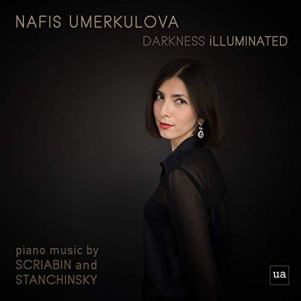
71tdcq35aal._ss500_Russians Alexey Stanchinsky and Alexander Scriabin are featured on Darkness Illuminated, a new disc on the Ulysses Arts label by Uzbek pianist Nafis Umerkulova. Here she seeks to put the obscure Stanchinsky in the spotlight alongside his far more famous contemporary, Scriabin, and the album comprises works by both composers written over a 17-year time period from 1894/5 until 1912, allowing the listener to appreciate how each composer’s oeuvre developed over time while also comparing and contrasting their music.

Such was Stanchinsky’s artistic gift that many believed he was destined to follow in the footsteps of that other great Russian Romantic composer Rachmaninov (he studied with Taneyev, who also taught Rachmaninov). But with his premature death at the age of 26, and the turmoil of the First World War, the Russian Revolution and the subsequent Soviet Regime, Stanchinsky fell into obscurity, and has since been thoroughly overshadowed by his more famous contemporary, Scriabin.

Both composers come from the great nineteenth-century European Romantic tradition, and the influence of Chopin is especially clear in their piano miniatures (one could easily mistake some of Stanchinsky’s Preludes and the Nocturne on this disc for Chopin). These are deeply lyrical, sensitive works, often introspective and intimate, and the later sets reveal more experimental writing, with forays into counterpoint, unexpected harmonies, modality and idioms drawn from Russian folk music. But perhaps the most striking work is the Piano Sonata in E-flat minor which opens this album. Cast in a single movement, with all the richness and virtuosity of Rachmaninov, it is a homage to Scriabin and shares many of the features of Scriabin’s piano sonatas with its fantasy-like structure, colourful harmonic palette and wide-ranging ideas, including a slow section in the major key which could be influenced by American folk music. It’s an impressive opening and Nafis gives this big-boned work full rein, allowing its myriad concepts to flow with a vibrant spontaneity.

Scriabin’s Preludes, Op 16 and 22, are wonderfully intricate, replete with Romantic elegance and lavish lyricism, each Prelude with its own distinctive character. Hints of experimentation are already present, especially in his use of harmony and dissonance to suggest specific moods, and his mastery of tension and release. By the time we reach the two Poems, Op 32, in the latter part of the album, his experimental approach to texture and harmonic shading is clear; these are works which look forward to the atonality of Schoenberg.

This is a most satisfying album which works rather in the manner of a recital disc, and Nafis makes a strong case for both composers in her highly accomplished playing, a spontaneity and freshness which really suits this music, and a rich, warm direct sound, combined with her evident affection for this music.

Recommended

‘Darkness Illuminated’ is released on the Ulysses Arts label


Meet the Artist interview with Nafis Umerkulova
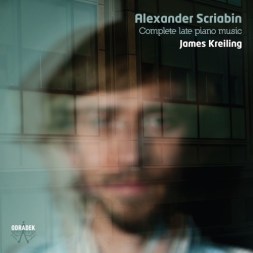
 

artworks-000404027133-aju8pu-t500x500James Kreiling, piano (Odradek)

The music of Alexander Scriabin inhabits a distinctive, personal soundworld which is hard to define. It is the music of excess, ecstasy, tumult and passion. It is excessive, overripe, decadent, heavily perfumed, languorous and frenzied, lacking in structure and sometimes downright bizarre. The music of extremes, it is “hyper everything”, and as such it defies description or categorization. Its language is complex, often atonal and frequently almost impenetrable. For some listeners, and artists too, it is this “over-the-top-ness” that is off-putting; for others, myself included, it is this sense of excess and rapture that is so compelling. His personal life and outlook mirrored the excesses of his music: he was dissolute, he could be outrageous, he had high-falutin’ ideas of his own self-worth, and he believed music should be intimately connected to all of human experience. Perhaps this explains the breathless sensuality, the roaring passion and mystic spirituality of his music. All of human life is here, in all its ecstasy, agony, terror and beauty.

In his piano music, he reveals himself as a master of the miniature, and while he wrote 10 piano sonatas – interesting in themselves as they chart his compositional development (nos. 5 to 10 are included on this album) – his shorter works for piano, including some 85 Preludes, distil in microcosm his unique style.

If anything, Scriabin’s late piano music is perhaps his most interesting, revealing his move away from the “pure” Chopin/Schumann/Liszt-influenced romanticism of the nineteenth century as he experimented with unusual harmonies (his “mystic chord”, derived from a dominant 7th) and a kaleidoscopic tonal palette. In addition, fleeting fragments of melody, fleeting filigree figurations, brooding dream sequences, haunting chromaticism, febrile complex rhythms point towards Schoenberg, Messiaen and the avant garde and leave us wondering what Scriabin might have written had he lived longer into the 20th century.

In this generous 2-disc recording James Kreiling makes a persuasive case for Scriabin’s late piano music, suggesting in his detailed readable liner notes that this is the best place for the Scriabin ingénue to start exploring his music. With scrupulous attention to detail and an insightful approach to the music (James’s doctoral research focussed on the late piano sonatas), James captures the composer’s idiosyncrasies with a compelling naturalness and an acute sensitivity to the shifting moods and colours, combining muscularity and delicacy. The free-form nature of this unusual music and the brevity of many of the works draw the listener into a continuous flow of sound – and a lovely sound it is too. The piano is bright-toned yet warm (the recording was made at Henry Wood Hall with Iain Gordon as piano technician, engineered by Michael Ponder), and stylishly-produced album artwork reflects the high quality of the recording.

Recommended


Meet the Artist interview with James Kreiling

Is it Chopin? Or Liszt? Or maybe Brahms? To the ingenue listener, Scriabin’s first piano sonata suggests all of these composers – Chopin’s long-spun lyricism, Liszt’s sweeping romanticism, Brahms’ plangent, orchestral textures, or maybe even Rachmaninov on a fantasy-frolic. But as Alexander Scriabin’s great friend, Leonid Sabaneyev said “he is not like Chopin. He is like Scriabin“.

Scriabin inhabits a distinctive, personal soundworld which is hard to define. It is the music of excess, ecstasy, tumult and passion. It is excessive, overripe, decadent, heavily perfumed, languorous and frenzied, lacking in structure and sometimes downright bizarre. The music of extremes, it is “hyper everything”, and as such it defies description or categorization. Its language is complex, often atonal and frequently almost impenetrable. For some listeners, and artists too, it is this “over-the-top-ness” that is off-putting; for others, myself included, it is this sense of excess and rapture that is so compelling. His personal life and outlook mirrored the excesses of his music: he was dissolute, he could be outrageous, he had high-falutin’ ideas of his own self-worth, and he believed music should be intimately connected to all of human experience. Perhaps this explains the breathless sensuality, the roaring passion and mystic spirituality of his music. All of human life is here, in all its ecstasy.

Scriabin was also a synaesthete, as I am, and it was his synaesthesia which initially drew me to his music.

…..he wrote and spoke of the colours of his music, of the constantly changing shapes that chords and rhythms and melodies could summon up, almost like a spiritualist at a séance. His scores bristle with detailed and evocative markings designed to help the performers imagine what the listeners see and feel.

– Gerard McBurney

The ten piano sonatas chart the course of Scriabin’s musical development more faithfully than any of his other music. The last sonatas hint at where his music was heading and offer a captivating glimpse into his adventures in atonality, while the early ones demonstrate his forays into late-nineteenth-century romanticism, the music of his compatriot Rachmaninov.

In presenting Scriabin’s ten piano sonatas in a single concert, British pianist Peter Donohoe amply demonstrated the variety of Scriabin’s writing for the piano – its rich textures, trembling filigree gestures, mystic perfumed harmonies, and ferocious virtuosity (Scriabin was a fine pianist himself). From the first youthful sonata, written a year after Scriabin left the Moscow Conservatoire and at a time when he was raging against a self-inflicted injury to his right hand, to the incense-laden mysticism of the ninth, the infamous “Black Mass”, Peter Donohoe plunged into the programme with relish. Never mind that there were still nine sonatas to go, the first was played with pulsating power and energy.

The programme was not presented entirely chronologically, and the middle section of the concert featured sonatas six, seven and eight, played in a single sequence without applause (as requested by the performer). At this point, one simply submitted to the music, to be drenched in myriad sounds and textures. Here Scriabin’s kaleidoscopic tonal palette, filigree figurations, perfumed sonorites and complex rhythms were magically brought to life by a pianist who totally “gets” this music. Hauntingly-lit piquant harmonies, ethereal accompaniments, jazz idioms, Peter Donohoe brought muscularity and featherlight delicacy to this ecstatic music.

The music was interspersed with engaging readings by Gerard McBurney, which illuminated the music and the man. These were accompanied by projections behind the piano, mostly grainy photographs of the composer and his friends, or abstract images which were supposed to suggest a synaesthete’s response to the music. For this synaesthete, it was rather awkward – and I suspect it may have been for Scriabin too: for him key of F was associated with deep red, while for me it is mauve, yet we were treated to blue during the first sonata (in F minor).

I was disappointed not to be able to stay for the final segment of the concert, but I have Peter’s recording of the complete Scriabin Piano Sonatas to enable me to complete this magnificent journey.

scriabin_ragtime_300x300The curious, often sensual and hypnotic soundworld of Alexander Scriabin is viewed through the lens of a three-piece jazz ensemble in the David Gordon Trio’s new album Alexander Scriabin’s Ragtime Band. Released at the close of the year marking the centenary of Russian composer Alexander Scriabin’s death, the album is a witty and imaginative take on Scriabin’s music, part reinterpretation, part hommage to the many elements and influences which make up this composer’s unusual oeuvre.



In an earlier article for this site, written on the anniversary of Scriabin’s death, David Gordon describes the many motifs and idioms from jazz which are also present in Scriabin’s music. He also highlights the other music which was being created over in America and Western Europe at the same time, from Irving Berlin to Claude Debussy. Thus the album contains tracks which reference these composers too, from the entertaining ‘Alexander Scriabin’s Ragtime Band’ (track 2) which directly references Berlin’s ‘Alexander’s Ragtime Band’. In ‘Cakewalk’ there is a groovy hint of Debussy’s ‘Golliwog’s Cakewalk’ from Children’s Corner, a reminder that Debussy fell under the spell of a new kind of music emerging from America. ‘Famous Etude’ turns Scriabin’s Op 8, No. 12 into a sensual tango which segues into a samba, David Gordon weaving a hypnotic piano improvisation over silky cymbal and drums.

In an way, the opening track is the most interesting. Scriabin’s original Prelude op. 74 no. 2  becomes Praeludium Mysterium, a trippy number with spooky, Schoenberg-like dissonance which tells us as much about the strange soundworld and musical personality of Alexander Scriabin as it does about the David Gordon Trio’s ability to create something striking and new out of what is normally defined as “classical” music. The result is a wonderfully weird fusion. The ensuing tracks are arrangements, mostly by the Trio’s pianist, David Gordon, and like the opening track, they are not just “jazzed up” classics. The music exploits Scriabin’s penchant for dissonance and innovation and hints at what Scriabin might have composed had he lived longer.

Throughout, David Gordon’s piano sound is bright, yet warm, with sparing, sensitive rubato, a clear sense of phrasing and rhythmic vitality in the upbeat numbers. He is complemented by bass player Jonty Fisher and drummer Paul Cavaciuti. The Trio are adept at switching seamlessly between styles, and the whole album works as one might experience a set or two in a jazz club, or enjoy individual tracks as the mood takes you.

Mister Sam Records SAMCD004