BAFTA award winning comedian, impressionist, actor and pianist Alistair McGowan shares his thoughts on what drew him to the piano, the pleasures and challenges of practising, the inspiration of other pianists, and how the piano has enriched his life…..

What are you first memories of the piano?

My mother was always playing the piano when I was young. She was the accompanist at the Evesham Amateur Operatic and Dramatic Society and was always practising the score for their latest Rodgers and Hammerstein or Gilbert and Sullivan. She also played a few classical pieces which I would often ask her to play to get me to sleep. 

My older sister, Kay, learnt to Grade Eight. She didn’t touch the piano after her final exam. She is making noises about playing again and I really hope she does go back to it. She was very good!

Did you have piano lessons as a child?

I did two years and passed two grades but stopped when I was 9. I regretted it for the rest of my life and finally took up the piano again for a couple of years in my 30s until my TV show, ‘The Big Impression ’ got in the way. 

Clearing out my mother’s things after her death, I came upon my breakdowns of my Grade exams hoping there would be mention of ‘shows great promise’ but sadly they just talked of a lack of rhythm and expression!

I have really thrown myself at it again since 2016. I first conceived and performed a show about Erik Satie, then from 2018, toured with ‘The Piano Show’ (15 short pieces interspersed with stand-up routines and impressions) and released two CDs, the first of which through Sony Classical somehow briefly, in 2017, got to the top of the classical chart!

And now, I’ve put together the inaugural Ludlow Piano Festival. I’m not sure which has been the hardest but all have been incredibly rewarding !

What kind of repertoire do you enjoy playing, and listening to? 

I’ve always been drawn to Satie and Debussy; I keep finding new Debussy pieces I want to play. I just love losing myself in those chords and those incredible sound worlds he creates. I do like a good tune as well though! I am constantly writing down the names of pieces I hear on Radio 3 – Poulenc, Hahn, Scott, Bowen, Rachmaninov. And I adore John Field’s Nocturnes. 
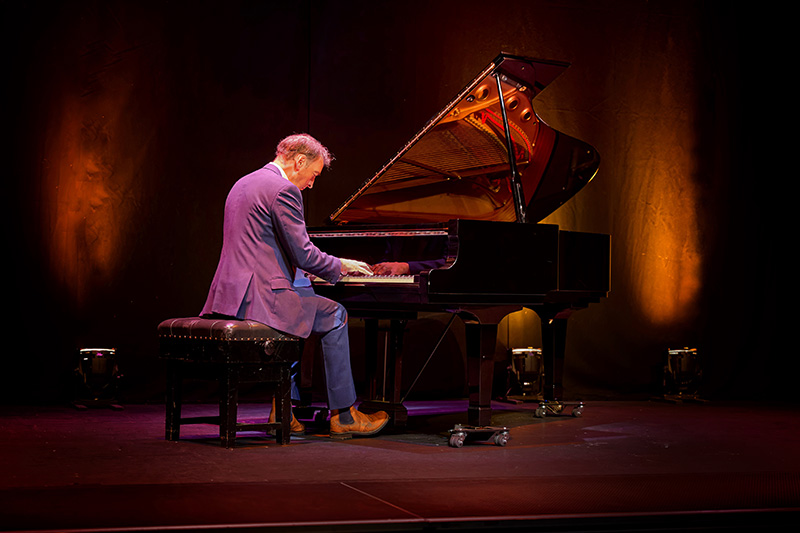
Alistair McGowan

How do you make the time to practise? 

At first, it was a struggle fitting things in around other work. But I watch less television in general with no regret and play less sport too. Partly because my body doesn’t let me now!

Do you enjoy practising? 

I have to force myself to do scales and arpeggios and Hanon exercises but otherwise, yes. I had some very good advice from fellow comic, Rainer Hersch, who suggested putting a watch by the piano and making sure that every fifteen minutes you change what you’re practising. I try to do that. 

But, generally, I get so lost in hearing a piece come together that it’s never a chore. 

Have you participated in any masterclasses or piano courses? 

I have attended weekend courses with Paul Roberts in Sussex. And I went on his week-long piano course in France and then attended four courses in subsequent years with James Lisney and latterly Charles Owen at the delightful La Balie (in south-west France, now, sadly, no longer happening). I’ve also recently done week in West Cork with James at Castle Townshend

As well as learning from such inspirational players and teachers, it’s great to meet other amateur pianists who share your passion. 

What have you gained/learnt from this experience?

I do feel I’ve enriched my life and my soul. And I have been a little surprised by how much I have enjoyed regularly turning my back on the modern world.

As an adult amateur pianist, what are the special challenges of preparing for a performance? 

Not letting the occasion distract you from listening to the sound you are making with every note. I have moments of being very focused but often hear myself or my late mother saying ‘What on earth do you think you’re doing?’. If you can keep that voice out of your head, you will generally be fine!

Also, if you breathe and practise breathing it practise, it helps. As does a touch of lavender under the nose. 

Most importantly, if you think of wanting your audience to hear the piece of music you’re playing and not to hear how well you play it, it takes your ‘self’ out of the equation and some how makes things less nerve-wracking. 

How did you prepare the pieces featured on your recordings? 

I worked very hard, bringing each of them to the boil in turn with my mentor Anthony Hewitt practically conducting me. I also went to listen to a good few pianists in concert and learnt a lot from hearing James Lisney, Lucy Parham, Viv McLean and, of course, Anthony. 

Recording yourself to see what you’re getting wrong – and what you’re getting right – is also a great help these days. 

And how did you find the experience of recording the music?

It was like a lesson, an exam, a recital and the greatest pleasure all at the same time – immensely draining and yet utterly thrilling to hear the music I had learnt and loved coming out of the best pianos in the world!

It was also terrifying knowing that this was the one chance to get each piece recorded. I read a wonderful book called ‘Piano Notes’ by Charles Rosen which has a very helpful chapter on the challenge of recording and refers especially to the need to not worry about mistakes. They can be covered. My teacher/mentor, Anthony Hewitt, was wonderfully helpful (and still conducting!) at the recordings. My producer, Chris Hazel, was unbelievably supportive, helpful and strict!

I had to pinch myself after each recording. I couldn’t believe what I was being allowed to do.

What advice would you give to other adults who are considering taking up the piano or resuming piano lessons? 

I think learning how to learn is as important as learning how to play; it’s important to get the most from your playing time. Setting goals is also important. Perhaps organise small recitals at home, before friends, in order to give yourself a deadline.

If you could play one piece, what would it be? 

Ah! That changes all the time. I have an eye on Debussy’s ‘Ballade Esclave’ – but think that’s still a few years away!

Alistair McGowan’s new show ‘3-in-1’, combining music, poetry and impressions, is at London’s 1901 Arts Club on Wednesday 22 January. Info/tickets here.


This site is free to access and ad-free, and takes many hours to research, write, and maintain. If you find joy and value in what I do, please consider making a donation to support the continuance of this site

Make A Donation

The words “salon concert” conjure up an image of a beautiful setting in nineteenth-century Paris, London or Vienna where a select few intellectuals and dilettantes gather to enjoy music, poetry, art and conversation – an exclusive event for like-minded individuals.

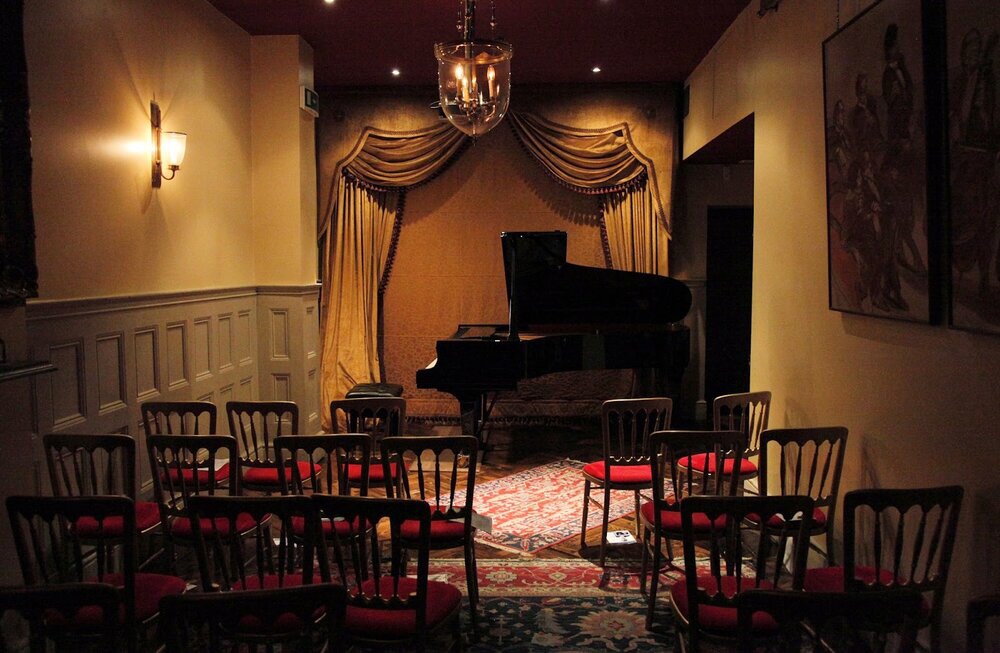
Today the spirit of the salon concert lives on in venues like the 1901 Arts Club (whose furnishings could have come straight from nineteenth-century Paris), the spacious Marylebone drawing room concerts of the highest order regularly hosted by Bob and Elizabeth Boas, or the more modern vibe of Fidelio Café on Clerkenwell Road, and in series such as …Petits Concerts or 7 Star Arts’ concerts at a convivial little Japanese café in Kew. But whatever the venue, the modern salon concert is about creating a special intimacy and connection between audience and musicians, and an ambiance of shared experience, and venues such as the 1901 Arts Club and Fidelio Arts Café have succeeded in reimagining the salon concert for the 21st century audience. Not only is it a wonderful way to experience live music, the modern salon concert breaks down the barriers normally associated with classical music in a formal concert hall and brings music-lovers together in a convivial, relaxed setting. The experience of enjoying music amongst friends is uplifting and inspiring.

Down in a pretty part of West Sussex, not far from Petworth, another salon concert series takes place, organised and generously hosted by Neil and Debbie Franks. Neil is chairman of The Petworth Festival, a keen amateur pianist, passionate music lover, and supporter of other musicians.

An elegant music room-cum-library, which boasts two fine grand pianos, (including possibly the best Steinway B I’ve ever played!) and seats around 70 people, is the setting for Neil Franks’ salon concerts. Initially, these house concerts were very much “music for friends, with friends” – he’d gather together a few talented piano friends and we’d play solos, duos, 6-hands, 8-hands and more – and mingle with audience during the interval and afterwards. Lately, his house concerts have transformed into a modern salon where young talent is showcased and celebrated. For Neil it is also an opportunity to support musicians in their careers and to recognise the “great value derived by the musicians in performing their own very personalised and precious repertoire to small audiences in intimate settings, and the huge enjoyment realised by audiences. In the right settings, the combination generates some absolutely wonderful and passionate performances. The same was true in the British and European salons of the 19th and early 20th centuries and much was written by composers and musicians at the time about the tremendously important and inspirational value they took from those evenings” (Neil Franks)

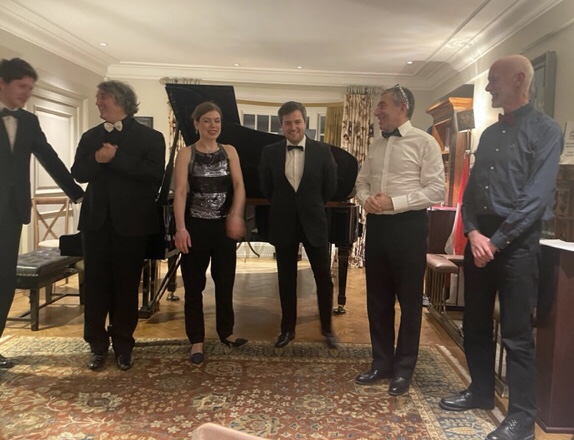
For the January concerts, he assembled a group of very talented musical friends, including established as well as up-and-coming, talented young pianists, namely Anthony Hewitt, Emanuil Ivanov, Florian Mitrea, Olga Stezhko and Julian Davis, Neil’s regular piano-duo partner. The jointly-held ambition of the concerts was to promote and re-invigorate the whole idea of salon concerts, to invite friends including local concert series organisers, with the objective of showcasing the talents of these musicians which would hopefully lead to further engagements at other regional concerts (this objective has already been successfully realised as some of the pianists will perform again in West Sussex venues later this year).

Between us, we very much enjoyed putting the programme together that I think I can say came together quite naturally as each pianist had something special to offer that led to a perfect combination of solos, duets, 2-piano duos, and even 8-hands pieces. The solos were almost mini, individually-curated recitals, and the multi-handed pieces offered contrast to the solos in which the individuals were in the spotlight.

Each pianist also gave short but informally presented introductions to their pieces – a far more welcoming practice than the paper-consuming lengthy, and usually rather dry and inaccessible essays of programme notes. The result was 2 hours of absolutely absorbing music: not just absorbing the notes, but really feeling the very vibrations of the music in the salon environment, something that is a rarity in a concert hall however magnificent the pianos might be. One of the notable advantages of the salon is the total elimination of any physical barrier between performer and audience.” (Neil Franks)

Of course, one of the added attractions of the salon concert is the opportunity to mingle with friends and other music lovers, and also the musicians, and enjoy drinks and canapés. Debbie and Neil are warm, generous hosts and, as an expert networker, Neil has a knack of bringing people together which encourages new connections and friendships. And at these concerts, there was also a good age range represented amongst the guests – a mix of the “usual” classical music concert-goer and younger people who would have little interest in sitting in a formal concert hall, church or town hall for 2 hours, but who were delighted to be welcomed into Neil and Debbie’s lovely home.

It is abundantly clear that classical music is in need of a lot of tender loving care, just like so many forms of cultural activities where consumption patterns have changed in recent years – and would have changed even if Covid didn’t happen, but Covid concentrated the disruption in a very short period. We are all very aware of the options available now, very much including the opportunity to “consume” our music online. We are equally aware that the majority of classical music takes place in formal settings of concert halls in major cities, town halls and churches in smaller towns. I think it’s reasonably safe to say that there will always be a hardcore audience of passionate music-lovers who will look for what they want to hear and travel to the concerts of their choice, but music needs to attract new and younger audiences, many of whom are not so likely to be attracted to these formal settings, especially as they may not be fully familiar with what’s on offer. So I think the key is to make music in interesting venues that already go some way to removing the formality barrier. The venues themselves can generate interest in attendance. So let’s all think outside the box and bring new ideas, new and interesting venues to make concert-going an experience for many more. Include art exhibitions, gardens, lovely food and drink and anything else you can imagine! ” (Neil Franks)

British pianist James Lisney is looking forward to his spring and early summer concerts with excitement.

The Cross-Eyed Pianist caught up with James to talk about how he and the music industry in general has fared during the past two years of the pandemic, the challenges and unexpected benefits of the enforced isolation, and the expectation of returning to live concert-giving once again.

The last two years have been extremely challenging for our industry. Have you seen any benefit from the enforced isolation of lockdowns and lack of live music?

The life of a self employed pianist has, in many cases, not been too adversely affected by the pandemic. Study, recordings, writing and online teaching have filled the gaps – but I am aware that there are many musicians who have had their careers decimated by the collapse of orchestral choral concerts in particular. Their phones and emails went ‘dead’ almost as soon as Covid was flagged up and, even when concerts started again, the full forces have not been employed on a regular basis. This economic hardship has not been specific to the young musicians, but there are scary statistics about how many musicians of all ages have either decided to retire or change profession. Apart from the lack of income, the expenses of their vocation continue: large insurance payments, membership of industry bodies, diary service subscription, instrument maintenance etc.

The matter of concert cancellations has been frustrating but it has also allowed unexpected time to rest and to study. For me this has enabled me to learn two monumental piano challenges by Beethoven: the Sonata in B flat (‘Hammerklavier’); and the ‘Diabelli’ Variations’ which I’m programming throughout the group of concerts that I am giving this spring and early summer. The lack of time pressure has allowed for deep and relaxed study – processes that have refreshed my love of music and the piano.

With time suddenly becoming a plentiful commodity, I have had time to explore Scriabin (for the first time), work at the music of Jan Vriend (always a slow process for me!), Chopin’s Études and Liszt’s Feux Follets – and I’ve even studied technical exercises that I’ve been intending to ‘get around to’ for about forty years!

The concerts I’m giving this spring and early summer are a gift to myself (programmed around my sixtieth birthday) and feature works that are the fruits of the pandemic (including Beethoven’s ‘Diabelli’ Variations and Scriabin Vers la flamme, for example); and music that I have performed for over four decades (such as Chopin’s Sonate funèbre and Ronald Stevenson’s ‘Peter Grimes Fantasy’).

During the pandemic you gave a concert at St George’s Bristol to an empty hall. How do you feel venues have adapted to the “new normal” and supported musicians during the past two years?

St George’s Bristol have been a fantastic support for me and many other musicians during Covid. They have adapted finances and concert formats, organised industry-leading livestream events, and kept in touch with their community, both local and nationwide. I performed the final sonatas Haydn, Beethoven and Schubert in autumn 2020 to an empty hall, but arrived home to email messages from audience members in the USA, the Czech Republic and New Zealand!

I am very much looking forward to returning to St George’s with Chopin on 21 May.

Talking of Chopin, he is a composer who remains very close to your heart. What is the attraction of this repertoire, for both player and audiences?

Chopin has been central to my programmes since I was eighteen. Audiences love this music and it is a constant fascination to attempt to play it – but it is also a constant inspiration in my work as a teacher. Chopin gets to the heart of our physical relationship with the instrument – and to the beauty and meaning of the score. He exemplifies exactitude and classical values with the skills of poetic recreation and improvisation. When one considers, in addition, the premises of his teaching philosophy, it is difficult to find an area of his influence that is not essential to the study of music from almost all of the eras of keyboard music.

The Sonatas and Fantaisie [Opus 49] have been in my repertoire since my teenage years and continue to fascinate and evolve for me – each return to study revealing a more essential layer of understanding. The pandemic has been a chance to work on the Mazurkas – music as dense in implication and as demanding intellectually as late Beethoven. The trio of Mazurkas, opus 56, for example, cover a huge intellectual range and can hardly be considered as “miniatures”.

The music salon at the 1901 Arts Club

Pre-pandemic you launched your …petits concerts series at the 1901 Arts Club. Tell us more about this series.

I am looking forward to returning to the large recital halls such as St Georges, the Bradshaw Hall in Birmingham and the beautiful Stoller Hall in Manchester – but I have a special place for the resumption of the …petits concerts series held at the bijoux concert venue and salon that is the 1901 Arts Club in Waterloo, London. This project was thriving in the seasons before Covid and enabled a spontaneous and simple organisation for concerts, contact with a relaxed and intimate audience (both during and after the performances) and the chance to raise money for a variety of purposes. The latest instalments in this series will be fundraisers for The Amber Trust (which supports the musical expression of partially sighted and blind children), of which I am proud to be a patron, and Help Musicians, a charity which has done so much to help musicians during the pandemic.


James Lisney will give concerts in Norwich, London, Birmingham, Manchester, Bristol, Cheltenham and Tunbridge Wells between April and June. For full details and booking, please visit his website

Readers can enjoy generously discounted tickets for the first …petite concerts recital on 25 April at the 1901 Arts Club. Use code LUDWIG when booking.

James Lisney


ames Lisney’s  acclaimed …petits concerts series returns to London’s 1901 Arts Club, a bijoux salon-style venue close to Waterloo Station.

In keeping with the ethos and ambiance of the venue, and inspired by the annual series of concerts given by Charles Valentin Alkan at the Erard showroom in Paris in the 1870s, James Lisney’s …petits concerts present classical music in an intimate and convivial setting.

The series feature piano music by Debussy, Stevenson, Chopin, Haydn, Liszt and Beethoven. Concert goers can enjoy a glass of champagne at a pre-concert reception and an opportunity to meet the performer and mingle with other music lovers. These concerts are in support of two charities, Help Musicians (formerly the Musicians Benevolent Fund), which has done so much to support musicians during the pandemic, and The Amber Trust, a charity which provides opportunities for blind and partially sighted children, and children with more complex needs, of which Lisney is patron.


READER OFFER: ENJOY DISCOUNTED TICKETS TO 14 MAY CONCERT with CODE FREDERyK

FIND OUT MORE / BOOK TICKETS