
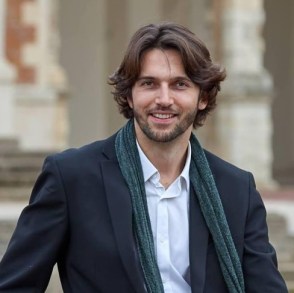
Award-winning composer Thomas Hewitt Jones was one of the first people I interviewed for my Meet the Artist series, back in 2012. Here, he has updated his interview with further thoughts on his significant influences and inspirations, and why we should cherish and value the arts.
Who or what are the most significant influences on your musical life and career as a composer?
Without a doubt, my paternal grandparents (both composers) were hugely significant influences on me, both musically and in terms of my career trajectory so far. My grandfather Tony was a great craftsman and studied with Nadia Boulanger; my granny Anita wrote educational music that is extremely accessible for young string players, yet is of consistently high quality. Both had studied harmony and composition techniques with the lovely man that was Bernard Rose while at Oxford (who told Tony in an early supervision “you’ll never get a girlfriend unless you cut off your beard”… anyway the next week Tony announced with a wry smile that he was engaged to Anita); however, over her lifetime Granny’s music did better commercially than Tony’s, who wrote entirely for himself (and often wrote choral music that was high quality, yet challenging to both listen to and perform). He once got offered a large amount of money to write music for a TV ad for a building company, and turned it down. I like to think that I have ended up with a mix of both approaches to composition, although I personally enjoy writing music for a wide audience which is nevertheless genuine, with…that ever-important word these days…integrity.
What have been the greatest challenges of your career so far?
I think that we live in a difficult time for composers who want to write music that has what I call ‘horizontal’ emotional narrative. There’s so much soundbitey ‘vertical’ contemporary classical music that is constructed like pop music, built around earworms and varying textures over a repetitive chord sequence rather than maintaining melodic, rhythmic and harmonic interest over time. Music can do so much more than just an earworm intended to get high numbers on Spotify.
On the other end of the artistic spectrum, I’ve got an amusing commercial music track called ‘Funny Song Cavendish’ that has gone mega-viral on TikTok (currently 2 billion streams, and countless celebrity videos as I write this). It is a lesser-discussed part of the music streaming arguments that are currently taking place, but newcomer music usage platforms such as TikTok present difficulties for composers and publishers because royalty streams are not always transparent until legislation is fought for in retrospect. I’ve actually recently been voted on the Ivors Academy Senate Committee for this year, and I’m going to be campaigning for this, and many other similar issues that will hopefully make issues of streaming rates more transparent for the composers of tomorrow. My overriding feeling is that composers in the year 2022 feel that they must write a certain type of music that will serve them well financially through the algorithms of streaming services, rather than being musically satisfying – rather than pushing artforms to a new and exciting place – which is, in my humble opinion, a sorry place to be.
What are the special challenges/pleasures of working on a commissioned piece?
It’s always an enjoyable challenge to write to a brief. As artists throughout time have invariably found, the difficult commissions are the ones where there is a clear cognitive dissonance during the creative process – if, for example, there are words a composer doesn’t particularly want to set, or a subject matter that doesn’t really interest him or her. The really great craftsmen can transcend these situations – but the arts at their best are an honest expression of humanity. A composer is invariably emotionally naked, and audiences aren’t stupid so they will realise pretty quickly if music isn’t authentic. I’ve been lucky not to have to deal with such situations, but in the arts there is nowhere to hide!
What are the special challenges/pleasures of working with particular musicians, singers, ensembles or orchestras?
I am incredibly lucky to have worked with some of the finest players around in recording sessions so far, many of whom have become friends as well as colleagues. The COVID lockdowns in 2019-21 were an interesting time because everyone was recording at home, but we managed to still make things work and release albums. As well as writing the music I very much enjoy the music production process as well, so these things came together during that time.
Of which works are you most proud?
I’m not sure that a composer can judge his or her work. Each piece of music you write is like a new offspring, but as soon as it has grown up and left home, it’s no longer yours. For this reason, I make a point of deleting files and throwing away copies of pieces of music that have had copyrights assigned and are published and out in the ether. If people email asking me for copies of pieces, I genuinely can’t help – and I occasionally hear things on the radio that I’ve forgotten I’ve written! As a writer, the thing you are working on is the only piece you are aware of.
How would you characterise your compositional language?
Approachable and mainstream, yet high quality and with integrity. That’s what I hope anyway, but it’s not for me to judge.
How do you work?
I have a lot of technology in my studio, and I love using it. That said, I believe that the key elements of music composition are exactly the same as they were in Bach’s time, that great melody and harmony (or interesting texture used in a way that is satisfying in narrative) are key to an emotional experience that makes great music.
It strikes me that today there are a lot of ‘noodlers’ who can’t look at a score and hear it in their head, and can’t compose away from their DAW [Digital Audio Workstation]. For me personally, that isn’t quite right. There is a place for every approach, and improvisation is incredibly important for all-round great musicianship. But for me, the first idea isn’t necessarily the best one, and while noodling might make for perfectly good underscore underneath an emotive speech in a film, it won’t break the mould as a standalone piece. (It might satisfy a mass radio streaming audience who are using music as background wallpaper though.) The creative process is full of contradictions so I always approach each project differently. As Stephen Sondheim so wisely said, ‘Content dictates form’.
As a musician, what is your definition of success?
A second performance. I think many of my peers would agree – if you ever meet a load of composers in a bar, they’ll either be chatting about the PRS, or about second performances.
What do you consider to be the most important ideas and concepts to impart to aspiring musicians?
This will sound facetious, but – like the human condition itself, the route into a musical career is also full of contradictions and there is honestly no set way to approach a career in music. I’m sure many would agree that it’s about hard work, luck, and being happy to be poor while you are building up a reputation in your early years. It took me 8 years after leaving university to make a successful living as a composer. Hopefully the horrendous swagger of entitlement of the generation above us (typified by the likes of certain members of our cabinet) will cause a reassessment of honesty, integrity and equal access for talented newcomers that will filter through to the arts as a whole. But that might be wishful thinking.
What do you feel needs to be done to grow classical music audiences?
I think that two ends of our industry have to meet in the middle, and everyone needs to be unjudgmental. I think ClassicFM has done such a huge amount for music appreciation in the general population, and I love its straight-to-the-point promotion of great melody. I also really enjoy listening to the Ligeti Piano Concerto. I think that great music needs to be given as much of an airing irrespective of commercial viability, background or composer’s gender.
Where would you like to be in 10 years’ time?
Last time I did this, I said I would like to be in a hut by the sea, with a wife and kids if I’m lucky. Well now I have a wife, Annalisa and two kids. Maybe next time I do this, I’ll have another kid, but hopefully not another wife!
What is your idea of perfect happiness?
Being with my wife and kids.
What is your most treasured possession?
My wife and kids.
What do you enjoy doing most?
Don’t ask.
What is your present state of mind?
I’ve got a huge amount of writing to do at the moment, on top of some mixing, so I’m extremely busy, but happy to be working on projects at the moment which are employing other musicians. Using live musicians is really important, and never more so than post-COVID. Software sampling is really great these days, but still nothing beats many musical brains working as one…
Thomas Hewitt Jones is an award-winning composer of contemporary classical and commercial music. Since winning the BBC Young Composer Competition in his teens, his music has been published by many of the major music publishers and is frequently heard in concert and on radio, TV and in the cinema.
Thomas’s diverse catalogue includes small instrumental, orchestral, choral and ballet works, and his large number of choral titles includes seasonal carols. ‘What Child is This?’ (OUP) has become a choral classic of recent years, garnering large numbers of performances each season. His music is regularly featured on Classic FM, including most recently ‘Christmas Party’ (his seasonal violin concerto, written and recorded for violinist Simon Hewitt Jones). In 2021, he released ‘Can you hear me?’, an acclaimed response to the COVID19 pandemic.
 I have been teaching and coaching one-to-one in my own studio at the bottom of the garden with its lovely Steinway for around thirteen years and had already run some one-day workshops there. And from 2000-2008, I ran my own chamber music course at the Purcell School. But it was these requests from pianists that got me thinking: could I run a piano weekend from my own house and studio? I realised that I did have the space for a small group both in my kitchen and studio, and that perhaps there might be a gap in the piano course market for a weekend of teaching in a small, supportive group within a home environment.



 The Cross-Eyed Pianist